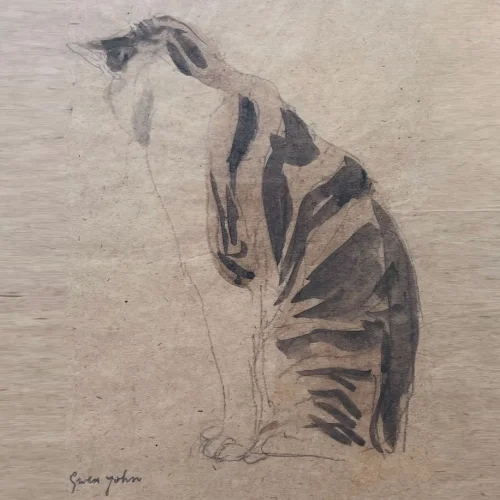
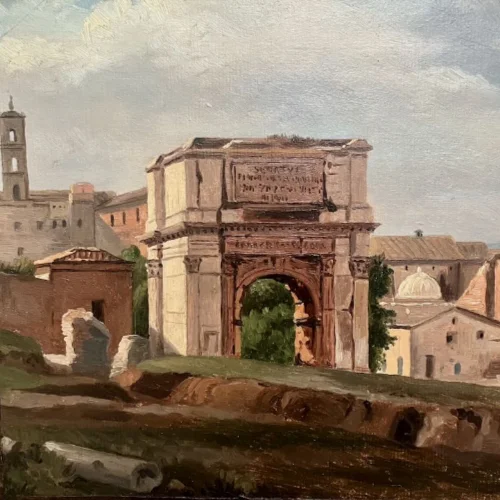
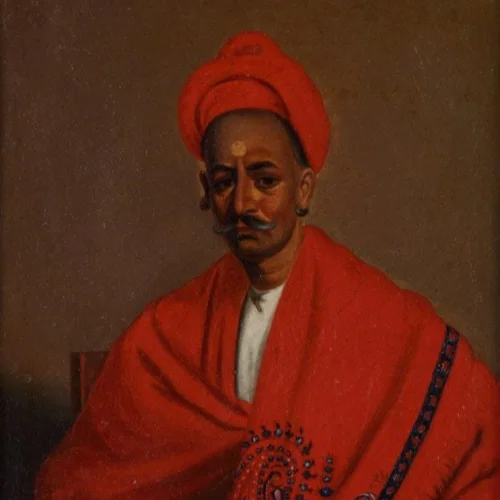
English School circa 1830 The head of a brow cow Oil on paper laid down on panel 9 x 8.7 cm.; 3 ½ x 3 3/8 inches Framed size 21 x 21 cm.; 8 ¼ x 8 ¼ inches Provenance Private collection, U.K.
View details

.webp)
Karen Taylor specialises in British art of all periods and acts as a principal and agent. She offers independent, impartial guidance on all aspects of collecting from acquiring a single picture to forming or disposing of a collection. She organises regular events and numbers British and International institutions amongst her customers.
Quick Links
JUST ARRIVED


Laura Knight, DBE, RA, RWS (1877-1970) Anna Pavlova rehearsing The Bacchanal, c. 1910-1911 Signed l.l.: Laura Knight, oil on canvas 45.5 x 41 cm.; 17 5/8 x 16 1/8 inches Provenance Peter and Vera Chadwick, 1977 (according to an inscription on the previous frame); Harry Greatorex, 1988; His sale at Sotheby’s, unidentified sale 1988(?), lot 73; Private collection U.K. until 2025 Knight captures the grace, elegance and kinetic energy of the most famous ballerina of her day on stage performing her most dynamic and erotic role. Pavlova (1881 – 1931) visited London with Sergei Diaghilev's company for the first time in the summer of 1910. She caused a sensation with her dramatic Dance Bacchanal from Pepita's ballet The Seasons, choreographed by Mikhail Fokine, which was to become one of her signature roles. An erotic duet, performed with Mikhail Mordkin saw the dancers throwing garlands and striking sensual poses with theatrical abandon, wearing Greek tunics. Knight was mesmerised by the Ballets Russes when they performed in London during the years before the First World War. In particular, she became enamoured with the dancer Anna Pavlova. In her autobiography, 1965, Knight wrote: ‘The whole look of Pavlova had perfection of finish … But whatever the beauty of form may have been, she possessed an attraction all her own ... a something not of this world.’ (L. Knight, The Magic of a Line, p. 161). In 1911 she made sketches of Pavlova at the Palace Theatre, continuing her interest in the figure in motion. Pavlova often invited Knight to her home, The Ivy House in Golders Green next to Hampstead Heath, which she bought in 1912, so she could sketch her. Knight drew Pavlova’s portrait many times as well as sketching her backstage and made small enamel pieces recording her dancing. Her work helped cement the dancer’s reputation in Britain and beyond. Pavlova settled in London after the Russian Revolution of 1917.
View details
KT748 Evelyn de Morgan (1855-1919) A head study of the model Alessandro di Marco Coloured chalks on coloured paper 35.5 x 32.5 cm: 14 x 12 ½ inches Provenance Private collection, U.K. Alessandro di Marco was a professional artist’s model from Piedmont. Evelyn De Morgan made studies of him on several occasions, initially when she was at the Slade and later in her own studio. This drawing probably dates from 1890s. Another study of Alessandro in the De Morgan Foundation collection, for her 1899 painting The Valley of Shadows is not dissimilar to the present work (D_EDM_0038): https://www.demorgan.org.uk/collection/study-of-a-head-male/ Di Marco was used by Evelyn De Morgan in two works depicting Boreas, 'Boreas and Oreithyia' (De Morgan Foundation P_EDM_0040, 1896) and 'Boreas and the Fallen Leaves' (c. 1910-14). He also features in 'Aurora Triumphans' (1876), 'Life and Thought Have Gone Away’ (1893), 'The Poor Man Who Saved the City' (1901), 'The Marriage of St. Francis and Holy Poverty' (1905), 'The Gilded Cage, A Soul in Hell’ (with curly hair) and '1914'. Di Marco modelled for Frederic, Lord Leighton (1830-1896) in Rome and was one of the artists’ models working in London around 1870. Sir William Blake Richmond (1842-1921) described him as “a fellow so graceful and of such a colour, a kind of bronze gold” (S.T. Buckle, British Art Journal, Autumn 2012, Vol. 13, Issue 2, p.67: https://www.eb-j.org/pdfViewer/articles/MTA1OA== 2012). William Hamo Thornycroft noted in his diary that Alessandro sat for long periods of time without a break. He was the model for Merlin in Edward Burne-Jones’s earlier work 'The Beguiling of Merlin' (1872-77). He was also photographed by Julia Margaret Cameron. George Richmond described him as ‘the living embodiment of a classical sculpture’.
View details
Anna Tonelli (née Nistri) (c. 1763-1846) Portrait of Frances Anderson (née Gosling) (1768-1850), half-length, wearing a white dress and blue headdress, signed on backboard: Anna Tonelli/fe..in Londra/1798, inscribed on backing on reverse: glass taken out and restored 1848 (?). Frances Anderson née Gosling/born 1768 died 1850 at Dorset Gardens/Brighton Pastel, framed as an oval in the original frame 25.5 x 21 cm.; 10 x 8 ¼ inches Provenance By family descent to Pamela Bruce Clarke (1915-1989); By family descent at The Grange, Wendover, Buckinghamshire, until October 2024 Literature N. Jeffares, Dictionary of Pastellists before 1800, online edition, no. J.722.167 Portrait of Robert Anderson (1764-1837) half-length, wearing a black coat and with powdered hair, signed on backboard: Anna Tonelli/fece in Londra/1798, inscribed on label attached to backboard: Robert Anderson M.D. Born 1704 died 1837/at Dorset Gardens, Brighton, Restored 1893. W.B.C./Ancestor of Pamela Bruce Clarke Pastel, framed as an oval, in the original frame 25.5 x 21 cm.; 10 x 8 ¼ inches Frame size 32 x 28 cm.; 12 ½ x 11 inches Robert Anderson was a physician in Brighton who married Frances Gosling in 1788. The couple lived in Dorset Gardens, Brighton. Anna Tonelli, née Nistri, was probably trained in Florence, possibly by Giuseppe Piattoli (1743-1823) with whom she collaborated on a portrait of the family of Granduca Pietro Leopoldo, which was engraved in 1785. At some stage before 1785 she married the virtuoso violinist Luigi Tonelli. It seems highly likely that she came across the work of Hugh Douglas Hamilton in Rome. Tonelli met Lord Clive, ‘Clive of India’, while he was travelling in Italy, and he employed her to make pastels of members of his family. From 1794 she taught drawing to his children in London. She exhibited at the Royal Academy in 1794 and 1797, giving her address as 97 Norton Street. The artist travelled with the Clive family to India between 1798 and 1801, moving around southern India with Lady Clive and her daughters. During her time in the subcontinent, she seems to have worked in watercolour or miniature, rather than pastel, and charged twelve to thirty guineas for a miniature. She painted the Rajah of Tanjore and Tipu Sultan on this trip. She returned to Florence in 1801. Tonelli’s work has been confused often with that of Hugh Douglas Hamilton. She is known to have copied his work for Lord Clive, producing portraits in 1790s to add to a series begun by Hamilton. In 1806 the American agent in Paris, Filippo Mazzei, engaged her to bring up his daughter Elisabetta. He provided a description of the family to Thomas Jefferson (letter, 20th July 1806) with a view to them emigrating to the USA, praising the father, a violinist ‘the peer of any other’, the two children (born c.1789–90), and the mother who ‘sings and plays the piano like an expert; knows very well her own language, French, and English; draws and paints with excellent taste; is accomplished in embroidery and all needlework; and knows geography quite well.’ Jefferson’s response highlighted the expense of living in a major city, which may have deterred the family, as by 2 November 1807 they were in Pisa with Mazzei, while by 1809 they seem to have returned to Florence. The Grange, Wendover was owned from 1789 to 1794 by John Barker Church (1748-1818). Barker Church was an English born businessman and the supplier of the Continental Army during the American Revolutionary War. He was one of the few American revolutionaries to sit in the English parliament. His brother-in-law was Alexander Hamilton the influential founding father of the United States. Hamilton and Church were not only business partners but also friends having married sisters. Hamilton went on to have a love affair with Church’s wife Angelica Schuyler. She is featured in the popular musical ‘Hamilton’ by Lin-Manuel Miranda and Church is referred to as her ‘wealthy husband’.
View details
KT663 Thérèse Lessore (1884 – 1945) In a Belgian Train Signed and dated l.r.: Lessore/1921, watercolour over pencil, with a pencil outline, inscribed in pencil with title beneath mount l.r.: in a Belgian train Image 23 x 26.5 cm.; 9 x 10 3/8 inches, full sheet 28 x 32 cm.; 11 x 12 5/8 inches Provenance Bonhams, London, 17 November 1988, lot 27; Sandra Lumis Fine Art, London; Bernard Kelly, bought from the above, his sale at Lyon and Turnbull, London, 15 January 2025, lot 225 The artist came from an artistic family and was the daughter of the painter Jules Lessore (1849-1892) and sister of the sculptor Frederick Lessore (1879-1951). Born in Brighton, she attended the South-Western Polytechnic Art School and the Slade School of Fine Art from 1904–9, where she won the Melville Nettleship Prize for Figure Composition. She exhibited regularly at the New English Art Club and the Goupil Gallery, and had her first solo exhibition at Eldar Gallery, with a catalogue preface written by Walter Sickert. She was a founder member of The London Group, the artist-run organisation of radical painters which grew out of The Camden Town Group, where she was to exhibit regularly. Lessore was amongst the most talented female artists of The London Group. She married firstly the artist Bernard Adeney and in then 1926 she married Walter Sickert, as his third wife. He described her as “a Persian miniature”. The two artists shared a love of the music-hall and the circus which feature in both their work. Her contributions to exhibitions at The London Group were fewer after her marriage to Sickert who was 24 years her senior and for whom she cared and acted as his artist’s assistant. This acutely observed watercolour of two fellow passengers observed by the artist in Belgium a few years after the end of WWI verges on caricature.
View details
KT693 Elizabeth Gould (1804-1841) Maryland or northern bobwhite quail (Colinus virginianus) Signed l.r.: Eliza Gould/1829, watercolour, inscribed in pencil l.r.: Maryland Quail and further indistinctly inscribed, on wove paper watermarked 1816 64 x 50.5 cm.; 25 ¼ x 19 ¾ inches Provenance Thomas Barwick Lloyd Baker (1807-1886) of Hardwicke Court, Gloucestershire, promotor of reformatory schools and influential writer on crime and punishment; thence by family descent until 2025 Elizabeth Gould was one of the most important ornithological artists of the nineteenth century. Probably because much of her short life was spent in the shadow of her husband, Elizabeth Gould’s significant artistic and scientific contribution to the art of natural history has been overlooked traditionally. However, her reputation has recently been reassessed in Andrea Hart and Ann Datta’s monograph Birds of the World: The Art of Elizabeth Gould, published in 2023. The present watercolour is signed ‘Eliza Gould’ which was John Gould’s name for her and drawn when she was twenty-five. Her early work shows her talent as a draughtswoman, meticulous attention to detail and ability to capture the characteristics of a species most convincingly. The bobwhite quail, also known as the Virginia quail is a small but distinctive species native to much of North America, including the eastern coast of Mexico and the islands of the Caribbean. It has been in decline for the last half century due to habitat loss. In Maryland, they are found throughout the year in the eastern counties and less west of Chesapeake Bay. The bobwhite is a small bird, ranging from 9 to 11 inches in length and 13 to 15 inches in wingspan, weighing from 6 to 9 ounces each. While there are regional variations in appearance among males across its range, the females are similar in all locations. Females are generally dull brown with a buff-coloured throat, while males have a white throat and a distinctive brow stripe with a black border. Eastern bobwhites may have rufous-coloured breast feathers.
View details