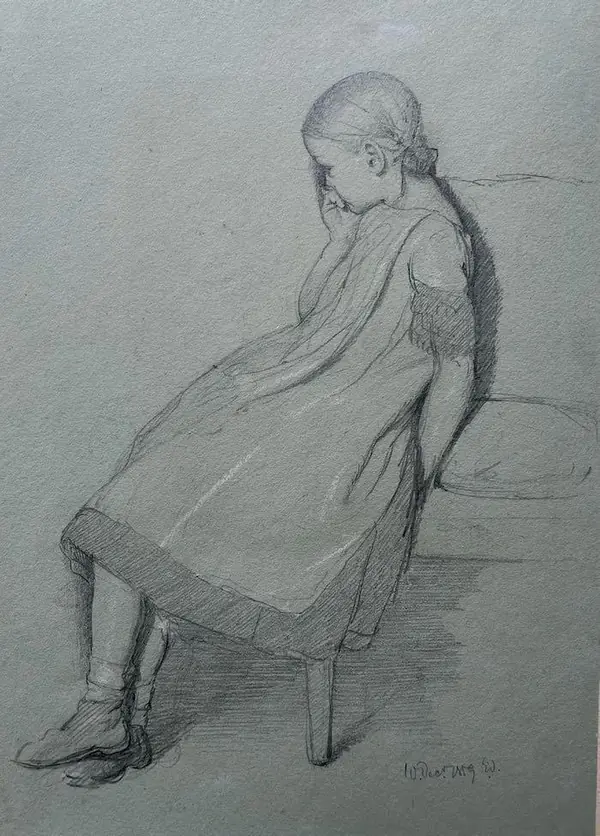
Abbott was one of the best amateur watercolourists of the late Eighteenth Century. A surgeon and apothecary, he lived in Exeter until 1825. He exhibited paintings at the Royal Academy from 1793, receiving contemporary acclaim for the style of his work. The artist John Downman said that ‘he prefers his drawings before his paintings, as they are done with more spirit’ (J. Farington, Diary 26 June 1804; vol. VI, p. 2362). In 1825 Abbott inherited Fordland, a Devon estate, from his uncle James White, an Exeter barrister, Nonconformist and close friend of Francis Towne. Abbott became a patron and pupil of Towne’s, and his linear style shows the artist’s influence. After moving to Fordland he devoted himself to drawing.
View detailsArtists
Explore the artists represented by Karen Taylor Fine Art, specialists in British watercolours and drawings from the 18th to the early 20th century.
Use arrow keys to navigate, Enter to select, Escape to close
All
A
B
C
D
E
F
G
H
I
J
K
L
M
N
O
P
Q
R
S
T
U
V
W
X
Y
Z
Showing all artists
Use arrow keys to navigate, Enter to select, Escape to close
Artist A-Z
Artist Z-A


The Italian artist, born in Cremona, settled in England in 1803, having travelled in Greece and Egypt with William Wilkins, R.A. His work has often been confused with that of Constable, particularly his coastal views which look quite similar. Examples of his work may be found at the British Museum, the V&A, Brighton Art Gallery and in several other museum collections.
View details
Alexander studied at the Royal Institution, Edinburgh from 1887-8, and in Paris with the sculptor Emmanuel Frémier. In 1887-8 the artist travelled to Tangier with his father and fellow artists Pollock Nisbet and Joseph Crawhall. He returned to Egypt in 1892, after his artistic studies, and lived on a houseboat on the Nile for 4 years, painting in the desert. This drawing appears to be of North Africa, the evocative rooftops an engaging subject on the characteristic oatmeal paper he often used. In 1902 Alexander was elected an associate of the Royal Scottish Academy becoming a full member in 1913. He exhibited widely including at the Royal Scottish Academy, Royal Academy, Fine Art Society, Royal Watercolour Society and the Leicester Galleries. Alexander’s work is held in the Tate Gallery, Aberdeen Art Gallery, Dundee Art Gallery and by Fife Council.
View details
Helen Allingham is renowned for her watercolour images of cottages and gardens and was one of the most fêted Victorian female artists. Helen Paterson was born in Swadlincote, Derbyshire, in September 1848, the eldest of seven children of a doctor. In Altrincham, Cheshire she was educated at the Unitarian school for girls, established by her maternal grandmother, Sarah Smith Herford. On her father’s death in 1862, the family moved to Birmingham to live with her paternal grandmother. The artist studied at the Birmingham School of Design (1862-65), the Royal Female School of Art, Bloomsbury, London (1866-67), the Royal Academy Schools (1868-72) and the Slade School of Art (evening classes, 1872-74). In the spring of 1868, she visited Italy and, on her return to London she drew illustrations for Once a Week and other periodicals. This led in 1870 to a job as an artist on the staff of The Graphic. In 1874, Helen Paterson started to exhibit at the Dudley Gallery and married the Irish poet, William Allingham (1824-1889) with whom she had three children. After her marriage she continued to produce occasional illustrations for The Cornhill magazine and other periodicals and books. John Ruskin became a great admirer of her work. She was elected an Associate of the Society of Painters in Water Colours in 1875 and a full member in 1890 when women were first admitted. (In 1881, the society had become the Royal Society of Painters in Water-Colours.) From 1881, Helen Allingham lived at Sandhills, near Witley in Surrey and specialised increasingly in scenes of rural life. Her first two solo shows at the Fine Art Society followed ‘Surrey Cottages’ (1886) and ‘In the Country’ (1887). She died in Haslemere, Surrey in 1926. Her work is represented in numerous public collections, including the British Museum, Burgh House & Hampstead Museum and the V&A. Additional Information British Museum
View details
This sky study was done in the Berry region in the Loire Valley. Pin marks can be seen in the lower corners of the paper on which it is painted. The son of a painter of Greek origin, Auguste Paul Charles Anastasi was a pupil of Paul Delaroche and Camille Corot in Paris in the1840s. He began his career painting landscapes in the forest of Fontainebleau, joining the Barbizon school group. Anastasi regularly exhibited at the Paris Salons in 1850s and 1860s, showing landscapes of the countryside around Paris, Normandy, the Roman Campagna and Naples. He also worked as an engraver. In 1870 Anastasi became blind. His work can be found in many museums including the Musée d’Orsay, Paris and numerous French regional collections.
View details
Helen was the fifth daughter of twelve children of Henrietta Dendy and William Thomas Coleman, a physician and was schooled at home. Along with her sister, the pottery artist Rose Rebecca Coleman, she was taught painting and drawing by her older brother William Coleman who kept an art pottery studio in South Kensington and whom she helped make designs for Minton. Her early watercolours were first exhibited in the Dudley Gallery in London in 1864, thanks to the connections of her brother William. She married Thomas William Angell, a postmaster and an amateur artist, on 15 October 1874. The following year she joined the Royal Institute of Painters in Water Colours but resigned after she became an Associate of the Society of Painters in Water-Colour. Angell became Flower Painter in Ordinary to Queen Victoria from 1879 until her death, succeeding Valentine Bartholomew to the privileged position. She is said to have been anointed as his successor by William Henry Hunt, whose enthusiasm for still life subjects she shared. The artist’s work can be found in the collection of the Victoria & Albert Museum, the Royal Albert Museum, Exeter and other public collections.
View details
The daughter of Sir Thomas Spencer Wilson, Bt. of Charlton in Kent, the artist was a pupil of Francis Towne in her youth. Her mother was a Cheney of Badger Hall, Shropshire, where Peter de Wint was a frequent visitor. Lady (Margaret) Arden was a pupil and a patron of David Cox. She married George Compton, Lord Arden (1756-1840) in 1787.
View details
The artistic tradition of painting a self-portrait with a mirror goes back self-consciously to Velazquez’ Las Meninas and has been used by many artists to probe their artistic identity. The artist stares out at the viewer with authority and proclaims self-confident virtuosity as he paints a reflection of himself standing in front of a large canvas (another reference to Las Meninas, although he has chosen the opposite side of the composition) within the large brown wooden mirror which frames his work. He adds another smaller arched wooden mirror to provide a reflection of the back of his head, a play on space and composition which takes our eye a moment or two to unravel. A gilt framed painting is leaning against the wall and a doorway to a sunlit garden can be seen in the distance introducing a light source in the same position as Velazquez chose in Las Meninas. A painter’s rag can be seen wedged into the space between the top of the post and the mirror itself, an indication of work in progress. An interesting account of the two most famous mirrors in the history of western art, the convex mirror in Van Eyck’s Arnolfini Marriage and the rectangular mirror in Velazquez’ Las Meninas can be found in the exhibition catalogue of Reflections- Van Eyck and the Pre-Raphaelites, A. Smith et al, National Gallery, 2018. Paul Audra was the son of a painter from whom he learnt his craft. He studied at the École des Beaux-Arts in Lyon and then in 1888 at the École Nationale Supérieure des Beaux-Arts in Paris. In the atelier of Gustave Moreau, he worked alongside Matisse and Rouault. He returned home to Valence and became the teacher of drawing at the local school and set up his own atelier, moving in 1908 to Nice when he ran the École des Art Décoratifs from 1910. After serving in WWI he started painting again in 1917 and met Renoir and also became reacquainted with Matisse who he helped find a studio in Nice and with whom he occasionally collaborated. He is known to have enjoyed painting self-portraits. Audra exhibited at the salon in Lyon in 1897 and at the Salons d’Automne from 1907-1920.
View details
Badmin studied at Camberwell School of Art and the Royal College of Art, which he left in 1928. He is renowned for his affectionate depictions of the English countryside and his posters and illustrations, most notably for Shell Oil. At the age of twenty-six he became one the youngest ever members of the Royal Watercolour Society and was also a member of the Royal Society of Engravers. He exhibited at the Fine Art Society, Leicester Galleries and elsewhere. The Victoria & Albert Museum and British Museum hold examples of his work. He lived in Bignor, Sussex. Additional Information Art UK Suffold Artists
View details
Major Francis Longe (1726-1776), the owner of Spixworth Hall near Norwich, is painted at home, just returned from shooting, presenting his wife, Tabitha (née Howes) with a bag containing a live leveret, a symbol of love. His dog peers around the door which shows the park from which his master has just returned, and a spaniel lies at his mistress’s feet. The sitters’ identity as landowners of some standing is directly expressed. The label on the back of the painting states that Major Longe is 30 years of age and this dates the work to 1756. His only son Francis, born in 1748, is standing next to his mother and would have been 8 years old at the time this work was made. Francis Longe married Tabitha Howes soon after he came down from Cambridge. Francis and Tabitha had a son, Francis, in 1748. Francis (the elder) was educated at Westminster School and Emmanuel College, Cambridge and served as High Sheriff of Norfolk in 1752, an office his son Francis was also to hold. His wife was the daughter of John Howes (d. 1771) of Morningthorpe Manor, Norfolk and his wife Barbara, daughter and heiress of Rev. Thomas Sydnor; they married in 1720. Barbara Howes was painted with her four children by D. Heins, when Tabitha was 14 years old. Francis, the boy in the present drawing, inherited the estate on the death of his father in 1776. He had married Catherine Jackson (1752-1828) four years earlier. Catherine’s father had an important position in the Admiralty, and sponsored Captain James Cook’s voyage of discovery to Australia. Sydney was originally called Port Jackson after him. Francis and Catherine Longe had no issue; Francis died in 1812 and the estate passed to his cousin upon his widow’s death in 1828. Spixworth Hall was an Elizabethan house located just north of Norwich on the Buxton Road. The estate became mired in debt in the hands of Francis’s widow Catherine; there were disputes over her ability to sell or mortgage parts of the property. She was reduced to cutting down a grand avenue of oak trees that lined the drive up to the Hall to produce an income. Spixworth Park was inherited by a relative, a great-grandson of Francis Longe and grandson of his second son called John (b.1731), Rector of Spixworth until his death in 1806. The house was demolished in 1950. The attribution to Thomas Bardwell is historic and strongly based upon stylistic grounds as well as the inscription on the (now lost) label which accompanied it into the late 20th century. Bardwell was born in East Anglia in 1704 and died in Norwich on 9th September 1767 and became very popular amongst the gentry of East Anglia where he painted portraits, views of country houses and conversation pieces. The Geffrye Museum, London have an oil group portrait, possibly of the Brewster family of Beccles, dated 1736 in their collection with similarities to the present drawing, notably in the high level of detail of the interior. Another comparable oil of the Broke and Bowles family dated 1740 is in the Government Art Collection (and was included in 'Manners and Morals, Hogarth and British Painting 1700-1760', Tate 1987-8). There are however no other known vellum works by Bardwell on the scale of the present work. Later in his career, Bardwell undertook a tour through Yorkshire to Scotland and painted portraits in some of the large houses en route. In his later years he had a thriving practice in Norwich. In 1756 he published a treatise entitled 'The Practice of Painting and Perspective Made Easy', an important book of its kind and of its time. The genre which grew in popularity from the early 1730s was initially associated with painters such as William Hogarth and Gawen Hamilton. These "conversations" represent a peculiarly English contribution to the arts. They reflected the rising prosperity of the urban middle class in the early 18th century which led to a demand for a more intimate and modest style of portraiture appropriate to the social status of a new class of patrons. They often depict their subjects in their domestic surroundings, a contrast to the swagger of grand portraiture. The paintings thus produced with a high level of skill are exceptional visual evidence of their lifestyle and rising prosperity, their pride in their economic achievements and their self-confidence within their prosperous bourgeois surroundings. Alongside these urban interiors are the relaxed rural conversation pieces of the Tory squirearchy produced in the years after about 1740 by artists such as Arthur Devis, Francis Hayman, Edward Haytley and Thomas Gainsborough. Bardwell would appear to have been well aware of these latest developments of composition and style both locally and in the metropolis. The portrait possibly of the Brewster Family of 1736 (see above) shows he was a pioneer of the genre, in both East Anglia and the country as a whole. Paul Walter was born in 1935 to Fred and Anna Walter, co-founders of the New Jersey industrial instruments firm Thermo Electric. Anna Walter was a benefactor of the Morgan Library and Museum and the Los Angeles County Museum of Art. Through collecting, patronage, and leadership roles at the Museum of Modern Art and the Metropolitan Museum of Art in New York, Paul Walter became one of the city’s most respected connoisseurs. We are grateful to M. Kirby Talley Jr. for his comments on this work.
View details
Ann Baring, who lived in Devon all her life, was the daughter of John Baring, (1730-1816) of Mount Radford House, Devon, an English merchant banker and M.P. and the eldest son of Johann Baring (1697–1748), a clothier from Bremen in Germany who had settled in Exeter, where he built up a large business and obtained English citizenship. Her mother was Ann Parker, the daughter of Francis Parker of Blagdon near Paignton in Devon. She is known to have worked in Ireland as well as Devon. A Miss Baring commissioned a watercolour from Towne of Lago Maggiore in 1781 (Tate Gallery, Francis Towne online catalogue FT 350). After John Baring’s father's death in 1748, he inherited the large family cloth business in Exeter. Together with his younger brother Francis, he extended his commercial interests to London and set up the partnership of John and Francis Baring, of which he was the senior partner. He soon retired from activity in London for Devon and left the running of the London business to Francis, under whose guidance it evolved into Barings Bank. In 1802, Barings and Hope & Co. were called on to facilitate the largest land purchase in history, the Louisiana Purchase, which doubled the area of the USA. John Baring founded banks in Plymouth and Exeter and was elected Member of Parliament for Exeter in 1776. He was also appointed Sheriff of Devon for 1776. He retired from Parliament in 1802. His daughter Ann had three sisters, Elizabeth, Charlotte and Margaret and two brothers. The Baring daughters and their cousins were prominent in Exeter society and were known in the circle that included Towne’s friends and customers. In 1786 Ann’s sister Charlotte married John Short of Bickham, one of Towne’s patrons (see FT240), and in 1790 Frances, daughter of Charles Baring, married William (see FT876), the son of Towne’s musician friend William Jackson, whose house, Cowley Place, was very near to Barton Place. In 1791 Frances’s sister Jaquetta married Sir Stafford Northcote of Pynes, another nearby estate where Towne had sketched (FT143). Charles Baring’s daughter Lucy was a close friend of Frances, daughter of John Merivale, Towne’s major patron, and after Lucy’s death in 1815 Frances married her widower, John Lewis Mallet of the Audit Office. I am grateful to Richard Stephens for his comments on this watercolour.
View details
Barrett was a painter of landscapes and architectural subjects. He had been articled to the architect Norman Shaw and then studied in Paris under Lefèbvre and Bouguereau. He worked as an illustrator for The Graphic and The Daily Graphic. He was an inveterate traveller in the Middle East and Italy and was commissioned by Queen Victoria to paint her favourite view in Florence. From 1885 he exhibited at the Royal Academy, New Watercolour Society and New Gallery, becoming AWRS in 1901 and RWS in 1913. He was also a Fellow of the Royal Geographical Society. Barrett’s one-man shows A Collection of Watercolour Drawings Illustrating India and Egypt was held at the Fine Art Society in 1894 and Watercolours of India at the Leicester Galleries, London in 1912. The fort at Gwalior was the favourite building of Babur, the first Mughal emperor of India.
View details
Bawden was a painter, illustrator and graphic artist whose prints and book covers are well known. He studied and taught at the Royal College of Art, worked as a commercial artist and as a war artist in WWII. One of the main members of the Great Bardfield Artists, Essex, many of his watercolours depict the local area. His work can be found in most major collections including the Higgins Art Gallery & Museum, Bedford. Additional Information Wikipedia
View details
Beale was born in London to Frances, née Smith, and Lionel John Beale, a surgeon. Her sister, Ellen Brooker Beale, was also an artist with whom she collaborated. Sophia and Ellen Beale went to Queen’s College School, London and took art lessons at the popular Leigh’s Academy run by the artist Matthew Leigh. They copied extensively after the Old Masters and antiquities in the National Gallery and British Museum. From 1860 to 1867 the two sisters shared a studio on Long Acre in Covent Garden. In 1869 Sophia Beale travelled in Germany and France, when the present work was drawn, and in 1872 she returned to Paris, where she took classes run for women at Charles Joshua Chaplin’s (1825-1891) studio (where Mary Cassatt also studied), financing her studies by working at M. Bertin’s studio. On her return to London, Beale used the money she had earned in Paris to open an art school in Albany Street, near Regent’s Park, teaching the latest Parisian techniques. Beale was a feminist and in 1889 among the two thousand signatories to the ‘Declaration in Favour of Women's Suffrage’ formulated by the Central Committee for Women’s Suffrage. Beale also advocated for the Royal Academy and the universities to allow greater access for women. The artist exhibited extensively during her lifetime at the Society of British Artists in Sussex Street, where she showed around thirty works, while she also had four works accepted by the Royal Academy between 1863 and 1887. Between 1868 and 1882 she exhibited at the Royal Hibernian Academy and with the Society of Women Artists from 1860 to 1881. She published four books, A guide to the Louvre (1883), The Amateur’s Guide to Architecture (1887), The Churches of Paris from Clovis to Charles X (1893) and her autobiography, Recollections of a Spinster Aunt (1908). She also wrote articles including a review of the 1894 exhibition ‘Fair Women’ at the Grafton Gallery in London for The American Architect and Building News (1876-1908), Boston 45, no. 975 (see Meaghan Clark, Fashionability, Exhibition Culture and Gender Politics: Fair Women, 2021, p. 21).
View details
Around 1819, Bentley was apprenticed as an engraver to Theodore Fielding and worked in Paris with his brother, Newton Fielding, with whom he engraved watercolours by Richard Parkes Bonington. His style was influenced by Bonington and at this time he met William Callow, a fellow apprentice. In 1827, Bentley set up as an engraver and illustrator. Focussing on watercolour, he was elected an associate of the Society of Painters in Water Colours in 1834, and a full member in 1843. He exhibited 209 works with the society, also exhibiting at the Society of British Artists and the New Society of Painters in Water Colours. Bentley travelled extensively around the coasts of the British Isles, and to the Channel Islands and Normandy, together with Callow in 1836, 1840 and 1841 gathering inspiration for his marine watercolours. His studio sale was held at Christie’s on 16 April 1855. Bentley’s work is represented in numerous public collections, including the British Museum, V&A; and the Whitworth Art Gallery, Manchester.
View details

Fanny (Frances) Blake was the sister of Frederick Rudolph Blake of Welwyn, Hertfordshire, the great-grandfather of H.M.G. Bond and E.M.G. Williams. She was an extremely talented pupil of Peter de Wint and is singled out for special mention in the ‘Gentleman’s Magazine’ of 1851, in a review of an exhibition of the work of amateur watercolorists as an ‘accomplished artist, admirable for truth, completeness and delicacy’. This watercolour is a record of the previous church of St Patrick at Patterdale which dated from the 14th century and was extensively rebuilt around 1620, known to Wordsworth, Coleridge, Southey and Turner. A new church was built at Patterdale by Salvin in the early 1850s after a storm destroyed the building depicted here. The ancient yew tree in this work, thought to have dated back to the Norman Conquest, was destroyed in a storm in 1883.
View details
The artist was an engraver, designer and illustrator from Paris who lived most of his life in London. He was the son of designer François Boitard (1667-1719). His distinctive line and sense of humour characterises his work which often features mildly satirical drawings of ordinary people. This drawing comes from an album of works by the artist once owned by Leonard G. Duke, the eminent collector.
View details
Harriet Bosanquet, (1798-1830) daughter of William Bosanquet, a banker, married John Raymond-Barker of Fairford Park on 6 May 1823. They had two daughters, Augusta b. 1827 and Leonora, b. 1829, presumably the two girls in purple dresses in this watercolour. The drawing is by her sister Charlotte, the girls’ aunt. Charlotte Bosanquet was a talented artist of interiors and the Ashmolean Museum, Oxford have an extensive collection of her work. When their father William Bosanquet died in 1840 Charlotte was left unexpectedly impoverished and moved from house to house staying with members of her extended Hugenot family, building up what amounted to a pictorial diary of her movements amongst the many branches of the family, usually depicting the libraries, halls, or drawing rooms of their houses. One of her sketchbooks is entitled ‘The Bosanqueti – a selection of Several Mansion Houses, Villas, Lodges, Parks, etc., the principal residences of a distinguished Family with descriptive notes’ (see Cherry, Deborah. Painting Women: Victorian Women Artists. London: Routledge, 1993, p. 131). Fairford Park was built for Andrew Barker in 1661-2 by Valentine Strong (d.1662 and completed by Strong's eldest son Thomas) and the design is known only from Kip's engraved bird's eye view of about 1710. The house was altered circa 1740 and the grounds circa 1750-60 to Rococo taste. [ ’This almost perfect Restoration composition was however much altered in the C18; the house c. 1740 and the grounds c. 1750-60 to Rococo taste ...' (D.Verey & A. Brooks, Gloucestershire 1: the Cotswolds, 3rd ed., 1999, pp.369-70].Soane remodelled the house for John Raymond Barker in 1789-90. His Journal No. 1, in the Sir John Soane’s Museum, has an entry for 22 May 1789: 'Sanders went to Fairford this Eveng / to take plans of the House / & Offices; retd the 26', other entries follow and finish with 'Received in full April 1791 £227:8:6’. Soane’s changes to this room seem to have been restricted to the chimney piece and the cornice, and the bookcases seen framing the composition of this watercolour. (A drawing for the chimneypiece of the drawing room is in the Sir John Soane's Museum). After use as an American military hospital during the war, the family sold Fairford House in 1945 and the house (not the estate) was eventually bought by Gloucestershire County Council and became the site for Farmor's Comprehensive School.
View details
Sarah Bowdich or Sarah Lee, née Wallis (1791-1856), was the daughter of a grocer and linen-draper in Colchester, where she grew up and learnt how to fish. Her parents were prosperous, property-owning non-conformists, but her father went bankrupt in 1802 and the family moved to London, where Sarah met and married the explorer Thomas Edward Bowdich (1791-1824). He sailed in 1815 for Cape Coast Castle, in present-day Ghana, with the Royal African Company, and Sarah followed in 1816 with their new-born baby. During the voyage she caught a shark and helped put down a mutiny. While she waited for her husband to return from a trip to England, Sarah studied the local culture and natural history. Thomas led an expedition inland to the Ashanti kingdom while Sarah was the first European woman to collect plants systematically in West Africa. The family settled in Paris in 1819 to study natural science in preparation for a further expedition to Africa and were assisted by the savant, Baron Georges Cuvier. They published English translations of French works, which were illustrated by Sarah. In 1822 they sailed for Africa, spending fifteen months in Madeira to study its natural history. Soon after reaching Bathurst (now Banjul in The Gambia), Thomas Bowdich died of fever in 1824. To support her three young children Sarah Bowdich forged a career in the art of natural history and her work became very popular. In 1825 in London, she published her husband’s last work on Madeira with additions of her own. Her descriptions of new species and genera of fish, birds and plants established her as the first woman known to have discovered whole genera of plants. She remarried an assize clerk, Robert Lee in 1826. In 1826 Sarah Bowdich began her most famous work The Freshwater Fishes of Great Britain comprising forty-eight plates depicting fishes, with accompanying text. The work had fifty subscribers, headed by the Duke of Sussex, the sixth son of George III, and appeared in twelve fascicles of four plates each between 1828 and 1838. Remarkably, each illustration in each of the fifty copies is an original watercolour by the artist, not a hand-coloured print, totaling 2400 watercolour illustrations. She worked from life from just-caught specimens, beautifully illustrated by the lifelike golden sheen of the carp’s scales in the present work. Her preface comments: ‘Every Drawing has been taken from the living Fish immediately it came from the water it inhabited, so that no tint has been lost or deadened, either by changing the quality of that element, or by exposure to the atmosphere’.
View details
Alice Boyd was one of the most talented women in the Pre-Raphaelite circle. In March 1859 she became a pupil of William Bell Scott who was Master of the Government School of Design in Newcastle. Her work has traditionally been overshadowed by Scott’s. Boyd and Scott fell in love, and, with his wife Letitia, divided their time between Penkill and the Scott's London home, living in a menage à trois. He first visited the ancestral home she shared with her brother Spencer Boyd in July 1860. In 1865, following Spencer’s death, Alice became laird of Penkill, the romantic castle perched on a promontory overlooking the Penwhapple burn five miles from Girvan in Ayrshire. Boyd painted several watercolours and oils outside her studio in the grounds of Penkill. She converted part of the stable block into a studio for herself and Bell Scott to use during the summer. The inscription on the original mount of the present work: Steps to the Studio, Penkill/Steps that lead to pleasant days/And work that needs nor blame nor praise, reflects a happy and productive working environment. The elaborately drawn peacock and roses and foliage, reminiscent of William Morris wallpaper, bear testament to the emerging Aesthetic movement. Boyd and Bell Scott entertained other members of the Pre-Raphaelite group at Penkill, and it was here that Dante Gabriel Rossetti found some solace in his most bleak moments of melancholia. The Penwhapple Burn inspired his poem The Stream's Secret, begun when he was staying at Penkill in 1869. His sister Christina delighted in the views of Ailsa Craig and the Clyde from the window in her turret bedroom and Alma-Tadema showered every morning in the freezing torrents of the Penwhapple waterfall. William Holman Hunt sent souvenirs to Penkill as gifts for Alice, Arthur Hughes was a frequent visitor and William Morris is believed to have designed four embroidered panels which hung in the passage from the banqueting hall. Penkill has been described as having a 'relaxed atmosphere of art and animals, whisky, friends and endless talk' (Country Life, 21 March 1991, p. 118). Penkill was a centre of the Pre-Raphaelites until 1885 when Bell Scott had an angina attack and was almost bedridden until his death five years later. Alice lived there for another seven years. Christie’s sold many of the contents on 15 December 1991 and the castle is now a private residence.
View details

The second son of Hercules Sharpe, the artist was educated at Harrow. After leaving Cambridge where he read Maths he decided to become an artist and studied in Rome for three years. On the death of his elder brother he inherited the Brabazon estates (and name) in Ireland. He spent his summers in England and his winters travelling in Europe and, from the 1860s, further afield. The artist visited India three times, in 1870, 1875 and 1876. In 1891 Sargent persuaded him to have an exhibition at the Goupil Gallery and, as a result, in his old age he was at the forefront of the modern movement.
View details
America’s best known Orientalist painter, Bridgeman went to Paris in 1866 and became a pupil of Jean-Leon Gérôme. He visited Egypt in 1873-1874, a trip which provided him with important inspiration and critical success for the pictures of the East which it inspired. His Paris Salon exhibit in 1877 The Funeral Procession of a Mummy on the Nile, bought by James Gordon Bennett, brought him the Cross of the Legion d’Honneur. He regularly exhibited during his lifetime at the Paris Salon, the Royal Academy, London and in the USA.
View details
The artist was an architect, the eldest son of the architect John Buckler, who drew Lyte’s Carey and the nearby church in 1834. A pair of unsigned sepia sketches of the same views, probably studies for the present works, hang at the house. These crisp works are typical of his meticulous draftsmanship and attention to architectural detail. Buckler specialised in the restoration of country houses, rebuilding Costessey Hall, Norfolk in 1825-6, a project acclaimed as an important instance of Gothic Revival in domestic architecture by Charles Locke Eastlake. In 1836 he came second in the competition to rebuild the Palace of Westminster after the fire. He also completed a number of restoration projects in parish churches including St Mary’s, Adderbury, Oxfordshire, St Nicholas’, Old Shoreham, West Sussex, St Mary’s, Steeple Barton, Oxfordshire and others. Buckler worked at a number of Oxford colleges, notably Brasenose, Oriel, Magdelen and Jesus and at the University Church of St Mary the Virgin. He also restored Oxburgh Hall, Norfolk, Hengrave Hall, Suffolk, and designed Butleigh Court in Somerset in 1845 and Dunston Hall, Norfolk from 1859.
View details

John Butler Yeats’ career as an artist began in the 1860s when he left a promising career in law. In 1867, he left Dublin for London, taking his two young children, Willie (William Butler Yeats) and Lily (Susan Mary Yeats) with him, and enrolled at Heatherley School of Art. His early career is marked by a pre-Raphaelite influence and he much admired the work of Dante Gabriel Rossetti. In the early 1870s he studied at the Slade School of Art under Edward Poynter and found his strength in portraiture. He admired the work of George Frederick Watts, notably his Hall of Fame series depicting celebrated Victorians of the period which influenced commission from Hugh Lane in 1903 to paint Ireland’s most prominent cultural figures, now largely housed in the National Gallery of Ireland. Yeats wrote that ‘The best portraits will be painted where the relation of the sitter and the painter is one of friendship’. His pencil sketches of his family and friends have a great sensitivity and familiarity to them and it is with the pencil that he was at his best. Yeats returned to Dublin from London. By his early sixties, he had finally risen to prominence, chiefly through the success of his shared exhibition with Nathaniel Hone organised by Sarah Purser in 1901 and through the Hugh Lane commission. He was a pivotal figure in the artistic and intellectual life of the city. By this time, his children were establishing themselves within Dublin cultural life , Willie through his poetry and the Abbey Theatre, Lily and Lolly through Dun Emer and later Cuala Press and Jack through his illustrations and paintings. In 1907, when the opportunity to travel to New York emerged Yeats moved across the Atlantic where he spent the last fourteen years of his life. Additional Information National Gallery Ireland Britannica
View details
Callow trained with Theodore and Newton Fielding. From 1827-9 he shared a studio with T.S. Boys in Paris, coming under the influence of R.P. Bonington. He had a teaching practise in Paris amongst the French nobility including the children of Louis Philippe. He travelled extensively in Europe and Britain throughout his long career, and made regular visits to Venice. He returned to England in 1841, and continued working as a drawing master for the next 40 years. He enjoyed huge popularity during his lifetime exhibiting regularly at the Society of Painters in Water-colours. His work can be found in all major drawings collections including the Victoria and Albert Museum and the Yale Center for British Art. Additional Information Yale Center for British Art Wikipedia
View details
The artist was the eldest daughter of John Carwardine of Thinghills Court, Withington, Herefordshire, and his wife Anne Bullock, a miniature painter. She also practised miniature painting, regarded as a genteel pastime for a woman. It seems that Penelope took up painting as a means of earning a living after her father ran into financial difficulties from around 1754. Cawardine exhibited at the Society of Artists in 1771 and 1772. Cawardine painted many fashionable sitters including Lady Anne Egerton, the Earl of Coventry, Maria Gunning, Countess of Coventry (Wallace Collection) and Alice, the Countess of Egremont (Kenwood). James Boswell the diarist visited her home on March 15, 1763 to call on Lord Eglington who was having a miniature done, and described her in his London Journal as a ‘a very good-looking, agreeable woman’. She moved in artistic circles and was painted by George Romney, John Downman and Thomas Bardwell. She is said to have been a friend of Sir Joshua Reynolds and his sister Frances, and apparently Reynolds painted a portrait of one of her sisters as a present for her. (The only record of this is in Algernon Graves and William Vine Cronin’s A History of the Works of Sir Joshua Reynolds P.R.A., 1899, where a brief entry for Miss Cawardine states ‘Sat in 1777’). Her brother Rev. Thomas Carwardine (1734-1824), was rector and clerk of Earl's Colne Priory, Essex and a close friend of Romney, who was godfather to his daughter Anne (b.1779) and a frequent visitor to their house. Romney painted his portrait in 1772. Penelope Cawardine married James Butler, organist of Ranelagh and St. Margaret's, and St. Anne's, Westminster in 1763 at St James’s, Piccadilly. After her marriage she worked much less, as the social customs of the day dictated. The National Museum of Sweden owns the only other recorded drawing by Cawardine, drawn in a very similar style to the present work. It shares the characteristic diagonal hatching of the red chalk, is on similar laid paper and is cut into a rough oval in the same way. Examples of her miniatures can be found in the Wallace Collection, the Victoria & Albert Museum, Kenwood House, the Museum of Fine Arts, Houston and the Tormey-Holder Collection. Cyril Fry (1918 -2010) was a dealer in British drawings who owned a gallery in Jermyn Street. Fry and his wife Shirley amassed a substantial private collection over the course of his career.
View details
Alice Mary Chambers was a talented and well-connected artist associated with Whistler and the Pre-Raphaelites, whose career and family ties have so far been overlooked. A notable figure in the late nineteenth century British art world, Chambers exhibited her work in many major galleries including the Royal Academy, was a close friend of the collector Charles Augustus Howell and gave Dante Gabriel Rossetti’s plaster death mask to the National Portrait Gallery. Chambers was born in Harlow, Essex in 1854 or 1855. Her father Charles Chambers (1817–1874), vicar of St Mary’s, Harlow, was a significant figure in the ritualist or AngloCatholic movement, her mother Mary Upton (c.1815–1873) the daughter of a Sedbergh cotton merchant. Orphaned by their death within a year of each other in 1873–4 she was able to complete her studies in art. The 1881 census records Chambers as an artist in drawing and painting, living at 17 Red Lion Square in the house which had been previously lived in by William Morris, Dante Gabriel Rossetti and Edward Burne-Jones and where Morris, Marshall, Faulkner & Co. had their first headquarters. Chambers was a direct contemporary of Evelyn De Morgan, Kate Bunce and Marianne Stokes and like them, the Pre-Raphaelite influence on her work was profound. She was a friend of the collector Charles Augustus Howell and through him met other artists such as Whistler (see McClean, op cit. p. 77). Howell was Ruskin’s secretary from 1865–70, and a close friend of Algernon Swinburne, the Burne-Joneses and Whistler. Howell famously oversaw the exhumation of Lizzie Siddal’s coffin to recover Rossetti’s manuscript poems in 1869 and was rumoured to have overseen the forgery of various paintings with the help of his lover, the artist Rosa Corder. When the collector Samuel Wreford Paddon sued Howell for fraud, Chambers and Corder provided promissory notes to help settle the claim. On Howell’s death in 1890 he named Chambers as an executor and trustee of his will and a guardian of his daughter Rosalind and she made the arrangements for his funeral and the sale of his estate. Chambers exhibited nine works at the Royal Academy between 1883 and 1893. Her work included such titles as Cydippe, Psyche, A Priestess of Ceres, Nancy, An Egyptian Fellah Woman, Relentless Memory and During the Prelude. She exhibited Daphne in 1892 at the New Gallery; the catalogue described it as a ‘little upright picture of a maiden penetrating with closed eyes through dense laurel thicket’ (New Gallery 7). She showed During the Prelude and Home through the wood: Brittany, at the Autumn 1894 exhibition of the Royal Birmingham Society of Artists (Royal Society 35, 55). She exhibited work at the Royal Institute of Painters in Water Colours, the Walker Art Gallery in Liverpool, and the Manchester City Art Gallery. She also provided the frontispiece illustration for Mary Hullah’s The Lion Battalion (1885), a collection of stories for children. She specialized in drawings of female figures and mythological and orientalist subjects, and favoured red chalk and her monogram is reminiscent of that of Rossetti. She often used a leafy backdrop, as in the present work (not unlike the famous Morris wallpaper Willow Boughs) which can also be seen in her lithograph of the actress of the silent screen Mary Anderson and a similar drawing of a woman with her hair up and with plants in the background which was sold at Christies, London (10 March 1995, lot 134). Chambers appears to have moved again in London and led quite a peripatetic life spending time in Spain and France and was living in Sussex by 1911. In 1913 she donated Rossetti’s plaster death mask to the National Portrait Gallery.
View details
Chapman was born in London. He studied at the East India Company’s Military Seminary at Addiscombe, where he won several exam prizes. After a year at Chatham he joined the Bombay Engineers. As Second Assistant in the Department of Roads and tanks he took charge of the works on the Agra road from the foot of the Thull Ghaut to Candore from 1846, receiving much praise for his work. He married Brigadier Twemlow’s second daughter Charlotte in Aurungabad in June 1848. After a leave of absence spent researching engineering projects in England in 1851, he joined the Institution of Civil Engineers as an Associate Member. On his return to India in October 1852, he was appointed to the survey of the construction of a canal between the Indus and Kurrachee. He concluded that a railway line would offer greater advantages. While investigating this he had a fatal accident on the river Indus in December 853. After his untimely death the road he had worked on was renamed Chapman Road, Thull Ghaut. Brigadier Twemlow (1796 - 1877) of the Royal (Bengal) Artillery was the commandant at Aurungabad (Nizam’s Contingent) who had a distinguished military career in India from 1812. He lived in a bungalow at Roza, ‘an old Mohammedan tomb surrounded by a walled garden’, (Francis Egerton, ‘Journal of a Winter’s tour in India’, 1852, vol. II, p. 225). He returned to England in 1853 and devoted himself to scientific and archaeological pursuits.
View details
The artist was born in London, the daughter of John Chase, an artist, and his second wife, Georgiana. John Chase had been partly trained by John Constable and his first wife, Mary Ann Rix (d. 1840), had also been a watercolour artist. Chase was taught perspective and watercolour painting by her father and life drawing by Margaret Gillies (1803-1907), who was not only an artist but also a pioneer of women’s liberation, and amongst the earliest supporters of the suffrage movement. She exhibited from 1866 to 1905 at the Royal Academy, the Royal Society of British Artists, the Royal Institute, the Dudley Gallery, the Grosvenor Gallery, the International Exhibition of 1871 and various provincial, colonial, and foreign exhibitions. On 22 March 1875, she was elected an associate of the Institute of Painters in Water Colours, and in 1879 she became a full member. In 1878 she contributed drawings and watercolours to the journal The Garden. In 1888 the Royal Horticultural Society awarded her a silver medal. Chase died in 1905 after a heart operation and is buried in St Pancras Cemetery. Examples of her work can be found in the Victoria & Albert Museum and in the collection of Aberdeen Art Gallery.
View details
Born in St Petersburg of a Swiss father and Russian mother, Chevalier moved to Switzerland in 1845 where he studied at the drawing academy affiliated with the Musée Arlaud in Lausanne before studying architecture at the Academy of Fine Arts in Munich. He travelled to London in 1851 to see the Great Exhibition, where he also trained as a lithographer and exhibited watercolours at the Royal Academy. Chevalier arrived in Melbourne in 1854 and found employment on the magazine Melbourne Punch. Alongside his work as a commercial illustrator he also published in 1865 a portfolio of 12 landscape prints, the earliest examples of chromolithography in Australia. Chevalier visited New Zealand in 1865–66, making extensive records of his tour, which he exhibited in Christchurch and Dunedin and in Melbourne at the Intercolonial Exhibition of 1866–67, as well as at the Paris Salon in 1868. When Queen Victoria’s second son, the Duke of Edinburgh, arrived in Melbourne in 1867 as part of his world tour, Chevalier accompanied the royal party as correspondent for The Illustrated Australian News. Later, he was invited to join the Duke’s entourage for the voyage back to England. His sketches and watercolours documenting the journey were exhibited at the Crystal Palace and at the South Kensington Museum in 1872. After settling in London in 1870, Chevalier received numerous commissions from the royal family. He also travelled routinely to Switzerland to paint. His influence on the development of the fine arts in Australia remained strong. Towards the end of his life Chevalier spent his winters in Madeira, where his final watercolours were made. This view shows Loo Rock in Funchal Bay and gives an evocative sense of the terraces of the city in the late 1880s.
View details
These fine examples of watercolours by Chinese Artists of the Straits School are in the style of the Chinese artists who worked for Sir Stamford Raffles in Singapore and Major-General William Farquhar (c.1771-1839) who was Resident of Malacca from 1808-1818. The frequent movements of trade and personnel between India and China, via ports on the Malay peninsula including Malacca and Prince of Wales Island, meant that collectors frequently had both Indian and Chinese drawings in their collections. Henry Noltie has suggested that this school is named ‘Straits School’ (see Forgotten Masters Indian Painting for the East India Company, ed. W. Dalrymple, 2019, pp. 78-82). British patrons commissioned local Chinese artists to draw the flora and fauna of Malacca and the extensive botanical annotations in Jawi, the Malay script derived from Arabic, Romanised Malay, Latin and Greek and with reference to the Linnaean system of classification, created by Carl Linnaeus (1707-78) are typical of this material. The accumulation of natural history drawings by officials of the British East India Company gave rise to the term ‘Company School’, now out of favour, which has been used to describe the work of Indian or Chinese artists for British patrons. The distinctive style is a result of a fusion of two artistic traditions, the European with its desire for realism and the Asian taste for a more stylised approach. The eighteenth and early nineteenth century saw an enormous rise of interest in Europe in the study of natural history by both scientists and amateurs. A knowledge of the subject was considered to be an important part of a liberal education and many people studied ‘natural philosophy’ and the various branches of natural history. Accurate drawings were vital tools in classification as well as a reminder of the excited reaction to new discoveries.
View details
Born in London, Chinnery spent most of his working life in India and on the China coast. The preeminent artist of British India from 1802 his paintings and drawings record the world of the British East India Company. He lived in Madras, Calcutta and Dacca where he taught Sir Charles D’Oyly. In 1825 he sailed for China to escape his creditors and his wife and built a thriving practise amongst the trading community in Macao, Hong Kong and Canton. He worked in oils and watercolours and painted miniatures and numerous sketches, many inscribed in his distinctive shorthand. Additional Information Art UK Wikipedia
View details
Edward William Cooke spent ten seasons in Venice from 1850-1877, entranced by the city’s architecture like so many artists before and after him. Rowed by his gondolier, Vincenzo Grilla, Cooke found innumerable subjects to explore. As John Munday observes, ‘What marine painter, worth his salt, could ignore the call of the Serenissima? Certainly not Edward Cooke, for her waterways fringed by palaces and churches of a unique style reflecting moving colour and light were thronged by a fascinating variety of working craft. Further, the islands in the lagoons were set against a mountainous backdrop and were subject to atmospheric effects which could be theatrical. What more, to his taste, could any place offer?’ (John Munday, Edward William Cooke: 1811-1880, Woodbridge 1996, p. 151). Cooke’s views of Venice earned the enthusiastic praise of his contemporaries, including John Ruskin. The Royal Academy, London has a collection of Cooke’s pencil sketches which illustrate in depth the quality of his draughtsmanship.
View details


Cotman is regarded as one of the greatest English watercolourists of the Norwich School. Early in his career he was associated with the circle of Dr Thomas Monro where he met Turner and Girtin. His unique style developed around 1803-5 when he visited Yorkshire and produced his Greta drawings, regarded as his greatest works. He moved to Great Yarmouth to teach Dawson Turner's daughters from 1812-1842, was in Norwich from 1824 and then back to London for most of the rest of his life, elected Professor of Drawing at King's College in 1833. He made trips to Normandy in 1817, 1818 and 1820. His later work was experimental and highly coloured. Additional Information Cotmania Art UK Wikipedia
View details
Miles Edmund was John Sell Cotman’s eldest son and his closest collaborator, his work often very similar to that of his father. He is particularly famed for his seascapes in watercolour of which the present work is a fine, exhibited, example. He was born in Norwich and spent his childhood and adolescence in Great Yarmouth, learning from his father. He exhibited with the Norwich Society of Artists from 1823, when the family returned to Norwich, and assisted his father with a drawing school run from the family home. He married Elizabeth Juby in 1842 and they had three children. The family lived in North London in the early 1850s but returned to Norfolk a few years later, where Cotman continued to paint and teach. M.E. Cotman’s work can be found in many public collections including the British Museum and Norwich Castle Museum & Art Gallery.
View details
One of the greatest landscape painters of the early 19th century Cox joined the Society of Painters in Water Colour in 1812. He moved from his native Birmingham to London in 1804 where he worked as a drawing master. He moved to Hereford and made regular tours of the Wye Valley and Wales. He visited the Low Countries in 1826, Paris in 1829 and France in 1832. He lived in London from 1826-1841 and continued to travel in Yorkshire, Derbyshire, Wales, Lancashire and Kent. From 1841 he lived in Birmingham until his death making regular tours of North Wales.His work developed throughout his life and falls into 3 major stylistic periods. Additional Information Tate Yale Center for British Art Wikipedia
View details
The artist studied in Birmingham under Joseph V. Barber (1788-1838) and moved to London in 1828. He was one of the leading practitioners of the Birmingham School of Artists and a founder member of the Etching Club. Creswick exhibited over 250 paintings in London during his lifetime at the Royal Academy and Suffolk Street Galleries, and also worked as an illustrator. He sought out subjects from the rivers and streams all over the British Isles. The present work has a pleasing spontaneity and sense of place which reflects Creswick’s habit of painting outside from nature. He was particularly drawn to streams which he painted many times. He revels in depicting the colours, shapes and textures of the boulders in the foreground of this work and excels himself conveying the softness of the moss on the first rock. John Ruskin praised Creswick’s handling of foliage and his observations from nature in the first volume of Modern Painters (1843). Oils on paper by him are comparatively rare. Creswick’s work is represented in many British institutional collections and the Yale Center for British Art, New Haven.
View details
Cristall worked in oil and watercolours and was born at Camborne, Cornwall, in 1767 to an educated, seafaring family. Dr. Monro was one of his early friends. His first artistic job was as a china-painter in the potteries. He became a student at the Royal Academy, and was in 1805 a founder member of the Water-colour Society, of which he was also the first president from 1821 until 1832. Cristall was a founder and important member of the Sketching Society. He toured North Wales in 1803, 1820 and Cumberland in 1831. His early work, usually of classical figures in landscapes developed into watercolours of rural labourers treated with an unusual realism. His sketches from nature have a pleasing freshness of touch. In 1812 he married a French widow. He continued to devote most of his time to painting, and after 1821, was almost always sketching plein air in the Wye Valley where he lived for seventeen years in Goodrich, Herefordshire, returning to London after his wife's death. He died in London and was buried next to his wife at Goodrich, where there is a monument to his memory. A three days' sale of his studio was held at Christie & Manson's in April 1848. His work can be found in most major drawings collections including the British Museum, the Yale Center for British Art and the V&A. Additional Information British Museum V&A Yale Center for British Art
View details

D’Oyly and his second wife Elizabeth Jane Ross moved to Patna in Bihar in 1821 when he became Opium Agent for the East India Company. Their house at Bankipore, a suburb of Patna, was a focus of artistic activity, and Elizabeth also painted as well as being a musician.
View details
Francis Danby was born in Wexford. Danby studied in Dublin, where he first exhibited in 1812. After moving to London he settled in Bristol where he became a prominent member of the Bristol School of Artists. Danby painted landscapes and genre scenes in oils and watercolour and also a few apocalyptic works similar to those of John Martin. He first exhibited at the Royal Adacemy in 1817 and was elected ARA in 1826. He moved to Switzerland in 1826 where he lived until 1841. He retired to Exmouth in Devon in 1847 where he pursued his lifelong hobby of sailing and boatbuilding. His works can be found in most major collections of British art, including Tate, the V&A, Bristol Museum and Art Gallery and the Yale Center for British Art. Additional Information V&A British Museum Tate
View details

Day was an accomplished amateur artist, who exhibited at the Royal Academy between 1782 and 1801 as an Honorary Exhibitor. The late Judy Egerton wrote an article about him in The Connoisseur, July 1970, pp. 176-185. It is not known for certain when Day met John Webber, the Swiss-born artist who is famous for accompanying Captain Cook on his last expedition to the South Seas between 1776 and 1780. The Connoisseur article notes, without giving a source, that the friendship between the two artists “began about 1787”. Day and Webber were sketching together in the Wye valley in 1788, which is the first time that pairs of views by the two artists of the same subject are known to exist. Two watercolours by Webber of Chepstow Castle dated 1788, which are now in the Whitworth Art Gallery, University of Manchester (D.1900.12 & D.1970.77) (see Charles Nugent, British Watercolours in the Whitworth Art Gallery, 2003, p. 282) correspond to two watercolours by Day which were acquired by Chepstow Museum in 2012. They also made a sketching tour to Derbyshire together in 1789. A family note lists Day’s interest in the following order:’ Geology, Minerology and Painting’ and he formed one of the earliest private collections of minerals in England. He always carried a bag for specimens on his sketching tours. His collection was carried on by his son William Day (1797-1849) and his grandson and passed to the Hampstead Central Library where it was destroyed by bombing during WWII.
View details
Edward Dayes was a London based watercolourist and mezzotint engraver who trained under William Pether. Best known for his characteristic topographical views often painted in a palette of greys, blues, greens and browns he also made history paintings and miniatures. He made annual sketching trips in England and Wales from around 1790. Towards the end of his career Dayes was draughtsman to the Duke of York and he taught Thomas Girtin from 1788. His work can be found in most major drawings collections including the British Museum, V&A, Tate Britain and the Yale Center for British Art. Additional Information V&A British Museum Yale Center for British Art
View details
Evelyn De Morgan, who attended the Slade School of Art, was influenced by George F. Watts and Edward Burne-Jones and by the work of her uncle John Roddam Spencer Stanhope. She often visited Stanhope in Florence, where she developed a love of the work of Botticelli and Quattrocento art. She first exhibited at the Grosvenor Gallery in 1877. In 1887 she married the ceramicist William De Morgan, with whom she often wintered in Florence. It has been suggested that this may be a preliminary study for a figure in her painting The Red Cross, 1916, in the collection of the De Morgan Foundation. Her work is held in many national collections including the Walker Art Gallery, Liverpool; the National Trust properties Wightwick Manor, Wolverhampton, and Knightshayes Court, Devon; the Russell-Cotes Art Gallery and Museum, Bournemouth; the National Portrait Gallery, London; and the Southwark Art Collection, London. Maxwell David Eugene Clayton-Stamm was an authority on the work of William De Morgan (on whom he published extensively), Pre-Raphaelite ceramics and the Blake-Varley sketchbook of 1819. He was a collector and bibliophile.
View details
One of the greatest British landscape watercolourists of the 19th century, Peter de Wint, whose father was of Dutch extraction, was based in London and Lincoln. He spent his summer staying with various patrons, teaching and painting. His distinctive panoramic watercolours are painted with a masterly wet touch and he developed a technique of building layers in the notoriously difficult medium. He exhibited regularly throughout his career and his work is found in all major drawings collections. Additional Information British Museum Wikipedia
View details
The artist lived in Camberwell, London in the 1830s and had a house in Guilford High Street in Surrey. He exhibited at the Royal Academy between 1824-1856 and also showed regularly at the Royal Society of British Artists and the British Institution. He specialised in rural landscapes. Additional Information Royal Academy British Museum
View details
Baron François Adolphe Ackerman (1809-1890) was born in Paris and followed his grandfather and father into the world of finance becoming receveur général des Finances for the department of the Dordogne in 1834 at the age of twenty-five. He was an able financier and rebuilt the family estate at Coulonges, Rahay, Sarthe also becoming mayor of Rahay. He became deputy governor of the Banque de France in December 1870 and régent of the Banque de France on 27 January 1871, holding the office until his death. He was painted by Winterhalter. He and his wife had two daughters one of whom, Henrietta, married vicomte Henri de Bouillé.
View details
George Dennis was an English artist, explorer and writer. He left school at 15 but was a prodigious linguist, who taught himself ancient Greek and Latin then learnt Spanish, French, Portuguese and several other languages. His intrepid spirit inspired his first visit to Spain in the 1830s. From Cadiz he travelled to Grenada through the Sierra Nevada, visiting Cacin, Alhama, the Tajo, the Sierra Tejada, Velez, Malaga and Ronda. He continued on to Gibraltar via Benadalid, Gaucin, Posada amongst other places and then finally returned to Cadiz. The roads were dangerous and he encountered difficulties with banditti. He also ventured further north visiting Tudela, Zaragoza, Toledo and Illesas. His first work, ‘A Summer in Andalucia’ (2 volumes) was published in 1839. Dennis travelled further in Italy and made an illustrated study of the cemeteries of Etruria, which was published in 1848 by the British Museum, London and he completed the first account of Etruscan sources in the modern era. He joined the Colonial Service later in life and became vice-consul to Sicily, and subsequently to Benghazi and Smyrna. He was a companion of the Order of St Michael and St George.
View details
Detmold worked as a painter, illustrator and printmaker specialising in meticulous, intense images. He and his twin brother Charles were taken by their great-uncle to London zoo and the Natural History Museum to draw from an early age. Their uncle Henry Detmold, an artist, further encouraged their development and they absorbed the influence of Japanese printmakers, fashionable in the late 19th century. E.J. Detmold’s work is to be found in many museum collections including that of the British Museum, the V&A and the Fitzwilliam Museum, Cambridge.
View details
The younger brother of Arthur Devis the portrait painter, Anthony Devis exhibited at the Royal Academy from 1761-1781. He travelled extensively in the British Isles and made several trips to the Lakes. By the end of the 1750s he had begun producing Lake District views, including the large oil painting now in Abbot Hall Art Gallery, Kendal, a ‘View of Derwentwater and Skiddaw from Lord’s Island’. Nothing is known of his visits to the Lake District but he produced a number of drawings in his characteristic style. The Wordsworth Trust own a drawing of Furness Abbey by Devis amongst a group of several others.
View details
Born at Ruabon near Wrexham, Downman left Wales in 1768 to study in London, under Benjamin West and then at the Royal Academy Schools. He began to exhibit watercolour portraits and it was in this genre that he was to make his name, although he occasionally exhibited subject pictures. He travelled to France and Rome in 1774, painting landscapes. A year later he returned to Britain and was to live in Cambridge, London, Exeter and Plymouth. In 1795 he was made ARA. His delicately drawn portraits were quite quickly produced and he enjoyed fashionable patronage in London. Downman toured the Lake District in 1812. He continued to exhibit at the Royal Academy until 1819 when he retired and returned to Wrexham. His work can be found in most major drawings collections including the National Portrait Gallery, London, the British Museum, the V&A and the Yale Center for British Art. Additional Information National Portrait Gallery British Museum V&A
View details
Evelyn Dunbar was a devout and committed Christian Scientist throughout her life. Much of her work reflects her beliefs, mostly indirectly but sometimes directly. Christopher Campbell-Howes, the artist’s nephew, has suggested that this work may be an interpretation of the hymn ‘Shall We Gather by the River,’ with words adapted from the original Baptist version of Revelation 22. It begs comparison with Stanley Spencer, whose art was a significant influence on her work. The absence of men in the composition is deliberate, while the inclusion of young children and babies with the young women who make up the circle gathered around an ambiguous stone, in the centre, perhaps adds an air of mystery and female potency to the work. Evelyn Mary Dunbar was the fifth child of William Dunbar, a tailor and purveyor of household linens, and Florence (née Murgatroyd), an amateur artist known for floral still lifes. Dunbar's childhood and adolescence were spent in Rochester, where she developed strong skills in draughtsmanship and composition, as well as a sophisticated sense of colour. Dunbar was encouraged by her mother and her aunt, and she was awarded an exhibition to the Royal College of Art in 1929, where she was greatly influenced by William Rothenstein, Allan Gwynne-Jones, Alan Sorrell, Percy Horton and Charles Mahoney. In her fourth and postgraduate year she was invited by Mahoney, her mural tutor, to join a team to decorate the hall at Brockley Grammar School for Boys (now Prendergast Hilly Fields School) with an extensive series of murals, mostly based on Aesop's fables. Started in 1933, they were inaugurated to acclaim in 1936. In December 1939 Sir William Rothenstein suggested she should apply for employment as a war artist. She was given the remit of recording the Home Front of women's war time activities. Dunbar was the only female artist to be given a series of rolling employment contracts throughout the war, and by 1945 had completed 44 works. In 1942 Dunbar married Roger Folley, a horticultural economist then serving in the RAF. While Folley worked at Oxford University, Dunbar taught at the Ruskin School of Art. She painted biblical and literary allegorical paintings at this period. In 1950 Folley was appointed to a senior post at Wye College, in Kent where the couple moved. Landscape and portraiture began to occupy her, and her only solo exhibition, held in Wye in 1953, reflected her wider subject matter (See Christopher Campbell-Howes, Evelyn Dunbar: A Life in Painting, 2016). A retrospective of Dunbar’s work entitled Lost Works was held at Pallant House, Chichester, in 2015.
View details
Both the Ladies of Llangollen came from Ireland and it was here that the two women formed a strong emotional bond and attachment that would endure for the rest of their lives and attract the attention of Regency society. Eleanor Charlotte Butler (1739 –1829) (seated in this drawing and wearing the order of Saint Louis, an order of chivalry founded by the French king) was the youngest daughter of the Earl of Ormonde of Kilkenny Castle. Sarah Ponsonby (1755 – 1831) lived with relatives, Sir William and Lady Elizabeth Fownes, in Woodstock, County Kilkenny and was a second cousin of Frederick Ponsonby, 3rd Earl of Bessborough, father of Lady Caroline Lamb. Ponsonby attended boarding school at Kilkenny, and it was there, aged 13, that she met Butler, who was 16 years her senior. They became fast friends and corresponded regularly. Rather than face the possibility of being forced into unwanted marriages, or into a convent in the case of Butler, the pair left County Kilkenny together in April 1778 dressed as men, with a pistol and Sarah’s beloved dog Frisk. Their families tracked them down and tried to make them give up their plans. They finally succeeded in fleeing together to Wales and established themselves at a cottage near Llangollen, which they renamed Plas Newydd, in 1780, which they refurbished in a Gothick style. Windows were gothicised and old stained glass panels inserted into them. A library was filled with finely bound books and curiosities of all kinds, including a lock of Mary Queen of Scots' hair. They developed a passion for old, carved wood, from medieval churches to fragments of Elizabethan furniture. The staircase hall was lined with it, and a trio of canopies built on to the door and windows. The extraordinary front porch incorporates carvings of the four evangelists, Latin inscriptions, seventeenth century bedposts and lions donated by the Duke of Wellington (visitors soon learnt that to appear with gifts of carvings ensured a warm welcome). Over the years they added a circular stone dairy and created a garden in the picturesque style. Eleanor kept a diary of their activities. Living on a modest income they maintained a quiet life, studying literature and languages which they described as their ‘system’ and improving their estate. They did not actively socialise and were uninterested in fashion, wearing dark riding habits for formal and informal occasions and beaver hats, as seen in Dundas’ drawing. Their hair remained cropped in the ‘Titus’ style, fashionable in the 1790s and they continued to use hair power, which went out of fashion after the same decade. Many observers commented on their masculine appearance. Their life began to attract the interest of the outside world and Plas Newydd became a haven for visitors, as they become a celebrated example of 'retirement', leaving society for a rustic idyll, which delighted writers such as Wordsworth and Sir Walter Scott. They were also admired for their 'Romantic Friendship’.Visitors including Southey, Wordsworth, Shelley, Lord Byron, Lady Caroline Lamb, Sir Walter Scott, the Duke of Wellington and Josiah Wedgwood visited. The two formed a literary circle that encompassed Mary Tighe, Ann Talbot, Anna Seward, Hester Thrale (otherwise known as Hester Piozzi, Dr. Johnson’s friend, was a neighbour), Henrietta Bowdler, Madame de Genlis and William Wordsworth. Copious correspondence resulted, some of which, for example letters to Anna Seward, have been published (Collected Letters of Anna Seward, 1811). On some days as many as twenty visitors arrived. Their notoriety spread abroad and continental visitors includedPrince Hermann von Pückler-Muskau, the German nobleman and landscape designer, who wrote admiringly about them. Queen Charlotte wanted to see their cottage and persuaded George III to grant them a pension. There was speculation that there was more than romantic friendship between Eleanor and Sarah in their own lifetime. The diaries of Anne Lister (1791–1840), an English landowner from Halifax, West Yorkshire, record a visit to the Ladies of Llangollen in 1822. Her diaries contain accounts of her own lesbian relationships written in code. She was fascinated by the two women and discreetly tried to establish if they were more than just friends, concluding that it seemed unlikely that their friendship was just platonic. Their queer materiality has been explored by Fiona Brideoak in ’Desire, Indeterminism and the Legacies of Criticism’, 2017.Butler and Ponsonby lived together for over fifty years until the end of their lives. Their books and glassware carried both sets of initials and their letters were jointly signed. Eleanor Butler died in 1829, and Sarah Ponsonby two years later. They are both buried at St Collen's Church in Llangollen. Plas Newydd is now a museum run by Denbighshire County Council and is open to the public. Although the Ladies of Llangollen's fame was extraordinary, romantic female friendships were common in eighteenth century Europe. Women often spent a great deal of time in each other's company and developed strong, intense relationships. Female friends frequently wrote to one another using passionate, romantic language that can suggest a sexual relationship to modern readers. Some of the relationships reflected in correspondence were no doubt sexual, others may simply have reflected the conventions of friendship. It is impossible to find conclusive proof whether the relationship between Eleanor Butler and Sarah Ponsonby was sexual or not, but there is abundant evidence that it was loving. Not that many images of the pair are known as the ladies disliked having their portrait taken. Lady Mary Leighton (née Parker) sketched them individually in pencil and a lithograph was made by Richard James Lane, after Lady Leighton circa 1830-1840s showing them seated at Plas Newydd. A second pirated version was made by James Henry Lynch, printed by Day & Haghe, circa 1833-1845 and shows the pair full-length wearing riding habits and top hats in their garden. Lady Delamere sketched them in old age showing them walking inside Plas Newydd (see E. Mavor, 'The Ladies of Llangollen- a study in Romantic Friendship',1971, ill. facing frontispiece and facing p. 97). Provenance: Augusta Raymond-Barker (step-niece of the artist), Fairford Park, Gloucestershire; thence by family descent until 2016 See also:Fiona Brideoak, 'The Ladies of Llangollen – Desire, Indeterminism and the Legacies of Criticism', 2017. The artist of this drawing, which lies somewhere between portraiture and caricature, was Lady Emily Dundas, née Reynolds-Moreton, the fourth daughter of Thomas, 1st Earl of Ducie. In 1847 she married Admiral Sir James Whitley Deans Dundas, GCB, (1785-1862) as his second wife. He became the First Naval Lord in the first Russell ministry in July 1847 and they lived at Admiralty House. Thackeray records that during the 1850 season Lady Emily Dundas gave a glittering party. Lady Emily Dundas is recorded as accompanying her husband on many official engagements such as inspecting the fleet in various places from Cork to Malta and as far afield as New Zealand. He was appointed Commander-in-Chief in the Mediterranean in 1852 and led all naval operations in the Black Sea, including the bombardment of Sevastopol in October 1854 during the Crimean War. She went with him to Turkey and took a house at Therapia. Lady Emily Dundas had four sisters. Her youngest sister, Lady Catherine Reynolds-Moreton (d. 2 Dec. 1892), married in 1841, John Raymond-Barker, of Fairford Park, Gloucestershire (d. 21 May 1888). He had two daughters by his first wife, Harriet Bosanquet (1798-1830) Augusta (1827-1900) and Leonora. Augusta assembled the friendship album from which this watercolour comes which reveals the women of her family and circle as accomplished watercolourists.
View details
Gainsborough Dupont was born in Sudbury, Suffolk, on 24 December 1754, the third son of Philip Dupont and Thomas Gainsborough’s sister Sarah. In the 1760s Dupont was sent to Bath to be raised by his aunt Mary Gibbon, the recently widowed sister of Thomas and Sarah, who set up a millinery shop there beside her brother’s studio in 1762. On 12 January 1772, Dupont was formally apprenticed to Gainsborough, the older man’s first and only studio assistant, and worked for him for sixteen years. Dupont was painted by his uncle four times in the early 1770s (see David Solkin et al., 'Gainsborough’s Family Album', National Portrait Gallery, London, 2018, nos 26, 32& 48 and fig. 36). On 6 March 1775, some nine months after the Gainsboroughs moved to London, Dupont joined the Royal Academy Schools. After his formal training he worked in his uncle’s studio in Schomberg House, Pall Mall, and continued to live at his home there, where he learned to scrape mezzotints and made small copies in oil after his uncle’s portraits. In 1784, Gainsborough asked him to copy a portrait of Queen Caroline to accompany a portrait of her husband George II by John Shackleton in Huntingdon Town Hall. After Gainsborough’s death on 2 August 1788, his nephew had the opportunity to develop his own practice. Dupont continued to work in the studio at Schomberg House. Portrait commissions came, notably from George III, who admired his work, and from some of the children of his uncle’s friends. In 1793 he was given his most prestigious commission, to paint a huge canvas, larger than any his uncle had painted, of the Elder Brethren of Trinity House: thirty-one figures placed across a canvas nine and a half feet tall and nearly nineteen feet wide. The group portrait – commissioned to decorate the newly completed headquarters of Trinity House on Tower Hill – took three years to complete. In 1794 Thomas Harris (d. 1820), a theatrical proprietor, commissioned a series of spirited portraits of actors that are, with a few exceptions, now in the Garrick Club, London. Dupont was also a painter of landscapes (see catalogue by John Hayes, op. cit., pp. 192–6) and he exhibited at the Royal Academy from 1790 to 1795. Hayes notes that the dating of Dupont’s landscapes is problematic, but that there does appear to be a progression from a grand, slightly stiff manner, through a poetic, pastoral kind of landscape, linking with Gainsborough’s smaller late works, to a more fluent, vigorous and dramatic style, possibly influenced by Lawrence. This group fits into his later oeuvre. John Mayheux, the first owner of these pictures, was an assistant at the Board of Control, under Lord Melville, which oversaw the activities of the East India Company from London.
View details
The son of a tradesman and apprenticed at the age of fifteen to William Pether a printmaker and landscapist, Edridge became a popular London based painter of miniatures, portraits and landscapes. Working initially in ivory he developed his characteristic drawings in pencil and pen and ink on paper with detailed backgrounds. He painted Nelson, William Pitt and John Wesley amongst many others. He also drew landscapes and he made two journeys to France in 1817 and 1818. Edridge was elected an associate of the Royal Academy in November 1820. His work can be found in many collections including the British Museum, the V&A, the National Portrait Gallery and Tate. Additional Information Tate
View details

Emily Farmer exhibited over one hundred works at the New Society of Painters in Water Colours during her lifetime, achieving good notices from contemporary critics, but her work has fallen from public view like that of many other women artists. She was the daughter of John Biker Farmer who worked for the East India Company and his wife Frances Ann (née Frost). Like many women of her generation Emily was home educated and was taught art by her brother Alexander Farmer, the genre painter. Farmer’s early work was in miniature and she exhibited twice at the Royal Academy in 1847 and 1849 but from 1850 she began to concentrate on genre painting and developed her particular love of painting children. Farmer was elected to the New Society of Painters in Water Colours in 1854. Of a membership of fifty-seven artists in 1850 she was the tenth female member of the Society added four years later, the other nine being Fanny and Louisa Corbaux, Jane Egerton, Fanny Harris, Mary Margetts, Mrs William (Emma) Oliver, Sarah Setchell and Fanny Steers. She exhibited nearly one hundred works there, including the present watercolour, over the course of her artistic career. Pamela Nunn points out that although there was not much women’s work exhibited at the New Society’s exhibitions it was often regarded as the most interesting.1 Farmer was singled out for special mention by contemporary critics: “...Miss Farmer’s pictures, which are, all things considered, the best figure pieces in the collection. They are true in gesture and expression, conscientious in execution and harmonious in colour”, Spectator, May 3, 1862, p. 495. “Miss Farmer is the only figure artist (here) whose drawings give any hope or promise”..., ibid, April 28, 1866, p. 467. “Let us call attention to the two modest bits of Domestic by Miss Farmer, the best of that class in the room”, Critic, April 28, 1860, p. 351. Farmer also exhibited work at the Royal Scottish Society of Painters in Water Colours and the Liverpool Academy. Emily Farmer lived for over half a century at Porchester House in Porchester, Hampshire where she died in 1905. She is buried in the churchyard of St Mary’s, Porchester. Examples of her work can be found in the Victoria and Albert Museum and the National Gallery of Art, Washington D.C. Roundell Palmer, 1st Earl of Selborne (1812-1895), PC, FRCS, was an English lawyer and politician. He was appointed Solicitor General in Lord Palmerston’s government in 1861 and promoted to Attorney General in 1862. He handled many questions of international law which arose from the American Civil War including the Alabama Affair and was the leading counsel for Britain before the Alabama Claims tribunal in Geneva. In 1872 he was appointed Lord Chancellor under Gladstone, an office he held again from 1880-1885. He lived at Blackmoor House in Hampshire, built from 1865-1882 to the designs of Alfred Waterhouse. Two chairs and a hanging corner cupboard designed by Waterhouse for Blackmoor are now in the collection of the Victoria & Albert Museum.
View details
Copley Fielding was born in Halifax, Yorkshire, and grew up in London and the Lake District. He gave drawing lessons in Liverpool from 1807. He moved to London in 1809 and had lessons from John Varley and married his sister-in-law. He became an associate of the Old Water Colour Society in 1810 and a full member in 1812. Fielding made sketching trips to Wales, County Durham, Yorkshire and the Wye Valley. He was a popular drawing master and a prolific draughtsman. He had moved to Brighton by 1829. In 1831 he was elected President of the OWCS until his death in 1855. He exhibited extensively throughout his life and his work can be found in all major drawings collections, including the British Museum, Tate, V&A, Yale Center for British Art, New Haven and the National Gallery of Art, Washington DC. Additional Information Tate V&A British Museum
View details
The artist was the youngest son of Nathan Theodore Fielding. From c. 1827 to 1830 he lived in Paris, where he ran the family engraving business, at which William Callow worked. He collaborated with his brothers Thales and Theodore in England before returning to France, where he built up an extensive teaching practice, with pupils including members of the family of King Louis-Philippe. Provenance: Augusta Raymond-Barker, Fairford Park, Gloucestershire; thence by family descent until 2016
View details
Heneage Finch, 4th Earl of Aylesford was a talented amateur artist who studied drawing with John Baptist Malchair while he was at Christ Church College, Oxford. His mature style shows show the influence of Rembrandt, whose etchings he collected. Aylesford made frequent tours to Wales, including a trip in 1803 when he may have made this view of Tenby. Another very similar but slightly smaller drawing of boats at the shore at Tenby by him is in the collection of Tate (T08126) and a further view of Tenby is in the collection of the National Gallery of Art, Washington DC (2009.70.30). He was also a politician, patron of the arts (he was a trustee of the British Museum from 1787-1812), etcher and a talented amateur architect. His work can be found in many institutional collections.
View details

Francia was Bonington’s teacher whose work provides an important link between British and French watercolour painting in the early nineteenth century. A native of Calais, he left for London in 1788 after the outbreak of the French Revolution and remained until 1817. He established a practice as a drawing master in London and a reputation as a painter of marine and landscape watercolours. He attended the Monro ‘Academy’, made sketching tours, was secretary of the Brothers, a sketching club of which Girtin was a member and was also secretary of the Associated Artists in Water Colours. He exhibited at the Royal Academy from 1795-1822. Francia returned to Calais in 1817. He gave Bonington his first professional lessons in watercolour in Calais as well as other artists including William Wyld, Eugène Isabey, Tesson and Collignon. British and French artists who passed through the town on a tour of the coast or en route to Paris or London would visit him.
View details
Born in Sudbury, Suffolk, Thomas Gainsboroug trained in London before establishing a portrait practise in East Anglia. Throughout his career he claimed to prefer painting and drawing landscapes, allegedly saying ‘I wish very much to take my Viol da Gamba and walk off to some sweet Village where I can paint Landskips and enjoy the very End of Life in quietness and ease’. He moved to Bath in 1759 and enjoyed commercial success producing full length portraits in the tradition of Rubens and van Dyck. He was a founder member of the Royal Academy and settled in London in 1774, when his rivalry with Sir Joshua Reynolds became clear. He had one studio assistant, his nephew Gainsborough Dupont. Gainsborough drew prolifically in various media including pencil, charcoal, chalk, watercolour and bodycolour and his drawings were often preparatory sketches for oils or imaginary landscapes which could be very experimental in technique. He also made presentation watercolours with gilt tooled borders which he varnished. His work is found in major collections all over the world, including The Huntington, San Marino, the Getty, National Gallery of Art, Washington, the Metropolitan Museum, New York, The Frick Collection, New York, Tate, the National Gallery, London, Gainsborough’s House, Sudbury and many others. Additional Information Tate National Gallery of Art Gainsborough's House The Huntington Getty
View details
Justinian Gantz, described in the East India Gazette as 'Miniature Painter', was the son of the artist John Gantz. In addition to their work as draughtsmen for the East India Company, they may have practised as architects and ran a family lithographic press in Popham's Broadway, Chennai (M. Archer, British Drawings in the India Office Library, 1969, I, p.49, and J.R. Abbey, Travel in Aquatint and Lithography, 1957, II, no.445). Seven watercolours by Justinian Gantz of European houses in Chennai dating from 1832-1841 are in the collection of the British Library (M. Archer, op.cit., II, pp.604-606). The fortress of Gooty was an important British stronghold 269 miles from Chennai and 44 miles east of Bellary. It comprised a number of strong works, connected with each other on the summits of a cluster of hills and enclosing a space of level ground where the town was situated. Two fortified gateways gave access to the town to the south-west and north-west. A huge smooth rock to the north of the circle of hills ascended through 14 gateways and fortifications to form a citadel. This work was part of a group of views of southern India by Justinian and John Gantz included in the Spink exhibition in 1996.
View details
Garrard came from a family of artists who were descended from Marcus Gheeraerts the Younger (c.1561-1636). He was a pupil of Sawrey Gilpin (1733-1807) whose daughter Matilda he married. He studied at the R.A. Schools from 1778 and was a frequent exhibitor there from 1783-1826, becoming an ARA in 1800. Garrard specialised in animal portraiture and sculpture, but also painted landscapes, portraits and urban views. From 1795 he worked increasingly as a sculptor. He died in Brompton, then a village next to Knightsbridge. where many artists lived.
View details
The artist, who was of Hugenot descent, started his career as an apprentice engraver, after which he studied at the Royal Academy Schools, first exhibiting there in 1812. Gastineau became an associate of the OWCS in 1821 and a full member two years later. In 1824 he exhibited at the Paris Salon. Gastineau lived in London where he also worked as a popular drawing master. A landscape artist he toured the British Isles and Ireland regularly and also made several journeys to Europe. He exhibited regularly throughout his life. His work can be found in most major drawings collections including the British Museum, V&A and Tate. Additional Information Tate V&A
View details

Girtin is a seminal figure in the history of British watercolour, particularly celebrated for his revolutionary approach to the medium despite his short life. An accomplished painter and etcher, Girtin was instrumental in elevating watercolour from a medium primarily used for topographical records to as independent art form of great power and romantic sensibility. His close association, marked by both friendship and rivalry, with his contemporary J.M.W. Turner, further highlights his significance in a transformative era for British art. Thomas Girtin's artistic style developed rapidly during his brief career. Leaving behind his topographical training under Edward Dayes, with the characteristic use of an outline washed in with clear washes, he developed a bolder, more expressive, and distinctly Romantic approach to landscape painting. His mature work was characterized by a dramatic breadth of vision, a sensitivity to atmospheric effects, and a powerful and spontaneous use of colour. Girtin's works are held in major public collections around the world. Large collections can be found at the British Museum, Tate Britain, and the Victoria and Albert Museum in London, the Yale Center for British Art in New Haven, the Fitzwilliam Museum in Cambridge and the Metropolitan Museum of Art in New York. His life and work have been the subject of continued scholarly interest and major exhibitions. In 2002 ‘Thomas Girtin: The Art of Watercolour’ was held at Tate Britain, commemorating the bicentenary of his death. Additional Information Tate British Museum Thomas Girtin
View details

Click here for the latest catalogue Gordon-Cumming’s extensive publications and her participation in important exhibitions meant she was well known to her contemporaries but in the century since her death, she has largely faded from view, mainly because her work has rarely been shown, as it has remained in the hands of her descendants. The artist, known as Eka, was the twelfth child of Sir William Gordon-Cumming, 2nd Baronet of Altyre and Gordonstoun and his first wife Eliza Campbell and born at the family seat of Altyre, Morayshire, on the river Findhorn in the Scottish Highlands. As was normal at that time, Gordon-Cumming was educated at home, presumably by governesses or tutors. Eka was brought up in an artistic environment, as her mother painted in both oils and watercolours, and her siblings also drew. Her mother was also a palaeontologist who died in 1842. From 1848 to 1853 Eka went to Hermitage Lodge in Fulham, a school run by the three Stevens sisters. In 1854 she did the London season. The artist spent her summer holidays at the Gordon-Cumming home at Altyre, sketching, fishing (comparatively unusual for women in Victorian England), walking and climbing and visiting Gordonstoun. She developed an adventurous temperament and love of mountaineering. Gordon-Cumming pursued her artistic development in the 1860s exhibiting in Edinburgh and Glasgow from 1866 and 1867 respectively. Gregarious and sociable, she stayed with friends and relations, always sketching and painting in watercolours as she went. In 1868 she made her first painting tour of the Western Isles. In November 1868 the artist travelled to India, at the invitation of her half-sister Emilia and her husband Warden Sergison, formerly of the 4th Hussars. She returned to the United Kingdom in February 1870, with many watercolours and drawings, when her first article ‘Camp Life in the Himalayas’ was published in Good Words. She wrote more about her travels in From the Hebrides to the Himalayas in 1876. Henceforth, inspired by her first long journey, painting, writing and travel became her way of life. Gordon-Cumming drew and painted watercolours extensively while she travelled. She rose around 4 or 5 a.m., working very fast to produce accurate pencil sketches, which she would subsequently touch in with watercolour. In addition to small sketchbooks and larger blocks of paper, she travelled with a very large zinc block contained in a large tin box. This enabled her to compose larger compositions unconstrained by the risks of accidental damage (Memories, pp. 199-200). She returned to Ceylon from 1872 to July 1874, describing in her autobiography how ‘I proved, as I have often done before, how soothing are long days of solitary sketching, alone with beautiful nature’, Memories, p. 211. She returned with several hundred paintings ‘of exceeding interest’ which were exhibited in London, Glasgow and elsewhere. Two Happy Years in Ceylon was published in 1892 and was well received. In 1874 Rachel Hamilton Gordon invited the artist to accompany her and her husband Sir Arthur Gordon, to Fiji, following his appointment as the first British Governor of Fii. The party left England in March 1875 stopping at Singapore before arriving in Sydney. The artist spent three months in Australia visiting the Blue Mountains and the Duntroon sheep station. Between September 1875 and March 1878 Gordon-Cumming visited Fiji and New Zealand, and travelled across the South Seas, following a fortuitous encounter with the captain of a French man-of-war, the Seignelay, which enabled her to travel to Tonga, Samoa and Tahiti. The Roman Catholic bishop of Samoa, who was on a cruise around his oceanic diocese, acted as her chaperone. The French officers fitted up a pretty little cabin to accommodate the artist. This trip is recorded in her subsequent books At Home in Fiji (1881) and A Lady’s Cruise in a FrenchMan-of-War (1882). The artist then proceeded to California, where she spent several months in the Yosemite Valley. She rode in all directions, glad of the side saddle she had with her, to paint the views from various mountain summits and watched the seasons change from the melting of the snow, when the crags were visible and the trees leafless, to the growth of the vegetation. The Sequoia Gigantea captured her imagination as did the other trees. She organised the first art exhibition in Yosemite to show around fifty of her watercolours and sketches and recorded her time there in Granite Crags (1884). Gordon-Cumming continued her travels to Japan and arrived in Nagasaki on 6 September 1878. She spent a couple of months in Japan and left from Yokohama for China in December. She travelled through China until June 1879 visiting Hong Kong, Canton,Tsientsin and Peking. There she met a Scottish missionary, William Hill Murray, who had invented the Numeral Type system and was teaching blind Chinese to read and write. Gordon-Cumming became a stalwart supporter of his school and wrote two books about the blind in China, in addition to her publication Wanderings in China (1886). Gordon-Cumming continued what was to become her longest trip by returning to the United States via Japan, arriving in San Francisco in September 1879. On 1 October she left for Hawaii and spent two months exploring the islands and observing their volcanoes, as recorded in her publication Fire Fountains: The Kingdom of Hawaii (1873). She then crossed the United States and finally docked in Liverpool on 13 March 1880. Her home for the next nine years was with Nelly, her now widowed sister, at Crieff, Perthshire, and after Nelly’s death in 1889, she lived there alone. Her most productive period followed, during which she wrote many of her books and articles and continued to paint. Her autobiography Memories (1904) was her final work. The artist’s work was extensively exhibited in her lifetime. In 1914 Gordon-Cumming’s achievement was recognised when she was made a Life Fellow of the Royal Geographical Society. She died at Crieff on 4 September 1924. The artist was a landscape painter, an explorer and a mountaineer. Aware of her privileged circumstances she wanted to record the places she visited to share them with others. She was drawn to high peaks and mountains and was able to ride and climb to a level unusual amongst Victorian women. Her interest and aptitude must have started in her childhood in the Highlands of Scotland (views of two Munros, Schihallion, and Ben Lawers are included in this collection). She was to climb in the Himalayas, the tea country in Ceylon where she ascended Adam’s Peak and Mount Pedro, the highest mountain on the island, the Blue Mountains in New South Wales, and the volcanoes of the South Sea islands. Yosemite particularly impressed her as she wrote in Granite Crags, 'Truly these Californian Alps hold treasures of delight for lovers of all beautiful nature, who on their part can bring strength and energy for mountaineering — a sure foot, a steady head and any amount of endurance’.
View details
Charles Gore (1729-1807) was the son of a Lincolnshire landowner and educated at Westminster. Following his marriage to Mary Cockerill, the heiress of a fortune derived from shipbuilding, he settled in Southampton and learnt how to draw and design ships, one of which, a cutter, he named Snail He also became an accomplished sailor, sailing around the British Isles, the Channel Islands and the northern French coast. Gore’s social circle included the Duke of York, the Duke of Gloucester and the Duke of Cumberland, King George 111’s brothers. In 1773, his wife’s health necessitated travelling abroad and Gore undertook an extensive European grand tour, sketching with the German artist Jacob Philipp Hackert (1737-1807). In the spring of 1777, Gore visited Sicily with Hackert and Richard Payne Knight (1751 – 1824). His drawings from this visit were later worked up by John Robert Cozens (1752-1797). Gore’s work, and that of his daughter Eliza, who was taught by Hackert (and who was later to write a biography of her father) can be confused with his. Gore and Eliza may also have taken lessons in watercolour from the British watercolourist William Pars (1742 – 1782) who arrived in Rome in 1775, the same year as the Gores. Gore copied marine oils, completed the unfinished drawings of other artists, while he also developed his own style, reflecting his detailed knowledge of the sea. In 1779, Gore returned to England and became a member of the Dilettanti Society in 1781. He painted a series of panoramic views of Sussex. The family returned to the Continent in 1782. Gore settled in Weimar in 1791, it is believed at the insistence of Karl August, Duke of Saxe Weimar (1757 – 1828), who had fallen in love with Eliza. He was a member of the Ducal Court. Goethe (1749 – 1832) was a regular visitor and describes Gore in his biography of Hackert, published in 1811. Gore spent the rest of his life in Weimar. He bequeathed five folio albums containing around a thousand drawings to Duke Karl August, which today can be seen in the Goethe-Nationalmuseum, Weimar. The British Museum has a large collection of drawings by Gore that all came from Payne Knight's bequest, the foundation of its collection of drawings and watercolours. Many of these are Sicilian views, and there are several shipping scenes. Examples of Gore's work can also be found at Tate Britain, London, and the National Maritime Museum, Greenwich. Additional Information British Museum Tate
View details
Joshua Gosselin joined the Guernsey Militia in 1758 and over a military career of forty years rose to the rank of Colonel in 1789. He was elected a Greffier of the Royal Court in 1768. Gosselin had a deep love of nature and made a comprehensive list of the wildflowers of Guernsey, the earliest record of its kind. He also collected and studied seashells, was a noted antiquarian and an important figure in Guernsey society.
View details
Elizabeth Gould was one of the most important ornithological artists of the nineteenth century. Probably because much of her short life was spent in the shadow of her husband, Elizabeth Gould’s significant artistic and scientific contribution to the art of natural history has been overlooked traditionally. However, her reputation has recently been reassessed in Andrea Hart and Ann Datta’s monograph Birds of the World: The Art of Elizabeth Gould, published in 2023. Elizabeth was born and educated in Ramsgate, Kent. In 1827 she began working as a governess in London. She met John Gould, Curator and Preserver for the Museum of the Zoological Society from 1828, through her brother Charles Coxen, a fellow taxidermist. They married in 1829. John Gould was to become the publisher of the greatest series of bird books ever produced, and, until her death aged thirty-seven in 1841, Elizabeth was the major contributor of lithographs to his oeuvre creating over six hundred lithographic plates for their publications. Complications with the birth of their fourth child nearly killed Elizabeth in 1833. Some of her best work is to be found in Gould’s Birds of Europe (1832–1837) and this outstanding book also contained lithographs by Edward Lear who instructed her in lithography; together they raised the standard of ornithological illustration. The two artists also worked on Ramphastidæ or Family of Toucans, 1833-1835. Only a few women mastered lithography making Gould’s contribution all the more noteworthy. She had eight children in twelve years before her premature death. John Gould began his career as a taxidermist and by 1833 had become superintendent of the ornithological department at the newly established London Zoological Society, where he joined a circle of prominent naturalists. He was responsible for the scientific descriptions of birds collected by Charles Darwin during the voyage of HMS Beagle, and provided the crucial information that the wildly different Galapagos specimens were all finches. Less heralded have been the plates which accompanied the illustrations of Darwin’s ‘Birds’ which were credited to Elizabeth Gould after sketches by John in Darwin’s introduction to the work. The Goulds started in publishing during the late 1820s, when the first substantial collection of Himalayan birds was obtained by the Zoological Society. Their novelty in Britain made them interesting both to naturalists and wealthy enthusiasts, providing the opportunity to produce a lavish volume depicting all eighty species (one hundred birds in total were depicted, with the title A Century of Birds from the Himalaya Mountains, 1830 -1833). Elizabeth was responsible for the illustrations, made the original watercolours and also transferred them to lithographic stones for printing. The images were then finished to the highest standard by teams of professional hand-colourists. It was by far the most accurate work on foreign ornithology published up to that time. Its success convinced the couple to continue as a publisher, and over the next fifty years John Gould produced another forty-nine imperial folio volumes covering birds from almost every continent, including Australia, which he and Elizabeth visited to collect specimens and draw birds from life in 1838-1839. The two Australian books which the couple produced, A Synopsis of the Birds of Australia, and the Adjacent Islands (1837-8) closely followed by The Birds of Australia and the Adjacent Islands (1837-8) cemented the Goulds reputation. Elizabeth is thought to have made all the plates which are minutely detailed and full of charm.
View details
Duncan Grant was born in Inverness in 1885. He studied at Westminster School of Art and also in Paris, where he met Matisse and Picasso and at the Slade in London. From 1908 he was part of the Bloomsbury group, that included Vanessa Bell, her sister Virginia Woolf and Roger Fry. Grant’s painting style was influenced by the Post-Impressionist exhibitions of 1910 and 1912 that Fry organised in London. With Fry and Bell, Grant founded the Omega Workshops to make decorative works. In his later years he lived at Charleston, Sussex, with Vanessa Bell. The pair travelled widely in Europe and spent much time in the South of France. After Bell's death in 1961, he continued painting and travelling.
View details

The artist was the fifth son of John Green, a merchant in the Levant and his wife, Harriet. The Green family were prominent members of The Levant Company and the Maltese Consular Service. Edward Green’s dates have been incorrectly recorded, but family records indicate he was born on 11 January 1801, baptised on 14 July 1801 at St Botolph’s, Bishopsgate, London, and died in 1884. Green studied at the prestigious Royal Academy Schools in London, where his name appears in the records as Frederick Edward Green / E.F. Green. He was admitted as a probationary student on 11 January 1822, and registered as a full student on 4 April 1822, aged 21, for painting. Green was admitted to the life drawing school on 29 November 1822. He excelled at the Schools and won a silver medal in 1826, for a copy made in the painting school. The artist married Catherine Colona Stilon in Malta on 2 June 1840 and a daughter, Melita (Kate) was born to the couple on 30 April 1841. They had a second daughter Ellen Green. His brother, James Moring Green (the seventh son), was also an artist and Vice Consul of Naples. Two of his other brothers were Consul and Vice-Consul in Greece and this no doubt lies behind the number of interesting paintings he made of Greek subjects. After his wife’s death in 1845, Edward F. Green sold all his paintings, copies of Old Masters and curiosities at an auction by Foster Auctioneers, 54 Pall Mall (which was advertised in ‘The Atheneum’) and travelled to India. He is recorded as having lived in Bombay, now Mumbai, and evidently travelled in the surrounding area, and possibly, further afield. He stayed in India for three years, returning to Malta in 1848 for the funeral of his father-in-law, Dr Guiseppe Stilon, a Royal Naval Surgeon of Italian origin (whose will is in the National Archives, Kew). Green’s motivation to visit India is not known but it seems likely that it was influenced by the loss of his wife. Little is known about Green’s soujourn there, but he was an artist with a taste for travel and a journey to India would have appeared exciting and begun a new chapter in his life. British artists had been visiting India since William Hodges’ arrival in 1780 and the activities of the East India Company and the increased number of permanent British residents created a market for pictures both in India and the United Kingdom. With his eye for local customs and costumes, Green would have found a ready supply of colourful subjects to paint. Exhibition History Green exhibited regularly at the Royal Academy, showing 14 works between 1824 – 1851. He also showed 21 works at the British Institution and exhibited at the Society of British Artists. The artist specialised in exotic and orientalist subjects inspired by his extensive travels in Italy, Greece, Albania, Persia and India, and he specialised in painting particularly evocative oils by highlighting details of local costume and customs. His portrait of a Greek girl in a landscape wearing a Greek costume and embroideries was illustrated as a colour plate in Fani Maria Tsigakou, The Rediscovery of Greece, 1981, col. Pl. V, p. 194. He also worked as a portrait painter, a ready source of income, and in 1830 painted the portrait of Major-General Sir Robert Henry Dick (1785? – 1846), the soldier who lived in India. This was engraved as a mezzotint by Henry Haig circa 1847. A portrait of a young man by Green is in the collection of the Guildhall Art Gallery. His various addresses are recorded as 13 New Bond Street in 1824; at 65 Upper Charlotte Street in 1826; at 16 Howland Street in 1828 and 1829; at Upper Gloucester Place in 1837; all in London, at Strada Mercante in Valletta, Malta in 1840 and 1841; at 2 Titchfield Terrace in St. John's Wood in 1843; in Bombay, India in 1846 and at 17 Nottingham Street, London in 1851. Poona (Pune), Maharashtra Poona (now Pune) in Maharashtra was one of the major military bases of the British East India Company from 1818 after the fall of Peshwa during the third Anglo-Maratha War. A large military cantonment was built to the east of the city. Due to its milder climate, it was the monsoon capital for Bombay, situated almost two thousand feet up in the Western Ghats. It was one of the most important cities of the Bombay Presidency established in 1858 when India came under direct British rule. Poona had long been a place which British artists visited, from Thomas and William Daniell and James Wales in 1780s and 1790s. Wales founded an art school for local painters in the city in 1791 with the help of Sir Charles Ware Malet, British Resident at the Peshwa’s court, although the school ceased to exist after his death in 1795. William Carpenter (1818 – 1899) was in Poona around the same time as Edward Green and drew many watercolours of the city, its inhabitants and the surrounding area. William Simpson (1823 – 1899) also visited Poona towards the end of his time in India, once the railway had been extended there in 1858.
View details
Apollonia Griffith was a talented print maker and watercolourist. Her father was the London merchant Thomas Griffith of Ham Common, who had four children including her brother William, celebrated for his contribution to Indian botany. William studied medicine at London University, where his botanical interests developed. In 1832 he joined the East India Company as an assistant surgeon at Madras. After trips to Bhutan and Afghanistan, he took charge of Calcutta Botanic Garden in 1842. Only three years later he was to die at Malacca of hepatitis, leaving behind a widow, young child and three maiden sisters. A cenotaph was erected to commemorate him in the Botanic Garden in Calcutta. On his deathbed William asked fellow botanist John McClelland to sort through and publish his manuscript papers, and it is through these posthumous memoirs, journals of his travels on the Indian subcontinent published in 1847 with lithographs by Apollonia, that Griffith’s work is so widely known and celebrated. Her role is praised in the introduction to the memoirs: we owe the transfer of the landscapes to stone, which add so much to the appearance of the following volume, to the talent and kindness of his sister.
View details
Grimm was born in Switzerland and moved to London in 1768 having spent three years in Paris. He made a number of views along the Thames shortly after his arrival in the capital. This view is taken slightly upstream from the wooden Fulham Bridge, which is visible in the drawing with a stage coach crossing. A further smaller view of the Berkshire House in 1772 with its distinctive sign by the waterside steps is recorded with the title ‘a view from Putney up the river’ (7 1/8 x 8 1/4 inches in the J. Braithwaite collection); this work is recorded as having been based on a study (Rotha Mary Clay 'Samuel Hieronymous Grimm', 1941, p. 66). This bridge was opened in 1729 in line with Fulham High Street with a slight curve on the Putney side in front of the church. The British Museum has a sketchbook by the artist of Thames views from Fulham to Kew (1919.7.12.25). In 1957, Athelhampton House was bought by the eminent surgeon Robert Victor Cooke to house his extensive collection of 16th and 17th-century furniture, paintings, tapestries and carvings. Following his wife’s death in 1964, he gave the house to his son Robert Cooke MP (later Sir Robert) on his marriage to his wife, Jennifer King, in 1966. Their son Patrick inherited the house in 1995.
View details
The artist was born in Greenford, Middlesex, the son of a Swiss jeweller who modelled George II’s crown. He was a noted amateur draughtsman, but extravagant living exhausted his inherited fortune and forced him to earn an income from his hobby. The results of his regular antiquarian sketching tours were published as The Antiquities of England and Wales, The Antiquities of Scotland and The Antiquities of Ireland between 1773 and his death. He also drew portraits and figurative works, although they are comparatively rare. He was a larger-than-life figure of substantial girth and known as the ‘Greatest Porter Drinker of the Age’. He died suddenly in Dublin and was buried at Drumcondra, where his tombstone records that Grose ‘whilst in cheerful conversation with his friends, expired in their arms without a sigh 18 May 1791 aged 60’.
View details
Guillaumet was a leading French Orientalist painter. From 1857 he studied under François-Édouard Picot and Félix Barrias at the École des Beaux-Arts. He won the second prize in the Prix de Rome for historical landscape in 1861 and set off for Italy. In Marseille he was delayed by a storm and by chance took a boat for Alger. He was entranced by Algeria and its light. During this first journey he made a large quantity of drawings and studies. Between 1862 and 1884 Guillaumet returned to Algeria on ten or eleven trips, spending several months there each time, travelling around the country, living either in villages, or in Kabyle ksour (fortified villages) or with nomads. He also accompanied French expeditionary columns, as in 1864 and witnessed raids and the repression of insurrections. He wrote of his admiration for the landscape and his empathy for the population. Inspired by Fromentin’s works, he wrote texts about his Oriental experiences that appeared in the 'Nouvelle Revue' starting in 1879 and were later published together in an illustrated volume ‘Tableaux Algériens’ published posthumously in 1888. Guillaumet, who at first had a studio at Sèvres, settled permanently in Paris in 1885. He lived there with Cécile Neinlist (1838-1929) whom he married in 1879 and with whom he had a son, Édouard, born in 1866. He exhibited regularly at the Salon from 1861 to 1880. He enjoyed early success and the French state acquired several of his pictures of rural and nomadic Algeria for the Luxembourg and provincial museums. After his premature death a first retrospective exhibition was organized at the Paris École des Beaux-Arts in 1888. (1) His work may be found in Paris at the Musée d’Orsay and the Louvre. In Algeria, works by him are also on view in the public collections of the National Fine Arts Museum of Alger, at the National Museum Cirta in Constantine and the Zabana National Museum of Oran. He was the subject of a monographic exhibition’ L’Algérie de Gustave Guillaumet (1840-1887)’, (2) at the Musée des Beaux-Arts of La Rochelle, the Musée des Beaux-Arts of Limoges and at La Piscine in Roubaix (9 March – 2 June 2019). The Kulka-Heissfeld collection was formed by Richard Kulka (1863- 1931) the son of a Jewish industrialist with textile factories in Jägerndorf who moved to Vienna and became a lawyer. The paintings in the collection were mainly 19th and early 20th century landscapes. On his death he left 1/3 of his collection to his sister Adele Kulka and 2/3 to Valerie Heißfeld. Valerie and her daughter Lotte left Vienna in 1938 after the Anschluss with some of the collection. They applied for export applications for numerous works of art and succeeded in taking many with them. Lotte succeeded in fleeing to England on 1 March 1939 with around 25 pictures, of which this is one. Her mother and aunt, Adela Kulka, perished at the concentration camp at Theresienstadt. Exposition des œuvres de G. Guillaumet: au profit d’un monument à élever à la mémoire de F. Bonvin, Paris, École Nationale des Beaux-Arts, 7 to 31 January 1888.[↩] Marie Gautheron (dir.), L’Algérie de Gustave Guillaumet (1840-1887), exh. cat. 2018-2019 Musée des Beaux-Arts de La Rochelle, Musée des Beaux-Arts de Limoges and La Piscine de Roubaix, 2018.[↩]
View details


The daughter of an army officer, Hamnett was born in Wales and had a peripatetic childhood, showing early talent for drawing and painting. In 1911 she set up a studio in Grafton Street in Fitzrovia. Throughout her early career she worked at the Omega Workshops and was well known on the London art scene. Hamnett moved to Paris in 1913 and lived in Montparnasse. She attended Marie Wassilieff's academy where she had lessons with Fernand Leger, worked as an artist’s model and met Amedeo Modigliani, Chaim Soutine, and Gertrude Stein. She was at the heart of the Anglo-French exchange of artistic ideas at this period and came and went between Paris and London. Hamnett was back in France in 1920 enjoying the Bohemian life of the French capital with other artists and seeking out the avant-garde. One of Hamnett’s first solo exhibitions was held at the Eldar Gallery, London in 1918 and consisted mainly of portraits of figures she had met in Paris. Hamnett, dubbed the ‘Queen of Bohemia’ is now recognised as a leading proponent of British Modernism and a retrospective of her work, including many drawings, was held at Charleston in 2021. The grandmother of the previous owner and her husband used to frequent the Fitzroy Tavern and drink with the artists and intellectuals who were regulars there.
View details
The artist was a landscape painter of the Barbizon school. After following his family’s wish for him to go into business he started to study art in his late twenties. Following a few years in Italy he returned to France and fell in with Corot and the other artists of the Barbizon school. He and Corot travelled to Italy together in 1860. He exhibited regularly at the Salon from 1861. His work can be found in many of the world’s major museums.
View details
Born in London in 1837, as Katherine Carr, Kate Gardiner Hastings received her artistic education at the Slade School in London. From 1871 - 1876 she studied with John Poynter and upon the completion of her studies, in 1877, she married Alfred Gardiner Hastings. For the next few years she exhibited regularly showing her work at the Dudley Gallery and the Walker Gallery. The artist drew a series of portraits of Terry’s family circa 1890 which are now part of the National Trust Collection and held at Terry's former home, Smallhythe Place in Kent (NT/SMA/D/20, 21, 22, and 23). These portray Benjamin and Sarah Terry, (the actress’s mother and father) and her children Edith, the theatre director and activist and Edward Gordon Craig, the theatre designer. The pastel of Sarah Terry (1817-1892) was exhibited at the Summer Exhibition of 1890 at New Gallery, London. Another red chalk portrait of the actress as Ophelia in Hamlet c. 1878 by the artist is in the collection of the Victoria & Albert Museum (S.1484-2014).
View details
Matilda Hayes was the daughter of William Hayes (1734-1802), the British illustrator best known for A Natural History of British Birds (1775) and Rare and Curious Birds Accurately Drawn and Colored from Their Specimens in the Menagerie at Osterly Park (1794-99). One of Hayes’ seven children she worked with her father and drew bird illustrations. A self-taught artist, Hayes worked from live specimens he kept in captivity, as well as birds from the collection of one of his patrons, the Duchess of Portland. Like Audubon, Hayes depicted birds at life size whenever possible. He presumably taught his wife Anne and children including Charles, William, Annette, Emily, Maria and Matilda with whom he worked at printing, colouring and assembling volumes, and some of his bird illustrations were drawn by other members of his large family. In the mid-1780s, Hayes moved to Southall, near Osterley Park, and the estate’s owners, Robert and Sarah Child, of the banking family, who collected exotic birds, became his patrons. Horace Walpole described ‘a menagerie full of birds that comes from a thousand islands which Mr. Banks has not yet discovered’ (Walpole to Lady Ossory 21 June, 1773. (Lewis, ed. Walpole’s Correspondence, 1937), 126). Hayes and his family also painted portraits of birds belonging to John Montagu, Earl of Sandwich. The Red-bellied Macaw is a small, green macaw closely associated with the Mauritia palm tree of northern South America. It feeds on the palm's fruits, and nests in a hole in a dead palm surrounded by water.
View details

Helleu studied at the École des Beaux-Arts in 1876 in the atelier of Jean-Léon Gerome. In Paris, his circle of intimate friends included fellow artists Giovanni Boldini, Alfred Stevens, Edgar Degas, Rodin, Claude Monet and notably the Americans Whistler and Sargent, with whom he briefly shared a studio. Helleu exhibited several large pastel portraits to great acclaim at the Salons of 1885 and 1886, including one of Alice Louis-Guérin, to whom he became engaged in 1885. He and Alice married in 1886 at the church of Saint-Pierre in Neuilly. Although friendly with many of the Impressionist painters and invited by Degas to participate in the eighth and final Impressionist exhibition of 1886, Helleu declined to do so. He exhibited six pastels at the Salon des Pastellistes at the Galerie Georges Petit in 1887, including two further portraits of Alice. At this time he first met Comte Robert de Montesquieu, who was to become his leading patron and who, in 1913, published the first important monograph on the artist. In 1889 Paul and Alice Helleu spent some time with Sargent at Fladbury in England, and he made several studies of Alice and an oil of Paul painting her (Brooklyn Museum, New York). The 1890s were a successful decade for Helleu, who moved comfortably in society in both France and England. He obtained numerous lucrative portrait commissions and enjoyed considerable financial success. Helleu also met and enjoyed a long friendship with Marcel Proust, who is thought to have based the character of the painter Elstir in A la Recherche du Temps Perdu on him. Encouraged by Sargent, Helleu began travelling to America in 1902, where his reputation had preceded him, and he enjoyed further success drawing elegant Society women. His subjects included the Comtesse Greffulhe, Queen Alexandra and Consuelo Vanderbilt, the Duchess of Marlborough. These works were greatly admired by his contemporaries. His preferred subject remained Alice, whom he drew many times. The writer Edmond de Goncourt wrote of Alice Helleu that [s]he was incapable of making a movement that was not graceful and elegant, and ten times a day he [Paul-César Helleu] tried to capture those movements with a quick drypoint sketch. In 1931, four years after Helleu’s death, a retrospective exhibition of his work was held at the Galerie Charpentier in Paris. Today his work can be found in many museum collections, including the Museum of Fine Arts, Boston, the Musée du Luxembourg, Paris and the Musée d'Orsay, Paris.
View details

Hoare, a portraitist in oil and pastel settled in London in the 1720s and was apprenticed to the Flemish painter Giseppe Grisoni. In 1728 he returned to Italy and took Hoare with him. Hoare spent a decade in Italy, studying the Old Masters, meeting British ‘Grand Tourists’, many of whom became future patrons, and perfecting his technique in chalk and pastel. On his return to England he settled in fashionable Bath around 1738, where he remained until his death. He was a founder member of the Royal Academy. This portrait is a charming example of the intimate style Hoare adopted later in his career when painting his family and friends, with rapid, loose strokes which suggest form. It would have been intended as a private image of which very few were worked up into oil paintings.
View details
James Holland OWS was born in Burslem, Staffordshire, where his father and other members of his family (including his brother Thomas, also an artist) were employed at the pottery works of William Davenport in Longport. James was employed there from the age of twelve, for seven years, painting flowers on pottery and porcelain. In 1819, Holland came to London where he continued to work as a pottery painter, but also gave lessons in drawing landscapes, architecture, and marine subjects. He first exhibited at the Royal Academy in 1824, became an associate exhibitor of The Society of Painters in Water Colours in 1835 and joined the Society of British Artists in 1843. In 1858 he was elected a full member of the Old Water Colour Society. Holland travelled extensively on the Continent between the 1830s and the 1850s, and he became known for his topographical works which were reproduced in the illustrated travel annuals of the day. He visited Venice, Milan, Geneva, and Paris, Portugal, Normandy and made tours of North Wales in 1850 and 1855. He exhibited prolifically during his lifetime and showed thirty-two pictures at the Royal Academy, ninety-one at the British Institution, and 108 at the Society of British Artists.
View details
The artist was self-taught and specialised in drawings of animals and field sports. He also worked as an illustrator, print maker and in oils. From a wealthy Quaker Nottinghamshire family and a keen sportsman, Howitt took up art professionally when he encountered financial difficulties and became a drawing master in Ealing. He exhibited at the Incorporated Society of Artists and Royal Academy and illustrated many sporting and zoological books. He married Thomas Rowlandson's sister Elizabeth in 1779 and was part of Rowlandson's circle together with George Morland, Henry Wigstead and John Raphael Smith. His work was influenced by that of Rowlandson. He lived in London for most of his life. His work can be found in most major drawings collections. Additional Information Government Art Collection Yale Center for British Art Tate
View details
William Hunt, the son of a London manufacturer, was born with a deformation of his legs which restricted his movement and seems to have had a form of dwarfism. According to his early biographer, F. G. Stephens, Hunt was: ‘was a little less than… five foot. He was broad as well as round shouldered and his head was large beyond proportion to the rest of his figure which the torso was that of a larger man. His large and long frock coats and loose trousers although favourable to him on other accounts, did not add to his outward graces.’ Stephens adds that Hunt’s personal disabilities: ‘frequently made him reserved and not very easily accessible to strangers.’ Hunt studied with John Varley, from 1804-11, at the Royal Academy Schools and attended Dr Thomas Monro’s ‘Academy’. Hunt worked mainly in the studio and specialised in genre portraits, mainly of figures in domestic settings, and carefully drawn small-scale still lifes and pioneered new techniques of watercolour, using stipple techniques in subtle colour combinations and achieving a brightness of colour by overlaying washes over white gouache. He earned the soubriquet ‘Bird’s Nest Hunt’ and his work was highly prized. John Ruskin admired his work and took lessons from him in 1854 and 1861. He exhibited widely during his lifetime and his work can be found in all major drawings collections. Additional Information Tate Art UK Courtauld
View details