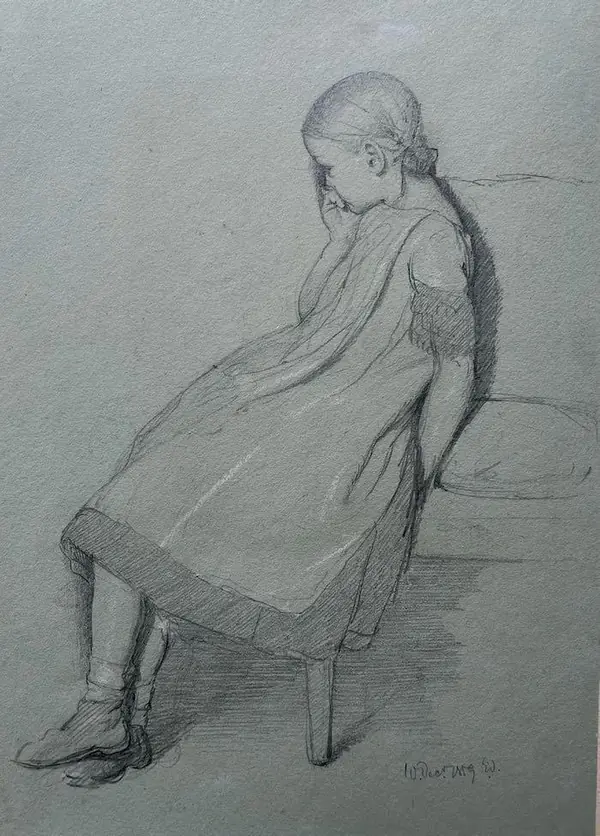
Abbott was one of the best amateur watercolourists of the late Eighteenth Century. A surgeon and apothecary, he lived in Exeter until 1825. He exhibited paintings at the Royal Academy from 1793, receiving contemporary acclaim for the style of his work. The artist John Downman said that ‘he prefers his drawings before his paintings, as they are done with more spirit’ (J. Farington, Diary 26 June 1804; vol. VI, p. 2362). In 1825 Abbott inherited Fordland, a Devon estate, from his uncle James White, an Exeter barrister, Nonconformist and close friend of Francis Towne. Abbott became a patron and pupil of Towne’s, and his linear style shows the artist’s influence. After moving to Fordland he devoted himself to drawing.
View detailsArtists – A
Use arrow keys to navigate, Enter to select, Escape to close
All
A
B
C
D
E
F
G
H
I
J
K
L
M
N
O
P
Q
R
S
T
U
V
W
X
Y
Z
Showing artists with the initial A
Use arrow keys to navigate, Enter to select, Escape to close
Artist A-Z
Artist Z-A


The Italian artist, born in Cremona, settled in England in 1803, having travelled in Greece and Egypt with William Wilkins, R.A. His work has often been confused with that of Constable, particularly his coastal views which look quite similar. Examples of his work may be found at the British Museum, the V&A, Brighton Art Gallery and in several other museum collections.
View details
Alexander studied at the Royal Institution, Edinburgh from 1887-8, and in Paris with the sculptor Emmanuel Frémier. In 1887-8 the artist travelled to Tangier with his father and fellow artists Pollock Nisbet and Joseph Crawhall. He returned to Egypt in 1892, after his artistic studies, and lived on a houseboat on the Nile for 4 years, painting in the desert. This drawing appears to be of North Africa, the evocative rooftops an engaging subject on the characteristic oatmeal paper he often used. In 1902 Alexander was elected an associate of the Royal Scottish Academy becoming a full member in 1913. He exhibited widely including at the Royal Scottish Academy, Royal Academy, Fine Art Society, Royal Watercolour Society and the Leicester Galleries. Alexander’s work is held in the Tate Gallery, Aberdeen Art Gallery, Dundee Art Gallery and by Fife Council.
View details
Helen Allingham is renowned for her watercolour images of cottages and gardens and was one of the most fêted Victorian female artists. Helen Paterson was born in Swadlincote, Derbyshire, in September 1848, the eldest of seven children of a doctor. In Altrincham, Cheshire she was educated at the Unitarian school for girls, established by her maternal grandmother, Sarah Smith Herford. On her father’s death in 1862, the family moved to Birmingham to live with her paternal grandmother. The artist studied at the Birmingham School of Design (1862-65), the Royal Female School of Art, Bloomsbury, London (1866-67), the Royal Academy Schools (1868-72) and the Slade School of Art (evening classes, 1872-74). In the spring of 1868, she visited Italy and, on her return to London she drew illustrations for Once a Week and other periodicals. This led in 1870 to a job as an artist on the staff of The Graphic. In 1874, Helen Paterson started to exhibit at the Dudley Gallery and married the Irish poet, William Allingham (1824-1889) with whom she had three children. After her marriage she continued to produce occasional illustrations for The Cornhill magazine and other periodicals and books. John Ruskin became a great admirer of her work. She was elected an Associate of the Society of Painters in Water Colours in 1875 and a full member in 1890 when women were first admitted. (In 1881, the society had become the Royal Society of Painters in Water-Colours.) From 1881, Helen Allingham lived at Sandhills, near Witley in Surrey and specialised increasingly in scenes of rural life. Her first two solo shows at the Fine Art Society followed ‘Surrey Cottages’ (1886) and ‘In the Country’ (1887). She died in Haslemere, Surrey in 1926. Her work is represented in numerous public collections, including the British Museum, Burgh House & Hampstead Museum and the V&A. Additional Information British Museum
View details
This sky study was done in the Berry region in the Loire Valley. Pin marks can be seen in the lower corners of the paper on which it is painted. The son of a painter of Greek origin, Auguste Paul Charles Anastasi was a pupil of Paul Delaroche and Camille Corot in Paris in the1840s. He began his career painting landscapes in the forest of Fontainebleau, joining the Barbizon school group. Anastasi regularly exhibited at the Paris Salons in 1850s and 1860s, showing landscapes of the countryside around Paris, Normandy, the Roman Campagna and Naples. He also worked as an engraver. In 1870 Anastasi became blind. His work can be found in many museums including the Musée d’Orsay, Paris and numerous French regional collections.
View details
Helen was the fifth daughter of twelve children of Henrietta Dendy and William Thomas Coleman, a physician and was schooled at home. Along with her sister, the pottery artist Rose Rebecca Coleman, she was taught painting and drawing by her older brother William Coleman who kept an art pottery studio in South Kensington and whom she helped make designs for Minton. Her early watercolours were first exhibited in the Dudley Gallery in London in 1864, thanks to the connections of her brother William. She married Thomas William Angell, a postmaster and an amateur artist, on 15 October 1874. The following year she joined the Royal Institute of Painters in Water Colours but resigned after she became an Associate of the Society of Painters in Water-Colour. Angell became Flower Painter in Ordinary to Queen Victoria from 1879 until her death, succeeding Valentine Bartholomew to the privileged position. She is said to have been anointed as his successor by William Henry Hunt, whose enthusiasm for still life subjects she shared. The artist’s work can be found in the collection of the Victoria & Albert Museum, the Royal Albert Museum, Exeter and other public collections.
View details
The daughter of Sir Thomas Spencer Wilson, Bt. of Charlton in Kent, the artist was a pupil of Francis Towne in her youth. Her mother was a Cheney of Badger Hall, Shropshire, where Peter de Wint was a frequent visitor. Lady (Margaret) Arden was a pupil and a patron of David Cox. She married George Compton, Lord Arden (1756-1840) in 1787.
View details
The artistic tradition of painting a self-portrait with a mirror goes back self-consciously to Velazquez’ Las Meninas and has been used by many artists to probe their artistic identity. The artist stares out at the viewer with authority and proclaims self-confident virtuosity as he paints a reflection of himself standing in front of a large canvas (another reference to Las Meninas, although he has chosen the opposite side of the composition) within the large brown wooden mirror which frames his work. He adds another smaller arched wooden mirror to provide a reflection of the back of his head, a play on space and composition which takes our eye a moment or two to unravel. A gilt framed painting is leaning against the wall and a doorway to a sunlit garden can be seen in the distance introducing a light source in the same position as Velazquez chose in Las Meninas. A painter’s rag can be seen wedged into the space between the top of the post and the mirror itself, an indication of work in progress. An interesting account of the two most famous mirrors in the history of western art, the convex mirror in Van Eyck’s Arnolfini Marriage and the rectangular mirror in Velazquez’ Las Meninas can be found in the exhibition catalogue of Reflections- Van Eyck and the Pre-Raphaelites, A. Smith et al, National Gallery, 2018. Paul Audra was the son of a painter from whom he learnt his craft. He studied at the École des Beaux-Arts in Lyon and then in 1888 at the École Nationale Supérieure des Beaux-Arts in Paris. In the atelier of Gustave Moreau, he worked alongside Matisse and Rouault. He returned home to Valence and became the teacher of drawing at the local school and set up his own atelier, moving in 1908 to Nice when he ran the École des Art Décoratifs from 1910. After serving in WWI he started painting again in 1917 and met Renoir and also became reacquainted with Matisse who he helped find a studio in Nice and with whom he occasionally collaborated. He is known to have enjoyed painting self-portraits. Audra exhibited at the salon in Lyon in 1897 and at the Salons d’Automne from 1907-1920.
View details