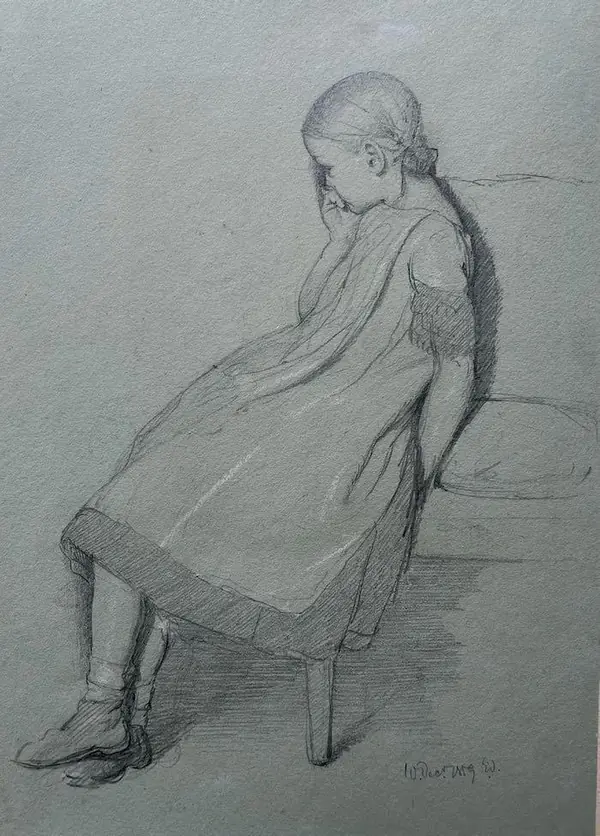
D’Oyly and his second wife Elizabeth Jane Ross moved to Patna in Bihar in 1821 when he became Opium Agent for the East India Company. Their house at Bankipore, a suburb of Patna, was a focus of artistic activity, and Elizabeth also painted as well as being a musician.
View detailsArtists – D
Use arrow keys to navigate, Enter to select, Escape to close
All
A
B
C
D
E
F
G
H
I
J
K
L
M
N
O
P
Q
R
S
T
U
V
W
X
Y
Z
Showing artists with the initial D
Use arrow keys to navigate, Enter to select, Escape to close
Artist A-Z
Artist Z-A


Francis Danby was born in Wexford. Danby studied in Dublin, where he first exhibited in 1812. After moving to London he settled in Bristol where he became a prominent member of the Bristol School of Artists. Danby painted landscapes and genre scenes in oils and watercolour and also a few apocalyptic works similar to those of John Martin. He first exhibited at the Royal Adacemy in 1817 and was elected ARA in 1826. He moved to Switzerland in 1826 where he lived until 1841. He retired to Exmouth in Devon in 1847 where he pursued his lifelong hobby of sailing and boatbuilding. His works can be found in most major collections of British art, including Tate, the V&A, Bristol Museum and Art Gallery and the Yale Center for British Art. Additional Information V&A British Museum Tate
View details

Day was an accomplished amateur artist, who exhibited at the Royal Academy between 1782 and 1801 as an Honorary Exhibitor. The late Judy Egerton wrote an article about him in The Connoisseur, July 1970, pp. 176-185. It is not known for certain when Day met John Webber, the Swiss-born artist who is famous for accompanying Captain Cook on his last expedition to the South Seas between 1776 and 1780. The Connoisseur article notes, without giving a source, that the friendship between the two artists “began about 1787”. Day and Webber were sketching together in the Wye valley in 1788, which is the first time that pairs of views by the two artists of the same subject are known to exist. Two watercolours by Webber of Chepstow Castle dated 1788, which are now in the Whitworth Art Gallery, University of Manchester (D.1900.12 & D.1970.77) (see Charles Nugent, British Watercolours in the Whitworth Art Gallery, 2003, p. 282) correspond to two watercolours by Day which were acquired by Chepstow Museum in 2012. They also made a sketching tour to Derbyshire together in 1789. A family note lists Day’s interest in the following order:’ Geology, Minerology and Painting’ and he formed one of the earliest private collections of minerals in England. He always carried a bag for specimens on his sketching tours. His collection was carried on by his son William Day (1797-1849) and his grandson and passed to the Hampstead Central Library where it was destroyed by bombing during WWII.
View details
Edward Dayes was a London based watercolourist and mezzotint engraver who trained under William Pether. Best known for his characteristic topographical views often painted in a palette of greys, blues, greens and browns he also made history paintings and miniatures. He made annual sketching trips in England and Wales from around 1790. Towards the end of his career Dayes was draughtsman to the Duke of York and he taught Thomas Girtin from 1788. His work can be found in most major drawings collections including the British Museum, V&A, Tate Britain and the Yale Center for British Art. Additional Information V&A British Museum Yale Center for British Art
View details
Evelyn De Morgan, who attended the Slade School of Art, was influenced by George F. Watts and Edward Burne-Jones and by the work of her uncle John Roddam Spencer Stanhope. She often visited Stanhope in Florence, where she developed a love of the work of Botticelli and Quattrocento art. She first exhibited at the Grosvenor Gallery in 1877. In 1887 she married the ceramicist William De Morgan, with whom she often wintered in Florence. It has been suggested that this may be a preliminary study for a figure in her painting The Red Cross, 1916, in the collection of the De Morgan Foundation. Her work is held in many national collections including the Walker Art Gallery, Liverpool; the National Trust properties Wightwick Manor, Wolverhampton, and Knightshayes Court, Devon; the Russell-Cotes Art Gallery and Museum, Bournemouth; the National Portrait Gallery, London; and the Southwark Art Collection, London. Maxwell David Eugene Clayton-Stamm was an authority on the work of William De Morgan (on whom he published extensively), Pre-Raphaelite ceramics and the Blake-Varley sketchbook of 1819. He was a collector and bibliophile.
View details
One of the greatest British landscape watercolourists of the 19th century, Peter de Wint, whose father was of Dutch extraction, was based in London and Lincoln. He spent his summer staying with various patrons, teaching and painting. His distinctive panoramic watercolours are painted with a masterly wet touch and he developed a technique of building layers in the notoriously difficult medium. He exhibited regularly throughout his career and his work is found in all major drawings collections. Additional Information British Museum Wikipedia
View details
The artist lived in Camberwell, London in the 1830s and had a house in Guilford High Street in Surrey. He exhibited at the Royal Academy between 1824-1856 and also showed regularly at the Royal Society of British Artists and the British Institution. He specialised in rural landscapes. Additional Information Royal Academy British Museum
View details
Baron François Adolphe Ackerman (1809-1890) was born in Paris and followed his grandfather and father into the world of finance becoming receveur général des Finances for the department of the Dordogne in 1834 at the age of twenty-five. He was an able financier and rebuilt the family estate at Coulonges, Rahay, Sarthe also becoming mayor of Rahay. He became deputy governor of the Banque de France in December 1870 and régent of the Banque de France on 27 January 1871, holding the office until his death. He was painted by Winterhalter. He and his wife had two daughters one of whom, Henrietta, married vicomte Henri de Bouillé.
View details
George Dennis was an English artist, explorer and writer. He left school at 15 but was a prodigious linguist, who taught himself ancient Greek and Latin then learnt Spanish, French, Portuguese and several other languages. His intrepid spirit inspired his first visit to Spain in the 1830s. From Cadiz he travelled to Grenada through the Sierra Nevada, visiting Cacin, Alhama, the Tajo, the Sierra Tejada, Velez, Malaga and Ronda. He continued on to Gibraltar via Benadalid, Gaucin, Posada amongst other places and then finally returned to Cadiz. The roads were dangerous and he encountered difficulties with banditti. He also ventured further north visiting Tudela, Zaragoza, Toledo and Illesas. His first work, ‘A Summer in Andalucia’ (2 volumes) was published in 1839. Dennis travelled further in Italy and made an illustrated study of the cemeteries of Etruria, which was published in 1848 by the British Museum, London and he completed the first account of Etruscan sources in the modern era. He joined the Colonial Service later in life and became vice-consul to Sicily, and subsequently to Benghazi and Smyrna. He was a companion of the Order of St Michael and St George.
View details
Detmold worked as a painter, illustrator and printmaker specialising in meticulous, intense images. He and his twin brother Charles were taken by their great-uncle to London zoo and the Natural History Museum to draw from an early age. Their uncle Henry Detmold, an artist, further encouraged their development and they absorbed the influence of Japanese printmakers, fashionable in the late 19th century. E.J. Detmold’s work is to be found in many museum collections including that of the British Museum, the V&A and the Fitzwilliam Museum, Cambridge.
View details
The younger brother of Arthur Devis the portrait painter, Anthony Devis exhibited at the Royal Academy from 1761-1781. He travelled extensively in the British Isles and made several trips to the Lakes. By the end of the 1750s he had begun producing Lake District views, including the large oil painting now in Abbot Hall Art Gallery, Kendal, a ‘View of Derwentwater and Skiddaw from Lord’s Island’. Nothing is known of his visits to the Lake District but he produced a number of drawings in his characteristic style. The Wordsworth Trust own a drawing of Furness Abbey by Devis amongst a group of several others.
View details
Born at Ruabon near Wrexham, Downman left Wales in 1768 to study in London, under Benjamin West and then at the Royal Academy Schools. He began to exhibit watercolour portraits and it was in this genre that he was to make his name, although he occasionally exhibited subject pictures. He travelled to France and Rome in 1774, painting landscapes. A year later he returned to Britain and was to live in Cambridge, London, Exeter and Plymouth. In 1795 he was made ARA. His delicately drawn portraits were quite quickly produced and he enjoyed fashionable patronage in London. Downman toured the Lake District in 1812. He continued to exhibit at the Royal Academy until 1819 when he retired and returned to Wrexham. His work can be found in most major drawings collections including the National Portrait Gallery, London, the British Museum, the V&A and the Yale Center for British Art. Additional Information National Portrait Gallery British Museum V&A
View details
Evelyn Dunbar was a devout and committed Christian Scientist throughout her life. Much of her work reflects her beliefs, mostly indirectly but sometimes directly. Christopher Campbell-Howes, the artist’s nephew, has suggested that this work may be an interpretation of the hymn ‘Shall We Gather by the River,’ with words adapted from the original Baptist version of Revelation 22. It begs comparison with Stanley Spencer, whose art was a significant influence on her work. The absence of men in the composition is deliberate, while the inclusion of young children and babies with the young women who make up the circle gathered around an ambiguous stone, in the centre, perhaps adds an air of mystery and female potency to the work. Evelyn Mary Dunbar was the fifth child of William Dunbar, a tailor and purveyor of household linens, and Florence (née Murgatroyd), an amateur artist known for floral still lifes. Dunbar's childhood and adolescence were spent in Rochester, where she developed strong skills in draughtsmanship and composition, as well as a sophisticated sense of colour. Dunbar was encouraged by her mother and her aunt, and she was awarded an exhibition to the Royal College of Art in 1929, where she was greatly influenced by William Rothenstein, Allan Gwynne-Jones, Alan Sorrell, Percy Horton and Charles Mahoney. In her fourth and postgraduate year she was invited by Mahoney, her mural tutor, to join a team to decorate the hall at Brockley Grammar School for Boys (now Prendergast Hilly Fields School) with an extensive series of murals, mostly based on Aesop's fables. Started in 1933, they were inaugurated to acclaim in 1936. In December 1939 Sir William Rothenstein suggested she should apply for employment as a war artist. She was given the remit of recording the Home Front of women's war time activities. Dunbar was the only female artist to be given a series of rolling employment contracts throughout the war, and by 1945 had completed 44 works. In 1942 Dunbar married Roger Folley, a horticultural economist then serving in the RAF. While Folley worked at Oxford University, Dunbar taught at the Ruskin School of Art. She painted biblical and literary allegorical paintings at this period. In 1950 Folley was appointed to a senior post at Wye College, in Kent where the couple moved. Landscape and portraiture began to occupy her, and her only solo exhibition, held in Wye in 1953, reflected her wider subject matter (See Christopher Campbell-Howes, Evelyn Dunbar: A Life in Painting, 2016). A retrospective of Dunbar’s work entitled Lost Works was held at Pallant House, Chichester, in 2015.
View details
Both the Ladies of Llangollen came from Ireland and it was here that the two women formed a strong emotional bond and attachment that would endure for the rest of their lives and attract the attention of Regency society. Eleanor Charlotte Butler (1739 –1829) (seated in this drawing and wearing the order of Saint Louis, an order of chivalry founded by the French king) was the youngest daughter of the Earl of Ormonde of Kilkenny Castle. Sarah Ponsonby (1755 – 1831) lived with relatives, Sir William and Lady Elizabeth Fownes, in Woodstock, County Kilkenny and was a second cousin of Frederick Ponsonby, 3rd Earl of Bessborough, father of Lady Caroline Lamb. Ponsonby attended boarding school at Kilkenny, and it was there, aged 13, that she met Butler, who was 16 years her senior. They became fast friends and corresponded regularly. Rather than face the possibility of being forced into unwanted marriages, or into a convent in the case of Butler, the pair left County Kilkenny together in April 1778 dressed as men, with a pistol and Sarah’s beloved dog Frisk. Their families tracked them down and tried to make them give up their plans. They finally succeeded in fleeing together to Wales and established themselves at a cottage near Llangollen, which they renamed Plas Newydd, in 1780, which they refurbished in a Gothick style. Windows were gothicised and old stained glass panels inserted into them. A library was filled with finely bound books and curiosities of all kinds, including a lock of Mary Queen of Scots' hair. They developed a passion for old, carved wood, from medieval churches to fragments of Elizabethan furniture. The staircase hall was lined with it, and a trio of canopies built on to the door and windows. The extraordinary front porch incorporates carvings of the four evangelists, Latin inscriptions, seventeenth century bedposts and lions donated by the Duke of Wellington (visitors soon learnt that to appear with gifts of carvings ensured a warm welcome). Over the years they added a circular stone dairy and created a garden in the picturesque style. Eleanor kept a diary of their activities. Living on a modest income they maintained a quiet life, studying literature and languages which they described as their ‘system’ and improving their estate. They did not actively socialise and were uninterested in fashion, wearing dark riding habits for formal and informal occasions and beaver hats, as seen in Dundas’ drawing. Their hair remained cropped in the ‘Titus’ style, fashionable in the 1790s and they continued to use hair power, which went out of fashion after the same decade. Many observers commented on their masculine appearance. Their life began to attract the interest of the outside world and Plas Newydd became a haven for visitors, as they become a celebrated example of 'retirement', leaving society for a rustic idyll, which delighted writers such as Wordsworth and Sir Walter Scott. They were also admired for their 'Romantic Friendship’.Visitors including Southey, Wordsworth, Shelley, Lord Byron, Lady Caroline Lamb, Sir Walter Scott, the Duke of Wellington and Josiah Wedgwood visited. The two formed a literary circle that encompassed Mary Tighe, Ann Talbot, Anna Seward, Hester Thrale (otherwise known as Hester Piozzi, Dr. Johnson’s friend, was a neighbour), Henrietta Bowdler, Madame de Genlis and William Wordsworth. Copious correspondence resulted, some of which, for example letters to Anna Seward, have been published (Collected Letters of Anna Seward, 1811). On some days as many as twenty visitors arrived. Their notoriety spread abroad and continental visitors includedPrince Hermann von Pückler-Muskau, the German nobleman and landscape designer, who wrote admiringly about them. Queen Charlotte wanted to see their cottage and persuaded George III to grant them a pension. There was speculation that there was more than romantic friendship between Eleanor and Sarah in their own lifetime. The diaries of Anne Lister (1791–1840), an English landowner from Halifax, West Yorkshire, record a visit to the Ladies of Llangollen in 1822. Her diaries contain accounts of her own lesbian relationships written in code. She was fascinated by the two women and discreetly tried to establish if they were more than just friends, concluding that it seemed unlikely that their friendship was just platonic. Their queer materiality has been explored by Fiona Brideoak in ’Desire, Indeterminism and the Legacies of Criticism’, 2017.Butler and Ponsonby lived together for over fifty years until the end of their lives. Their books and glassware carried both sets of initials and their letters were jointly signed. Eleanor Butler died in 1829, and Sarah Ponsonby two years later. They are both buried at St Collen's Church in Llangollen. Plas Newydd is now a museum run by Denbighshire County Council and is open to the public. Although the Ladies of Llangollen's fame was extraordinary, romantic female friendships were common in eighteenth century Europe. Women often spent a great deal of time in each other's company and developed strong, intense relationships. Female friends frequently wrote to one another using passionate, romantic language that can suggest a sexual relationship to modern readers. Some of the relationships reflected in correspondence were no doubt sexual, others may simply have reflected the conventions of friendship. It is impossible to find conclusive proof whether the relationship between Eleanor Butler and Sarah Ponsonby was sexual or not, but there is abundant evidence that it was loving. Not that many images of the pair are known as the ladies disliked having their portrait taken. Lady Mary Leighton (née Parker) sketched them individually in pencil and a lithograph was made by Richard James Lane, after Lady Leighton circa 1830-1840s showing them seated at Plas Newydd. A second pirated version was made by James Henry Lynch, printed by Day & Haghe, circa 1833-1845 and shows the pair full-length wearing riding habits and top hats in their garden. Lady Delamere sketched them in old age showing them walking inside Plas Newydd (see E. Mavor, 'The Ladies of Llangollen- a study in Romantic Friendship',1971, ill. facing frontispiece and facing p. 97). Provenance: Augusta Raymond-Barker (step-niece of the artist), Fairford Park, Gloucestershire; thence by family descent until 2016 See also:Fiona Brideoak, 'The Ladies of Llangollen – Desire, Indeterminism and the Legacies of Criticism', 2017. The artist of this drawing, which lies somewhere between portraiture and caricature, was Lady Emily Dundas, née Reynolds-Moreton, the fourth daughter of Thomas, 1st Earl of Ducie. In 1847 she married Admiral Sir James Whitley Deans Dundas, GCB, (1785-1862) as his second wife. He became the First Naval Lord in the first Russell ministry in July 1847 and they lived at Admiralty House. Thackeray records that during the 1850 season Lady Emily Dundas gave a glittering party. Lady Emily Dundas is recorded as accompanying her husband on many official engagements such as inspecting the fleet in various places from Cork to Malta and as far afield as New Zealand. He was appointed Commander-in-Chief in the Mediterranean in 1852 and led all naval operations in the Black Sea, including the bombardment of Sevastopol in October 1854 during the Crimean War. She went with him to Turkey and took a house at Therapia. Lady Emily Dundas had four sisters. Her youngest sister, Lady Catherine Reynolds-Moreton (d. 2 Dec. 1892), married in 1841, John Raymond-Barker, of Fairford Park, Gloucestershire (d. 21 May 1888). He had two daughters by his first wife, Harriet Bosanquet (1798-1830) Augusta (1827-1900) and Leonora. Augusta assembled the friendship album from which this watercolour comes which reveals the women of her family and circle as accomplished watercolourists.
View details
Gainsborough Dupont was born in Sudbury, Suffolk, on 24 December 1754, the third son of Philip Dupont and Thomas Gainsborough’s sister Sarah. In the 1760s Dupont was sent to Bath to be raised by his aunt Mary Gibbon, the recently widowed sister of Thomas and Sarah, who set up a millinery shop there beside her brother’s studio in 1762. On 12 January 1772, Dupont was formally apprenticed to Gainsborough, the older man’s first and only studio assistant, and worked for him for sixteen years. Dupont was painted by his uncle four times in the early 1770s (see David Solkin et al., 'Gainsborough’s Family Album', National Portrait Gallery, London, 2018, nos 26, 32& 48 and fig. 36). On 6 March 1775, some nine months after the Gainsboroughs moved to London, Dupont joined the Royal Academy Schools. After his formal training he worked in his uncle’s studio in Schomberg House, Pall Mall, and continued to live at his home there, where he learned to scrape mezzotints and made small copies in oil after his uncle’s portraits. In 1784, Gainsborough asked him to copy a portrait of Queen Caroline to accompany a portrait of her husband George II by John Shackleton in Huntingdon Town Hall. After Gainsborough’s death on 2 August 1788, his nephew had the opportunity to develop his own practice. Dupont continued to work in the studio at Schomberg House. Portrait commissions came, notably from George III, who admired his work, and from some of the children of his uncle’s friends. In 1793 he was given his most prestigious commission, to paint a huge canvas, larger than any his uncle had painted, of the Elder Brethren of Trinity House: thirty-one figures placed across a canvas nine and a half feet tall and nearly nineteen feet wide. The group portrait – commissioned to decorate the newly completed headquarters of Trinity House on Tower Hill – took three years to complete. In 1794 Thomas Harris (d. 1820), a theatrical proprietor, commissioned a series of spirited portraits of actors that are, with a few exceptions, now in the Garrick Club, London. Dupont was also a painter of landscapes (see catalogue by John Hayes, op. cit., pp. 192–6) and he exhibited at the Royal Academy from 1790 to 1795. Hayes notes that the dating of Dupont’s landscapes is problematic, but that there does appear to be a progression from a grand, slightly stiff manner, through a poetic, pastoral kind of landscape, linking with Gainsborough’s smaller late works, to a more fluent, vigorous and dramatic style, possibly influenced by Lawrence. This group fits into his later oeuvre. John Mayheux, the first owner of these pictures, was an assistant at the Board of Control, under Lord Melville, which oversaw the activities of the East India Company from London.
View details