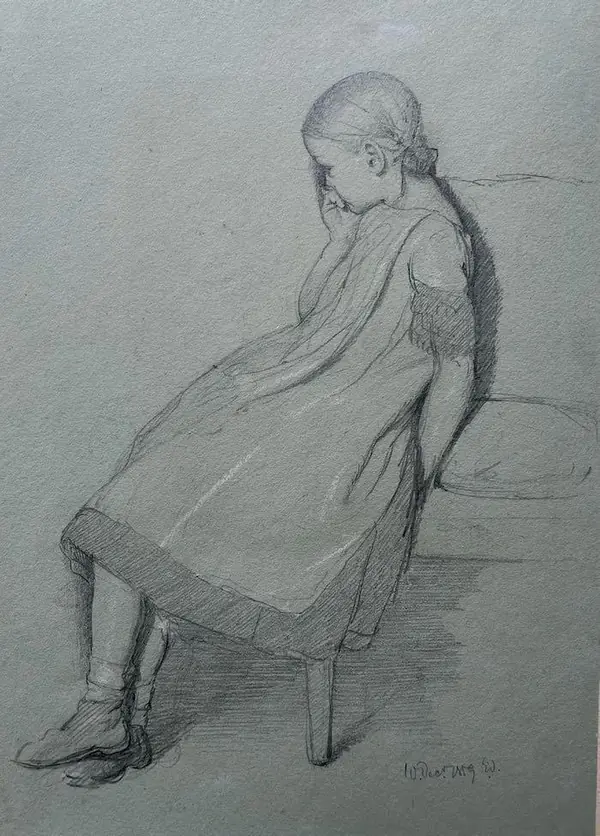
Emily Farmer exhibited over one hundred works at the New Society of Painters in Water Colours during her lifetime, achieving good notices from contemporary critics, but her work has fallen from public view like that of many other women artists. She was the daughter of John Biker Farmer who worked for the East India Company and his wife Frances Ann (née Frost). Like many women of her generation Emily was home educated and was taught art by her brother Alexander Farmer, the genre painter. Farmer’s early work was in miniature and she exhibited twice at the Royal Academy in 1847 and 1849 but from 1850 she began to concentrate on genre painting and developed her particular love of painting children. Farmer was elected to the New Society of Painters in Water Colours in 1854. Of a membership of fifty-seven artists in 1850 she was the tenth female member of the Society added four years later, the other nine being Fanny and Louisa Corbaux, Jane Egerton, Fanny Harris, Mary Margetts, Mrs William (Emma) Oliver, Sarah Setchell and Fanny Steers. She exhibited nearly one hundred works there, including the present watercolour, over the course of her artistic career. Pamela Nunn points out that although there was not much women’s work exhibited at the New Society’s exhibitions it was often regarded as the most interesting.1 Farmer was singled out for special mention by contemporary critics: “...Miss Farmer’s pictures, which are, all things considered, the best figure pieces in the collection. They are true in gesture and expression, conscientious in execution and harmonious in colour”, Spectator, May 3, 1862, p. 495. “Miss Farmer is the only figure artist (here) whose drawings give any hope or promise”..., ibid, April 28, 1866, p. 467. “Let us call attention to the two modest bits of Domestic by Miss Farmer, the best of that class in the room”, Critic, April 28, 1860, p. 351. Farmer also exhibited work at the Royal Scottish Society of Painters in Water Colours and the Liverpool Academy. Emily Farmer lived for over half a century at Porchester House in Porchester, Hampshire where she died in 1905. She is buried in the churchyard of St Mary’s, Porchester. Examples of her work can be found in the Victoria and Albert Museum and the National Gallery of Art, Washington D.C. Roundell Palmer, 1st Earl of Selborne (1812-1895), PC, FRCS, was an English lawyer and politician. He was appointed Solicitor General in Lord Palmerston’s government in 1861 and promoted to Attorney General in 1862. He handled many questions of international law which arose from the American Civil War including the Alabama Affair and was the leading counsel for Britain before the Alabama Claims tribunal in Geneva. In 1872 he was appointed Lord Chancellor under Gladstone, an office he held again from 1880-1885. He lived at Blackmoor House in Hampshire, built from 1865-1882 to the designs of Alfred Waterhouse. Two chairs and a hanging corner cupboard designed by Waterhouse for Blackmoor are now in the collection of the Victoria & Albert Museum.
View detailsArtists – F
Showing artists with the initial F


Copley Fielding was born in Halifax, Yorkshire, and grew up in London and the Lake District. He gave drawing lessons in Liverpool from 1807. He moved to London in 1809 and had lessons from John Varley and married his sister-in-law. He became an associate of the Old Water Colour Society in 1810 and a full member in 1812. Fielding made sketching trips to Wales, County Durham, Yorkshire and the Wye Valley. He was a popular drawing master and a prolific draughtsman. He had moved to Brighton by 1829. In 1831 he was elected President of the OWCS until his death in 1855. He exhibited extensively throughout his life and his work can be found in all major drawings collections, including the British Museum, Tate, V&A, Yale Center for British Art, New Haven and the National Gallery of Art, Washington DC. Additional Information Tate V&A British Museum
View details
The artist was the youngest son of Nathan Theodore Fielding. From c. 1827 to 1830 he lived in Paris, where he ran the family engraving business, at which William Callow worked. He collaborated with his brothers Thales and Theodore in England before returning to France, where he built up an extensive teaching practice, with pupils including members of the family of King Louis-Philippe. Provenance: Augusta Raymond-Barker, Fairford Park, Gloucestershire; thence by family descent until 2016
View details
Heneage Finch, 4th Earl of Aylesford was a talented amateur artist who studied drawing with John Baptist Malchair while he was at Christ Church College, Oxford. His mature style shows show the influence of Rembrandt, whose etchings he collected. Aylesford made frequent tours to Wales, including a trip in 1803 when he may have made this view of Tenby. Another very similar but slightly smaller drawing of boats at the shore at Tenby by him is in the collection of Tate (T08126) and a further view of Tenby is in the collection of the National Gallery of Art, Washington DC (2009.70.30). He was also a politician, patron of the arts (he was a trustee of the British Museum from 1787-1812), etcher and a talented amateur architect. His work can be found in many institutional collections.
View details

Francia was Bonington’s teacher whose work provides an important link between British and French watercolour painting in the early nineteenth century. A native of Calais, he left for London in 1788 after the outbreak of the French Revolution and remained until 1817. He established a practice as a drawing master in London and a reputation as a painter of marine and landscape watercolours. He attended the Monro ‘Academy’, made sketching tours, was secretary of the Brothers, a sketching club of which Girtin was a member and was also secretary of the Associated Artists in Water Colours. He exhibited at the Royal Academy from 1795-1822. Francia returned to Calais in 1817. He gave Bonington his first professional lessons in watercolour in Calais as well as other artists including William Wyld, Eugène Isabey, Tesson and Collignon. British and French artists who passed through the town on a tour of the coast or en route to Paris or London would visit him.
View details