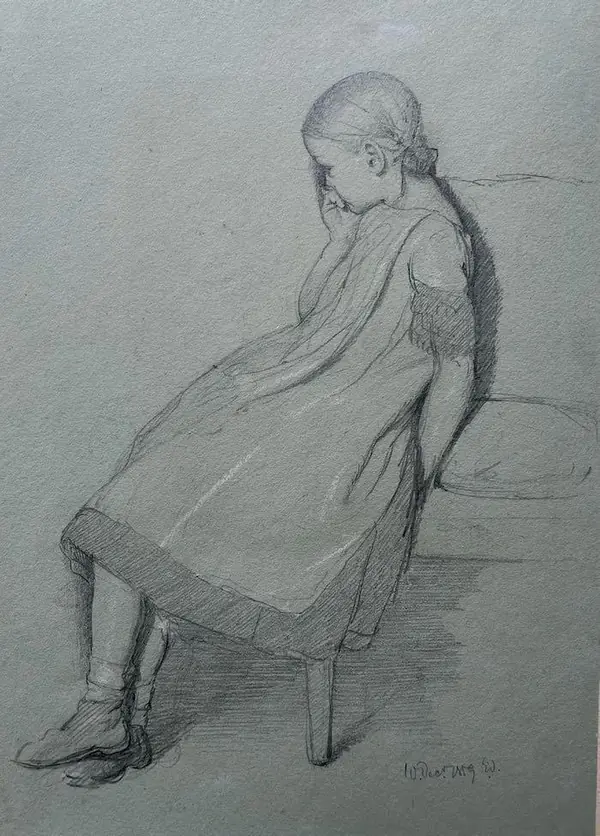
Born in Sudbury, Suffolk, Thomas Gainsboroug trained in London before establishing a portrait practise in East Anglia. Throughout his career he claimed to prefer painting and drawing landscapes, allegedly saying ‘I wish very much to take my Viol da Gamba and walk off to some sweet Village where I can paint Landskips and enjoy the very End of Life in quietness and ease’. He moved to Bath in 1759 and enjoyed commercial success producing full length portraits in the tradition of Rubens and van Dyck. He was a founder member of the Royal Academy and settled in London in 1774, when his rivalry with Sir Joshua Reynolds became clear. He had one studio assistant, his nephew Gainsborough Dupont. Gainsborough drew prolifically in various media including pencil, charcoal, chalk, watercolour and bodycolour and his drawings were often preparatory sketches for oils or imaginary landscapes which could be very experimental in technique. He also made presentation watercolours with gilt tooled borders which he varnished. His work is found in major collections all over the world, including The Huntington, San Marino, the Getty, National Gallery of Art, Washington, the Metropolitan Museum, New York, The Frick Collection, New York, Tate, the National Gallery, London, Gainsborough’s House, Sudbury and many others. Additional Information Tate National Gallery of Art Gainsborough's House The Huntington Getty
View detailsArtists – G
Showing artists with the initial G


Justinian Gantz, described in the East India Gazette as 'Miniature Painter', was the son of the artist John Gantz. In addition to their work as draughtsmen for the East India Company, they may have practised as architects and ran a family lithographic press in Popham's Broadway, Chennai (M. Archer, British Drawings in the India Office Library, 1969, I, p.49, and J.R. Abbey, Travel in Aquatint and Lithography, 1957, II, no.445). Seven watercolours by Justinian Gantz of European houses in Chennai dating from 1832-1841 are in the collection of the British Library (M. Archer, op.cit., II, pp.604-606). The fortress of Gooty was an important British stronghold 269 miles from Chennai and 44 miles east of Bellary. It comprised a number of strong works, connected with each other on the summits of a cluster of hills and enclosing a space of level ground where the town was situated. Two fortified gateways gave access to the town to the south-west and north-west. A huge smooth rock to the north of the circle of hills ascended through 14 gateways and fortifications to form a citadel. This work was part of a group of views of southern India by Justinian and John Gantz included in the Spink exhibition in 1996.
View details
Garrard came from a family of artists who were descended from Marcus Gheeraerts the Younger (c.1561-1636). He was a pupil of Sawrey Gilpin (1733-1807) whose daughter Matilda he married. He studied at the R.A. Schools from 1778 and was a frequent exhibitor there from 1783-1826, becoming an ARA in 1800. Garrard specialised in animal portraiture and sculpture, but also painted landscapes, portraits and urban views. From 1795 he worked increasingly as a sculptor. He died in Brompton, then a village next to Knightsbridge. where many artists lived.
View details
The artist, who was of Hugenot descent, started his career as an apprentice engraver, after which he studied at the Royal Academy Schools, first exhibiting there in 1812. Gastineau became an associate of the OWCS in 1821 and a full member two years later. In 1824 he exhibited at the Paris Salon. Gastineau lived in London where he also worked as a popular drawing master. A landscape artist he toured the British Isles and Ireland regularly and also made several journeys to Europe. He exhibited regularly throughout his life. His work can be found in most major drawings collections including the British Museum, V&A and Tate. Additional Information Tate V&A
View details

Girtin is a seminal figure in the history of British watercolour, particularly celebrated for his revolutionary approach to the medium despite his short life. An accomplished painter and etcher, Girtin was instrumental in elevating watercolour from a medium primarily used for topographical records to as independent art form of great power and romantic sensibility. His close association, marked by both friendship and rivalry, with his contemporary J.M.W. Turner, further highlights his significance in a transformative era for British art. Thomas Girtin's artistic style developed rapidly during his brief career. Leaving behind his topographical training under Edward Dayes, with the characteristic use of an outline washed in with clear washes, he developed a bolder, more expressive, and distinctly Romantic approach to landscape painting. His mature work was characterized by a dramatic breadth of vision, a sensitivity to atmospheric effects, and a powerful and spontaneous use of colour. Girtin's works are held in major public collections around the world. Large collections can be found at the British Museum, Tate Britain, and the Victoria and Albert Museum in London, the Yale Center for British Art in New Haven, the Fitzwilliam Museum in Cambridge and the Metropolitan Museum of Art in New York. His life and work have been the subject of continued scholarly interest and major exhibitions. In 2002 ‘Thomas Girtin: The Art of Watercolour’ was held at Tate Britain, commemorating the bicentenary of his death. Additional Information Tate British Museum Thomas Girtin
View details

Click here for the latest catalogue Gordon-Cumming’s extensive publications and her participation in important exhibitions meant she was well known to her contemporaries but in the century since her death, she has largely faded from view, mainly because her work has rarely been shown, as it has remained in the hands of her descendants. The artist, known as Eka, was the twelfth child of Sir William Gordon-Cumming, 2nd Baronet of Altyre and Gordonstoun and his first wife Eliza Campbell and born at the family seat of Altyre, Morayshire, on the river Findhorn in the Scottish Highlands. As was normal at that time, Gordon-Cumming was educated at home, presumably by governesses or tutors. Eka was brought up in an artistic environment, as her mother painted in both oils and watercolours, and her siblings also drew. Her mother was also a palaeontologist who died in 1842. From 1848 to 1853 Eka went to Hermitage Lodge in Fulham, a school run by the three Stevens sisters. In 1854 she did the London season. The artist spent her summer holidays at the Gordon-Cumming home at Altyre, sketching, fishing (comparatively unusual for women in Victorian England), walking and climbing and visiting Gordonstoun. She developed an adventurous temperament and love of mountaineering. Gordon-Cumming pursued her artistic development in the 1860s exhibiting in Edinburgh and Glasgow from 1866 and 1867 respectively. Gregarious and sociable, she stayed with friends and relations, always sketching and painting in watercolours as she went. In 1868 she made her first painting tour of the Western Isles. In November 1868 the artist travelled to India, at the invitation of her half-sister Emilia and her husband Warden Sergison, formerly of the 4th Hussars. She returned to the United Kingdom in February 1870, with many watercolours and drawings, when her first article ‘Camp Life in the Himalayas’ was published in Good Words. She wrote more about her travels in From the Hebrides to the Himalayas in 1876. Henceforth, inspired by her first long journey, painting, writing and travel became her way of life. Gordon-Cumming drew and painted watercolours extensively while she travelled. She rose around 4 or 5 a.m., working very fast to produce accurate pencil sketches, which she would subsequently touch in with watercolour. In addition to small sketchbooks and larger blocks of paper, she travelled with a very large zinc block contained in a large tin box. This enabled her to compose larger compositions unconstrained by the risks of accidental damage (Memories, pp. 199-200). She returned to Ceylon from 1872 to July 1874, describing in her autobiography how ‘I proved, as I have often done before, how soothing are long days of solitary sketching, alone with beautiful nature’, Memories, p. 211. She returned with several hundred paintings ‘of exceeding interest’ which were exhibited in London, Glasgow and elsewhere. Two Happy Years in Ceylon was published in 1892 and was well received. In 1874 Rachel Hamilton Gordon invited the artist to accompany her and her husband Sir Arthur Gordon, to Fiji, following his appointment as the first British Governor of Fii. The party left England in March 1875 stopping at Singapore before arriving in Sydney. The artist spent three months in Australia visiting the Blue Mountains and the Duntroon sheep station. Between September 1875 and March 1878 Gordon-Cumming visited Fiji and New Zealand, and travelled across the South Seas, following a fortuitous encounter with the captain of a French man-of-war, the Seignelay, which enabled her to travel to Tonga, Samoa and Tahiti. The Roman Catholic bishop of Samoa, who was on a cruise around his oceanic diocese, acted as her chaperone. The French officers fitted up a pretty little cabin to accommodate the artist. This trip is recorded in her subsequent books At Home in Fiji (1881) and A Lady’s Cruise in a FrenchMan-of-War (1882). The artist then proceeded to California, where she spent several months in the Yosemite Valley. She rode in all directions, glad of the side saddle she had with her, to paint the views from various mountain summits and watched the seasons change from the melting of the snow, when the crags were visible and the trees leafless, to the growth of the vegetation. The Sequoia Gigantea captured her imagination as did the other trees. She organised the first art exhibition in Yosemite to show around fifty of her watercolours and sketches and recorded her time there in Granite Crags (1884). Gordon-Cumming continued her travels to Japan and arrived in Nagasaki on 6 September 1878. She spent a couple of months in Japan and left from Yokohama for China in December. She travelled through China until June 1879 visiting Hong Kong, Canton,Tsientsin and Peking. There she met a Scottish missionary, William Hill Murray, who had invented the Numeral Type system and was teaching blind Chinese to read and write. Gordon-Cumming became a stalwart supporter of his school and wrote two books about the blind in China, in addition to her publication Wanderings in China (1886). Gordon-Cumming continued what was to become her longest trip by returning to the United States via Japan, arriving in San Francisco in September 1879. On 1 October she left for Hawaii and spent two months exploring the islands and observing their volcanoes, as recorded in her publication Fire Fountains: The Kingdom of Hawaii (1873). She then crossed the United States and finally docked in Liverpool on 13 March 1880. Her home for the next nine years was with Nelly, her now widowed sister, at Crieff, Perthshire, and after Nelly’s death in 1889, she lived there alone. Her most productive period followed, during which she wrote many of her books and articles and continued to paint. Her autobiography Memories (1904) was her final work. The artist’s work was extensively exhibited in her lifetime. In 1914 Gordon-Cumming’s achievement was recognised when she was made a Life Fellow of the Royal Geographical Society. She died at Crieff on 4 September 1924. The artist was a landscape painter, an explorer and a mountaineer. Aware of her privileged circumstances she wanted to record the places she visited to share them with others. She was drawn to high peaks and mountains and was able to ride and climb to a level unusual amongst Victorian women. Her interest and aptitude must have started in her childhood in the Highlands of Scotland (views of two Munros, Schihallion, and Ben Lawers are included in this collection). She was to climb in the Himalayas, the tea country in Ceylon where she ascended Adam’s Peak and Mount Pedro, the highest mountain on the island, the Blue Mountains in New South Wales, and the volcanoes of the South Sea islands. Yosemite particularly impressed her as she wrote in Granite Crags, 'Truly these Californian Alps hold treasures of delight for lovers of all beautiful nature, who on their part can bring strength and energy for mountaineering — a sure foot, a steady head and any amount of endurance’.
View details
Charles Gore (1729-1807) was the son of a Lincolnshire landowner and educated at Westminster. Following his marriage to Mary Cockerill, the heiress of a fortune derived from shipbuilding, he settled in Southampton and learnt how to draw and design ships, one of which, a cutter, he named Snail He also became an accomplished sailor, sailing around the British Isles, the Channel Islands and the northern French coast. Gore’s social circle included the Duke of York, the Duke of Gloucester and the Duke of Cumberland, King George 111’s brothers. In 1773, his wife’s health necessitated travelling abroad and Gore undertook an extensive European grand tour, sketching with the German artist Jacob Philipp Hackert (1737-1807). In the spring of 1777, Gore visited Sicily with Hackert and Richard Payne Knight (1751 – 1824). His drawings from this visit were later worked up by John Robert Cozens (1752-1797). Gore’s work, and that of his daughter Eliza, who was taught by Hackert (and who was later to write a biography of her father) can be confused with his. Gore and Eliza may also have taken lessons in watercolour from the British watercolourist William Pars (1742 – 1782) who arrived in Rome in 1775, the same year as the Gores. Gore copied marine oils, completed the unfinished drawings of other artists, while he also developed his own style, reflecting his detailed knowledge of the sea. In 1779, Gore returned to England and became a member of the Dilettanti Society in 1781. He painted a series of panoramic views of Sussex. The family returned to the Continent in 1782. Gore settled in Weimar in 1791, it is believed at the insistence of Karl August, Duke of Saxe Weimar (1757 – 1828), who had fallen in love with Eliza. He was a member of the Ducal Court. Goethe (1749 – 1832) was a regular visitor and describes Gore in his biography of Hackert, published in 1811. Gore spent the rest of his life in Weimar. He bequeathed five folio albums containing around a thousand drawings to Duke Karl August, which today can be seen in the Goethe-Nationalmuseum, Weimar. The British Museum has a large collection of drawings by Gore that all came from Payne Knight's bequest, the foundation of its collection of drawings and watercolours. Many of these are Sicilian views, and there are several shipping scenes. Examples of Gore's work can also be found at Tate Britain, London, and the National Maritime Museum, Greenwich. Additional Information British Museum Tate
View details
Joshua Gosselin joined the Guernsey Militia in 1758 and over a military career of forty years rose to the rank of Colonel in 1789. He was elected a Greffier of the Royal Court in 1768. Gosselin had a deep love of nature and made a comprehensive list of the wildflowers of Guernsey, the earliest record of its kind. He also collected and studied seashells, was a noted antiquarian and an important figure in Guernsey society.
View details
Elizabeth Gould was one of the most important ornithological artists of the nineteenth century. Probably because much of her short life was spent in the shadow of her husband, Elizabeth Gould’s significant artistic and scientific contribution to the art of natural history has been overlooked traditionally. However, her reputation has recently been reassessed in Andrea Hart and Ann Datta’s monograph Birds of the World: The Art of Elizabeth Gould, published in 2023. Elizabeth was born and educated in Ramsgate, Kent. In 1827 she began working as a governess in London. She met John Gould, Curator and Preserver for the Museum of the Zoological Society from 1828, through her brother Charles Coxen, a fellow taxidermist. They married in 1829. John Gould was to become the publisher of the greatest series of bird books ever produced, and, until her death aged thirty-seven in 1841, Elizabeth was the major contributor of lithographs to his oeuvre creating over six hundred lithographic plates for their publications. Complications with the birth of their fourth child nearly killed Elizabeth in 1833. Some of her best work is to be found in Gould’s Birds of Europe (1832–1837) and this outstanding book also contained lithographs by Edward Lear who instructed her in lithography; together they raised the standard of ornithological illustration. The two artists also worked on Ramphastidæ or Family of Toucans, 1833-1835. Only a few women mastered lithography making Gould’s contribution all the more noteworthy. She had eight children in twelve years before her premature death. John Gould began his career as a taxidermist and by 1833 had become superintendent of the ornithological department at the newly established London Zoological Society, where he joined a circle of prominent naturalists. He was responsible for the scientific descriptions of birds collected by Charles Darwin during the voyage of HMS Beagle, and provided the crucial information that the wildly different Galapagos specimens were all finches. Less heralded have been the plates which accompanied the illustrations of Darwin’s ‘Birds’ which were credited to Elizabeth Gould after sketches by John in Darwin’s introduction to the work. The Goulds started in publishing during the late 1820s, when the first substantial collection of Himalayan birds was obtained by the Zoological Society. Their novelty in Britain made them interesting both to naturalists and wealthy enthusiasts, providing the opportunity to produce a lavish volume depicting all eighty species (one hundred birds in total were depicted, with the title A Century of Birds from the Himalaya Mountains, 1830 -1833). Elizabeth was responsible for the illustrations, made the original watercolours and also transferred them to lithographic stones for printing. The images were then finished to the highest standard by teams of professional hand-colourists. It was by far the most accurate work on foreign ornithology published up to that time. Its success convinced the couple to continue as a publisher, and over the next fifty years John Gould produced another forty-nine imperial folio volumes covering birds from almost every continent, including Australia, which he and Elizabeth visited to collect specimens and draw birds from life in 1838-1839. The two Australian books which the couple produced, A Synopsis of the Birds of Australia, and the Adjacent Islands (1837-8) closely followed by The Birds of Australia and the Adjacent Islands (1837-8) cemented the Goulds reputation. Elizabeth is thought to have made all the plates which are minutely detailed and full of charm.
View details
Duncan Grant was born in Inverness in 1885. He studied at Westminster School of Art and also in Paris, where he met Matisse and Picasso and at the Slade in London. From 1908 he was part of the Bloomsbury group, that included Vanessa Bell, her sister Virginia Woolf and Roger Fry. Grant’s painting style was influenced by the Post-Impressionist exhibitions of 1910 and 1912 that Fry organised in London. With Fry and Bell, Grant founded the Omega Workshops to make decorative works. In his later years he lived at Charleston, Sussex, with Vanessa Bell. The pair travelled widely in Europe and spent much time in the South of France. After Bell's death in 1961, he continued painting and travelling.
View details

The artist was the fifth son of John Green, a merchant in the Levant and his wife, Harriet. The Green family were prominent members of The Levant Company and the Maltese Consular Service. Edward Green’s dates have been incorrectly recorded, but family records indicate he was born on 11 January 1801, baptised on 14 July 1801 at St Botolph’s, Bishopsgate, London, and died in 1884. Green studied at the prestigious Royal Academy Schools in London, where his name appears in the records as Frederick Edward Green / E.F. Green. He was admitted as a probationary student on 11 January 1822, and registered as a full student on 4 April 1822, aged 21, for painting. Green was admitted to the life drawing school on 29 November 1822. He excelled at the Schools and won a silver medal in 1826, for a copy made in the painting school. The artist married Catherine Colona Stilon in Malta on 2 June 1840 and a daughter, Melita (Kate) was born to the couple on 30 April 1841. They had a second daughter Ellen Green. His brother, James Moring Green (the seventh son), was also an artist and Vice Consul of Naples. Two of his other brothers were Consul and Vice-Consul in Greece and this no doubt lies behind the number of interesting paintings he made of Greek subjects. After his wife’s death in 1845, Edward F. Green sold all his paintings, copies of Old Masters and curiosities at an auction by Foster Auctioneers, 54 Pall Mall (which was advertised in ‘The Atheneum’) and travelled to India. He is recorded as having lived in Bombay, now Mumbai, and evidently travelled in the surrounding area, and possibly, further afield. He stayed in India for three years, returning to Malta in 1848 for the funeral of his father-in-law, Dr Guiseppe Stilon, a Royal Naval Surgeon of Italian origin (whose will is in the National Archives, Kew). Green’s motivation to visit India is not known but it seems likely that it was influenced by the loss of his wife. Little is known about Green’s soujourn there, but he was an artist with a taste for travel and a journey to India would have appeared exciting and begun a new chapter in his life. British artists had been visiting India since William Hodges’ arrival in 1780 and the activities of the East India Company and the increased number of permanent British residents created a market for pictures both in India and the United Kingdom. With his eye for local customs and costumes, Green would have found a ready supply of colourful subjects to paint. Exhibition History Green exhibited regularly at the Royal Academy, showing 14 works between 1824 – 1851. He also showed 21 works at the British Institution and exhibited at the Society of British Artists. The artist specialised in exotic and orientalist subjects inspired by his extensive travels in Italy, Greece, Albania, Persia and India, and he specialised in painting particularly evocative oils by highlighting details of local costume and customs. His portrait of a Greek girl in a landscape wearing a Greek costume and embroideries was illustrated as a colour plate in Fani Maria Tsigakou, The Rediscovery of Greece, 1981, col. Pl. V, p. 194. He also worked as a portrait painter, a ready source of income, and in 1830 painted the portrait of Major-General Sir Robert Henry Dick (1785? – 1846), the soldier who lived in India. This was engraved as a mezzotint by Henry Haig circa 1847. A portrait of a young man by Green is in the collection of the Guildhall Art Gallery. His various addresses are recorded as 13 New Bond Street in 1824; at 65 Upper Charlotte Street in 1826; at 16 Howland Street in 1828 and 1829; at Upper Gloucester Place in 1837; all in London, at Strada Mercante in Valletta, Malta in 1840 and 1841; at 2 Titchfield Terrace in St. John's Wood in 1843; in Bombay, India in 1846 and at 17 Nottingham Street, London in 1851. Poona (Pune), Maharashtra Poona (now Pune) in Maharashtra was one of the major military bases of the British East India Company from 1818 after the fall of Peshwa during the third Anglo-Maratha War. A large military cantonment was built to the east of the city. Due to its milder climate, it was the monsoon capital for Bombay, situated almost two thousand feet up in the Western Ghats. It was one of the most important cities of the Bombay Presidency established in 1858 when India came under direct British rule. Poona had long been a place which British artists visited, from Thomas and William Daniell and James Wales in 1780s and 1790s. Wales founded an art school for local painters in the city in 1791 with the help of Sir Charles Ware Malet, British Resident at the Peshwa’s court, although the school ceased to exist after his death in 1795. William Carpenter (1818 – 1899) was in Poona around the same time as Edward Green and drew many watercolours of the city, its inhabitants and the surrounding area. William Simpson (1823 – 1899) also visited Poona towards the end of his time in India, once the railway had been extended there in 1858.
View details
Apollonia Griffith was a talented print maker and watercolourist. Her father was the London merchant Thomas Griffith of Ham Common, who had four children including her brother William, celebrated for his contribution to Indian botany. William studied medicine at London University, where his botanical interests developed. In 1832 he joined the East India Company as an assistant surgeon at Madras. After trips to Bhutan and Afghanistan, he took charge of Calcutta Botanic Garden in 1842. Only three years later he was to die at Malacca of hepatitis, leaving behind a widow, young child and three maiden sisters. A cenotaph was erected to commemorate him in the Botanic Garden in Calcutta. On his deathbed William asked fellow botanist John McClelland to sort through and publish his manuscript papers, and it is through these posthumous memoirs, journals of his travels on the Indian subcontinent published in 1847 with lithographs by Apollonia, that Griffith’s work is so widely known and celebrated. Her role is praised in the introduction to the memoirs: we owe the transfer of the landscapes to stone, which add so much to the appearance of the following volume, to the talent and kindness of his sister.
View details
Grimm was born in Switzerland and moved to London in 1768 having spent three years in Paris. He made a number of views along the Thames shortly after his arrival in the capital. This view is taken slightly upstream from the wooden Fulham Bridge, which is visible in the drawing with a stage coach crossing. A further smaller view of the Berkshire House in 1772 with its distinctive sign by the waterside steps is recorded with the title ‘a view from Putney up the river’ (7 1/8 x 8 1/4 inches in the J. Braithwaite collection); this work is recorded as having been based on a study (Rotha Mary Clay 'Samuel Hieronymous Grimm', 1941, p. 66). This bridge was opened in 1729 in line with Fulham High Street with a slight curve on the Putney side in front of the church. The British Museum has a sketchbook by the artist of Thames views from Fulham to Kew (1919.7.12.25). In 1957, Athelhampton House was bought by the eminent surgeon Robert Victor Cooke to house his extensive collection of 16th and 17th-century furniture, paintings, tapestries and carvings. Following his wife’s death in 1964, he gave the house to his son Robert Cooke MP (later Sir Robert) on his marriage to his wife, Jennifer King, in 1966. Their son Patrick inherited the house in 1995.
View details
The artist was born in Greenford, Middlesex, the son of a Swiss jeweller who modelled George II’s crown. He was a noted amateur draughtsman, but extravagant living exhausted his inherited fortune and forced him to earn an income from his hobby. The results of his regular antiquarian sketching tours were published as The Antiquities of England and Wales, The Antiquities of Scotland and The Antiquities of Ireland between 1773 and his death. He also drew portraits and figurative works, although they are comparatively rare. He was a larger-than-life figure of substantial girth and known as the ‘Greatest Porter Drinker of the Age’. He died suddenly in Dublin and was buried at Drumcondra, where his tombstone records that Grose ‘whilst in cheerful conversation with his friends, expired in their arms without a sigh 18 May 1791 aged 60’.
View details
Guillaumet was a leading French Orientalist painter. From 1857 he studied under François-Édouard Picot and Félix Barrias at the École des Beaux-Arts. He won the second prize in the Prix de Rome for historical landscape in 1861 and set off for Italy. In Marseille he was delayed by a storm and by chance took a boat for Alger. He was entranced by Algeria and its light. During this first journey he made a large quantity of drawings and studies. Between 1862 and 1884 Guillaumet returned to Algeria on ten or eleven trips, spending several months there each time, travelling around the country, living either in villages, or in Kabyle ksour (fortified villages) or with nomads. He also accompanied French expeditionary columns, as in 1864 and witnessed raids and the repression of insurrections. He wrote of his admiration for the landscape and his empathy for the population. Inspired by Fromentin’s works, he wrote texts about his Oriental experiences that appeared in the 'Nouvelle Revue' starting in 1879 and were later published together in an illustrated volume ‘Tableaux Algériens’ published posthumously in 1888. Guillaumet, who at first had a studio at Sèvres, settled permanently in Paris in 1885. He lived there with Cécile Neinlist (1838-1929) whom he married in 1879 and with whom he had a son, Édouard, born in 1866. He exhibited regularly at the Salon from 1861 to 1880. He enjoyed early success and the French state acquired several of his pictures of rural and nomadic Algeria for the Luxembourg and provincial museums. After his premature death a first retrospective exhibition was organized at the Paris École des Beaux-Arts in 1888. (1) His work may be found in Paris at the Musée d’Orsay and the Louvre. In Algeria, works by him are also on view in the public collections of the National Fine Arts Museum of Alger, at the National Museum Cirta in Constantine and the Zabana National Museum of Oran. He was the subject of a monographic exhibition’ L’Algérie de Gustave Guillaumet (1840-1887)’, (2) at the Musée des Beaux-Arts of La Rochelle, the Musée des Beaux-Arts of Limoges and at La Piscine in Roubaix (9 March – 2 June 2019). The Kulka-Heissfeld collection was formed by Richard Kulka (1863- 1931) the son of a Jewish industrialist with textile factories in Jägerndorf who moved to Vienna and became a lawyer. The paintings in the collection were mainly 19th and early 20th century landscapes. On his death he left 1/3 of his collection to his sister Adele Kulka and 2/3 to Valerie Heißfeld. Valerie and her daughter Lotte left Vienna in 1938 after the Anschluss with some of the collection. They applied for export applications for numerous works of art and succeeded in taking many with them. Lotte succeeded in fleeing to England on 1 March 1939 with around 25 pictures, of which this is one. Her mother and aunt, Adela Kulka, perished at the concentration camp at Theresienstadt. Exposition des œuvres de G. Guillaumet: au profit d’un monument à élever à la mémoire de F. Bonvin, Paris, École Nationale des Beaux-Arts, 7 to 31 January 1888.[↩] Marie Gautheron (dir.), L’Algérie de Gustave Guillaumet (1840-1887), exh. cat. 2018-2019 Musée des Beaux-Arts de La Rochelle, Musée des Beaux-Arts de Limoges and La Piscine de Roubaix, 2018.[↩]
View details