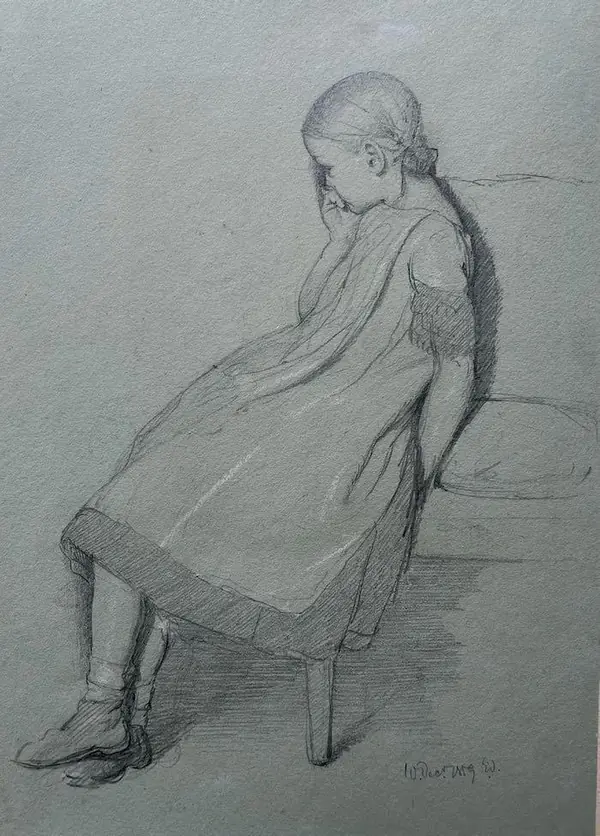
Ince studied with David Cox in Hereford before moving to London in 1826 when he started to exhibit at the Royal Academy. He moved first to Cambridge and then back to Presteigne in Wales in the 1830s where he was based for the rest of his life. His characteristic work is included in the drawings collections of most major museums.
View detailsArtists – I
Use arrow keys to navigate, Enter to select, Escape to close
All
A
B
C
D
E
F
G
H
I
J
K
L
M
N
O
P
Q
R
S
T
U
V
W
X
Y
Z
Showing artists with the initial I
Use arrow keys to navigate, Enter to select, Escape to close
Artist A-Z
Artist Z-A


Stanley Inchbold studied art under Sir Hurbert von Herkomer. He exhibited at the leading London galleries from 1884, namely at the Royal Academy and New Watercolour Society, and was also a member of the Royal Society of British Artists. He became a skilled landscape painter in both watercolour and oil, and travelled to paint all over Europe, America and North Africa. During the first twenty years of the twentieth century he produced many beautiful book illustrations and illustrated A.C. Inchbold's - Under the Syrian Sun (1906) and Lisbon and Cintra (1907). Other publications included A Beckett, The Spirit of the Downs (1909) and G.N. Whittingham The Home of Fadeless Splendour (1921). In The Literary World, 1906 Inchbold’s work was praised, ‘We do not remember to have seen before any such attempt as Mr. Inchbold makes to represent the wonderful variety of continually changing colour that is peculiar to the Holy Lands. Though these watercolours have their purely artistic value, they are specially interesting because of the vivid and sympathetic way in which they represent the cities and landscape of Palestine’. This is one of the most beautiful and impressive gates among the gates of the wall of Jerusalem, which was built under Sultan Suleiman the Magnificent. This is a central gate in the wall which faces north towards Nablus and Damascus. In Arabic it is called “Bab El Amud” (“the gate of the pillar”), probably after the pillar that stood at the centre of the gate’s courtyard during the Romano-Byzantine era. Turban-like decorations decorate the gate, and due to its importance, many observations points and guard towers were built there. During the Roman era, a stone-paved courtyard was added and at its centre stood the statue of the emperor. Two streets started from this courtyard, leading towards the south. To this day, two main streets split from Damascus Gate, preserving the Roman structure of this area: the right street is the Khan A- Zeit or Beit Habad street, and the left street is El Wad Street- or Hagai, commercial streets that cross the city from north to south.
View details
The accumulation drawings by officials of the British East India Company gave rise to the term ‘Company School’, now out of favour, which has been used to describe the work of Indian (or Chinese artists in S-E Asia) for British patrons. The distinctive style is a result of a fusion of two artistic traditions, the European with its desire for realism and the Asian taste for a more stylised approach deriving from the Mughal tradition of miniature painting (The work of Chinese artists is rarer than that of Indian artists and tends to be a little later in date). British patrons commissioned local artists to draw the flora and fauna of India and other areas of South-East Asia. Such work is typically annotated with botanical notes in native script, romanised versions of native descriptions, Latin and with reference to the Linnaean system of classification, created by Carl Linnaeus (1707-78). The eighteenth and early nineteenth century saw an enormous rise of interest in Europe in the study of natural history by both scientists and amateurs. A knowledge of the subject was considered to be an important part of a liberal education and many people studied ‘natural philosophy’ and the various branches of natural history. Accurate drawings were vital tools in classification as well as a reminder of the excited reaction to new discoveries being made all over the known world. These paintings often served a practical purpose, made to record useful and profitable plants. Many of the commissioners were doctors working for the East India Company. Botany was then an integral part of medical training as most drugs were still plant-based.
View details