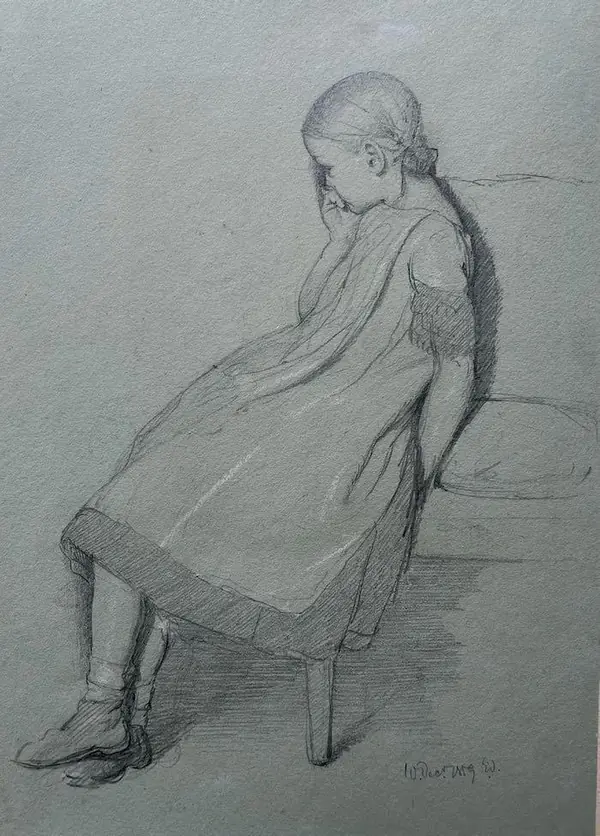
Joseph Nash was born in Great Marlow, Buckinghamshire. He was the eldest son of Okey Nash, who took holy orders and became the proprietor of the Manor House School, North End, Croydon where Nash was educated, and displayed early talent at drawing. Around 1827 Nash entered the architect’s office of Augustus Charles Pugin, at 105 Great Russell Street, Bloomsbury, London, to learn the art of architectural drawing. Two years later, he and his fellow apprentices accompanied Pugin on a trip to France toproduce drawings for Paris and its Environs (1830). He developed his skill as a lithographer, and also prepared Pugin’s drawings for Views Illustrative of the Examples of Gothic Architecture (1830).
View detailsArtists – N
Use arrow keys to navigate, Enter to select, Escape to close
All
A
B
C
D
E
F
G
H
I
J
K
L
M
N
O
P
Q
R
S
T
U
V
W
X
Y
Z
Showing artists with the initial N
Use arrow keys to navigate, Enter to select, Escape to close
Artist A-Z
Artist Z-A


Nash was a builder’s son who studied architectural drawing under Thomas Malton, attended the RA Schools and started his career as an architectural draughtsman. In 1807 he was appointed architectural draughtsman to the Society of Antiquaries and worked for them for many years. He was based in London until the mid 1830s when he moved to Brighton.
View details
Francis Nicholson was born in Pickering, Yorkshire on 14 November 1753, the son of a weaver. A founder member of the Society of Painters in Water-Colours he was dubbed ‘The Father of Watercolour Painting’ by his contemporaries. These beautiful drawings probably date from 1792-3 and represent the very best of his work, perfectly capturing the distinctive light and colour of the Lake District. He lived the first thirty years of his life in various Yorkshire towns, learning from local teachers and painting portraits and animals, mainly in oils. He made two visits to London and took lessons from C.N. Metz. In 1783 he settled in Whitby and took up landscape painting in watercolour, and first exhibited at the R.A. in 1789. An important early patron was Lord Bute who commissioned him to travel to the Isle of Bute to make a set of paintings. He toured the Lake District with Sir Henry and Lady Tuite circa 1795 and they remained important friends and patrons until Sir Henry’s death in 1805. Nicholson was commissioned by his patron Walter Fawkes of Farnley Hall in Yorkshire, also an important early collector of J.M.W. Turner, to provide him with numerous watercolours of views of the Lakes. Nicholson and Fawkes corresponded in 1798 on several occasions and Fawkes waxed lyrical about the artist’s work (R. Davies, “Francis Nicholson: Some Family Letters and Papers”, Old Water-Colour Society’s Club, 1930-1, Vol. VII, London 1931, pp. 15-30). Around this time Nicholson pioneered a new process of watercolour whereby he stopped out light areas with a mixture of beeswax and turpentine coloured with flake-white. This allowed the application of a wash, the removal of the solution in a few areas, further application of more washes, until the multiple washes gave depth to the shadows while the remaining areas were beautifully graded in tone. Finally the highlights were applied in brilliant colour. Nicholson demonstrated this technique to the Society of Arts in 1799. In the 'Transactions of the Society' later in the year watercolours done up to that time were described as ‘stained drawings’ and it was stated that Nicholson’s new method had produced a breakthrough allowing watercolours to be regarded as ‘proper paintings’ ('Transactions of the Society for the Encouragement of Arts etc', Vol. 17 (1799), p. 296). Nicholson resigned from the Society of Painters in Watercolours in 1813, comfortably off and to concentrate on his flourishing work as a drawing master. His professional success enabled him to develop experimental techniques in his later years and he was a pioneer in the development of lithography in England. In the Nicholson sale of 1844 lots 117-119 list 117 sketches of Cumberland and Westmoreland drawn between 1794 – 1807. Examples of Nicholson’s work can be found in most major British public collections. Bibliography R. Davies, 'Francis Nicholson: Some Family Letters and Papers', Old Water-Colour Society’s Club, 1930-1, Vol. VII, London 1931 B.S. Long, 'Francis Nicholson, Painter and Lithographer’, Walker’s Quarterly, no. 14, January 1924, Walker’s Galleries, London; G. Bell, C. Coulson and J. Dixon, ‘Francis Nicholson (1753-1844)’, 2012
View details
John Nixon was one of the best known caricaturists of urban society in late eighteenth century London. The son of Robert Nixon, a successful Irish merchant, he followed his father in a mercantile career. Nixon lived and worked at Basinghall Street, near Guildhall Yard in the City of London. He was a special juryman at the Guildhall and a Captain of the Guildhall Volunteers. The amateur artist moved in artistic and fashionable circles in London, acting as honorary secretary of the Beefsteak Club. Nixon exhibited at the Royal Academy of Arts between 1781 and 1813.
View details
A most interesting and resourceful Jewish artist, who had an American father, Noel exhibited landscapes, historical works and other undescribed drawings which were probably watercolours at the Royal Academy between 1795 and 1804. The large size of the present work suggests it is highly likely to have been an exhibition watercolour. Amelia Noel was drawing mistress to the daughters of George III. She also worked from 38 St James’s Place, London, and advertised instruction to ladies in drawing & painting (in oil, water colours and crayons) landscapes, figures, cattle, flowers, transparencies &c , at two guineas for twelve monthly lessons. 1 She also, together with her daughter Frances, gave lessons in painting on velvet. Noel was also an engraver and publisher and made a series of topographical etchings of Kent views which she published in 1797 and dedicated to Princess Charlotte. She presented a set of these to Princess Elizabeth (Royal Collection). The Royal Collection also has a series of copies by Princess Sophia after Noel’s prints of views of Kent. Noel’s elegant premises at 32 Albemarle Street impressed contemporaries: The elegant and scientific works of this lady for her superior talents and genius, are patronized by the royal family, nobility, &c. They may be viewed gratis, and consist of paintings and drawings in oil, water colours, crayons, and chalks; and the grandeur, taste, and spirit, of the ancient masters are admirably preserved. The apartments are fitted up after the French, Turkish, and Chinese, style, decorated with ornamental paintings, by Mrs Noel. The chairs, sophas, borders, draperies, &c. are all of painted velvets, executed in a manner peculiarly tasteful, and exclusively her own, and consist of historical figures, landscapes, &c. the recesses are painted in imitation of bronzes, basso reliefs, cameos, and marbles; and the window blinds and screens are transparent paintings. A Turkish saloon, a Chinese Boudouin, and a French salle, form a most pleasing and unique coup d’œil. Mrs Noel and daughter engage to teach ladies, in a few lessons, these arts, by a manner peculiarly easy, and unclogged by the usual methods of protraction . 2 Joseph Farington’s diary records Noel’s networking abilities and personal charm. She visited him with her daughter Frances on 8 April 1804 to ask for his support in having her work accepted and well placed at the Royal Academy that year, as the previous year it had been rejected and damaged. She won over Farington, who agreed to help her. 3 Amelia Noel was the daughter of Judah Levy, ‘an American merchant’, of Heydon Square, Minories (a chapman, whose bankruptcy is recorded in 1777). She married a Jew called Zebe or Zvi Noah, known as Henry Noel, in the synagogue in Duke’s Place, London, in 1781. His bankruptcy was recorded in 1783, 4 after which he appears to have run off with her money. Three children are recorded as having reached maturity: Noel’s artist daughter Frances Laura, later Mrs John Bell (1786–1863); Lewis Joseph John Noel (1784–1839), a solicitor; and Horace Morton Noel (1788–1814), Lieutenant in the 8th Foot, killed in the assault on Fort Erie in Canada. A nephew, Captain Uriah P. Levy, of the USS Vandalia, owned a portrait of her, said to be by Sir Joshua Reynolds, at his home in Monticello. The American artist Mather Brown exhibited a portrait of Noel at the Royal Academy in 1797 (no. 75, described as ‘a lady’) and it has been suggested that the pair were romantically linked, although there is no firm evidence for this. 5 1. The Times, 19 October 1799. 2. John Fetham, The picture of London, 1804, pp. 260ff. 3. Joseph Farington, The Diary of Joseph Farington, republished 1978–1984. 4. European magazine III. 5. Dorinda Evans, Mather Brown, 1982, pp. 142 & 220. All references are cited in Neil Jeffares, Dictionary of Pastellists before 1800 (online edition).
View details
Nollekens is generally considered to be the finest British sculptors of the late 18th century. He was born in London on 11th August 1737, the son of a Flemish painter, Josef Frans Nollekens (1702–1748), who had moved from Antwerp to London in 1733. In 1750, he was apprenticed to the sculptor Peter Scheemakers (1691 - 1781), another Flemish immigrant in London. In 1760, he moved to Rome, where he continued studying, as well as working as an antiques dealer, restorer and copier. Sculptures he made in Rome included a marble of ‘Timocles Conducted before Alexander’, for which he was awarded fifty guineas by the Society of Arts, and busts of David Garrick and Laurence Sterne , who were visiting the city. Nollekens returned to London in 1770. His reputation preceded him and, once he had set up his studio in Mortimer Street, he received many commissions from fashionable society and built up a large practice. In Rupert Gunnis’s words ‘he soon became to contemporary sculpture what Reynolds was to painting’ (Dictionary of British Sculptors 1660 – 1851, London 1951). Although he preferred working on mythological subjects, it was through his portrait busts that he became famous, as one of the most fashionable portrait sculptors in Britain. He enjoyed the patronage of King George III and went on to sculpt many leading figures, including William Pitt the Younger , Charles James Fox , the Duke of Bedford and the Marquess of Rockingham. He also made busts of figures from the arts such as Benjamin West . Most of his subjects were represented in classical costume. Nollekens became an associate of the Royal Academy in 1771 and a full Academician the following year. He exhibited regularly at the Royal Academy from 1771 – 1816. He died in 1823, leaving a fortune of £200,000.
View details