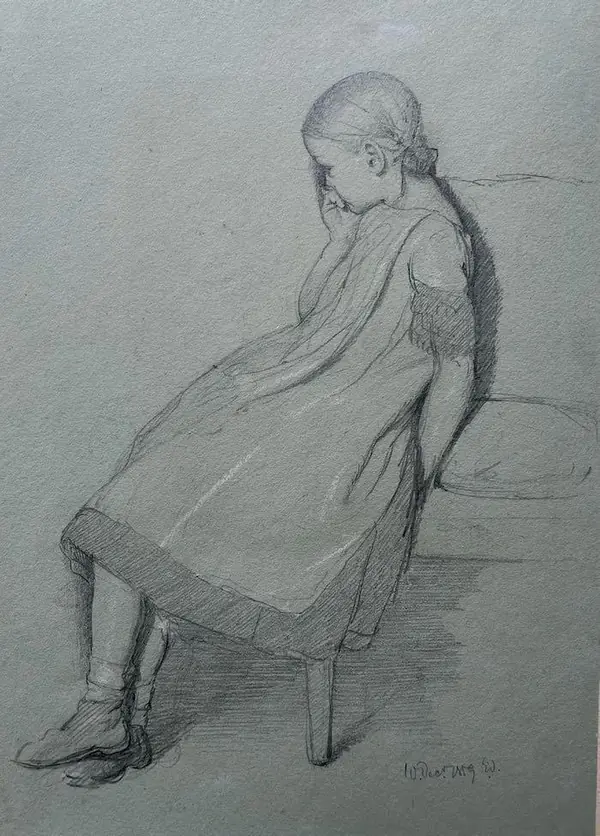
Sara Page (1855 – 1943) Sara Page was born in Moxley, Staffordshire, the fourth child of Samuel Page, a successful timber merchant, and his wife Sara Wells Page, the daughter of a wealthy local ironmaster. Her parents died in the 1870s leaving her and her siblings financially independent. From 1884-1891 she studied drawing at Wolverhampton School of Art and then travelled to Italy to continue her artistic education, making copies in oil after originals in the Uffizi Gallery in Florence. She was photographed in Venice by the photographers Fratelli Vianelli. In 1892, having been encouraged by Sir Frederick Leighton, Page went to Paris to study at the Académie Julian, under Bouguereau, Tony Robert-Fleury and Gabriel Ferrier. Male and female students received the same training which included drawing from live models, the sexes taught in separate ateliers. One of the ateliers for female students was at 5 rue de Berri. Page wrote that she ‘worked under the best French artists at the Académie Julian and found there both guidance and much interest in the companionship of many different nations, and as all the students (about 500) competed in efforts for the medal in painting and sculpture, life was animated’. Page received a medal for portrait painting. In 1893 she exhibited at the Société des Artistes Français. The present portrait was presumably executed around this time and the board on which it is painted was from a local shop of artist’s materials, a short walking distance from the Julian which is still in the rue Berry today. There are two similar pastel portraits of young women in the collection of Poole Museum by the artist, one of which is on a board with the same label from the Papeterie F. Dupré. Sara Page travelled to Brittany and in 1897 moved to Neuilly-sur-Seine, an area popular with artists, and studied with Gustave-Claude-Etienne Courtois (1852-1923) and Jean Dagnan-Bouveret (1852-1929) who had a studio at 73, boulevard Bineau. Page found a studio where she worked in rue Perronet. In 1913 she moved to 37 rue Charles Laffitte where she lived for thirteen years, also painting miniatures (In January 1910 The New York Tribune mentioned her exhibit at the George Petit Gallery of ‘a bright little group of Dutch children’,She also received a lengthy good review in Revue modern des arts et de la vie, 28 February 1921. Page continued to exhibit her work in London, her agent Percy Young, a publisher, and importer and manufacturer of artists’ materials in Gower Street. She showed at the Society of Women Artists and the Royal Academy. Towards the end of her life Page returned to England and continued to exhibit at the Royal Birmingham Society of Artists and the Walker Art Gallery, Liverpool. There are three works by her in the collection of Wolverhampton Art Gallery and two in Poole Museum. Almost ninety works by her have been identified showing that she worked in different genres and techniques in the academic style.
View detailsArtists – P
Showing artists with the initial P


Parker's specialised in portrait and genre paintings and in the 1820s he became one of the best-known artists in Newcastle, his work popularised through mezzotints. He helped establish the Northern Academy for the Arts. Parker showed at the Royal Academy and the British Institution and coastal pictures with fisherfolk and smugglers were subjects which he liked to paint. He usually drew watercolour sketches from nature and used them to work up his oil compositions. The present drawing would appear to be one of these. He taught on and off throughout his life, moving to become drawing master at the Wesleyan Proprietary Grammar School in Sheffield and later moved to London. Little is known about his years in the capital.An exhibition of Parker's work was held at the Laing Art Gallery in Newcastle in 1969. Cullercoats was a small fishing village up the coast from the mouth of the Tyne. From the 1820s artists from Newcastle drew and painted the fishermen and the local area. It remained popular with artists and is perhaps most commonly associated with the great American watercolourist Winslow Homer (1836-1910).
View details
John Partridge (1790 – 1872) was a portrait painter, who was born in Glasgow. In 1814, he was apprenticed to Thomas Phillips, RA, (1770 – 1845). Phillips was heavily influenced by Sir Thomas Lawence PRA (1769 - 1830), which manifests itself in Partridge’s portraiture. In 1815, he exhibited for the first time at the Royal Academy. He entered the RA Schools in 1816. Between 1823 and 1827, he travelled extensively in France and Italy, where he made copies of the old masters and sketched landscapes. On his return, his career blossomed and he became a fashionable portrait painter, painting over 200 portraits, including many of the leading figures of the day between 1827 and 1845 and exhibiting every year at the Royal Academy. A commission in 1836 from King Leopold I of the Belgians led to an introduction to Queen Victoria, who appointed him Portrait Painter extraordinary to Her Majesty and the Prince Consort in 1843. Their support, however, proved fickle, as The Queen switched her patronage to Franz Xaver Winterhalter, ending Partridge’s aspirations. Sadly, his career did not live up to its auspicious beginnings, largely due to hostility and conflict, probably instigated by Ramsay Richard Reinagle, within the Royal Academy, and he never exhibited there again after 1846. Thereafter, his practice declined significantly. Partridge’s work can be seen at the British Museum and the Castle Museum, Nottingham. Partridge also donated some of his unsold work to the National Portrait Gallery, where many remain on display. Additional Information National Galleries Government Art Collection Art UK
View details
William Payne AOWS (1760 – 1830) was born into a prosperous family in London. He had some drawing lessons, possibly from Paul Sandby, and, in 1778, he was appointed a ‘fifth class’ draughtsman by the Board of Ordnance, working in its Drawing Office at the Tower of London, where he received additional training in drawing, mathematics and perspective, the last taught by Henry Gilder, a protégé and servant of Thomas Sandby. In 1783, he was promoted to the ‘second class’ and was posted to Plymouth, where he remained until 1788. In these years he began to work in his own style and drew many West Country views, which were exhibited at the Royal Academy. He undertook extensive tours of the West Country and Wales between 1790 and 1794, when he resigned from the Board of Ordnance. Payne developed the watercolour from a tinted drawing to a painting which relied less on prominent pen outline and more on the build-up of washes. Nonetheless, he retained the use of a monochrome palette and invented his own characteristic tint which is still known as ‘Payne’s Grey’. Payne’s success in extending the bounds of watercolour, with his loose, yet clear, application of pigment, which was easily taught to others, led to him becoming a fashionable and successful drawing master. John Glover (1767 – 1849) is probably his best-known pupil. In 1809, Payne relaunched himself as an exhibiting artist, working in both oil and watercolour, exhibiting his work at the British Institution. Payne’s work can be seen in numerous museums, including the Victoria & Albert Museum, London, the Ashmolean Museum, Oxford and the National Gallery of Art, Washington D.C. Additional Information Tate
View details
Pedersen was born in Copenhagen in 1870. Having studied at the Academy of Arts in Copenhagen he travelled for 20 years in India, Sri Lanka, Indonesia, Penang and Singapore. His older brother worked on a tobacco plantation in Sumatra and in 1898 he first visited Indonesia, travelling to Sumatra, Penang, Singapore, Java and Siam. He painted many portraits of native subjects which he clearly found interesting on his travels as well as landscapes and cityscapes. He worked for the Susuhunan (ruler) of Surakarta in Java, whose kraton or palace Von Pedersen visited (thanks to the Dutch Governor General) and whose portrait he painted and was subsequently given as a token of the Susuhunan’s loyalty to the Queen of the Netherlands. It is now in the Royal Dutch Collection. Eight of the artists’ paintings were published in 1926 in "Peeps at many lands" ed. by J.F. Scheltema.
View details
Mary Perrin specialised in intense watercolour portraits of female subjects, often drawing them with elaborate hats or coiffures. She also painted landscapes. Her work is recorded frequently in Irish exhibitions. Perrin exhibited at the Water Colour Society of Ireland (WCSI) which was founded in 1870 as the Amateur Drawing Society by an informal group of six well-connected women from Co. Waterford, Baroness Pauline Prochazca, Miss Harriet Keane, Miss Frances Keane, Miss Henrietta Phipps, Miss Fanny Currey and Miss Fanny Musgrave. Eight years after its founding, the organisation briefly became the "Irish Fine Art Society" before settling to its current name in 1888. It held (and still holds) an Annual Exhibition of the work of its members. Perrin started to exhibit at the Royal Institute of Painters in Watercolour in London in 1896 at their galleries at 195 Piccadilly. Perrin also showed regularly at the Royal Academy, the Society of Women Artists and the Walker Art Gallery in Liverpool. Perrin’s work was frequently praised by contemporary critics who remarked on the ‘richness and power’ of her watercolour (Freeman’s Journal, 8 March 1886, in a review of The Irish Fine Art Society exhibition) and she won many prizes at various Irish societies. The backboard labels on this work records her Irish address Fortfield House, Terenure, Co. Dublin. Another work by her has a partial address in London, …s (Hans?) Crescent, London SW., suggesting that she moved between the two cities. Perrin took an active part in the social life of Dublin and is often mentioned in contemporary newspapers as attending charitable and major social events such as the Viceregal Drawing Room in Belfast and costume balls. The artist’s family home, Fortfield House in Dublin, was bought by the Rt. Hon. John Hatchell (1788-1870) in 1858. He was an Irish lawyer and politician and his daughter Penelope married John Perrin. The house remained in the Perrin-Hatchell family until the death of Mary Perrin in 1929. In her will she left her estate to George Hatchell of Tanganyika. The house was demolished in 1834. This work may have belonged to Professor Malcolm McHardy, FRCSE (d.1912) who was Professor of Ophthalmology at King’s College and Ophthalmic Surgeon to King’s College Hospital. He published extensively on ophthalmic surgery.
View details
Henry Pilleau (1813-1899) was educated at Westminster and joined the 16th Lancers, before transferring to the Army Medical Corps. He rose to the rank of Colonel and became Deputy Inspector General of Hospitals in India, before devoting himself to painting. He travelled extensively in the British Isles and internationally, for example visiting Egypt in 1845 and 1868 – 69. Pilleau’s ‘Sketches of Egypt’, comprised of text and colourful plates of famous views and sites was published in 1845 by Dickinson, which was dedicated to George Everest (1790-1866), Surveyor-General of India between 1830 - 1843, after whom Mount Everest was named. A watercolour of the Dead Sea by Pilleau was presented to Queen Victoria in 1887 by the Royal Society of Water-Colour Painters as a gift to mark Her Majesty’s Golden Jubilee. Pilleau’s work can be seen in several national collections, including the British Museum and the Victoria & Albert Museum in London. Additional Information British Museum Victoria & Albert Museum
View details
Francis Place was the earliest English artist whose main preoccupation was with landscape. He travelled on foot through Yorkshire, Wales, Scotland, Ireland and France, and was thus a forerunner of the sketching tours of artists a hundred years later. He knew Wenceslas Hollar (1607-1677), whose topographical work influenced his style and who accompanied an expedition to Tangier in 1669 to make records of the area. Place also worked as a book illustrator, pioneer of mezzotint and experimental potter (see E. Croft-Murray and P. Hulton, 'Catalogue of British Drawings', vol. I, British Museum, 1960 pp. 456-470). Additional Information British Museum
View details
The artist was the daughter of the 3rd Earl of Radnor born at Coleshill in Berkshire, and the wife of William Ellice (1816-1892) whom she married in 1847. She was a childhood friend of Princess Victoria with whom she was taken to play aged six and told by the young princess that she could not play with her toys and was not to address her by her christian name. She was one the Queen’s bridesmaids, the last survivor of the group, and wrote about it in the Cornhill Magazine of June 1897. Jane was actively involved in the temperance movement from the mid-1850s and chaired many meetings in London and elsewhere on the subject and was President of the Faringdon, Berkshire branch of the British Women’s Temperance Association. In 1887 Jane wrote a book titled ‘The shadow of a coming danger to the cause of temperance from the celebration of the Jubilee of Queen Victoria’ which highlighted the social problems caused by alcohol. There is a portrait of her after John Hayter in the Royal Collection and a portrait of Jane as a young girl was illustrated in the 23 June 1897 issue of 'The Sketch'.
View details
Prout was born in Plymouth. John Britton the antiquary employed him as a draughtsman on his serial Beauties of England and Wales (1803-13). His early work which often depicts coastal scenes was exhibited in London where he built up a practice as a drawing master. He published several drawing manuals. In 1817 he became an associate of the OWCS. He travelled to Europe in search of topographical subjects and it is for his European town views that he is most acclaimed. He was appointed painter in Water-Colours to King George IV in 1829 and later to Queen Victoria. From 1820-1846 he regularly travelled France, the Netherlands, Germany, Switzerland, Venice and many other places drawing the old buildings he saw. His work was reproduced as engravings and lithographs and widely disseminated. He exhibited regularly throughout his life and his work can be found in all major drawings collections. Additional Information Tate Government Art Collection Royal Academy Art UK National Portrait Gallery
View details