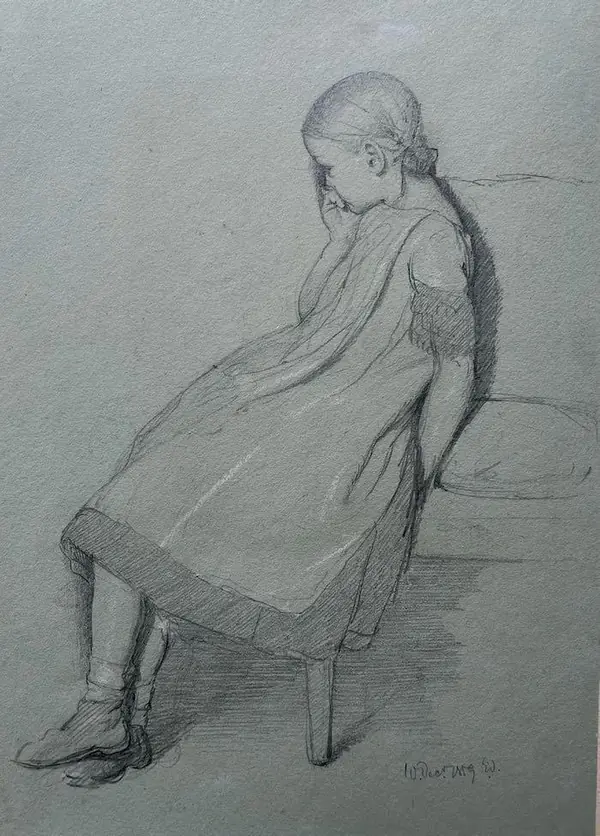
Augusta Raymond-Barker (1827-1900) was the elder daughter of John Raymond-Barker and his first wife Harriet Bosanquet, spent her childhood at Fairford Park, Gloucestershire and sketched from an early age. Her aunt was the interiors artist Charlotte Bosanquet (1790-1852). She married Colonel Sir Lumsley-Graham. She was a keen watercolorist, a superb copyist and had an eye for small, delicate drawings. She is buried in the graveyard of Fairford Church.
View detailsArtists – R
Use arrow keys to navigate, Enter to select, Escape to close
All
A
B
C
D
E
F
G
H
I
J
K
L
M
N
O
P
Q
R
S
T
U
V
W
X
Y
Z
Showing artists with the initial R
Use arrow keys to navigate, Enter to select, Escape to close
Artist A-Z
Artist Z-A


The artist was born in Matlock Bath, Derbyshire, the daughter of Samuel and Ann Rayner who were both professional artists. The most talented of six children, who all worked as artists, Louise studied painting from the age of fifteen, first with her father, and subsequently with George Cattermole, Edward Nieman, David Roberts and Frank Stone. She specialised in watercolour and her streetscapes capture the flavour of city life in 1870s and 1880s and are architecturally detailed. In 1851, when Louise was ten, the family moved to London and, except when travelling, she spent much of her life there. She would often accompany her architect brother Richard on his business trips and paint . As a result, Louise was widely travelled, both in Britain and in northern France. She most enjoyed visiting old cathedral cities and market towns, and is acclaimed for her views of Chester, London, Hastings, Tewksbury, Warwick, Edinburgh, Wrexham, Shrewsbury as well as Salisbury. By 1865 she had moved to Chester where she spent many years working and teaching painting. She lodged at the home of Robert Shearing (who owned a chemist's shop in Watergate Street) and his wife Mary Anne at 2 Ash Grove, in what was then a secluded rural location outside the city. In 1910, she and her sister Margaret, who had lodged with her for a time in Chester, moved to Tunbridge Wells. When Margaret died, in 1920, Louise moved for the last time to Southwater Road, St Leonard's-on-Sea, Sussex, and died there on 8th October 1924, aged 92. She never married. For over half a century, Louise was a regular exhibitor at the Royal Academy, the Old and the New Watercolour Societies, the Society of British Artists, Suffolk Street Gallery, the British Institution, the Society of Female Artists, the Dudley Gallery, the Birmingham Society of Artists and the Walker Art Gallery, Liverpool. Her work can be found in many public collections including the Grosvenor Museum, Chester, the Russell-Cotes Art Gallery and Museum, Bournemouth, Derby Museum and Art Gallery and the Salisbury Museum.
View details
Samuel Read moved to London in 1841 to study wood engraving under J.W. Whymper. In 1843 he started to send architectural drawings to the Royal Academy for exhibition and in 1844 he began drawing for the Illustrated London News. He was the first artist special correspondent and was sent to Constantinople in 1853 to cover the Crimean War. He travelled extensively in Europe, particularly in Germany and Italy and visited Toledo in 1862, the presumed date of this drawing. An interior of Toledo Cathedral is in the collection of the Victoria and Albert Museum (1125-1886) and several views of Burgos cathedral are also recorded. He exhibited frequently at the Royal Society for Painters in Water Colour and in 1875 he published Leaves from a Sketchbook. Examples of his work, which can be reminiscent of that of David Roberts, can be found in the Victoria and Albert Museum and the Reading Art Gallery.
View details
Sir Joshua Reynolds, PRA (1723 – 1792) was the most influential portrait painter of the later eighteenth century. The first President of the Royal Academy, which he co - founded in 1768, he shaped the development of British art, as a leading proponent of the ‘Grand Manner’, an idealised aesthetic style derived from classicism and High Renaissance art, which mirrored the taste and collections of his fashionable patrons. By the end of his career he was viewed as an equal to the great European painters, such as Titian, Velasquez, Rembrandt and Rubens. Reynolds’ success reflected his ability to capture his sitters’ characters, developing a new form of portraiture that brought them to life, using innovative compositions and techniques, going beyond mere recording. Born in Devon, Reynolds was apprenticed to Thomas Hudson, himself a very fashionable portrait painter, from 1740 to 1743. He subsequently established his career in Devon and London, before setting off for Italy, via Minorca, thanks to the patronage of Commodore Keppel. On his return from in 1753, he rapidly became London’s most fashionable portrait painter, which he remained until the end of his career. His approach was reinvigorated by a visit to the low countries in 1781, and further study of Rubens, his portraits became simpler and more natural, a style with which we can, perhaps, engage better with today. Reynolds was knighted in 1769, and, in 1784, he became the Principal Painter in Ordinary to the King, testimony to his pre-eminence, given George III did not especially care for him. Nonetheless, the post seems to have disappointed him, writing that it was ‘of near equal dignity with His Majesty’s Rat-catcher.’ Reynolds continued working until he went blind in 1790. Reynolds work is well represented in British and American museums, and in many National Trust properties. Additional Information Royal Academy National Gallery National Trust Tate National Portrait Gallery
View details
The artist was born in Islington, London. His father, Warwick Reynolds senior was a cartoonist and watercolourist. He was educated at Stroud Green, and studied art at the Grosvenor Studio, St. John's Wood Art School and the Académie Julien in Paris. Reynolds started a career as a magazine illustrator in 1895, which included working on ‘Ally Sloper’s Half Holiday’, ‘The Gem’, and other magazines including ‘The Strand’, ‘Pearsons’s’, ‘The Quiver’ and ‘The Idler’. He was particularly interested in drawing and painting animals and drew the animals at London Zoo in black and white from 1895-1901. He illustrated numerous books on wildlife subjects including ‘Habits and Characters of British Wild Animals’ (1920), ‘Romance of the Wild’ (1922) and ‘Dwellers in the Jungle’ (1925). He also worked in oils, pastels and watercolours and painted portraits and animal subjects. He married Mary Kincaid, the daughter of a master printer, in 1906, and they lived in Glasgow where Reynolds worked as a staff artist on ‘The Daily Record’. He died in Glasgow at the age of 46. Reynolds exhibited extensively in Glasgow, Liverpool, London and Edinburgh and the year after he died memorial exhibitions were mounted at the Sporting Gallery in London and Wellington Art Galleries, Glasgow. Examples of his work can be found In Kelvingrove Museum and Art Gallery, Glasgow and Aberdeen Art Gallery. Additional Information Art UK
View details
George Richmond was the son of the miniaturist Thomas Richmond and Ann Oram (1772-1859), a good-looking woman, possibly of Jewish descent, whose father had been an innkeeper at Kew Green. He has captured her in a moment of repose, her hands in her lap. This drawing was presumably made at the family house at 42 Half Moon Street, Mayfair, which remained the base to which the young George returned if he ran out of money. He records that in 1827 while living at Shoreham, where Samuel Palmer found him lodgings, he tried to live on 10 shillings a week ‘excepting some Tea and Sugar sent by my dear mother from London’ (Hartley MSS, quoted in R. Lister ‘George Richmond’, 1981, p. 16). This work shows traces of the influence of Henry Fuselli who was Professor of Painting and Keeper of the Royal Academy where the artist enrolled aged 15 in 1824. Ann Oram was also painted by her husband Thomas who made a miniature of her wearing a bonnet in 1808, of which a stipple engraving was made by William Holl Jr.
View details
David Roberts was one of the first professional British artists to travel to the Near East in 1838. He arrived in Jerusalem at Easter 1839, having travelled from Egypt via Sinai and Petra; later he continued north to Lebanon and departed from Beirut in May. Roberts was fortunate to ingratiate himself with the local Turkish governor in Jerusalem, who allowed the artist to sketch all the sights he wished around the city as well as Bethany, Jericho, and Bethlehem. The pool of Siloam is a rock-cut pool on the southern slope of the City of David, the original site of Jerusalem, to the south of the city walls of Jerusalem. In this work Roberts has drawn a number of the ancient tombs which are cut into the rocks and thought to be the burial sites of the highest-ranking officials of the Judaean Kingdom. Roberts’s eastern compositions reached a wide audience through 247 lithographs made by Louis Haghe, including the present subject. Originally published in parts, these were later bound into six volumes as The Holy Land, Idumea, Arabia, Egypt and Nubia (1842-9). Their enormous popularity reflected the contemporary appetite for material relating to the Orient.
View details
Mary Robinson, the sister of William Heath Robinson, was a talented calligrapher and illustrator and occasional metal sculptor. She was taught by Charles Edward Johnson (1832-1913), a member of the Royal Society of Painter in Watercolours, as was her brother Charles Robinson. She became a member of the Royal Society of Scribes and Illustrators in 1921. Her brother William praises her skill in his autobiography, My Line of Life, 1938: ’My sister has, I believe, found a great consolation in the work that now occupies her all her lifetime. Her writing and illumination are sometimes exquisite’, pp. 164-65. Mary devoted some of her life to nursing her mother and sister.
View details
George Romney (1734 – 1802) was a fashionable portrait painter, who also had ambitions to paint historical subjects and a prolific and fluent draughtsman who drew throughout his career and put as much energy into drawing as he did to painting. Born in Cumbria, he was apprenticed to Christopher Steele in Kendal, before moving to London in 1762, where he established himself as both a portrait and history painter. Between 1773 and 1775, Romney studied in Italy and, on his return, he soon became the third fashionable portrait painter, after Gainsborough and Reynolds, developing an effective style that changed little. Romney probably produced his best work in oils between 1775 and 1780, in which period he painted his masterpiece ‘The children of 2nd Earl Gower’ (Abbot Hall Gallery, Kendal). His success and fame, coupled with his relatively modest fees, engendered Sir Joshua Reynold’s envy, as a result of which he never exhibited at the Royal Academy. In 1781, he first encountered Emma Hart, who became his muse and was the subject of numerous portraits, many of which depicted her as allegorical or mythological figures. She ceased sitting for Romney upon her marriage to Sir William Hamilton in 1791, when she moved to Naples, where she was to meet Admiral Nelson in 1793. Romney’s portraits of Emma Hamilton are amongst his best-known works. Despite his success as a portrait painter, he found this work somewhat constricting, and he aspired to be a history painter. His drawings are testimony to these ambitions, which have a greater power and freedom, depicting, for example, scenes in Shakespeare’s tragedies. Only about a third of his drawings are studies for portraits. Romney was a prolific artist, leaving a legacy of 2,000 paintings and 5,000 drawings, which can be seen in museums around the world. The Iveagh Bequest, Kenwood and the National Portrait Gallery (London) have notable collections of his paintings, while the British Museum (London) owns many of his drawings. His son John Romney left a significant gift of his father’s drawings to the Fitzwilliam Museum, Cambridge. Additional Information Romney Society Tate National Portrait Gallery Lakeland Arts
View details
Thomas Matthew Rooke RWS (1842 – 1942) was born in London and studied at the National School of Design and the Royal Academy Schools. In 1871, he joined Morris & Co, working under Burne – Jones, whose studio assistant he remained until his death in 1898. From 1878 to 1893, he worked for John Ruskin, on Burne – Jones’s recommendation, to record threatened landscapes and buildings, largely in Italy. Patrons such as Sydney Cockerell and the Society for the Protection of Ancient Buildings employed him to undertake similar work until around 1908. Rooke also continued to paint, and he exhibited his work at institutions including the Royal Academy, the Old Watercolour Society, the Grosvenor Gallery, and the New Gallery. He continued working almost until the end of his life. Rooke’s work can be seen at the Victoria & Albert Museum, London, the Fitzwilliam Museum, Cambridge, The Millenium Gallery, Shefield, the City Art Gallery, Manchester and the Delaware Art Museum, DE. Additional Information Art UK Tate Delaware Art Museum
View details
The artist’s training at the Académie Julian is reflected in this elegant and rather French looking drawing aux trois crayons drawn in 1899. Countess Bathurst was a successful model for couturiers such as Jacques Fath and Christian Dior as well as featuring in Vogue. Born Gloria Clarry, she married William Rothenstein’s nephew, the lawyer David Rutherston (1925-1975) in 1965, the son of the artist Albert Rutherston (1881-1953). Following husband’s death in 1975, Gloria married Henry, 8th Earl Bathurst (1927-2011) in 1978 and moved to Cirencester Park, Gloucestershire.
View details
Rowlandson worked extensively in the West Country, where he made annual tours. He usually stayed with his friend and patron Matthew Michell, a banker, who had an estate at Hengar near Bodmin in Cornwall. Michell had collected several hundred drawings by the artist by the time of his death in 1807. A work entitled Oakhampton Town and Castle was included on the third day of the four-day sale of his drawings and prints at Sotheby’s, 29 June to 2 July 1818, lot 186. This vigorous, picturesque drawing shows Rowlandson’s facility with the pen to great effect. It seems likely that the figure in the castle ruins is a self-portrait; although it is not drawn with much facial detail, the hat, stance and general demeanour are reminiscent of Rowlandson, who often included himself in his drawings. Okehampton is on the road from Exeter to Hengar and was thus an easy place for the artist to visit en route to Michell’s estate. Okehampton Castle, overlooking the river Okement, was once the largest castle in Devon. The original Norman motte and bailey structure was converted into a grand home in the fourteenth century by Hugh Courteney, Earl of Devon. It fell into decline during the reign of Henry VIII, and by Rowlandson’s time it was a ruin.
View details