John Thirtle (1777 – 1839) was a leading member of the Norwich School of artists, arguably second only to his brother – in – law, John Sell Cotman. Apprenticed to a London frame maker, he returned to Norwich in around 1800, where he ran a framing, carving and gilding business, in addition to painting and taking pupils. He was a founder of the Norwich Society in 1803 and exhibited with it until he and four others seceded in 1816, to form the Norfolk and Norwich Society of Artists, which dissolved after three years. returning to the fold in 1827. His output declined form around 1820 and he stopped exhibiting in 1830, as a lung infection prevented him from sketching. Thirtle, in common with other members of the Norwich School, was inspired by the riverside cityscape of Norwich, its warehouses, bridges and the bustling river traffic between Whitlingham and New Mills. His style, influenced by Thomas Girtin, Crome and (to a lesser extent) Cotman, was technically accomplished. His earlier landscapes were painted with a restricted range of buffs, blues and grey-browns, but he later developed a brilliancy of colour, producing works that included angular block forms. The quality of several of his watercolours has deteriorated owing to the fading of the indigo pigment that he used extensively. His works can be seen in many public collections, including the British Museum, London, the Victoria & Albert Museum, London, and the Castle Museum, Norwich. Additional Information British Museum Norfolk Museum Collections
View detailsArtists – T
Showing artists with the initial T


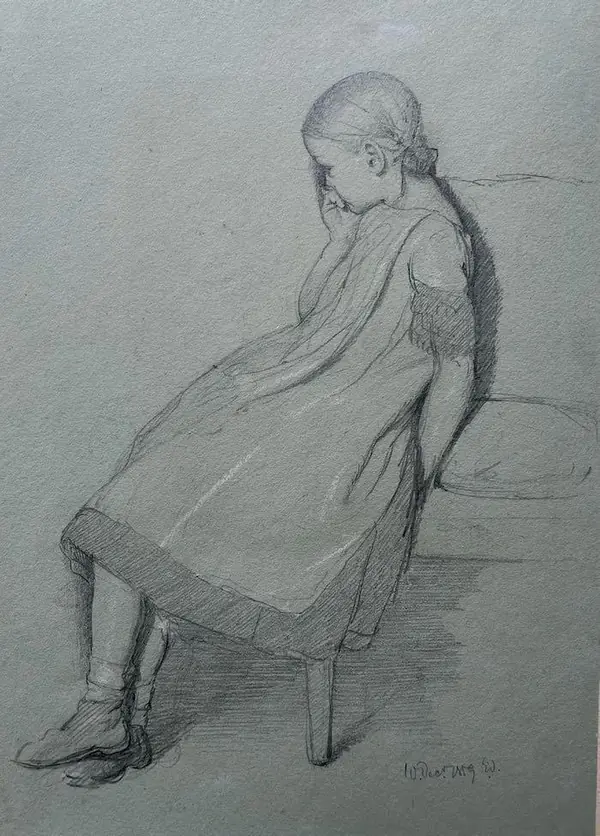
The artist was born in Worcester and trained there and in Birmingham. He specialised in depictions of country life and his drawings of young girls are delightfully and minutely observed. Arnold Fellows was a pupil at Queen Mary’s Grammar School, Walsall, between 1911 and 1917. He became a master of the school for a brief period, before moving to spend the remainder of his life as a teacher at Chigwell School in Essex. Fellows devoted much of his life to collecting art, notably works on paper, and eventually donated his entire collection to his old school. He was the author of The wayfarer's companion: England's history in her buildings and countryside, published by Oxford University Press, 1937.
View details
Archibald Thorburn (1860 – 1935) is arguably Britain’s most distinguished ornithological artist. He was born in Scotland, the son of Robert Thorburn, portrait miniaturist to Queen Victoria. He attended the newly established St John's Wood School of Art. His formal education ended on the death of his father in 1882, but he was mentored by Joseph Wolf, considered by Landseer to be ‘without exception, the best all-round animal artist who ever lived’. He first exhibited at the Royal Academy at the age of twenty, but his major breakthrough came when Lord Lilford employed him in 1887 to complete the work on ‘Coloured Figures of the Birds of the British Isles’, which was published in 36 parts between 1885 and 1898, after the original artist, John Gerrard Keulemans, fell ill. He illustrated the books of others as well as his own, as well as undertaking private commissions. His work can be seen in many public collections.
View details
Anna Tonelli, née Nistri, was probably trained in Florence, possibly by Giuseppe Piattoli (1743-1823) with whom she collaborated on a portrait of the family of Granduca Pietro Leopoldo, which was engraved in 1785. At some stage before 1785 she married the virtuoso violinist Luigi Tonelli. It seems highly likely that she came across the work of Hugh Douglas Hamilton in Rome. Tonelli met Lord Clive, ‘Clive of India’, while he was travelling in Italy, and he employed her to make pastels of members of his family. From 1794 she taught drawing to his children in London. She exhibited at the Royal Academy in 1794 and 1797, giving her address as 97 Norton Street. The artist travelled with the Clive family to India between 1798 and 1801, moving around southern India with Lady Clive and her daughters. During her time in the subcontinent, she seems to have worked in watercolour or miniature, rather than pastel, and charged twelve to thirty guineas for a miniature. She painted the Rajah of Tanjore and Tipu Sultan on this trip. She returned to Florence in 1801. Tonelli’s work has been confused with that of Hugh Douglas Hamilton, which may account for the inscription on the frame. She is known to have copied his work for Lord Clive, producing portraits in 1790s to add to a series begun by Hamilton. It seems unlikely that Hamilton has any connection with the present work, as he had returned to Ireland by this date. In 1806 the American agent in Paris, Filippo Mazzei, engaged her to bring up his daughter Elisabetta. He provided a description of the family to Thomas Jefferson (letter, 20th July 1806) with a view to their emigrating to the USA, praising the father, a violinist ‘the peer of any other’, the two children (born c.1789–90), and the mother who ‘sings and plays the piano like an expert; knows very well her own language, French, and English; draws and paints with excellent taste; is accomplished in embroidery and all needlework; and knows geography quite well.’ Jefferson’s response highlighted the expense of living in a major city, which may have deterred the family, as by 2 November 1807 they were in Pisa with Mazzei, while by 1809 they seem to have returned to Florence. I am grateful to Neil Jeffares for his biographical information about the artist.
View details
Bequeathed by the artist in 1816 to James White of Exeter (1744–1825), on whose death it passed to Towne’s residuary legatee John Herman Merivale (1779–1844) and his successors. Merivale’s granddaughter Emily Harriet Buckingham (1853–1923) inherited the drawing in 1915 and bequeathed it to her sister Frances Ann Laura Solly (b.1858). On 2 March 1936 she sold it to Agnew’s (no.1855) for £6, and they sold it (on 29 February 1936 according to Agnew’s) for £9 9s. to Miss N. Butler, who sold it back to Agnew’s (no.6038) on 7 October 1947 for £10. On 11 October 1949 Agnew’s sold it for £28 10s. to Gilbert Davis (1899–1983), who sold it at Sotheby’s on 19 May 1954, lot 39, for £20 to Agnew’s (no.7509), who sold it to Lieutenant Commander George Gosselin Marten of Crichel, Wimborne (d.1997). It was sold by a relative, F. W. Marten, at Christie’s on 3 March 1970, lot 102, for £441, and at Christie’s South Kensington on 28 January 2015, lot 758 where bought by Beaumont Nathan for Hugo Burge (1972-2023) for £8125. His sale at Lyon and Turnbull 19 March 2025, lot 75. Literature R. Stephens, A Catalogue Raisonné of Francis Towne (1739-1816) online, no. FT452. Richard Stephens suggests that this view of Hornsey may have been drawn while Towne was on his way to the Lake District in 1786.
View details
Philip Trench (1809 – 1888) (from 1873 Chenevix Trench) was born into an Anglo – Irish family in Dublin. He served in the Bengal Civil Service from 1828 to 1871, when he retired to Botley in Hampshire, where he was a J.P. His brother was Archbishop of Dublin. Four of his drawings were engraved by Thomas Landseer as plates for ‘Tiger Hunting; or A Day's Sport in the East’., which was published in London by Hodgson & Graves in 1836. His son (also Philip) provided illustrations for the 1897 edition of ‘A Sportsman in Ireland’.
View details

Charles Tunnicliffe, OBE, RA (1901 – 1979) is best known as a naturalistic painter of birds and wildlife. Born and brought up in rural Cheshire, he attended Macclesfield School of Art, before going to Royal College of Art. He began his career as an engraver and etcher. Tunnicliffe worked in a wide variety of media. Probably what best characterises his work is his ability to depict birds as they are seen in nature, but without sacrificing accuracy or precision. He was a renowned illustrator, as a result of which his work was seen by millions of people. For example, in 1927, he illustrated Henry Williamson’s ‘Tarka the Otter’, the beginning of a long association with Williamson, while he in the 1950’s and 1960’s, he was commissioned to illustrate Brooke Bond tea cards and Ladybird books. From 1947, he lived in Anglesey and he bequeathed his collection to Oriel Yns Mon (The Anglesey Gallery). The RSPB awarded him its Gold Medal in 1975. Additional Information Oriel Môn Art UK
View details
Turner of Oxford was in Sussex in 1846 from when this beautiful drawing may well date, as he made a large watercolour from near Portsmouth with the Isle of Wight in the distance in that year. He has chosen a calm day and the stillness of the shepherds amplifies the awe with which they are observing the beauty of nature. The location has an interesting history. In 1313, a ship, the St Mary of Bayonne, was blown off-course and ran aground on the treacherous Atherfield Ledge in Chale Bay. Its cargo of white wine was sold illegally by the sailors and many barrels found their way into the cellars of Walter de Godeton, Lord of the Manor of Chale. The ship came from Gascony, then part of King Edward II’s kingdom. He was not amused and Walter de Godeton was fined by an ecclesiastical court. The Pope heard of the incident and, in order to avoid excommunication, de Godeton was ordered to build an oratory and beacon on Chale Down as penance.
View details