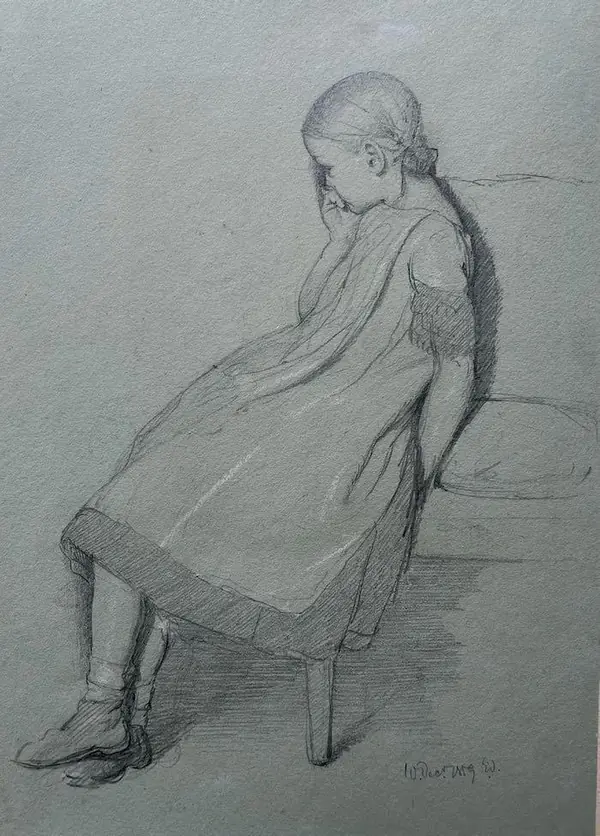
The little-known artist exhibited a work entitled ‘Fruit’ at the Royal Academy in 1876, her address given as 43 Porchester Square, Hyde Park West, London. Fanny Vallance was the daughter of Henry Vallance (d. 1905), who built Farnham Park, in Farnham Royal, Buckinghamshire in 1865, and his wife Emily, née Carr. Most of the contents of the house were sold after his death in 1905. A photograph of the artist taken in 1862 by Camille Silvy in her Bayswater studio is in the collection of the National Portrait Gallery.
View detailsArtists – V
Use arrow keys to navigate, Enter to select, Escape to close
All
A
B
C
D
E
F
G
H
I
J
K
L
M
N
O
P
Q
R
S
T
U
V
W
X
Y
Z
Showing artists with the initial V
Use arrow keys to navigate, Enter to select, Escape to close
Artist A-Z
Artist Z-A


Cornelius was the brother of John Varley the artist and second son of Richard Varley, who had a keen interest in science. Until he was nineteen Cornelius was preoccupied with scientific rather than artistic pursuits, encouraged by his uncle Samuel (1752-1822) a watchmaker, manufacturer of scientific instruments and amateur scientist with whom he worked from the age of twelve. In 1811 Cornelius took out a patent for a Graphic Telescope, an adaptation of a camera lucida. The specification reads: “My invention consists in combining one or two reflecting surfaces with a simple kind of telescope that inverts the object, and thereby gaining an erect image without any additional length to the telescope-placing the telescope out of the way of the image-and apparently projecting the said image flat on a table, so that it may be easily traced on paper; the image being seen by one eye, and the pencil or tracer by the other or by both eyes’. The user of the PGT would see an image on a speculum mirror and a less clear image superimposed over the paper below it. The artist could then trace this image to accurately record their subject. Portrait drawings made with the Graphic Telescope have an emphasis on the silhouette, as is evident in the present work, and Varley advertised the invention as designed ‘for drawing portraits’ (see ‘Cornelius Varley The Art of Observation’, Lowell Libson, 2005, p. 15 and footnote 24). Both John and Cornelius Varley drew portraits of their artistic colleagues including Cotman, Blake, Copley Fielding, W.H. Pyne, the Chalon brothers and Frederick Mackenzie. John Sell Cotman used the telescope as did Samuel Prout and Thomas Horner (1785-1844), the owner of the Regent’s Park Colosseum. Cornelius Varley sometimes signed his drawings with P.G.T. after his name, signifying use of the Patent Graphic Telescope. The PGT, which was manufactured by Cornelius, won many awards, including silver medals from the Society of Arts in 1831 and 1833, and a prize medal at the 1851 Great Exhibition. (See Huon Mallalieu, ‘Varley the Optician’, in ‘Cornelius Varley The Art of Observation’, stet, pp. 25-32). The Whipple Museum, Cambridge have a fine example of the Patent Graphic Telescope made around 1840. The artist attended classes at Dr Thomas Munro’s Academy around 1800. He toured Norfolk and North Wales with his brother John in 1802 and also visited Ireland. He was a founder member of the OWCS in 1804 and regularly exhibited Welsh and East Anglian landscapes. His career as an artist dwindled towards the end of his life. The artist married Elizabeth Livermore Straker (1798-1874) on 12 April 1821 at St Giles, Cripplegate, London. She was the daughter of John Straker and Elizabeth. Elizabeth and Cornelius had nine children, three girls and six boys. She outlived her husband by a year and is buried at Brookwood cemetery in Surrey. Examples of his work can be found in most major drawings collections including the British Museum, V&A, Tate, Yale Center for British Art and the Metropolitan Museum, New York. Additional Information British Museum
View details
Theodor von Holst (1810 – 1844) was born in London. His precocious talent was recognised early on, when Sir Thomas Lawrence bought drawings from the ten-year-old von Holst. Henry Fuseli was a family friend, and, after copying from the antique at the British Museum, von Holst became his pupil at the Royal Academy Schools in 1824, the last year of Fuseli’s life. Fuseli had a profound influence on von Holst, with a similar fascination for the bizarre and fantastic. His work is, however, more colourful than Fuseli’s. Like Fuseli, von Holst largely painted literary subjects. He was the first artist to illustrate Shelley’s ‘Frankenstein’. Almost half his work was inspired by the German Romantics, such as Goethe. While recognised for his imagination and the quality of his draughtsmanship, his choice of subjects, with its emphasis on the supernatural and demonic did not always accord with fashionable taste. Dante Gabriel Rossetti greatly admired his work and viewed him as an important link between English Romantic painters, such as Blake and Fuseli, with the Pre- Raphaelite circle. Gustav Holst, the composer, was his great nephew. His work can be seen at the British Museum and the Victoria & Albert Museum in London, the Gustav Holst Birthplace Museum, Cheltenham, the Yale Center for British Art, New Haven, CT, and Indiana University Art Museum, Bloomington, IN. Additional Information Yale Center for British Art V&A British Museum
View details