Charles Gore
- Years
- –
- Country
- United Kingdom
- Available items
- 1
Biography
Show more Show less
Charles Gore (1729-1807) was the son of a Lincolnshire landowner and educated at Westminster. Following his marriage to Mary Cockerill, the heiress of a fortune derived from shipbuilding, he settled in Southampton and learnt how to draw and design ships, one of which, a cutter, he named Snail He also became an accomplished sailor, sailing around the British Isles, the Channel Islands and the northern French coast.
Gore’s social circle included the Duke of York, the Duke of Gloucester and the Duke of Cumberland, King George 111’s brothers.
In 1773, his wife’s health necessitated travelling abroad and Gore undertook an extensive European grand tour, sketching with the German artist Jacob Philipp Hackert (1737-1807). In the spring of 1777, Gore visited Sicily with Hackert and Richard Payne Knight (1751 – 1824). His drawings from this visit were later worked up by John Robert Cozens (1752-1797). Gore’s work, and that of his daughter Eliza, who was taught by Hackert (and who was later to write a biography of her father) can be confused with his.
Gore and Eliza may also have taken lessons in watercolour from the British watercolourist William Pars (1742 – 1782) who arrived in Rome in 1775, the same year as the Gores.
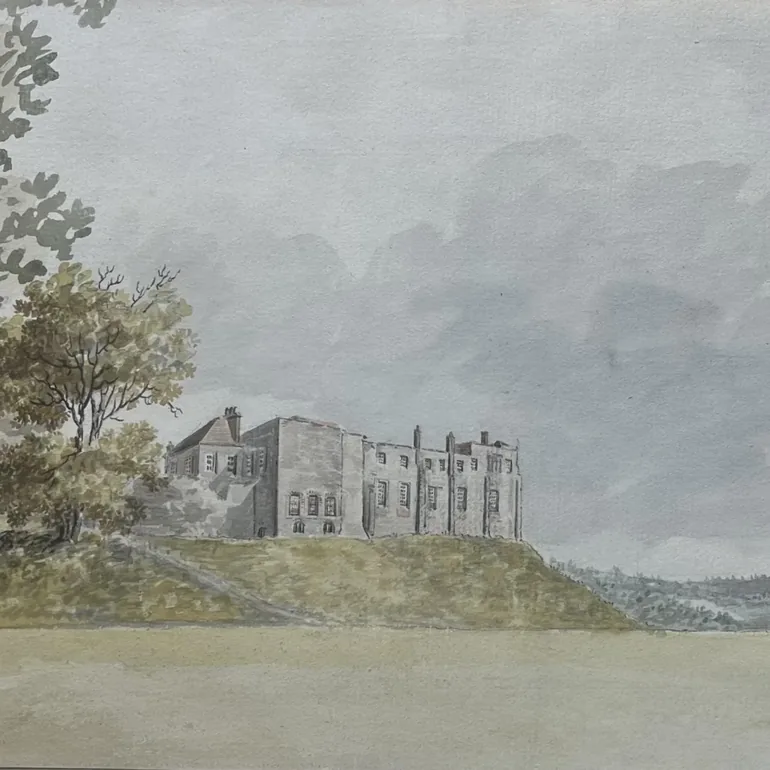
Gore copied marine oils, completed the unfinished drawings of other artists, while he also developed his own style, reflecting his detailed knowledge of the sea.
In 1779, Gore returned to England and became a member of the Dilettanti Society in 1781. He painted a series of panoramic views of Sussex.
The family returned to the Continent in 1782. Gore settled in Weimar in 1791, it is believed at the insistence of Karl August, Duke of Saxe Weimar (1757 – 1828), who had fallen in love with Eliza. He was a member of the Ducal Court. Goethe (1749 – 1832) was a regular visitor and describes Gore in his biography of Hackert, published in 1811. Gore spent the rest of his life in Weimar. He bequeathed five folio albums containing around a thousand drawings to Duke Karl August, which today can be seen in the Goethe-Nationalmuseum, Weimar.
The British Museum has a large collection of drawings by Gore that all came from Payne Knight's bequest, the foundation of its collection of drawings and watercolours. Many of these are Sicilian views, and there are several shipping scenes.
Examples of Gore's work can also be found at Tate Britain, London, and the National Maritime Museum, Greenwich.
Additional Information
British Museum
Tate