Edward Frederick Green
- Years
- –
- Country
- United Kingdom
- Sold items
- 1
Biography
Read more Read less
The artist was the fifth son of John Green, a merchant in the Levant and his wife, Harriet. The Green family were prominent members of The Levant Company and the Maltese Consular Service. Edward Green’s dates have been incorrectly recorded, but family records indicate he was born on 11 January 1801, baptised on 14 July 1801 at St Botolph’s, Bishopsgate, London, and died in 1884.
Green studied at the prestigious Royal Academy Schools in London, where his name appears in the records as Frederick Edward Green / E.F. Green. He was admitted as a probationary student on 11 January 1822, and registered as a full student on 4 April 1822, aged 21, for painting. Green was admitted to the life drawing school on 29 November 1822. He excelled at the Schools and won a silver medal in 1826, for a copy made in the painting school.
The artist married Catherine Colona Stilon in Malta on 2 June 1840 and a daughter, Melita (Kate) was born to the couple on 30 April 1841. They had a second daughter Ellen Green. His brother, James Moring Green (the seventh son), was also an artist and Vice Consul of Naples. Two of his other brothers were Consul and Vice-Consul in Greece and this no doubt lies behind the number of interesting paintings he made of Greek subjects.
After his wife’s death in 1845, Edward F. Green sold all his paintings, copies of Old Masters and curiosities at an auction by Foster Auctioneers, 54 Pall Mall (which was advertised in ‘The Atheneum’) and travelled to India. He is recorded as having lived in Bombay, now Mumbai, and evidently travelled in the surrounding area, and possibly, further afield. He stayed in India for three years, returning to Malta in 1848 for the funeral of his father-in-law, Dr Guiseppe Stilon, a Royal Naval Surgeon of Italian origin (whose will is in the National Archives, Kew).
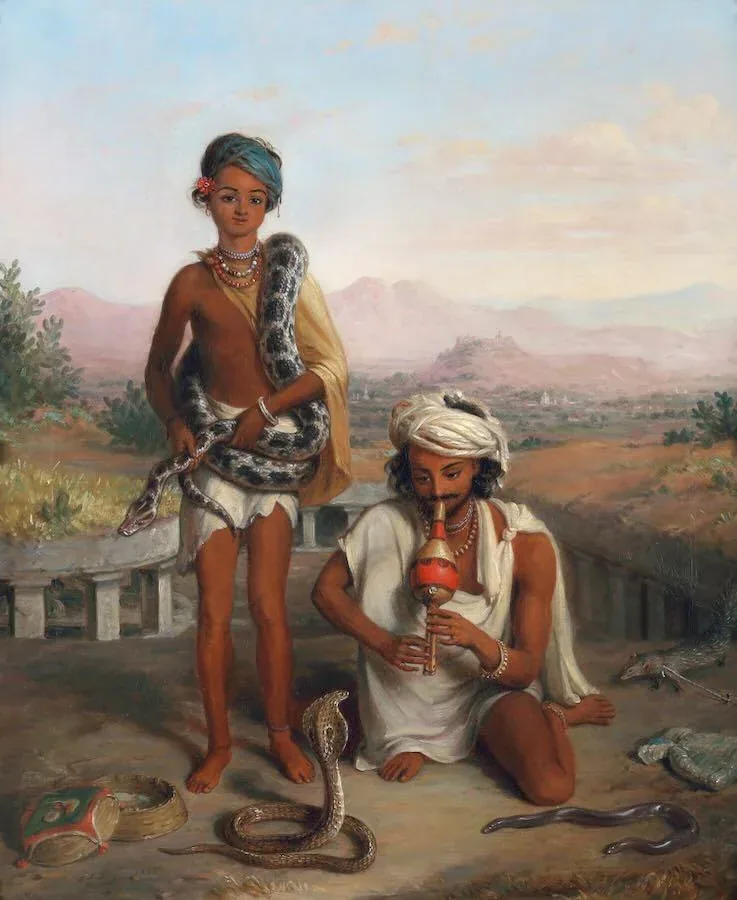
Green’s motivation to visit India is not known but it seems likely that it was influenced by the loss of his wife. Little is known about Green’s soujourn there, but he was an artist with a taste for travel and a journey to India would have appeared exciting and begun a new chapter in his life. British artists had been visiting India since William Hodges’ arrival in 1780 and the activities of the East India Company and the increased number of permanent British residents created a market for pictures both in India and the United Kingdom. With his eye for local customs and costumes, Green would have found a ready supply of colourful subjects to paint.
Exhibition History
Green exhibited regularly at the Royal Academy, showing 14 works between 1824 – 1851. He also showed 21 works at the British Institution and exhibited at the Society of British Artists. The artist specialised in exotic and orientalist subjects inspired by his extensive travels in Italy, Greece, Albania, Persia and India, and he specialised in painting particularly evocative oils by highlighting details of local costume and customs. His portrait of a Greek girl in a landscape wearing a Greek costume and embroideries was illustrated as a colour plate in Fani Maria Tsigakou, The Rediscovery of Greece, 1981, col. Pl. V, p. 194. He also worked as a portrait painter, a ready source of income, and in 1830 painted the portrait of Major-General Sir Robert Henry Dick (1785? – 1846), the soldier who lived in India. This was engraved as a mezzotint by Henry Haig circa 1847. A portrait of a young man by Green is in the collection of the Guildhall Art Gallery.
His various addresses are recorded as 13 New Bond Street in 1824; at 65 Upper Charlotte Street in 1826; at 16 Howland Street in 1828 and 1829; at Upper Gloucester Place in 1837; all in London, at Strada Mercante in Valletta, Malta in 1840 and 1841; at 2 Titchfield Terrace in St. John's Wood in 1843; in Bombay, India in 1846 and at 17 Nottingham Street, London in 1851.
Poona (Pune), Maharashtra
Poona (now Pune) in Maharashtra was one of the major military bases of the British East India Company from 1818 after the fall of Peshwa during the third Anglo-Maratha War. A large military cantonment was built to the east of the city. Due to its milder climate, it was the monsoon capital for Bombay, situated almost two thousand feet up in the Western Ghats. It was one of the most important cities of the Bombay Presidency established in 1858 when India came under direct British rule.
Poona had long been a place which British artists visited, from Thomas and William Daniell and James Wales in 1780s and 1790s. Wales founded an art school for local painters in the city in 1791 with the help of Sir Charles Ware Malet, British Resident at the Peshwa’s court, although the school ceased to exist after his death in 1795. William Carpenter (1818 – 1899) was in Poona around the same time as Edward Green and drew many watercolours of the city, its inhabitants and the surrounding area. William Simpson (1823 – 1899) also visited Poona towards the end of his time in India, once the railway had been extended there in 1858.