

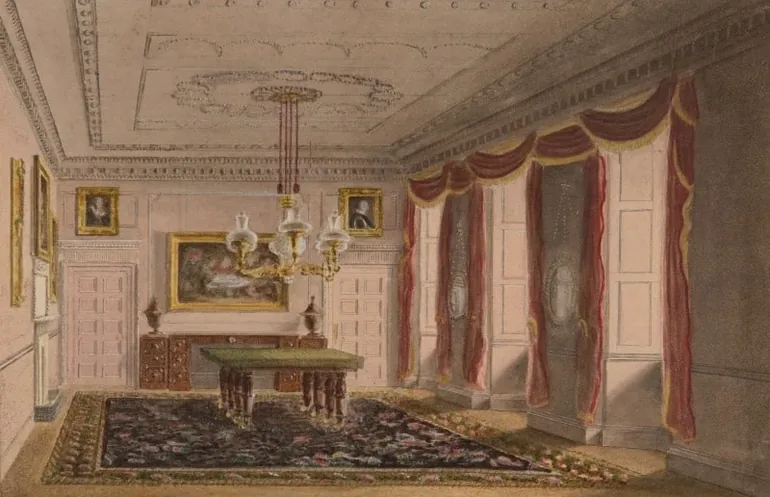
English School
- Years
- –
- Country
- United Kingdom
- Available items
- 3
No biography available.
No biography available.

Pen and grey ink and watercolour over traces of pencil with touches of white18.9 x 29 cmThere are three drawings (on two sheets) for the eating room at Fairford in the Sir John Soane’s Museum dating from 1789–90 (SM (5) 80/1/65 recto & verso (6) 81/2/99). They aim to remodel the room to make the wall panels more balanced, to use the same cornice as the main stair - case and to remodel the existing chimneypiece.Provenance: Augusta Raymond-Barker, Fairford Park, Gloucestershire; thence by family descent until 2016
View details
KT493Watercolour over traces of pencil, inscribed in pen and dark brown ink verso: 58/Sketch Cozens (crossed out)/J. Varley15 x 24.5 cm.; 6 x 9 5/8 inchesProvenanceC.L.N. Miles Esq;Spink (K3 7052);Private collection U.K. until 2021This intriguing drawing has been attributed to John Robert Cozens and John Varley in the past. It bears a resemblance to one of Edward Dayes Icelandic subjects and can be compared with the view of Mount Hekla in the collection of Eton College https://catalogue.etoncollege.com/object-fda-d-183-2010This drawing was probably based on an on-the-spot sketch of Iceland, made circa 1800-1810, as would have been the case for the view of Mount Hekla in the Eton collection. Hekla is one of Iceland’s most active volcanoes located in the south of the country.The influence of Girtin and Turner, can be seen in the treatment of the sky and the mountains, and is a resemblance to the work on which Turner and Girtin collaborated has been suggested. Stylistically the lower half of this work seems to look back to the blot techniques of Alexander Cozens.I am grateful to Ian Warrell and Greg Smith for their comments on this drawing.
View details
Oil on canvas60 x 50 cm; 23 1/2 x 19 1/2 inchesFrame size 72 x 62 cmMary Anne Fisher, the daughter of Colonel Fisher of Cambridge married Thomas Quintin (1780 - 1852) in June 1801, at St. Mary-The-Great, Cambridge.Thomas’s grandfather was Thomas Quintin (d. 1806), a wealthy London glass manufacturer, who bought the Hatley St George estate in Cambridgeshire in 1785. His eldest son, John Whitby Quintin (d. 1833), inherited the estate.Mary Anne’s husband Thomas was his eldest son.The couple had at least ten children and named their second son William St Quintin. From the late 1830s Thomas appears to have adopted the surname St Quintin although, confusingly, he still appears to have been referred to as Thomas Quintin. A monument to the family in Hatley St George church refers to him as Quintin, but to his son and grandson as St Quintin. Two of their sons followed their father to Cambridge, William St. Quintin to Peterhouse in 1824 and John Whitby II to Emmanuel in 1834. William joined the Bengal Civil Service.Thomas and Mary Ann succeeded to the family estate in Little Gransden, adjoining Hatley St. George. By 1816 the estate consisted of 1,400 acres. In 1841 the parish, excluding the 50 acres of the park, was largely divided between four farms, of which three were held by Thomas St. Quintin's tenants. In 1868 the estate was sold to John Carberry Evans.Mary Ann Fisher St Quintin died on 4 July 1874 at Lathbury, Buckinghamshire and is buried with her husband at St Peter and All Saints Church, Harrold, Bedfordshire.
View detailsNo sold items
Subscribe to receive details of our new events, complimentary fair tickets and catalogues.


