George Romney
- Years
- -
- Country
- United Kingdom
- Available items
- 2
- Sold items
- 1

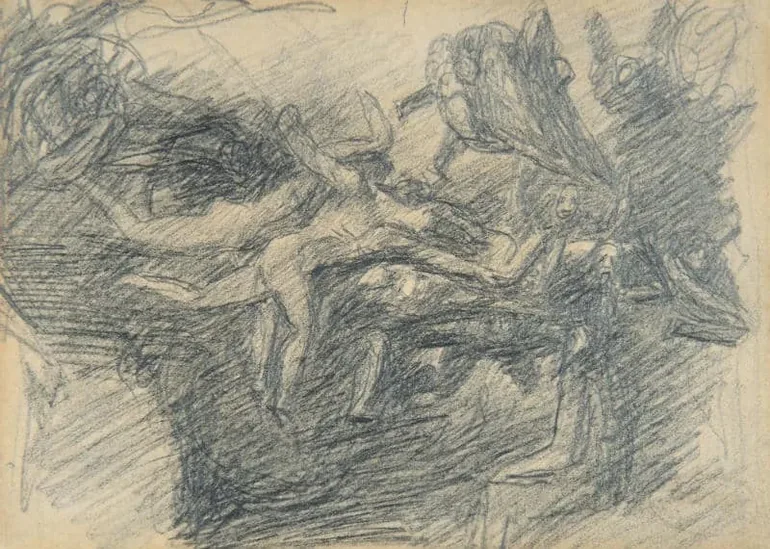
Graphite, with a collector’s mark l.r.14 x 19.7 cm; 5 1/2 x 7 3/4 inchesProvenance: Xavier Haas, c.1937; Professor Anne Crookshank until 2017Infernal ghosts, and hellish furies, round/Environ’d thee; some howl’d; some yell’d, some shriek’d/Some bent at thee their fiery darts, while thou/Sat’st unappall’d in calm and sinless peace.John Milton, Paradise Regained, Book 4This small but highly detailed drawing was done in late 1794 or early 1795, when Romney began to work on the subject of ‘The Temptation of Christ’, producing intense pencil sketches for a project that he barely began to realise in oils. The poet William Hayley’s son Thomas claims credit for having suggested this theme to Romney, which was inspired by a passage in Milton’s Paradise Regained [Book 4, lines 422-5].Christ can be seen seated at the bottom right of this strong drawing, with the fiends of Satan whirling around his head. There are other studies of this subject in the collection of the Yale Centre for British Art, New Haven (see Alex Kidson, George Romney 1734-1802, London 2002, p. 228).John Romney claimed that his father’s projected canvas measured about 16 by 12 feet, which would have been by far the largest painting he ever conceived, and that it was ‘equal in original conception and wild fancy to any thing ever produced by any artist..had he finished [it] it would have ranked him with Michel Angelo’ (see Romney, Rev. John, Memoirs of the Life and Works of George Romney..’, London 1830, p. 245). The rolled canvas upon which there was a nearly finished head of Christ and the beginning of Satan’s head was sent to Christie’s in April 1807 for the studio sale, was never unrolled due to its size, and subsequently disappeared.Xavier Haas was a Parisian dealer of the Galerie Haas et Gross, who formed the greatest collection of Romney drawings after the break-up of the artist’s studio.Anne Crookshank (1927-2016) was Emeritus Professor of art history at Trinity College, Dublin and played a major role in the development of the study of Irish art.
View detailsPen and grey ink and grey wash over pencil24.5 x 17.1 cm.; 10 x 6 ¾ inchesProvenanceWith the Squire Gallery;J. Thursby-Pelham;Mrs Guy Argles and by descent until 1995, anon. sale Christie’s, London, 7 November 1995, lot 71;Spink, London;Christie’s, London, 21 November 2002, lot 8, where bought by the previous owner;Dreweatt’s, Château de Lasfonds sale, 16 November 2022, lot 143ExhibitedSpink, London, ‘Annual Exhibition of Watercolours and Drawings, 28 May – 21 June 1996, no. 4This imposing drawing shows Satan holding his shield aloft to defend himself against Heaven. Romney made many illustrations to Milton’s ‘Paradise Lost’ around 1794. This drawing appears to show a moment in Book 1 when Satan and the other rebels are ‘Hurled headlong, flaming from the ethereal sky’. Elsewhere in the poem Milton compares Satan’s shield to a moon seen through Galileo’s telescope.Another similar drawing in the collection of the Fitzwilliam Museum also shows Satan holding his shield above his headhttps://data.fitzmuseum.cam.ac.uk/id/object/16046It is possible that the French Revolution, raging at this time, was close to Romney’s mind when he worked on these drawings for 'Paradise Lost', giving them some contemporary political significance.
View detailsBlack chalk and pencil on laid paper watermarked with the Strasburg Lily56.5 x 48.5 cm.; 22 ¼ x 19 inchesProvenanceChristopher Powney, 1980; from whom bought byPrivate collection, U.K. until 2023ExhibitedMorton Morris & Company with Christopher Powney, ‘Drawings by George Romney’, 21 October – 7 November 1980, no. 48 (ill.)The drawing shows Antigone mourning the death of her brother Polynices at the hand of their sibling Eteocles who also perished in their fatal duel.Powney suggested that the subject taken from the Thebaid of Statius, Book XII (see Drawings by George Romney, op cit.). The Latin epic poem in twelve books, published in the last decade of the first century, tells of the clash between the two sons of Oedipus, Eteocles and Polynices over the throne of Thebes.This substantial early work by Romney dates from the end of the 1760s or the early 1770s. It exhibits the bold and incisive characteristics which are hallmarks of Romney’s drawing style but is an unusually finished composition, controlled and tempered by the demands of neoclassicism.Romney’s friend the writer William Hayley (1745-1820) fuelled the artist’s desire to learn more about literature and the classics, and on Romney’s visits to his home in Sussex Hayley kept a notebook in which he, Romney and the other guests wrote down ‘Hints for Pictures’ to encourage the enlargement of his knowledge of the classics. Hayley was planning a new translation of Statius (see A. Kidson, George Romney, (1734-1802, 2002, p. 6).Like most Romney's drawings, this work is of a subject which was not turned into an oil. Romney destroyed many of his drawing before leaving for Paris in 1764 as he lacked the space in which to store them. The majority of those that survive date from after 1775 and his return from Rome. Another drawing of Antigone is in the Romney collection at the Fitzwilliam Museum, Cambridge.
View details