Hugh William Williams
- Years
- –
- Country
- United Kingdom
- Sold items
- 1
Biography
Show more Show less
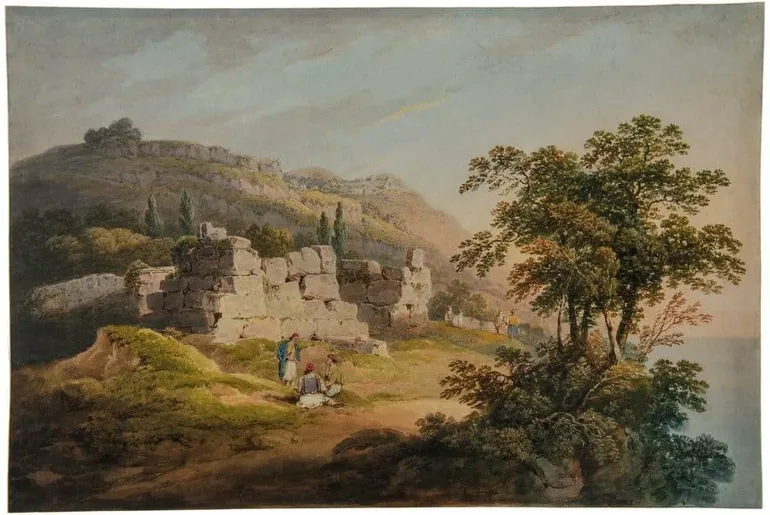
Hugh William Williams (1773 - 1829), also known as ‘Grecian’ Williams, was a landscape artist who trained in Edinburgh.
Williams was the ward of Louis Ruffini, a Turin-born manufacturer of embroidered muslin, who may have been related by marriage to Williams’ father. Having studied pattern design and other skills under David Allan in the 1790’s, he seems to have worked at Ruffini’s factory just outside Edinburgh. He may also have been a pupil of Alexander Nasmyth’s in the 1790’s, as he produced landscape watercolours in his style. He was also an actor and a scene painter.
Williams established himself as a professional artist in Glasgow, and by 1793 had founded a Drawing Academy there with the miniaturist, Alexander Galloway. He returned to Edinburgh in the mid 1790s, when he involved himself in printmaking.
From 1800 onwards, Williams exhibited his work in London, including at the Royal Academy in that year and in 1815. As he was not elected to the Society of Painters in Water Colours, he joined the newly formed rival group of Associated Artists in Water Colours and exhibited with it in 1808 and 1809.
Back in Edinburgh in 1808, Williams became a founder member of short-lived society of Associated Artists in Watercolour. In 1813, he published six large views of Highland scenery, which he dedicated to some of his patrons, including the Dowager Duchess of Buccleuch and William Douglas of Orchardton, (d. 1821), a wealthy amateur artist and Member of Parliament.
Between 1816 – 1818, Williams undertook an extended tour of Italy and Greece, funded and accompanied by William Douglas. While they were in Rome, they joined the circle of Elizabeth, Duchess of Devonshire, for whom he produced illustrations for her edition of Virgil. This tour, and subsequent exhibitions in 1822 and 1826, gave his work its distinct character his sobriquet. The exhibitions were acclaimed by critics and he worked on views based on his travels for much of the rest of his life.
Despite being best known for his classical subjects, his Scottish landscapes had a formative influence on the picturesque taste and the development of landscape painting. He also travelled extensively within the British Isles, both before and after his Grand Tour in 1816-18. He lived almost entirely by his art, a remarkable achievement for a landscape painter in watercolour, but he also supported himself by publishing his work as prints.
His portrait by Sir Henry Raeburn, painted in around 1818, hangs in the Scottish National Portrait Gallery.
His work is represented in many public collections, including the British Museum, the V&A; Whitworth Art Gallery (Manchester); Glasgow Museums and the National Galleries of Scotland; Ulster Museum (Belfast); and Rhode Island School of Design (Providence, RI) and the Yale Center for British Art (New Haven, CT).
Additional Information
Tate
V&A
Yale Center for British Art