James Ward, RA
- Years
- –
- Country
- United Kingdom
- Sold items
- 2
Biography
Show more Show less
James Ward, RA (1769 – 1859) was considered one of the outstanding artists of his day, whose distinct style, great skill and versatility placed him above most of his contemporaries. Contemporary critics would have viewed him as an equal to Turner and Constable.
Ward was born in London and was apprenticed at age twelve to the engraver John Raphael Smith, just as his brother William was completing his apprenticeship. As well as becoming known as an engraver, he was also a talented draughtsman, and he began to pursue a career as a painter. His early work was largely comprised of rustic genre scenes, characterised by loose brushwork and simplified forms. His style was heavily influenced by his brother-in-law, George Morland, and also drew on observations made during a trip to Wales.
In 1794, Ward was appointed painter and engraver in mezzotint to the Prince of Wales.
Around 1800, Ward adopted a more dramatic style featuring bolder forms and intense colours, as he adopted the style of Van Dyck and Rubens. At this time, he worked on several large allegorical paintings, such as the Allegory of Waterloo, now lost.
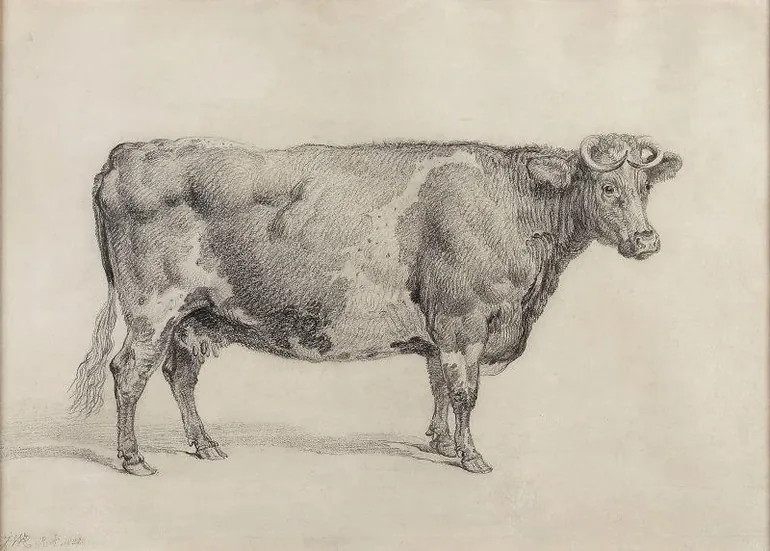
As a mature artist he was much in demand for his closely observed portraits of horses, livestock and other animals. He also painted landscapes, which he sometimes modelled on Rubens. His most famous landscape is Gordale Scar (1811 – 1814), which today hangs in Tate Britain, which is considered a masterpiece of English Romantic painting.
From the late 1830s, he became increasingly preoccupied with religious subjects. His career effectively ended in 1852, following a stroke.
He was elected ARA in 1807 and RA in 1811.
Ward’s work can be seen in many public collections, including Tate Britain, London, the Victoria & Albert Museum, London and the Yale Center for British Art, New Haven.
Additional Information
Tate
V&A
Yale Center for British Art