John Partridge
- Years
- –
- Country
- United Kingdom
- Sold items
- 1
Biography
Show more Show less
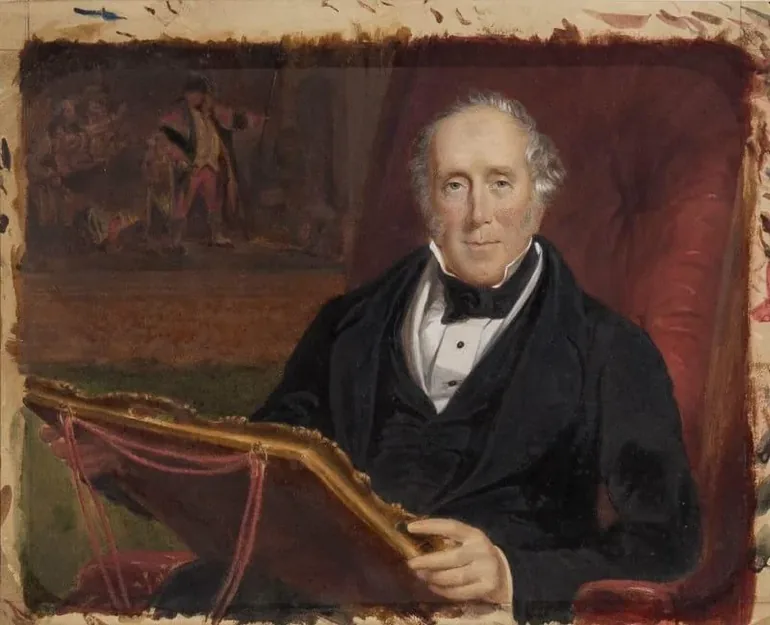
John Partridge (1790 – 1872) was a portrait painter, who was born in Glasgow. In 1814, he was apprenticed to Thomas Phillips, RA, (1770 – 1845). Phillips was heavily influenced by Sir Thomas Lawence PRA (1769 - 1830), which manifests itself in Partridge’s portraiture.
In 1815, he exhibited for the first time at the Royal Academy. He entered the RA Schools in 1816. Between 1823 and 1827, he travelled extensively in France and Italy, where he made copies of the old masters and sketched landscapes. On his return, his career blossomed and he became a fashionable portrait painter, painting over 200 portraits, including many of the leading figures of the day between 1827 and 1845 and exhibiting every year at the Royal Academy.
A commission in 1836 from King Leopold I of the Belgians led to an introduction to Queen Victoria, who appointed him Portrait Painter extraordinary to Her Majesty and the Prince Consort in 1843. Their support, however, proved fickle, as The Queen switched her patronage to Franz Xaver Winterhalter, ending Partridge’s aspirations. Sadly, his career did not live up to its auspicious beginnings, largely due to hostility and conflict, probably instigated by Ramsay Richard Reinagle, within the Royal Academy, and he never exhibited there again after 1846. Thereafter, his practice declined significantly.
Partridge’s work can be seen at the British Museum and the Castle Museum, Nottingham. Partridge also donated some of his unsold work to the National Portrait Gallery, where many remain on display.
Additional Information
National Galleries
Government Art Collection
Art UK