John Thirtle
- Years
- –
- Country
- United Kingdom
- Sold items
- 1
Biography
Show more Show less
John Thirtle (1777 – 1839) was a leading member of the Norwich School of artists, arguably second only to his brother – in – law, John Sell Cotman. Apprenticed to a London frame maker, he returned to Norwich in around 1800, where he ran a framing, carving and gilding business, in addition to painting and taking pupils. He was a founder of the Norwich Society in 1803 and exhibited with it until he and four others seceded in 1816, to form the Norfolk and Norwich Society of Artists, which dissolved after three years. returning to the fold in 1827. His output declined form around 1820 and he stopped exhibiting in 1830, as a lung infection prevented him from sketching.
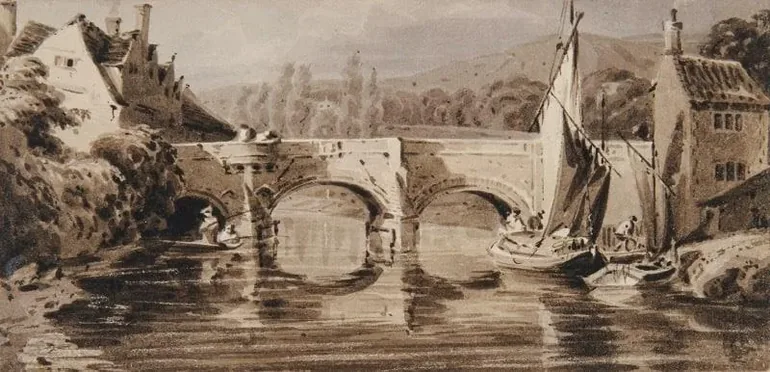
Thirtle, in common with other members of the Norwich School, was inspired by the riverside cityscape of Norwich, its warehouses, bridges and the bustling river traffic between Whitlingham and New Mills. His style, influenced by Thomas Girtin, Crome and (to a lesser extent) Cotman, was technically accomplished. His earlier landscapes were painted with a restricted range of buffs, blues and grey-browns, but he later developed a brilliancy of colour, producing works that included angular block forms. The quality of several of his watercolours has deteriorated owing to the fading of the indigo pigment that he used extensively.
His works can be seen in many public collections, including the British Museum, London, the Victoria & Albert Museum, London, and the Castle Museum, Norwich.
Additional Information
British Museum
Norfolk Museum Collections