Thomas Girtin
- Years
- –
- Country
- United Kingdom
- Available items
- 1
Biography
Show more Show less
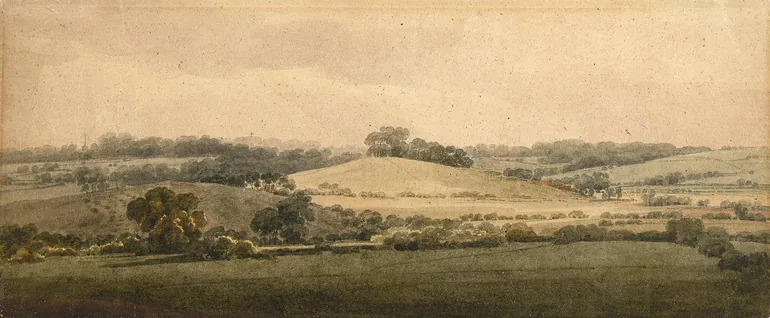
Girtin is a seminal figure in the history of British watercolour, particularly celebrated for his revolutionary approach to the medium despite his short life. An accomplished painter and etcher, Girtin was instrumental in elevating watercolour from a medium primarily used for topographical records to as independent art form of great power and romantic sensibility. His close association, marked by both friendship and rivalry, with his contemporary J.M.W. Turner, further highlights his significance in a transformative era for British art.
Thomas Girtin's artistic style developed rapidly during his brief career. Leaving behind his topographical training under Edward Dayes, with the characteristic use of an outline washed in with clear washes, he developed a bolder, more expressive, and distinctly Romantic approach to landscape painting. His mature work was characterized by a dramatic breadth of vision, a sensitivity to atmospheric effects, and a powerful and spontaneous use of colour.
Girtin's works are held in major public collections around the world. Large collections can be found at the British Museum, Tate Britain, and the Victoria and Albert Museum in London, the Yale Center for British Art in New Haven, the Fitzwilliam Museum in Cambridge and the Metropolitan Museum of Art in New York.
His life and work have been the subject of continued scholarly interest and major exhibitions. In 2002 ‘Thomas Girtin: The Art of Watercolour’ was held at Tate Britain, commemorating the bicentenary of his death.
Additional Information
Tate
British Museum
Thomas Girtin