

Thomas Shotter Boys
- Years
- –
- Country
- United Kingdom
- Available items
- 1
- Sold items
- 3
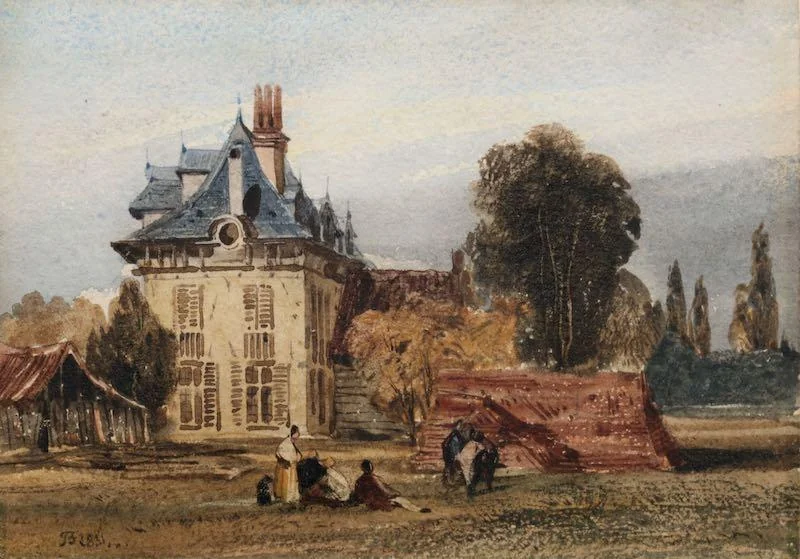
Boys moved to Paris in the early 1820s and became a friend and pupil of Richard Parkes Bonington (1802–1828). He exhibited a large number of watercolours in Paris in the 1830s and is deemed to have made an important contribution to the revival of watercolour painting in France. Boys made several visits to Belgium in the late 1820s and 1830s and was in Brussels during the Belgian Revolution of 1830. His wife Célestine was Belgian, her home either in or near Soignies. His Picturesque Architecture in Paris, Ghent, Rouen etc., was published in 1839.
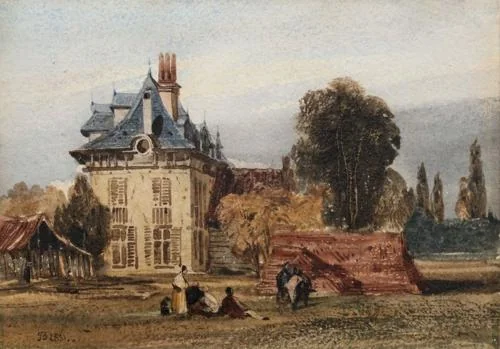
Signed with monogram l.l. and dated 1831, watercolour over traces of pencil with gum arabic and scratching out 8.5 x 12 cm.; 3 3/8 x 4 ¾ inches Boys moved to Paris in the early 1820s and became a friend and pupil of Richard Parkes Bonington (1802–1828). He exhibited a large number of watercolours in Paris in the 1830s and is deemed to have made an important contribution to the revival of watercolour painting in France. Boys made several visits to Belgium in the late 1820s and 1830s and was in Brussels during the Belgian Revolution of 1830. His wife Célestine was Belgian, her home either in or near Soignies. His Picturesque Architecture in Paris, Ghent, Rouen etc., was published in 1839.
View details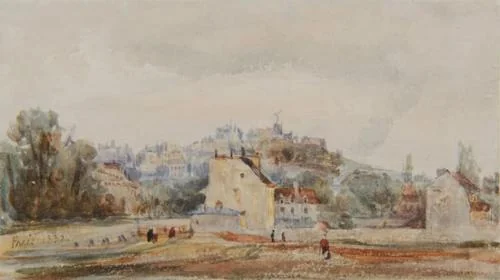
Inscribed l.r.: Paris 1832, watercolour 9.5 x 16.6 cm Provenance Sotheby’s, 13 March 1980, lot 59; David Messum, ‘Les Jeunes Romantiques’, Beaconsfield, June 1980; Private collection UK until 2018 Views of Paris are considered to be the most important subjects drawn by the artist. This delicate and spontaneous watercolour dating from 1832 shows Boys at the height of his powers exhibiting great subtlety in the treatment of light and space. 1832 was a turbulent year in Paris; in April and May there was an outbreak of cholera which left over 18,000 people dead including the liberal orator General Lamarque, whose funeral on 5th June and the subsequent uprising have been immortalised in Victor Hugo’s ‘Les Miserables’. Boys moved to Paris in the early to mid 1820s when British engravers were in demand. He met Bonington there and became his closest English friend during that artist’s final two years of life. He taught Bonington etching and was almost certainly one of his pupils in turn, and copied some of his work. By the early 1830s, when William Callow was Boys’ pupil and they shared a studio in Rue du Bouloy, Boys’s work had developed a style grounded in topographical accuracy with a sophisticated handling of watercolour. The present work illustrates how Paris at this date was significantly smaller than the city is now. The hill of Montmartre rose above the plain of the Seine outside the city walls. It was the site of a gypsum quarry and windmills where grain was ground for bread for the city. There was a telegraph station on the top of the hill which had been used by Napoleon to transmit orders to the French troops and to receive news.
SoldView details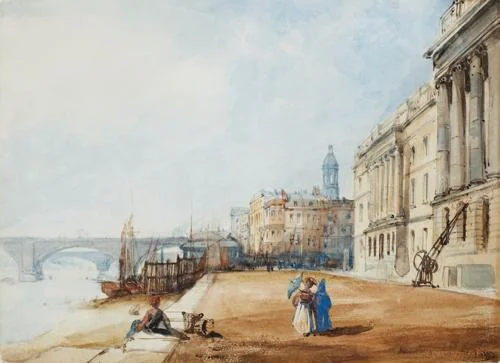
Watercolour over pencil with gum arabic and scratching out 23 x 31.5 cm.; 9 x 12 ½ inches Frame size 41 x 49 cm.; 16 ¼ x 19 ¼ inches Provenance Appleby Brothers;Private collection U.K. until 2021 This would appear to be the watercolour on which Boys’ lithograph of the subject for ‘London As It Is’, 1842, was based. A record of London in 1840s, the book was issued with plates which were hand-mounted in imitation of watercolours. Boys’ reputation was significantly enhanced by this publication. There are several differences between the final lithograph, which is in portrait format, and this watercolour, notably in the foreground where the figures are omitted in the lithograph in favour of a large group of packages with the loading machine moved from the side of the Custom House to the edge of the Thames, blocking the view of London Bridge.
SoldView details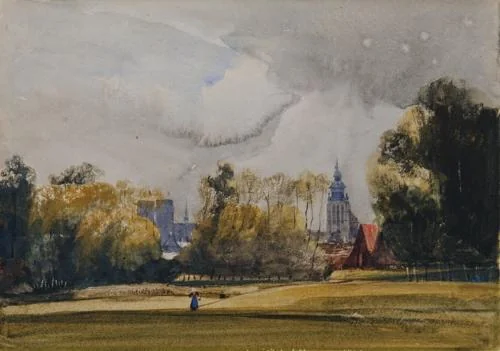
Watercolour with bodycolour and scratching out, inscribed verso in pencil: Hors du port de Hal. The distinctive tower of Notre Dame de la Chapelle, where Pieter Bruegel the Elder is buried, is seen on the right-hand side of the composition. It was built near the city walls in the twelfth century, although the remains today date from a century later. The nearby Porte de Hal is the only surviving fortified city gate of the walls of medieval Brussels. The two towers of Brussels cathedral balance the view to the left. Boys made several visits to Belgium in the late 1820s and early 1830s and was in Brussels during the Belgian Revolution of 1830. His wife Célestine was Belgian, her home either in or near Soignies. The artist’s virtuoso mastery of watercolour techniques is splendidly illustrated in the deft handling of the medium in this drawing. Provenance: The artist’s sale; John Manning, 8 Bury Street; Thomas Agnew & Sons, London; Anthony Molins, his sale at Sotheby’s London, 24 November 1977; Private collection, UK
SoldView details
Subscribe to receive details of our new events, complimentary fair tickets and catalogues.
We use essential cookies to make this site work. With your permission we'd also use Google Analytics cookies to see how the site is used. You can change your mind at any time under Cookie Settings.