William Payne
- Years
- –
- Country
- United Kingdom
- Sold items
- 4
Biography
Show more Show less
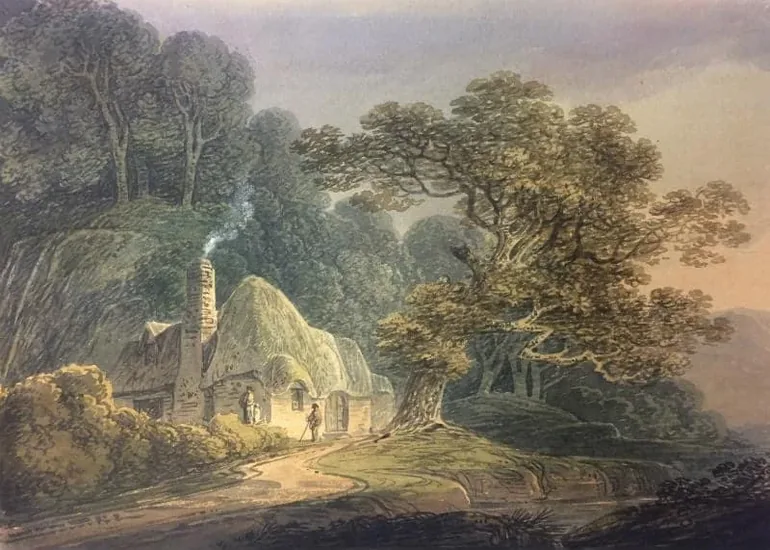
William Payne AOWS (1760 – 1830) was born into a prosperous family in London. He had some drawing lessons, possibly from Paul Sandby, and, in 1778, he was appointed a ‘fifth class’ draughtsman by the Board of Ordnance, working in its Drawing Office at the Tower of London, where he received additional training in drawing, mathematics and perspective, the last taught by Henry Gilder, a protégé and servant of Thomas Sandby.
In 1783, he was promoted to the ‘second class’ and was posted to Plymouth, where he remained until 1788. In these years he began to work in his own style and drew many West Country views, which were exhibited at the Royal Academy. He undertook extensive tours of the West Country and Wales between 1790 and 1794, when he resigned from the Board of Ordnance.
Payne developed the watercolour from a tinted drawing to a painting which relied less on prominent pen outline and more on the build-up of washes. Nonetheless, he retained the use of a monochrome palette and invented his own characteristic tint which is still known as ‘Payne’s Grey’.
Payne’s success in extending the bounds of watercolour, with his loose, yet clear, application of pigment, which was easily taught to others, led to him becoming a fashionable and successful drawing master. John Glover (1767 – 1849) is probably his best-known pupil.
In 1809, Payne relaunched himself as an exhibiting artist, working in both oil and watercolour, exhibiting his work at the British Institution. Payne’s work can be seen in numerous museums, including the Victoria & Albert Museum, London, the Ashmolean Museum, Oxford and the National Gallery of Art, Washington D.C.
Additional Information
Tate