
Pen and brown and grey ink and watercolour on two sheets of laid paper, joined 25.8 x 36.7 cm.; 10 x 14 ½ inches Provenance By descent from the artist until 2015; Guy Peppiatt Ltd.; Hugo Burge (1979-2023) Abbott was one of the best amateur watercolourists of the late Eighteenth Century. A surgeon and apothecary, he lived in Exeter until 1825. He exhibited paintings at the Royal Academy from 1793, receiving contemporary acclaim for the style of his work. The artist John Downman said that ‘he prefers his drawings before his paintings, as they are done with more spirit’ (J. Farington, Diary 26 June 1804; vol. VI, p. 2362). In 1825 Abbott inherited Fordland, a Devon estate, from his uncle James White, an Exeter barrister, Nonconformist and close friend of Francis Towne. Abbott became a patron and pupil of Towne’s, and his linear style shows the artist’s influence. After moving to Fordland he devoted himself to drawing where this work is most likely to have been drawn.
View details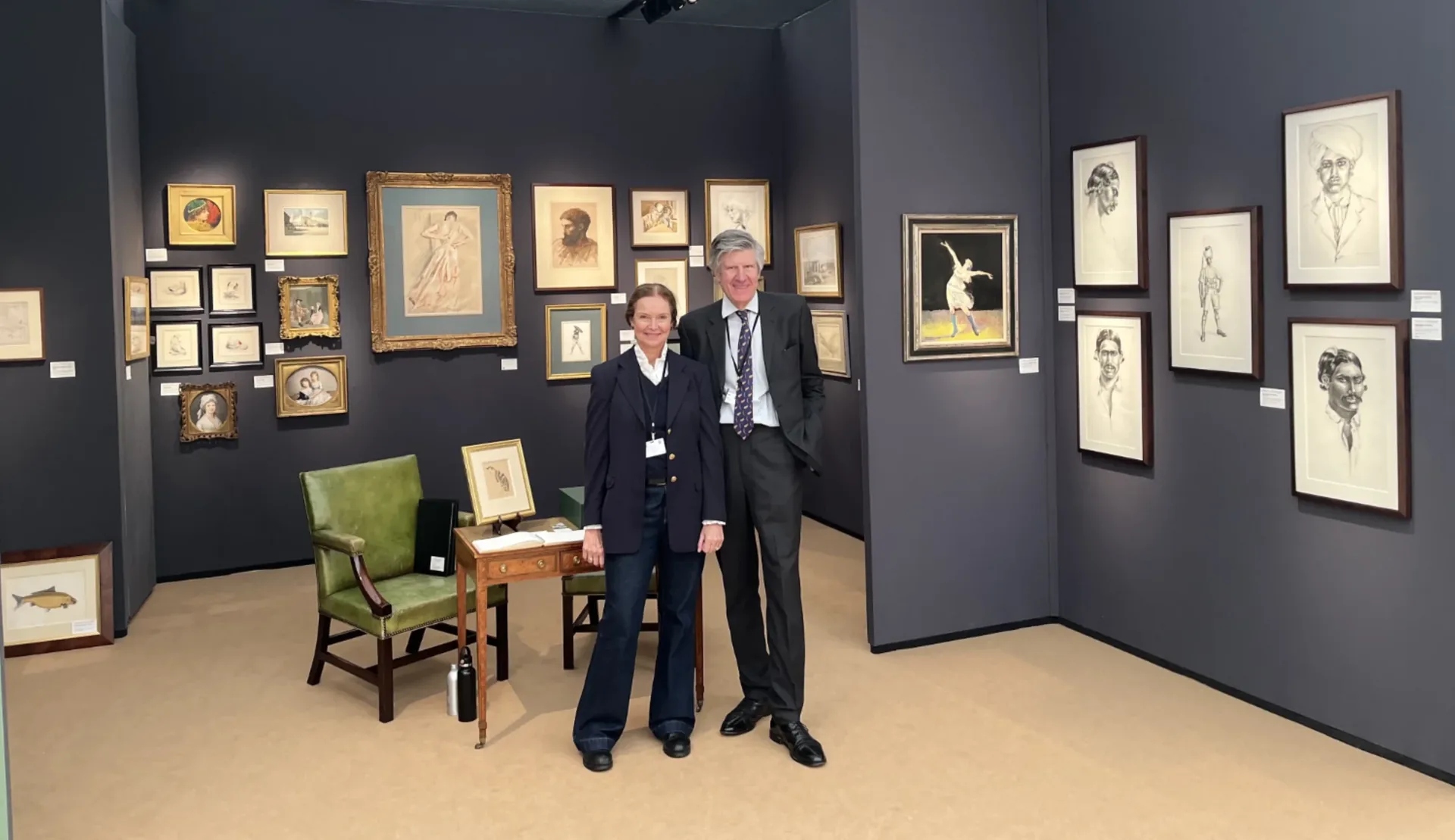
A unique contemporary perspective on thousands of years of art history, from the ancient era and Old Masters to the late 20th century.
FRIEZE MASTERS
14th – 18th October 2026 · The Regent's Park
About This Event
Karen Taylor will be exhibiting a selection of British works on paper by some of the leading British women artists from 18th, 19th and early 20th centuries, from Sarah Stone to Laura Knight. Her stand will examine women artists’ contribution to science, portraiture and the landscape tradition, alongside examples by their male counterparts. Artists who travelled in search of inspiration will be highlighted, including examples by Thomas Jones, David Roberts, Edward Lear and Constance Gordon-Cumming. The show will include a strong selection of works by artists inspired by India.
Frieze Masters offers a unique contemporary perspective on thousands of years of art history, from collectible objects to significant masterpieces from the ancient era and Old Masters to the late 20th century. The 2026 edition of the fair will showcase over 130 of the most significant galleries from around the world.
The fair takes place in The Regent’s Park in the heart of London, in an elegant, contemporary environment designed by renowned architect Annabelle Selldorf, benefiting from natural light and a thoughtful aesthetic which lends itself to the sophistication of Frieze Masters. World-leading independent curators advise on feature sections for 20th-century art and focussed presentations of historical art and objects. The relationship between historical art and contemporary practice is further explored through the acclaimed Frieze Masters Talks programme, which was curated in 2025 by Arturo Galansino (Director General of Fondazione Palazzo Strozzi in Florence).
The celebrated Spotlight section will return to Frieze Masters, curated by Dr Devika Singh and Dr Sofia Gotti. The section is dedicated to solo presentations of artists working in the 20th century with a special focus on underappreciated work from the mid-century. Spotlight will explore unexpected positions, new research into overlooked figures from across the world, and significant early work from established artists.
More details:
Karen Taylor’s Frieze page
Frieze Masters
Works on Display

Signed with initials l.l.: E.A., watercolour over traces of pencil heightened with bodycolour and stopping out, with touches of red chalk, in a period burr maple frame Sheet 38.9 x 27.6 cm.; 15 ¼ x 10 ¾ inches, painted area 33 x 18 cm.; 13 x 7 inches Provenance Christie’s, London, 3 February 2000, lot 160; Sotheby’s, Gleneagles, 30 August 2000, lot 1153; Private collection, London until 2023 Alexander is best known for his exquisite watercolours of flora, fauna and the natural world. Alexander studied at the Royal Institution, Edinburgh from 1887-8, and in Paris with the sculptor Emmanuel Frémier. In 1887-8 the artist travelled to Tangier with his father and fellow artists Pollock Nisbet and Joseph Crawhall. He returned to Egypt in 1892 and lived there for four years. After his return he married Dora, moved to just outside Musselburgh, and created a menagerie that he used for his work. Plants remained important subjects for his painting and, in 1909, he illustrated J. H. Crawford’s The Wild Flowers. In 1902 Alexander was elected an associate of the Royal Scottish Academy becoming a full member in 1913. He exhibited widely including at the Royal Scottish Academy, Royal Academy, Fine Art Society, Royal Watercolour Society and the Leicester Galleries. Alexander’s work is held in the Tate Gallery, Aberdeen Art Gallery, Dundee Art Gallery and by Fife Council.
SoldView details
Gouache on vellum, in the original swept frame with labels attached, inscribed on a former label: ‘…ell Pinxt…about the year 1756’ 28 x 24 cm; 11 x 9 1/2 inches Provenance Sotheby’s, London, 22 March 1979, lot 84; Davis & Long Company, New York, British Watercolours 1 - 29 November 1980, ex. catalogue; Private collection, U.S.; Paul F. Walter, New York, until 2017 Exhibited Anthony Reed, London, 1980, ‘Heads and Bodies’, no. 15, ill.; Sainsbury Centre for Visual Arts, University of East Anglia, ‘Sporting Art from East Anglian Collections’, 28 June-10 August 1980, no. 19, ill. Comparative Literature: cf. Walpole Soc. XLVI (l978) M.Kirby Talley Jr.: 'Thomas Bardwell of Bungay, artist and author' This rural conversation piece is of exceptional interest as it is rare to find 18th century conversation pieces on vellum on such a small scale; it also has a fine level of painted detail providing invaluable information for the social historian. Major Francis Longe (1726-1776), the owner of Spixworth Hall near Norwich, is painted at home, just returned from shooting, presenting his wife, Tabitha (née Howes) with a bag containing a live leveret, a symbol of love. His dog peers around the door which shows the park from which his master has just returned, and a spaniel lies at his mistress’s feet. The sitters’ identity as landowners of some standing is directly expressed. The label on the back of the painting states that Major Longe is 30 years of age and this dates the work to 1756. His only son Francis, born in 1748, is standing next to his mother and would have been 8 years old at the time this work was made. Francis Longe married Tabitha Howes soon after he came down from Cambridge. Francis and Tabitha had a son, Francis, in 1748. Francis (the elder) was educated at Westminster School and Emmanuel College, Cambridge and served as High Sheriff of Norfolk in 1752, an office his son Francis was also to hold. His wife was the daughter of John Howes (d. 1771) of Morningthorpe Manor, Norfolk and his wife Barbara, daughter and heiress of Rev. Thomas Sydnor; they married in 1720. Barbara Howes was painted with her four children by D. Heins, when Tabitha was 14 years old. Francis, the boy in the present drawing, inherited the estate on the death of his father in 1776. He had married Catherine Jackson (1752-1828) four years earlier. Catherine’s father had an important position in the Admiralty, and sponsored Captain James Cook’s voyage of discovery to Australia. Sydney was originally called Port Jackson after him. Francis and Catherine Longe had no issue; Francis died in 1812 and the estate passed to his cousin upon his widow’s death in 1828. Spixworth Hall was an Elizabethan house located just north of Norwich on the Buxton Road. The estate became mired in debt in the hands of Francis’s widow Catherine; there were disputes over her ability to sell or mortgage parts of the property. She was reduced to cutting down a grand avenue of oak trees that lined the drive up to the Hall to produce an income. Spixworth Park was inherited by a relative, a great-grandson of Francis Longe and grandson of his second son called John (b.1731), Rector of Spixworth until his death in 1806. The house was demolished in 1950. The attribution to Thomas Bardwell is historic and strongly based upon stylistic grounds as well as the inscription on the (now lost) label which accompanied it into the late 20th century. Bardwell was born in East Anglia in 1704 and died in Norwich on 9th September 1767 and became very popular amongst the gentry of East Anglia where he painted portraits, views of country houses and conversation pieces. The Geffrye Museum, London have an oil group portrait, possibly of the Brewster family of Beccles, dated 1736 in their collection with similarities to the present drawing, notably in the high level of detail of the interior. Another comparable oil of the Broke and Bowles family dated 1740 is in the Government Art Collection (and was included in 'Manners and Morals, Hogarth and British Painting 1700-1760', Tate 1987-8). There are however no other known vellum works by Bardwell on the scale of the present work. Later in his career, Bardwell undertook a tour through Yorkshire to Scotland and painted portraits in some of the large houses en route. In his later years he had a thriving practice in Norwich. In 1756 he published a treatise entitled 'The Practice of Painting and Perspective Made Easy', an important book of its kind and of its time. The genre which grew in popularity from the early 1730s was initially associated with painters such as William Hogarth and Gawen Hamilton. These "conversations" represent a peculiarly English contribution to the arts. They reflected the rising prosperity of the urban middle class in the early 18th century which led to a demand for a more intimate and modest style of portraiture appropriate to the social status of a new class of patrons. They often depict their subjects in their domestic surroundings, a contrast to the swagger of grand portraiture. The paintings thus produced with a high level of skill are exceptional visual evidence of their lifestyle and rising prosperity, their pride in their economic achievements and their self-confidence within their prosperous bourgeois surroundings. Alongside these urban interiors are the relaxed rural conversation pieces of the Tory squirearchy produced in the years after about 1740 by artists such as Arthur Devis, Francis Hayman, Edward Haytley and Thomas Gainsborough. Bardwell would appear to have been well aware of these latest developments of composition and style both locally and in the metropolis. The portrait possibly of the Brewster Family of 1736 (see above) shows he was a pioneer of the genre, in both East Anglia and the country as a whole. Paul Walter was born in 1935 to Fred and Anna Walter, co-founders of the New Jersey industrial instruments firm Thermo Electric. Anna Walter was a benefactor of the Morgan Library and Museum and the Los Angeles County Museum of Art. Through collecting, patronage, and leadership roles at the Museum of Modern Art and the Metropolitan Museum of Art in New York, Paul Walter became one of the city’s most respected connoisseurs. We are grateful to M. Kirby Talley Jr. for his comments on this work.
View details
Signed l.r.: S Bowdich del and inscribed l.c.: A2. Carp. /2 natl. size, pen and grey ink watercolour heightened with gold 27.7 x 35 cm.; 10 7/8 x 13 ¾ inches Literature The Freshwater Fishes of Great Britain, ‘Drawn and Described by Mrs. T. Edward Bowdich’ London, 1828, plate II Sarah Bowdich or Sarah Lee, née Wallis (1791-1856), was the daughter of a grocer and linen-draper in Colchester, where she grew up and learnt how to fish. Her parents were prosperous, property-owning non-conformists, but her father went bankrupt in 1802 and the family moved to London, where Sarah met and married the explorer Thomas Edward Bowdich (1791-1824). He sailed in 1815 for Cape Coast Castle, in present-day Ghana, with the Royal African Company, and Sarah followed in 1816 with their new-born baby. During the voyage she caught a shark and helped put down a mutiny. While she waited for her husband to return from a trip to England, Sarah studied the local culture and natural history. Thomas led an expedition inland to the Ashanti kingdom while Sarah was the first European woman to collect plants systematically in West Africa. The family settled in Paris in 1819 to study natural science in preparation for a further expedition to Africa and were assisted by the savant, Baron Georges Cuvier. They published English translations of French works, which were illustrated by Sarah. In 1822 they sailed for Africa, spending fifteen months in Madeira to study its natural history. Soon after reaching Bathurst (now Banjul in The Gambia), Thomas Bowdich died of fever in 1824. To support her three young children Sarah Bowdich forged a career in the art of natural history and her work became very popular. In 1825 in London, she published her husband’s last work on Madeira with additions of her own. Her descriptions of new species and genera of fish, birds and plants established her as the first woman known to have discovered whole genera of plants. She remarried an assize clerk, Robert Lee in 1826. In 1826 Sarah Bowdich began her most famous work The Freshwater Fishes of Great Britain comprising forty-eight plates depicting fishes, with accompanying text. The work had fifty subscribers, headed by the Duke of Sussex, the sixth son of George III, and appeared in twelve fascicles of four plates each between 1828 and 1838. Remarkably, each illustration in each of the fifty copies is an original watercolour by the artist, not a hand-coloured print, totaling 2400 watercolour illustrations. She worked from life from just-caught specimens, beautifully illustrated by the lifelike golden sheen of the carp’s scales in the present work. Her preface comments: ‘Every Drawing has been taken from the living Fish immediately it came from the water it inhabited, so that no tint has been lost or deadened, either by changing the quality of that element, or by exposure to the atmosphere’.
View details
Brigadier Twemlow’s Bengali Servant in an interior Signed l.r. and l.l. with initials, inscribed verso in pen and brown ink: Brigr. Twemlow’s/Bengali Servant./W.C., grey and brown washes over pencil 27.3 x 22 cm.; 10 ¾ x 8 5/8 inches Framed size 34 x 29 cm.; 13 ½ x 11 ¼ inches Chapman was born in London. He studied at the East India Company’s Military Seminary at Addiscombe, where he won several exam prizes. After a year at Chatham he joined the Bombay Engineers. As Second Assistant in the Department of Roads and tanks he took charge of the works on the Agra road from the foot of the Thull Ghaut to Candore from 1846, receiving much praise for his work. He married Brigadier Twemlow’s second daughter Charlotte in Aurungabad in June 1848. After a leave of absence spent researching engineering projects in England in 1851, he joined the Institution of Civil Engineers as an Associate Member. On his return to India in October 1852, he was appointed to the survey of the construction of a canal between the Indus and Kurrachee. He concluded that a railway line would offer greater advantages. While investigating this he had a fatal accident on the river Indus in December 853. After his untimely death the road he had worked on was renamed Chapman Road, Thull Ghaut. Brigadier Twemlow (1796 - 1877) of the Royal (Bengal) Artillery was the commandant at Aurungabad (Nizam’s Contingent) who had a distinguished military career in India from 1812. He lived in a bungalow at Roza, ‘an old Mohammedan tomb surrounded by a walled garden’, (Francis Egerton, ‘Journal of a Winter’s tour in India’, 1852, vol. II, p. 225). He returned to England in 1853 and devoted himself to scientific and archaeological pursuits. Ayah and Child outside a bungalow Signed l.l. W.C., inscribed verso in pencil: Ayah & child./Egeltana (?)April 180/4 9, watercolour over pencil 25.5 x 20.5 cm.; 9 7/8 x 8 1/8 inches Framed size 33 x 28cm.; 13 x 11 inches (2)
SoldView details
Watercolour over traces of pencil heightened with gum arabic and stopping out 12.7 x 21.2 cm.; 5 x 8 2/8 inches Provenance Martyn Gregory Fine Art This colourful watercolour dates from 1833-4 and is based on a sketch made on the spot by Commander Robert Elliot, R.N. (1790-1849) in the early 1820s. Several professional watercolour artists copied his sketches, amongst them Thomas Shotter Boys, David Cox, William Purser, Samuel Prout and Clarkson Stanfield, and their watercolours were engraved and published in 1834-5 as Views in India, China, and on the Shores of the Red Sea. The present watercolour was not engraved, but other views made for this series by Cotman are in the collection of the Victoria and Albert Museum, London and the Harris Museum and Art Gallery, Preston. The Elephanta Caves, on Elephanta Island off Mumbai are a UNESCO World Heritage Site, famous for their rock-architecture and carvings. This watercolour is taken from inside the most famous cave.
View details
Evelyn De Morgan (1855 – 1919) The head of a woman Coloured chalks on buff paper 35.8 x 23.4 cm.; 14 1/8 x 9 ¼ inches Provenance Private collection U.K., by descent until 2024. This beautiful drawing of the head of a woman deep in thought may be a study for the figure of Purity in De Morgan’s 1914 painting 'The Vision', also known as ‘1914', an allegorical painting inspired by World War I. The work depicts two women representing Peace and Purity in the foreground, with a demon representing war behind them (private collection, with the Louise Whitford Gallery/David Hughes in 1981). De Morgan was a pacifist, deeply moved by the horrors of the Boer War (1899-1902) and World War I, who made over fifteen paintings criticising war.
SoldView details
KT379 Signed and dated l.l.: John Dearman 1845, signed and inscribed on stretcher: Cattle crossing Merrow Down Guilford Surrey/storm passing off.Jn. Dearman 184., oil on paper laid down on canvas stamped PREPARED BY/CHARLES ROBERSON/LONG ACRE LONDON 18 x 15.4 cm.; 7 x 6 1/8 inches Frame size 28 x 26 cm.; 11 x 10 inches Provenance Christie’s, London (1002V); John Abbott (1937-2011) This delightful oil sketch captures a huge brooding sky with distant light breaking through which suggests that the storm is passing. The grandeur of nature is enhanced by the small figure of a shepherd with a flash of red at his neck, with his dog and flock of sheep, which draw the eye to the foreground. Virtuoso handling of the impasto of the landscape in the middle distance show the work of an artist spontaneously enjoying his paint. Dearman also records the weather effects on the stretcher in his neat hand. The artist lived in Camberwell, London in the 1830s and had a house in Guilford High Street. He exhibited at the Royal Academy between 1824-1856 and also showed often at the Royal Society of British Artists and the British Institution.
SoldView details
Watercolour over traces of pencil, inscribed verso: Llangollen-lan-Llangollen and inscribed on mount: Emily Dundas, a tiny sketch of a girl’s head verso 9.3 x 9.4 cm; 3 5/8 x 3 5/8 inches, in a carved wood frame Both the Ladies of Llangollen came from Ireland and it was here that the two women formed a strong emotional bond and attachment that would endure for the rest of their lives and attract the attention of Regency society. Eleanor Charlotte Butler (1739 –1829) (seated in this drawing and wearing the order of Saint Louis, an order of chivalry founded by the French king) was the youngest daughter of the Earl of Ormonde of Kilkenny Castle. Sarah Ponsonby (1755 – 1831) lived with relatives, Sir William and Lady Elizabeth Fownes, in Woodstock, County Kilkenny and was a second cousin of Frederick Ponsonby, 3rd Earl of Bessborough, father of Lady Caroline Lamb. Ponsonby attended boarding school at Kilkenny, and it was there, aged 13, that she met Butler, who was 16 years her senior. They became fast friends and corresponded regularly. Rather than face the possibility of being forced into unwanted marriages, or into a convent in the case of Butler, the pair left County Kilkenny together in April 1778 dressed as men, with a pistol and Sarah’s beloved dog Frisk. Their families tracked them down and tried to make them give up their plans. They finally succeeded in fleeing together to Wales and established themselves at a cottage near Llangollen, which they renamed Plas Newydd, in 1780, which they refurbished in a Gothick style. Windows were gothicised and old stained glass panels inserted into them. A library was filled with finely bound books and curiosities of all kinds, including a lock of Mary Queen of Scots' hair. They developed a passion for old, carved wood, from medieval churches to fragments of Elizabethan furniture. The staircase hall was lined with it, and a trio of canopies built on to the door and windows. The extraordinary front porch incorporates carvings of the four evangelists, Latin inscriptions, seventeenth century bedposts and lions donated by the Duke of Wellington (visitors soon learnt that to appear with gifts of carvings ensured a warm welcome). Over the years they added a circular stone dairy and created a garden in the picturesque style. Eleanor kept a diary of their activities. Living on a modest income they maintained a quiet life, studying literature and languages which they described as their ‘system’ and improving their estate. They did not actively socialise and were uninterested in fashion, wearing dark riding habits for formal and informal occasions and beaver hats, as seen in Dundas’ drawing. Their hair remained cropped in the ‘Titus’ style, fashionable in the 1790s and they continued to use hair power, which went out of fashion after the same decade. Many observers commented on their masculine appearance. Their life began to attract the interest of the outside world and Plas Newydd became a haven for visitors, as they become a celebrated example of 'retirement', leaving society for a rustic idyll, which delighted writers such as Wordsworth and Sir Walter Scott. They were also admired for their 'Romantic Friendship’.Visitors including Southey, Wordsworth, Shelley, Lord Byron, Lady Caroline Lamb, Sir Walter Scott, the Duke of Wellington and Josiah Wedgwood visited. The two formed a literary circle that encompassed Mary Tighe, Ann Talbot, Anna Seward, Hester Thrale (otherwise known as Hester Piozzi, Dr. Johnson’s friend, was a neighbour), Henrietta Bowdler, Madame de Genlis and William Wordsworth. Copious correspondence resulted, some of which, for example letters to Anna Seward, have been published (Collected Letters of Anna Seward, 1811). On some days as many as twenty visitors arrived. Their notoriety spread abroad and continental visitors includedPrince Hermann von Pückler-Muskau, the German nobleman and landscape designer, who wrote admiringly about them. Queen Charlotte wanted to see their cottage and persuaded George III to grant them a pension. There was speculation that there was more than romantic friendship between Eleanor and Sarah in their own lifetime. The diaries of Anne Lister (1791–1840), an English landowner from Halifax, West Yorkshire, record a visit to the Ladies of Llangollen in 1822. Her diaries contain accounts of her own lesbian relationships written in code. She was fascinated by the two women and discreetly tried to establish if they were more than just friends, concluding that it seemed unlikely that their friendship was just platonic. Their queer materiality has been explored by Fiona Brideoak in ’Desire, Indeterminism and the Legacies of Criticism’, 2017.Butler and Ponsonby lived together for over fifty years until the end of their lives. Their books and glassware carried both sets of initials and their letters were jointly signed. Eleanor Butler died in 1829, and Sarah Ponsonby two years later. They are both buried at St Collen's Church in Llangollen. Plas Newydd is now a museum run by Denbighshire County Council and is open to the public. Although the Ladies of Llangollen's fame was extraordinary, romantic female friendships were common in eighteenth century Europe. Women often spent a great deal of time in each other's company and developed strong, intense relationships. Female friends frequently wrote to one another using passionate, romantic language that can suggest a sexual relationship to modern readers. Some of the relationships reflected in correspondence were no doubt sexual, others may simply have reflected the conventions of friendship. It is impossible to find conclusive proof whether the relationship between Eleanor Butler and Sarah Ponsonby was sexual or not, but there is abundant evidence that it was loving. Not that many images of the pair are known as the ladies disliked having their portrait taken. Lady Mary Leighton (née Parker) sketched them individually in pencil and a lithograph was made by Richard James Lane, after Lady Leighton circa 1830-1840s showing them seated at Plas Newydd. A second pirated version was made by James Henry Lynch, printed by Day & Haghe, circa 1833-1845 and shows the pair full-length wearing riding habits and top hats in their garden. Lady Delamere sketched them in old age showing them walking inside Plas Newydd (see E. Mavor, 'The Ladies of Llangollen- a study in Romantic Friendship',1971, ill. facing frontispiece and facing p. 97). Provenance: Augusta Raymond-Barker (step-niece of the artist), Fairford Park, Gloucestershire; thence by family descent until 2016 See also:Fiona Brideoak, 'The Ladies of Llangollen – Desire, Indeterminism and the Legacies of Criticism', 2017. The artist of this drawing, which lies somewhere between portraiture and caricature, was Lady Emily Dundas, née Reynolds-Moreton, the fourth daughter of Thomas, 1st Earl of Ducie. In 1847 she married Admiral Sir James Whitley Deans Dundas, GCB, (1785-1862) as his second wife. He became the First Naval Lord in the first Russell ministry in July 1847 and they lived at Admiralty House. Thackeray records that during the 1850 season Lady Emily Dundas gave a glittering party. Lady Emily Dundas is recorded as accompanying her husband on many official engagements such as inspecting the fleet in various places from Cork to Malta and as far afield as New Zealand. He was appointed Commander-in-Chief in the Mediterranean in 1852 and led all naval operations in the Black Sea, including the bombardment of Sevastopol in October 1854 during the Crimean War. She went with him to Turkey and took a house at Therapia. Lady Emily Dundas had four sisters. Her youngest sister, Lady Catherine Reynolds-Moreton (d. 2 Dec. 1892), married in 1841, John Raymond-Barker, of Fairford Park, Gloucestershire (d. 21 May 1888). He had two daughters by his first wife, Harriet Bosanquet (1798-1830) Augusta (1827-1900) and Leonora. Augusta assembled the friendship album from which this watercolour comes which reveals the women of her family and circle as accomplished watercolourists. The artist of this drawing, which lies somewhere between portraiture and caricature, was Lady Emily Dundas, née Reynolds-Moreton, the fourth daughter of Thomas, 1st Earl of Ducie. In 1847 she married Admiral Sir James Whitley Deans Dundas, GCB, (1785-1862) as his second wife. He became the First Naval Lord in the first Russell ministry in July 1847 and they lived at Admiralty House. Thackeray records that during the 1850 season Lady Emily Dundas gave a glittering party. Lady Emily Dundas is recorded as accompanying her husband on many official engagements such as inspecting the fleet in various places from Cork to Malta and as far afield as New Zealand. He was appointed Commander-in-Chief in the Mediterranean in 1852 and led all naval operations in the Black Sea, including the bombardment of Sevastopol in October 1854 during the Crimean War. She went with him to Turkey and took a house at Therapia. Lady Emily Dundas had four sisters. Her youngest sister, Lady Catherine Reynolds-Moreton (d. 2 Dec. 1892), married in 1841, John Raymond-Barker, of Fairford Park, Gloucestershire (d. 21 May 1888). He had two daughters by his first wife, Harriet Bosanquet (1798-1830) Augusta (1827-1900) and Leonora. Augusta assembled the friendship album from which this watercolour comes which reveals the women of her family and circle as accomplished watercolourists.
View details
Oil on laid paper laid down on canvas 20.5 x 25.1 cm.; 8 1/8 x 9 7/8 inches Provenance Private collection, USA, until 2025 This charming plein air sketch was made not long after the completion of the restoration of the Arch of Titus in 1824. During the early nineteenth century the integrity of the structure was spoilt by the remains of medieval stone walls and accumulations of rubble at the sides. These were cleared in the early 1820s by Giuseppe Valadier (1762–1839) who restored the Arch to something approaching its original (and current) appearance. The artist differentiates between the original Pentelic marble and the white Travertine used for the newly carved sections of the monument. On the Via Sacra to the south-east of the Forum, the Arch of Titus was designed to glorify the memory of the emperor Titus and his official deification or consecratio. It was built shortly after the death of Titus in 81AD by his brother Domitian, who succeeded him as emperor.
View details
Signed, inscribed and dated l.r.: Hindoo Temple near Dehra/Himmalayas in the background-/Oct. 1869./C.F.G.C., watercolour over pencil with touches of white. Dehradun, the capital of Uttarakhand, is in the foothills of the Himalayas. On the banks of a river is a Hindu temple in front of which figures ride elephants through the shallow waters. On the riverbank, a woman performs the aarti, releasing a diya to float upon the waters as an offering. For further work by this artist please see the catalogue link and enquire about availability
SoldView details
Signed, inscribed and dated l.r.: Cave on the Island/of Elephanta/Dec 9th. 69 and further signed by another, watercolour over pencil. The artist visited the famous Hindu temple carved into the rockface on the island of Elephanta. Constructed between the fifth and sixth century, the temple is part of the ‘City of Caves’ devoted to the cult of Shiva. For further work by this artist please see the catalogue link and enquire about availability.
View details
KT693 Elizabeth Gould (1804-1841) Maryland or northern bobwhite quail (Colinus virginianus) Signed l.r.: Eliza Gould/1829, watercolour, inscribed in pencil l.r.: Maryland Quail and further indistinctly inscribed, on wove paper watermarked 1816 64 x 50.5 cm.; 25 ¼ x 19 ¾ inches Provenance Thomas Barwick Lloyd Baker (1807-1886) of Hardwicke Court, Gloucestershire, promotor of reformatory schools and influential writer on crime and punishment; thence by family descent until 2025 Elizabeth Gould was one of the most important ornithological artists of the nineteenth century. Probably because much of her short life was spent in the shadow of her husband, Elizabeth Gould’s significant artistic and scientific contribution to the art of natural history has been overlooked traditionally. However, her reputation has recently been reassessed in Andrea Hart and Ann Datta’s monograph Birds of the World: The Art of Elizabeth Gould, published in 2023. The present watercolour is signed ‘Eliza Gould’ which was John Gould’s name for her and drawn when she was twenty-five. Her early work shows her talent as a draughtswoman, meticulous attention to detail and ability to capture the characteristics of a species most convincingly. The bobwhite quail, also known as the Virginia quail is a small but distinctive species native to much of North America, including the eastern coast of Mexico and the islands of the Caribbean. It has been in decline for the last half century due to habitat loss. In Maryland, they are found throughout the year in the eastern counties and less west of Chesapeake Bay. The bobwhite is a small bird, ranging from 9 to 11 inches in length and 13 to 15 inches in wingspan, weighing from 6 to 9 ounces each. While there are regional variations in appearance among males across its range, the females are similar in all locations. Females are generally dull brown with a buff-coloured throat, while males have a white throat and a distinctive brow stripe with a black border. Eastern bobwhites may have rufous-coloured breast feathers.
View details
Signed and inscribed verso: Far away in Cloudland/BWSpiers/And when the smoke ascends on high/Then thou behold'st the vanity of worldly stuff/Gone with a puff/thus think, and smoke tobacco-/G.W.-Smoking Spiritualised, watercolour over pencil heightened with gum arabic and touches of white, and further inscribed on original backing: B.W. Spiers Far Away 13.5 x 18cm; 5 1/2 x 7 1/8 inches Benjamin Walter Spiers (1845-1894) was an idiosyncratic painter of studio still lives who lived in London, at 70 Hereford Road in Bayswater, where the current watercolour may have been drawn. He crammed his antiquarian pictures with books, furniture, objects and paintings a number of which reappear in several of his still lifes. He often drew corners of interiors of his favourite antique shops in London’s Wardour Street. The bust and the chair shown in the present work appear in several of his compositions. He was captured here by an artist with the initials G W who has caught him relaxing with a cigarette in his studio. Spiers often penned a verse to accompany a picture, as in the present work. It is amusing seeing the tables turned and the artist drawn as the subject of his own studio interior. Spiers’ extraordinary fidelity in his own painting and his eclectic taste makes him the leading exponent of a particular type of 19th century interior painting. The dealer and scholar Christopher Wood considered him to be ‘one of the most remarkable painters of still-life in English Art’ (see C. Wood, ‘Knicknacks and silly Old Books’, 'Country Life', 10 June 1993, pp. 124-125). Christie’s London had a large group of Spiers work for sale on 14 December 2016. In one of these works 'Worthless old knickknacks and silly old books', based on the poem 'The Cane-Bottom'd Chair' by Thackeray, the same painting of Gainsborough's (lost) 'Cottage Children', which hangs over the fireplace in the present work, can be seen. Spiers was interested in possessions rather than objects of nature and his curiosity for antiquarian objects, books, maps, prints and china is displayed with trompe-l’oeil accuracy in his watercolours. The same objects repeatedly appear which suggests that Spiers owned them. Little is known about Spiers’ life. He lived in London, first at 17 Hereford Street, Bayswater, and then at Longwood in Acol Road, West Hampstead. He is thought to be related to Richard Phené Spiers, the architect, whose brother, Walter Spiers was a curator of the Soane Museum. He exhibited at the Royal Academy from 1876 to 1891, and 'The Times' Academy notice for 27 June 1881 says of his two exhibited works, ‘We consider these two works to be the gems of the water- colour gallery.’ Christie’s London 14 December 2019, lot 80
SoldView details
Signed, inscribed and dated l.r.: Carl Haag London 14 Sept 1849, oil on paper 35 x 25.3 cm.; 13 ½ x 10 inches, framed size 50 x 40 cm.; 19 3/4 x 15 3/4 inches Provenance Peter Ward-Jackson (1916-2015) Literature W. Karbach and C. Allison, Carl Haag Victorian Court Painter and Travelling Adventurer between Orient and Occident, 2019, no. 85 Having studied in Munich (where he worked as a miniaturist and book illustrator), Paris and Brussels the artist arrived in England in the spring of 1847. After spending that winter in Rome, he returned to London to study watercolour painting at the Royal Academy Schools. He almost lost a hand in an accidental explosion in December 1848. Haag’s first exhibited work at the Royal Academy in 1849 was entitled The Return from the Vineyards and the present work may have been made as a preparatory study. He became a member of the Old Water Colour Society in 1853. Haag travelled widely all over Europe and the Near East. He was popular with Royal and aristocratic patrons and spent the autumn of 1853 at Balmoral and the winter at Windsor. Peter Ward-Jackson was a curator at the Victoria and Albert Museum and a leading authority on furniture, prints and drawings, particularly ornament designs. His publications became standard works in these fields such as his catalogue of the V&A’s Italian Drawings (in two volumes, 1979-80).
View details
Signed, inscribed and dated l.r.: Nina Hamnett/Oct 1924/Paris, pencil, partial watermark ENGLAND 25.4 x 25.7 cm.; 10 x 10 1/8 inches Provenance By family descent until 2024 This may be a portrait of Mary Torr, painted in oils by Hamnett in 1924. The daughter of an army officer, Hamnett was born in Wales and had a peripatetic childhood, showing early talent for drawing and painting. In 1911 she set up a studio in Grafton Street in Fitzrovia. Throughout her early career she worked at the Omega Workshops and was well known on the London art scene. Hamnett moved to Paris in 1913 and lived in Montparnasse. She attended Marie Wassilieff's academy where she had lessons with Fernand Leger, worked as an artist’s model and met Amedeo Modigliani, Chaim Soutine, and Gertrude Stein. She was at the heart of the Anglo-French exchange of artistic ideas at this period and came and went between Paris and London. Hamnett was back in France in 1920 enjoying the Bohemian life of the French capital with other artists and seeking out the avant-garde. One of Hamnett’s first solo exhibitions was held at the Eldar Gallery, London in 1918 and consisted mainly of portraits of figures she had met in Paris. Hamnett, dubbed the ‘Queen of Bohemia’ is now recognised as a leading proponent of British Modernism and a retrospective of her work, including many drawings, was held at Charleston in 2021. The grandmother of the previous owner and her husband used to frequent the Fitzroy Tavern and drink with the artists and intellectuals who were regulars there.
View details
Signed l.r.: Helleu, black, red and white chalks 70 x 48.5 cm; 27 1⁄2 x 19 inches Provenance Nevill Keating Pictures Ltd., London; Private collection until 2022 This elegant drawing aux trois crayons of the artist’s wife Alice, drawn from behind, is recorded in the online archive of Les Amis de Paul-César Helleu as PCH DE1-3216. Helleu studied at the École des Beaux-Arts in 1876 in the atelier of Jean-Léon Gerome. In Paris, his circle of intimate friends included fellow artists Giovanni Boldini, Alfred Stevens, Edgar Degas, Rodin, Claude Monet and notably the Americans Whistler and Sargent, with whom he briefly shared a studio. Helleu exhibited several large pastel portraits to great acclaim at the Salons of 1885 and 1886, including one of Alice Louis-Guérin, to whom he became engaged in 1885. He and Alice married in 1886 at the church of Saint-Pierre in Neuilly. Although friendly with many of the Impressionist painters and invited by Degas to participate in the eighth and final Impressionist exhibition of 1886, Helleu declined to do so. He exhibited six pastels at the Salon des Pastellistes at the Galerie Georges Petit in 1887, including two further portraits of Alice. At this time he first met Comte Robert de Montesquieu, who was to become his leading patron and who, in 1913, published the first important monograph on the artist. In 1889 Paul and Alice Helleu spent some time with Sargent at Fladbury in England, and he made several studies of Alice and an oil of Paul painting her (Brooklyn Museum, New York). The 1890s were a successful decade for Helleu, who moved comfortably in society in both France and England. He obtained numerous lucrative portrait commissions and enjoyed considerable financial success. Helleu also met and enjoyed a long friendship with Marcel Proust, who is thought to have based the character of the painter Elstir in A la Recherche du Temps Perdu on him. Encouraged by Sargent, Helleu began travelling to America in 1902, where his reputation had preceded him, and he enjoyed further success drawing elegant Society women. His subjects included the Comtesse Greffulhe, Queen Alexandra and Consuelo Vanderbilt, the Duchess of Marlborough. These works were greatly admired by his contemporaries. His preferred subject remained Alice, whom he drew many times. The writer Edmond de Goncourt wrote of Alice Helleu that [s]he was incapable of making a movement that was not graceful and elegant, and ten times a day he [Paul-César Helleu] tried to capture those movements with a quick drypoint sketch. In 1931, four years after Helleu’s death, a retrospective exhibition of his work was held at the Galerie Charpentier in Paris. Today his work can be found in many museum collections, including the Museum of Fine Arts, Boston, the Musée du Luxembourg, Paris and the Musée d'Orsay, Paris.
SoldView details
William Henry Hunt, OWS (1790-1864) Lighting the Brazier Signed l.l.: W HUNT., watercolour over traces of pencil with scratching out, title inscribed on original frame 36.2 x 26.7 cm.; 14 ¼ x 10 ½ inches Provenance Agnew’s, Liverpool, no. 253; Malllams, Oxford, 19 March 2026, lot 443 This unpublished watercolour is a notable addition to the group of black subjects drawn by W.H. Hunt held in public collections in the UK and USA. It fits into a group on which Hunt was working in 1830s depicting black children warming themselves by fires. For domestic servants lighting fires was a daily job. In the 1830s Hunt exhibited twenty humorous images of children which were later lithographed as Hunt’s Comic Sketches published in 1844, including two of black children, including Master James Crow -Out of His Element and Miss Jim Ima Crow seated by fires. The Lady Lever Art Gallery, Port Sunlight, has the original watercolour of Jim Crow which appears to show the same black boy as in the present work (see J. Witt, William Henry Hunt (1790-1846), 1982, no.477, see lithograph). Both boys are shown seated in front of a brazier, a suggestion that they feel the cold alluded to in the title of the lithograph, seated on a barrel or basket of the same height. The present watercolour (executed circa 1830-40) also has similarities with a watercolour of the same black model holding a slate at the Victoria and Albert Museum, London also entitled ‘A Brown Study’ (FA526). Both drawings share the same neutral background and have an added strip at the top. Another version of this work, without an added strip, is in the collection of the Yale Center for British Art (B1975.4.583). Hunt made several other studies of black sitters, including a drawing of a young girl in pencil on buff paper in the Courtauld Institute, London and a boy posing as a boxer in the Metropolitan Museum of Art, New York (2020.120). Jan Marsh has suggested that because of Hunt’s choice of theme his sitters are most likely to have been youths aged around 10 – 14 years old who were not at school or apprenticed but earning small amounts in the street running errands, carrying parcels and doing other small jobs, and were therefore visible and available to artists notably in London, Bristol and Liverpool (private email March 2026). Hunt preferred to use the same sitters as models. Hunt was born with a deformation of his legs which restricted his movement and seems to have had a form of dwarfism. According to his early biographer, F. G. Stephens, Hunt was: ‘was a little less than… five foot. He was broad as well as round shouldered and his head was large beyond proportion to the rest of his figure which the torso was that of a larger man. His large and long frock coats and loose trousers although favourable to him on other accounts, did not add to his outward graces.’ . Stephens adds that Hunt’s personal disabilities: ‘frequently made him reserved and not very easily accessible to strangers.’ While Hunt’s interactions with black sitters were inevitably informed by the prejudices of his age it is quite possible that his own disability drew him to marginalised members of his society. He is known to have befriended black acrobats and musicians. British artists showed increasing interest in Black subjects during the 1830s. Slavery was abolished throughout the British Empire over the years 1833 -1838 and the abolition movement was hotly debated in Parliament and beyond.
SoldView details
This group of nineteen distinctive depictions of fruit and vegetables from South-East Asia are inscribed with titles in Indian English (possibly in Romanised Hindi) and drawn on European laid paper which is variously watermarked. There are three different numbering systems on the sheets. Many of the fruit and vegetables, such as the durian, are more commonly found in South-East Asia rather than on the Indian subcontinent, suggesting that it is possible that the drawings may have been made for a European patron in South-East Asia. Stylistically the drawings have many of the characteristics of the ‘Straits School’, a hybrid Indo-Chinese style. The accumulation of natural history drawings by officials of the British East India Company gave rise to the term ‘Company School’, now out of favour, which has been used to describe the work of Indian or Chinese artists for British patrons. The distinctive style is a result of a fusion of two artistic traditions, the European with its desire for realism and the Asian taste for a more stylised approach. The work of Chinese artists is rarer than that of Indian artists and tends to be a little later in date. British patrons commissioned local artists to draw the flora and fauna of India and other areas of South-East Asia. Such work is typically annotated with botanical notes in native script, romanised versions of native descriptions, Latin and with reference to the Linnaean system of classification, created by Carl Linnaeus (1707-78). The eighteenth and early nineteenth century saw an enormous rise of interest in Europe in the study of natural history by both scientists and amateurs. A knowledge of the subject was considered to be an important part of a liberal education and many people studied ‘natural philosophy’ and the various branches of natural history. Accurate drawings were vital tools in classification as well as a reminder of the excited reaction to new discoveries being made all over the known world. The collecting of specimens was the basis of most natural history drawings, plants were pressed and dried and the drawings recorded the specimen in its living shape and colours. This group of fruit and vegetables are found in various parts of South-East Asia. Some are common others are less well known. The collection is presented mounted in a hand-made solander box. Brinjala (Aubergine) Inscribed l.r.: Brinjala and numbered ninety-five, N106 and 96, watercolour, bodycolour and gum arabic on wove paper 31.7 x 20.5 cm.; 12 ½ x 8 1/8 inches Aubergine is known as brinjal in South-East Asia. Mangosteen Inscribed l.r.: mongostan, numbered ninety-seven. N 97 and 101, watercolour and gum arabic on laid paper watermarked IFD 31.7 x 20.5 cm.; 12 ½ x 8 1/8 inches Mangosteens grow in South East Asia, particularly in Indonesia. It is a juicy, slightly acidic fruit and it is also used in traditional medicine. Ratahouli (pepper) Inscribed l.c.: Ratahouli, numbered ninety-five, N107 and 1010, watercolour and gum arabic on laid paper watermarked HIS/GD 33 x 23 cm.; 13 x 9 inches Cashew Inscribed Rajab, numbered ninety-eight, N109 and 1012, watercolour and gum arabic on laid paper 33 x 23 cm.; 13 x 9 inches The cashew tree is a tropical evergreen tree that produces the cashew seed and the cashew accessory fruit. The nut can be seen growing from the bottom of the fruits in the drawing, both green and then brown once it has ripened. Jambu Air (Szygium Aqueum) Inscribed l.c.: jambol, numbered A Hundred, N111 and 1019, watercolour and gum arabic on laid paper watermarked HIS 33 x 23 cm.; 13 x 9 inches This is a special of the brush cherry tree; its common names include watery rose apple and bell fruit. Chilli Inscribed l.r.: fjoli, numbered ninety-one, N100 and 105, watercolour and gum arabic on laid paper watermarked with a crest 33 x 23 cm.; 13 x 9 inches Pomegranate Inscribed l.r. ramangh, numbered A hundred and three, N114 and 1019, watercolour and gum arabic on laid paper watermarked HIS 33 x 23 cm.; 13 x 9 inches Papaya Watercolour and gum arabic inscribed l.r. papaya, numbere ninety-nine, N100 and 1013, on laid paper watermarked with a crest 32.5 x 23 cm.; 12 ½ x 9 inches Durian Inscribed l.r.: doorian, numbered eighty-five, N94 and 96, watercolour and gum arabic on laid paper 32.7 x 23 cm.; 12 ¾ x 9 inches The durian, with its spiny outer shell and moist, pungent flesh can weigh up to seven pounds. These large fruits grow on trees, have a short period of ripeness and their cultivation is difficult. The durian is famously not allowed on public transport in Singapore on account of its unpleasant smell. Lobed tropical tomato Inscribed l.r.: samati, numbered ninety, N100 and 109, watercolour with touches of gum arabic on laid paper 32 x 21 cm.; 12 ½ x 8 ¼ inches Berlimbing Inscribed l.r.: blinbingh, numbered A hundred and two, N113 and No 16, on laid paper watermarked HIS 33 x 23 cm.; 12 ¾ x 9 inches Berlimbing, also known as bling bling or berling berling, is a sour fruit used in curries. Buah Chiku (Sapodilla, Chikoo, Sapota or Naseberry) Inscribed l.r.: boa sawa, numbered ninety-three, N104 and 104, watercolour and gum arabic with touches of bodycolour on laid paper partially watermarked with the Strasburg Lily 33 x 23 cm.; 13 x 9 inches This appears to be Buah Sawo or Chiku, but the identification of this plant is open to question. Ban Branjahr (?) Inscribed l.r.: Ban Branjarh (?), numbered eight eight, N90 and 102, watercolour, bodycolour and gum arabic on laid paper, watermarked 31.7 x 20.5 cm.; 12 ½ x 8 1/8 inches This plant has not been identified. Lotus Inscribed l.c.: Fratil, numbered ninety-seven, N108 and 1011, watercolour and gum arabic, watermarked with a crest 33 x 23 cm.; 13 x 9 inches This drawing shows the lotus head with seeds after it has flowered. It is the seed of plants in the genus Nelumbo and the seeds are used in Asian cooking and traditional medicine. Melon (probably watermelon) Inscribed l.r.: patuka, numbered ninety-two N103 and 106, watercolour and gum arabic on laid paper 33 x 23 cm.; 13 x 9 inches Mango Inscribed l.r.: Manga, numbered A Hundred and one, N112 and 1015, watercolour and gum arabic 31.7 x 20.5 cm.; 12 ½ x 8 1/8 inches Longan Inscribed l.r.: froita lanja, numbered eight nine, N99 and 103, watercolour and gum arabic on laid paper watermarked with a crest 32.2 x 21 cm.; 12 ½ x 8 ¼ inches Rambutan Inscribed l.r.: frouita kafri, numbered eighty-six, N96 and 100, watercolour and gum arabic 32 x 21 cm.; 12 ½ x 8 ¼ inches Buah Gowok (Syzgium polycephalum) Inscribed l.r.: rambutan and numbered eighty-five, watercolour and gum arabic and pencil on laid paper 31.7 x 20.5 cm.; 12 ½ x 8 1/8 inches
View details
Stamped with estate stamp l.l., watercolour and pencil on tan paper, numbered verso in pencil: 67 (twice) 16.2 x 12.9 cm.; 6 3/8 x 5 1/8 inches Provenance The Estate of the artist, by descent In February 1904 Gwen John and Dorelia McNeill left Toulouse for Paris where they took a room in the Hôtel de Mont Blanc at 19 Boulevard Edgar Quinet in the 14th arrondissement. They acquired a female tortoiseshell cat with a white breast which Gwen John named after the street and drew frequently, and which would appear to be the subject of the present drawing which dates from around 1905-1908. Gwen John had many cats throughout her life, and when Edgar Quinet disappeared in 1908 she wrote a poem in her memory entitled Au Chat which she sent to Rodin. Her remarkable cat drawings capture the personality of the animals and are understandably acclaimed.
View details
Signed l.l.: John, pencil and black chalk 45.5 x 30.5 cm.; 17 7/8 x 12 inches Provenance Lady Hornby (1934-2021) Exhibited Augustus John, Olympia, 23-28 February 1999, no. 61 (no catalogue) This freely drawn, captivating drawing dates from c. 1904-1906. It epitomises the qualities of John’s fluent draughtsmanship and his ability to capture the essence of a sitter with apparent ease. Its immediacy, sureness and simplicity place it amongst his finest female portraits. Sheran Cazalet was the daughter of Peter Cazalet, Queen Elizabeth, the Queen Mother’s, racing trainer. Her grandparents, William and Maud Cazalet, were friends of Augustus John. She married Sir Simon Hornby in 1968. He was the last family member to serve as chairman of WH Smith and served as chairman of the Design Council; he died in 2010. The couple lived at The Ham, Oxfordshire, where they assembled a collection of twentieth century works on paper, created a beautiful garden and entertained in style. Many of the contents of The Ham were sold at Christie’s, London, in 2012.
View details
Signed, inscribed and dated below: Drawn 1785, by I. Johnson. Woodbridge.-/This OAK stands in Winfarthing, Norfolk, on the Estate of the Rt. Hon: Lord ALBERMARLE./Circumference at Base 51 Feet, at three Feet high 32 Feet, at six Feet, 30 Feet Circum. Height 60 Feet., watercolour and bodycolour over pencil with pen and black ink. Image size 34 x 29 cm.; 13 3/8 x 11 3/8 inches, sheet size 40 x 33 cm.; 15 ¾ x 13 inches Provenance Simon Carter, Woodbridge; R. Geoffrey Smith, Berveriche Manor Farm, Middleton; Martyn Gregory Gallery, London; Hugo Burge (1972-2023) Literature Huon Mallalieu, Dictionary of British Watercolour Artists up to 1920, vol. III, 1990, p. 191, ill.; John Blatchley, Isaac Johnson of Woodbridge: Georgian Surveyor and Artist, 2014, pp. 12-16 The artist was a surveyor and antiquarian as well as an artist who lived in Woodbridge, Suffolk for his adult life. Around 1785 he was considering a volume illustrating the most remarkable trees of Norfolk and Suffolk which never came to fruition, but for which the current drawing would have been a likely candidate. White's History, Gazetteer, and Directory of Norfolk, 1883 describes the tree which stood on the estate of the Earl of Albermarle: The celebrated 'Winfarthing Oak,' probably the largest in England except the one at Cowthorpe, in Yorkshire, stands near the Lodge farmhouse, and is a grand and picturesque old ruin. It measures 70 feet round at the roots, and 40 feet in the middle of the main stem, and must have been at one time a magnificent spreading tree, with enormous arms. It is traditionally said to have been called the 'Old Oak' in the time of the Conqueror, and is usually considered to be more than 1200 years old. It is now a mere shell, bleached snowy white, and capable of containing a large number of persons in its interior. It still retains vitality on its south side, and three years ago a rook's nest was built in its branches.
View details
Laura Knight, DBE, RA, RWS (1877-1970) Anna Pavlova rehearsing The Bacchanal, c. 1910-1911 Signed l.l.: Laura Knight, oil on canvas 45.5 x 41 cm.; 17 5/8 x 16 1/8 inches Provenance Peter and Vera Chadwick, 1977 (according to an inscription on the previous frame); Harry Greatorex, 1988; His sale at Sotheby’s, unidentified sale 1988(?), lot 73; Private collection U.K. until 2025 Knight captures the grace, elegance and kinetic energy of the most famous ballerina of her day on stage performing her most dynamic and erotic role. Pavlova (1881 – 1931) visited London with Sergei Diaghilev's company for the first time in the summer of 1910. She caused a sensation with her dramatic Dance Bacchanal from Pepita's ballet The Seasons, choreographed by Mikhail Fokine, which was to become one of her signature roles. An erotic duet, performed with Mikhail Mordkin saw the dancers throwing garlands and striking sensual poses with theatrical abandon, wearing Greek tunics. Knight was mesmerised by the Ballets Russes when they performed in London during the years before the First World War. In particular, she became enamoured with the dancer Anna Pavlova. In her autobiography, 1965, Knight wrote: ‘The whole look of Pavlova had perfection of finish … But whatever the beauty of form may have been, she possessed an attraction all her own ... a something not of this world.’ (L. Knight, The Magic of a Line, p. 161). In 1911 she made sketches of Pavlova at the Palace Theatre, continuing her interest in the figure in motion. Pavlova often invited Knight to her home, The Ivy House in Golders Green next to Hampstead Heath, which she bought in 1912, so she could sketch her. Knight drew Pavlova’s portrait many times as well as sketching her backstage and made small enamel pieces recording her dancing. Her work helped cement the dancer’s reputation in Britain and beyond. Pavlova settled in London after the Russian Revolution of 1917.
View details
Pencil 26.5 x 18 cm.; 10 1⁄2 x 7 1/8 inches Provenance Estate of the artist (his daughter Henrietta Phipps), until 2000; Davis & Langdale Company, New York, 2000; Private collection, from 2000 until 2023 Exhibited: Davis & Langdale Company, New York, 2000, Henry Lamb: Works on Paper, no. 13 [checklist] This compelling drawing was executed around 1930. Henry Lamb was born in Adelaide, Australia in 1883, shortly before his father moved the family to Manchester, where he spent his childhood. He studied medicine before abandoning this path to be an artist. At twenty-two he left for London to study under Augustus John and William Orpen at their Chelsea Art School. John was a particularly formative influence and Lamb moved to Paris with him a few years later. Lamb spent a couple of summers on the south coast of Brittany, in search of a more traditional way of life. This impulse drew Lamb to Gola Island in Northern Ireland two years later. In London in 1905, Lamb joined the Fitzroy Street Group and was a founding member of both the Camden Town Group and the London Group. He married Nina Forrest, or Euphemia, in 1906 but the marriage proved short-lived. He was friendly with the Bloomsbury Group, having known Vanessa Stephen and Clive Bell from his early days in London, but he often had little patience with them. He was close friends with the eminent critic and biographer Lytton Strachey and between 1912 and 1914 he painted his portrait, now held in the Tate and one of his greatest works. In the First World War, Lamb served as a doctor in the Royal Army Medical Corps in France, Salonika and Palestine; he was awarded the Military Cross. He was not an official war artist but drew extensively and the resulting oils are an important part of his oeuvre. In 1928 he married Lady Pansy Pakenham and moved to Coombe Bissett in Wiltshire. Lamb was appointed an official war artist for the Second World War, making portraits of soldiers and studies of servicemen at work across the South of England. Lamb was elected as an associate of the Royal Academy and a Trustee of both the National Portrait Gallery and the Tate at this time. He was finally awarded full membership of the Royal Academy in 1949. Interest in Lamb’s work has revived in recent years, and he has been the subject of recent exhibitions at Salisbury Museum and Poole Museum. His work can be found in many collections around the world, including the Tate, the Imperial War Museum, the Government Art Collection and the National Gallery of Canada.
SoldView details
Henry Lamb (Australian/British 1883 – 1960) Inscribed l.r.: Edwin John, pencil Provenance The Estate of the artist; Davis & Langdale Company, New York (DLA 3328); Where purchased by Sarah John (1946 - 2024); Bequeathed to the present owner This drawing dates from c. 1913-1915. Edwin John (1905-1978) was the fourth son of Augustus John and Ida and was born in Paris. After a brief career as a middleweight boxer he became a watercolourist. He inherited the estate of his aunt Gwen and did much to secure her posthumous reputation. Henry Lamb was born in Adelaide, Australia in 1883. He studied medicine in Manchester before abandoning it in1905 to train as an artist. At twenty-two he left for London to study under Augustus John and William Orpen at their Chelsea Art School at 72 Flood Street. They held weekly classes in life drawing and painting, still life, figure composition, landscape and decorative painting. He was a talented student and he and John formed a strong friendship. For a while Lamb imitated John’s bohemian manner of dress, wore gold earrings and grew his hair longer. He also began to draw like John. Lamb was a frequent visitor to the John household into 1930s and became close to Dorelia (with whom he had an affair) and to the children who he encouraged to draw. This drawing also has echoes of the work of Stanley Spencer. Spencer (like John) had studied at the Slade from 1908-1912 under Henry Tonks. Lamb and Spencer met in 1913 and were close friends for a while. Another drawing of Edwin from this period was with Piano Nobile in 2024 (Augustus John and the First Crisis of Brilliance, 26 April –13 July 2024, no. 12).
View details
KT734 Edward Lear (British 1812-1888) Sunset at Philae, Egypt Inscribed and dated l.r.: Philae. Feby. 3. 1854/from Biggeh. Sunset. P 18 and extensively further inscribed with colour notes, pen and brown ink and watercolour over traces of pencil 33 x 50 cm.; 13 x 19 ¾ inches Provenance Appleby Brothers, 27 William IV Street, Trafalgar Square, London, no. M2139; Private collection, U.K. until 2026 Lear visited Philae for the second time in late January and early February 1854. He had intended to travel up the Nile with the artist Holman Hunt but left Cairo earlier than expected when the opportunity arose after Christmas 1853, having met Thomas Seddon (1821-1856) and the explorer Sir Richard Burton (1821-1890). His views of the island were often taken from a vantage point which situated it in the landscape, showing the First Cataract, the rocky barrier that divided ancient Egypt from Nubia and the Nile. Here he enjoys painting the rocks in different shades of grey as the sun goes down, its light illuminating the temple with a golden glow. Lear spent ten days exploring the island and set up camp in the Temple of Isis. Many parties of English travellers visited, and Lear entertained some of them with dinner and music on the Temple Terrace. He adored the place and wrote that it was ‘more like a real fairy island than anything else I can compare it to. It is very small, & was formerly all covered with temples, of which the ruins of 5 or 6 now only remain. The great Temple of Isis, on the terrace of which I am now writing, is so extremely wonderful that no words can give the least idea of it. The Nile is divided here into several channels, by other rocky islands, & beyond you see the desert & the great granite hills of Assouan’ (Lear in a letter to his sister Ann, 7th February 1854, quoted in V. Noakes, ‘Edward Lear’, 1988, p, 124). He made many drawings of Philae, including a similar work dated a day later, 4 February 1854, from a different vantage point which is in the Ashmolean Museum. Lear painted Philae in oils around twenty times. He wrote on his 1867 trip that ‘In no place- it seems to me, can the variety & simplicity of colours be so well studied as in Egypt; in no place are the various beauties of shadow more observable, or more interminably numerous (Diary, 25.ii.67). Bigeh is an island and archaeological site in the Nile, formerly in the First Cataract of the river and it controlled the access to ancient Upper Egypt and Nubia. It was sacred to the ancient Egyptians who believed that Osiris was buried on the island. Its sacred temple was only accessible to priests. When the construction of the Aswan Dam began in 1960, it became apparent that the ancient temples and surrounding area would be submerged and destroyed by the rising waters of the newly created Lake Nasser. An international fund-raising campaign by UNESCO led to their relocation to higher ground by 1968.
View details
Signed l.c.: E. Lear, pencil with watercolour, pen and black ink and touches of gold 17.7 x 23 cm.; 7 x 9 inches These charming, quirky drawings are characteristic early works by Lear, dating from the late 1820s or early 1830s when he was establishing himself as an ornithological artist. They relate to a group of drawings which Lear gave to Mrs Godfrey Wentworth, who supported his employment by the Zoological Society in 1831, and whom he credited with launching him as an artist. They are imaginary, fanciful subjects drawn with not a little humour, resembling the stylised watercolours of birds painted on late eighteenth century porcelain. Robert McCracken Peck has made the interesting suggestion that Lear and his sister Ann may have been thinking of approaching ceramics companies with them (see Robert McCracken Peck, The Natural History of Edward Lear, 2016, pp. 27-9). Two surviving family albums from the late 1820s, containing a mixture of similar natural history subjects by Edward Lear and his sisters Ann and Sarah, are in the collection of the Houghton Library, Harvard University (MS Typ 55.4 and 55.27). Sir Edward Strachey was a man of letters and friend of Lear’s, who wrote an introduction to Nonsense Songs in 1895. He lived at Sutton Court, Chew Magna in Somerset and was a neighbour of Lear’s close friend Chichester Fortescue, the Liberal politician whom Lear first met in Rome in 1845.
View details
Dated l.l.: 1 PM. Jan 2 1867, numbered l.r.: 130 and inscribed with colour notes, pen and brown ink and watercolour heightened with bodycolour on buff paper 8 x 24.5 cm.; 3 1/8 x 9 5/8 inches Provenance Spink (K3/4703) This watercolour dates from Lear’s second trip up the Nile and his third visit to Egypt in the winter of 1866-1867, when he travelled with his Canadian cousin, Archie Jones. The men met in Luxor and visited Esneh, Edfu and Denderah, and had reached Philae by the end of January. Lear found his cousin irritating due to his habit of whistling and his lack of enthusiasm for the temples.
SoldView details
Signed l.l.: E. Lear, pencil with watercolour 23 x 17.7 cm.; 9 x 7 inches These charming, quirky drawings are characteristic early works by Lear, dating from the late 1820s or early 1830s when he was establishing himself as an ornithological artist. They relate to a group of drawings which Lear gave to Mrs Godfrey Wentworth, who supported his employment by the Zoological Society in 1831, and whom he credited with launching him as an artist. They are imaginary, fanciful subjects drawn with not a little humour, resembling the stylised watercolours of birds painted on late eighteenth century porcelain. Robert McCracken Peck has made the interesting suggestion that Lear and his sister Ann may have been thinking of approaching ceramics companies with them (see Robert McCracken Peck, The Natural History of Edward Lear, 2016, pp. 27-9). Two surviving family albums from the late 1820s, containing a mixture of similar natural history subjects by Edward Lear and his sisters Ann and Sarah, are in the collection of the Houghton Library, Harvard University (MS Typ 55.4 and 55.27). Sir Edward Strachey was a man of letters and friend of Lear’s, who wrote an introduction to Nonsense Songs in 1895. He lived at Sutton Court, Chew Magna in Somerset and was a neighbour of Lear’s close friend Chichester Fortescue, the Liberal politician whom Lear first met in Rome in 1845.
View details
Signed l.r.: E. Lear, pencil with watercolour and touches of gold 23 x 17.7 cm.; 9 x 7 inches Provenance (for all the bird drawings) Sir Edward Strachey, Bt., (1812-1901) and by descent to the previous owners The drawings are available individually or as a group These charming, quirky drawings are characteristic early works by Lear, dating from the late 1820s or early 1830s when he was establishing himself as an ornithological artist. They relate to a group of drawings which Lear gave to Mrs Godfrey Wentworth, who supported his employment by the Zoological Society in 1831, and whom he credited with launching him as an artist. They are imaginary, fanciful subjects drawn with not a little humour, resembling the stylised watercolours of birds painted on late eighteenth century porcelain. Robert McCracken Peck has made the interesting suggestion that Lear and his sister Ann may have been thinking of approaching ceramics companies with them (see Robert McCracken Peck, The Natural History of Edward Lear, 2016, pp. 27-9). Two surviving family albums from the late 1820s, containing a mixture of similar natural history subjects by Edward Lear and his sisters Ann and Sarah, are in the collection of the Houghton Library, Harvard University (MS Typ 55.4 and 55.27). Sir Edward Strachey was a man of letters and friend of Lear’s, who wrote an introduction to Nonsense Songs in 1895. He lived at Sutton Court, Chew Magna in Somerset and was a neighbour of Lear’s close friend Chichester Fortescue, the Liberal politician whom Lear first met in Rome in 1845.
View details
Signed l.l.: E. Lear, pencil with watercolour, gum arabic and pen and black ink 17.7 x 23 cm.; 7 x 9 inches These charming, quirky drawings are characteristic early works by Lear, dating from the late 1820s or early 1830s when he was establishing himself as an ornithological artist. They relate to a group of drawings which Lear gave to Mrs Godfrey Wentworth, who supported his employment by the Zoological Society in 1831, and whom he credited with launching him as an artist. They are imaginary, fanciful subjects drawn with not a little humour, resembling the stylised watercolours of birds painted on late eighteenth century porcelain. Robert McCracken Peck has made the interesting suggestion that Lear and his sister Ann may have been thinking of approaching ceramics companies with them (see Robert McCracken Peck, The Natural History of Edward Lear, 2016, pp. 27-9). Two surviving family albums from the late 1820s, containing a mixture of similar natural history subjects by Edward Lear and his sisters Ann and Sarah, are in the collection of the Houghton Library, Harvard University (MS Typ 55.4 and 55.27). Sir Edward Strachey was a man of letters and friend of Lear’s, who wrote an introduction to Nonsense Songs in 1895. He lived at Sutton Court, Chew Magna in Somerset and was a neighbour of Lear’s close friend Chichester Fortescue, the Liberal politician whom Lear first met in Rome in 1845.
View details
Signed with monogram l.r., inscribed l.l.: near Calikut., watercolour heightened with touches of bodycolour Provenance Franklin Lushington (1823-1901) and thence by descent Lear was invited to India by his friend and patron Lord Northbrook who was appointed Viceroy in 1871, and his journey there was the last and longest of his life. He was overwhelmed by the colour and vitality of India and enjoyed the bustle of Viceregal life. Calicut, or present-day Kozhikode, is on the Malabar coast in Kerala and was a centre of the Indian spice trade. Edward Lear arrived there in October 1874, just as the monsoon began. He was warned about the dangers of contracting fever but stayed, despite the pouring rain, until the skies were clear enough to draw. He described the roads around the city as “of such redundant beauty one can hardly dream.” Franklin Lushington, Lear’s close friend and first owner of this drawing, was the son of Edmund Henry Lushington. He was appointed judge to the Supreme Court of Justice in the Ionian Islands in 1855 and Lear went with him to live in Corfu. They first met in Malta in 1849, where Franklin’s elder brother Henry was Chief Secretary to the government. On his death, Lear left all his papers to Lushington, who later destroyed most of them.
View details
Signed with initials and dated u.r.: A.L./1880, sepia wash over pencil with a touch of red chalk on laid paper, in the original frame 44.5 x 32 cm.; 17 ½ x 12 ½ inches Provenance Frank Edward Bliss until 1923; (L. 265 and 988 supplement), his sale at Christie’s, London, 9 February 1923, lot 25; Arthur Crossland, Heaton Mount, Bradford, His sale at Christie’s, London, 3 February 1956, lot 59, bt, Meatyard; Arnold Fellows collection no. 322; Bequeathed to Queen Mary’s Grammar School, Walsall until sold by a charitable trust, 2023 Exhibited City of Bradford Corporation Art Gallery Jubilee Exhibition, 1930, no. 453 This powerful drawing is a fine example of the extraordinary technique of Alphonse Legros. A painter, sculptor and etcher, Legros was born in Dijon and spent his early career in Paris. Legros was encouraged by Whistler to come to London in 1863. He was Professor of Fine Art at the Slade from 1875-1892, where his insistence on the quality of line laid the foundation for the Slade tradition of fine draughtsmanship. He set out to broaden the syllabus, introducing etching and, in 1884, classes in medal making. Frank Edward Bliss (1847-1930) was born in America and moved to London in 1886. He amassed a large collection of modern prints from 1905 and put together a famous collection of the work of Legros (see the British Museum letterbook for 1929). He sold them in three sales in 1913, 1920 and 1923. Bliss returned to the USA in 1923 to live in California. Arnold Fellows was a pupil at Queen Mary’s Grammar School, Walsall, between 1911 and 1917. He became a master of the school for a brief period, before moving to spend the remainder of his life as a teacher at Chigwell School in Essex. Fellows devoted much of his life to collecting art, notably works on paper, and eventually donated his entire collection to Queen Mary’s Grammar School. He was the author of The wayfarer's companion: England's history in her buildings and countryside, published by Oxford University Press, 1937.
View details
KT663 Thérèse Lessore (1884 – 1945) In a Belgian Train Signed and dated l.r.: Lessore/1921, watercolour over pencil, with a pencil outline, inscribed in pencil with title beneath mount l.r.: in a Belgian train Image 23 x 26.5 cm.; 9 x 10 3/8 inches, full sheet 28 x 32 cm.; 11 x 12 5/8 inches Provenance Bonhams, London, 17 November 1988, lot 27; Sandra Lumis Fine Art, London; Bernard Kelly, bought from the above, his sale at Lyon and Turnbull, London, 15 January 2025, lot 225 The artist came from an artistic family and was the daughter of the painter Jules Lessore (1849-1892) and sister of the sculptor Frederick Lessore (1879-1951). Born in Brighton, she attended the South-Western Polytechnic Art School and the Slade School of Fine Art from 1904–9, where she won the Melville Nettleship Prize for Figure Composition. She exhibited regularly at the New English Art Club and the Goupil Gallery, and had her first solo exhibition at Eldar Gallery, with a catalogue preface written by Walter Sickert. She was a founder member of The London Group, the artist-run organisation of radical painters which grew out of The Camden Town Group, where she was to exhibit regularly. Lessore was amongst the most talented female artists of The London Group. She married firstly the artist Bernard Adeney and in then 1926 she married Walter Sickert, as his third wife. He described her as “a Persian miniature”. The two artists shared a love of the music-hall and the circus which feature in both their work. Her contributions to exhibitions at The London Group were fewer after her marriage to Sickert who was 24 years her senior and for whom she cared and acted as his artist’s assistant. This acutely observed watercolour of two fellow passengers observed by the artist in Belgium a few years after the end of WWI verges on caricature.
View details
Signed l.r.: Edith Martineau, watercolour with scratching out and touches of gum arabic, inscribed on label attached to backboard: Hampstead Heath, looking/over to Harrow on the Hill, Brent/Reservoir, painted in early spring/from just beyond Spaniards old/Fir Trees in 1905. Edith Martineau A.R.W.S./5 Eldon Road/Hampstead/property of Miss Emma Lister/Hampstead Heath, and again on backboard: E.L. Lister/bought 1905, and with provenance details on a second label, in original gilded oak frame 28 x 39.5 cm.; 11 x 15 1⁄2 inches Provenance Miss Emma Lister, Upper Heath Street, Hampstead, 1905, a bequest to her great-nephew Walter Pierre Courtauld (1910-1989), November,1915; Private collection, London until 2021 Edith Martineau, together with her sister Gertrude, was one of a small group of female artists associated with the Pre-Raphaelites. The daughter of Dr James Martineau, a Unitarian minister and theologian of Hugenot descent, the artist was born in Liverpool. After studying at the Liverpool School of Art and Leigh's School of Art, later known as Heatherley’s, the first British school to allow women into their life classes, Martineau became one of the first women to be admitted to the Royal Academy Schools in 1862, aged nineteen, for seven years and then a further two. The artist exhibited at the Royal Academy from 1877-1890, the Grosvenor Gallery, the Dudley Gallery (with many other followers of the Pre-Raphaelites) and the New Society of Painters in Water Colour. Martineau contributed to numerous annual exhibitions at the Walker Art Gallery in Liverpool, the Royal Society of Artists in Birmingham, the Manchester City Art Gallery and the Society of Women Artists. In 1888 she was elected an associate member of the Royal Society of Painters in Water Colours, one of only nine women. Her work was also exhibited at the Palace of Fine Arts in 1893 at the World’s Columbian Exposition in Chicago. By 1901 Edith Martineau, who never married, lived at 5 Eldon Road in Hampstead near the Heath, with her sisters Gertrude and Mary. The Heath, depicted here in spring with the new grass appearing beside the remains of the winter bracken became a favourite subject. Wyld's Farm can be seen on the right of the composition; it was located just past Jack Straw's Castle where Wyldwood Road is today. Martineau painted the Heath's landscape and winding paths at different seasons until her death from influenza in February 1909. She held her first major exhibition together with her elder sister Gertrude (1837–1924), also a watercolourist, at the Modern Gallery in 1906. A second joint exhibition was held at the New Dudley Gallery in 1910 in commemoration of Edith Martineau's death. Martineau worked on a small scale in watercolour primarily and is known for her delicately painted and meticulous landscapes which owe much to the Pre-Raphaelites, and genre paintings. She worked in a number of styles, experimenting with classicism, aestheticism and portraiture. Examples of her work can be found in the collection of the Victoria & Albert Museum, the National Gallery of Art in Washington D.C. and other institutions. Her aunt Harriet Martineau (1802-1876) was a Victorian woman of note, a social theorist, political economist, journalist and writer.
View details
Signed l.l.: W Muller/1839., oil on panel 43.5 x 27 cm.; 17 x 10 5/8 inches Provenance Thomas Agnew & Sons, London; Anonymous sale Sotheby’s, London, 10 November 1982, lot 49; Noortman & Brod, New York, 1983; Anonymous sale, Christie’s, New York, 10 February 1998 lot 160; Matthew Rutenberg, New York, until 2020 Exhibited Noortman & Brod, 18th and 19th Century Paintings, April – May 1983, New York, June - July 1983, London This spirited painting executed with great bravura was done shortly after the artist’s return from Egypt in 1839. Müller arrived in Egypt by steamer in November 1838. He was one of the first established European artists to visit Egypt and was there at the same time as David Roberts, although neither knew of the other’s presence there. Müller was exhilarated by his arrival in the bustling metropolis of Cairo and was particularly intrigued by the slave market, which he described as ‘one of my most favourite haunts’ (W. J. Müller, ‘An Artist’s Tour of Egypt’, Art-Union 1, London, 1839, pp. 131-2). Müller is the best-known artist of the Bristol School. His German father settled in the city and was the first curator of the Bristol Institution, the forerunner of the Bristol Museum and Art Gallery. His early exposure to art led to a short apprenticeship with James Baker Pyne and a friendship with the Reverend James Bulwer (1749-1879), a pupil of John Sell Cotman, whose collection of Norwich School drawings Müller would have known. In 1833 Müller was one of the founders of the Bristol Sketching Club and his travels began the following year with visits to Holland, Germany and Venice. His 1838 trip started in Athens before he continued to Cairo. In 1840 he visited France and in 1843 he went to Lycia at the same time as Sir Charles Fellows’ expedition, during which he produced some of his finest watercolours. He died at the age of 43 after his return from Turkey. Following Müller’s death, prices of his oil paintings rose dramatically in the salerooms. Articles on his work appeared regularly and in 1875 N. Neal Solly, the biographer of David Cox, wrote a long biography. In 1896 the Birmingham Museum and Art Gallery held a retrospective of 192 of Müller’s paintings, watercolour and drawings. His reputation was kept alive in Bristol where the 150th anniversary of his birth in 1962 was celebrated with an exhibition at Bristol Art Gallery, while in 1984 Tate Gallery held a show of his French and Lycian watercolours. In 1991 a major retrospective was held at Bristol Museum and Art Gallery, who hold the most comprehensive collection of his work, organised by Francis Greenacre, the renowed authority on Müller and the Bristol School.
View details
KT327 Windermere with St Martin's Bowness Watercolour over pencil, in the original English Carlo section frame 30 x 41.6 cm.; 11 ¾ x 16 3/8 inches Provenance: Private collection Scotland, until 2019 framed Francis Nicholson Francis Nicholson was born in Pickering, Yorkshire on 14 November 1753, the son of a weaver. A founder member of the Society of Painters in Water-Colours he was dubbed ‘The Father of Watercolour Painting’ by his contemporaries. These beautiful drawings probably date from 1792-3 and represent the very best of his work, perfectly capturing the distinctive light and colour of the Lake District. He lived the first thirty years of his life in various Yorkshire towns, learning from local teachers and painting portraits and animals, mainly in oils. He made two visits to London and took lessons from C.N. Metz. In 1783 he settled in Whitby and took up landscape painting in watercolour, and first exhibited at the R.A. in 1789. An important early patron was Lord Bute who commissioned him to travel to the Isle of Bute to make a set of paintings. He toured the Lake District with Sir Henry and Lady Tuite circa 1795 and they remained important friends and patrons until Sir Henry’s death in 1805. Nicholson was commissioned by his patron Walter Fawkes of Farnley Hall in Yorkshire, also an important early collector of J.M.W. Turner, to provide him with numerous watercolours of views of the Lakes. Nicholson and Fawkes corresponded in 1798 on several occasions and Fawkes waxed lyrical about the artist’s work (R. Davies, “Francis Nicholson: Some Family Letters and Papers”, Old Water-Colour Society’s Club, 1930-1, Vol. VII, London 1931, pp. 15-30). Around this time Nicholson pioneered a new process of watercolour whereby he stopped out light areas with a mixture of beeswax and turpentine coloured with flake-white. This allowed the application of a wash, the removal of the solution in a few areas, further application of more washes, until the multiple washes gave depth to the shadows while the remaining areas were beautifully graded in tone. Finally the highlights were applied in brilliant colour. Nicholson demonstrated this technique to the Society of Arts in 1799. In the 'Transactions of the Society' later in the year watercolours done up to that time were described as ‘stained drawings’ and it was stated that Nicholson’s new method had produced a breakthrough allowing watercolours to be regarded as ‘proper paintings’ ('Transactions of the Society for the Encouragement of Arts etc', Vol. 17 (1799), p. 296). Nicholson resigned from the Society of Painters in Watercolours in 1813, comfortably off and to concentrate on his flourishing work as a drawing master. His professional success enabled him to develop experimental techniques in his later years and he was a pioneer in the development of lithography in England. In the Nicholson sale of 1844 lots 117-119 list 117 sketches of Cumberland and Westmoreland drawn between 1794 – 1807. Examples of Nicholson’s work can be found in most major British public collections. Bibliography R. Davies, 'Francis Nicholson: Some Family Letters and Papers', Old Water-Colour Society’s Club, 1930-1, Vol. VII, London 1931 B.S. Long, 'Francis Nicholson, Painter and Lithographer’, Walker’s Quarterly, no. 14, January 1924, Walker’s Galleries, London; G. Bell, C. Coulson and J. Dixon, ‘Francis Nicholson (1753-1844)’, 2012
View details
Samuel Palmer, RWS (1805-1881) La Vocotella near Corpo di Cava, Italy Pencil and watercolour heightened with bodycolour with scratching out 26.7 x 37.8 cm.; 10 ½ x 14 7/8 inches Provenance With Agnew’s, London 2002, no. 53 Anonymous sale Sotheby’s, London, 23 November 2006, lot 145; W/S Fine Art, ‘Andrew Wyld: Connoisseur Dealer’, Christie’s, London, 10 July 2012, lot 147; Timothy Clowes, his sale at Sotheby’s, London, 23 September 2021, lot 148; Where bought by a private collector until 2026 Samuel and Hannah Palmer stayed at a small inn at Corpo di Cava on their Italian honeymoon in the summer of 1838. The inn overlooked a Benedictine monastery and a ravine. During this very happy period of his life, Palmer produced some of his finest watercolours, which combined the mysticism of his Shoreham work with more Italianate composition and structure. He told his friend George Richmond that it was here that he felt he was ‘no longer a mere maker of sketches, but an artist’ (E. Malins Samuel Palmer’s Italian Honeymoon, 1968, p. 73). This watercolour is constructed on classical lines with the receding serpentine path with a figure and is infused with the golden glow of Italian sunlight. A similar watercolour of the same place from a different viewpoint is in the collection of the Graves Art Gallery Sheffield (see R. Lister Catalogue Raisonné of the works of Samuel Palmer, 1988, no. 311, pp. 126-7, ill.). In a letter to her parents, written during August 1838, Hannah Palmer mentioned two views of Corpo di Cava by her husband. Presumably one is the Graves Art Gallery drawing and the present work may be the second which Raymond Lister records as untraced (R. Lister, Catalogue Raisonné of the Works of Samuel Palmer, Cambridge 1988, see no. 310).
View details
Signed twice l.r.: Mary and M.Perrin, watercolour over traces of pencil with bodycolour and gum arabic, inscribed verso: The Flamingo Fan/by/Miss Mary Perrin,/Fortfield House/Terenure/Co Dublin/From Professor McHardy F.R.C.S./March 1911/Exhibition picture Royal Academy, further inscribed on fragments of original label attached to backboard: Miss Mary P….n/Fortfield House/Terenure Co. Dublin/No:2/The Flamingo Fan/…Dubli/…House/…/ure/Dublin Circular, 21 cm diam.; 8 ¼ inches, on artist’s board measuring 22.5 x 22 cm.; 8 ¾ x 8 5/8 inches Frame size 35.5 x 35.5 cm.; 14 x 14 inches Exhibited Royal Academy, London, 1905, no. 929 Mary Perrin specialised in intense watercolour portraits of female subjects, often drawing them with elaborate hats or coiffures. She also painted landscapes. Her work is recorded frequently in Irish exhibitions. Perrin exhibited at the Water Colour Society of Ireland (WCSI) which was founded in 1870 as the Amateur Drawing Society by an informal group of six well-connected women from Co. Waterford, Baroness Pauline Prochazca, Miss Harriet Keane, Miss Frances Keane, Miss Henrietta Phipps, Miss Fanny Currey and Miss Fanny Musgrave. Eight years after its founding, the organisation briefly became the "Irish Fine Art Society" before settling to its current name in 1888. It held (and still holds) an Annual Exhibition of the work of its members. Perrin started to exhibit at the Royal Institute of Painters in Watercolour in London in 1896 at their galleries at 195 Piccadilly. Perrin also showed regularly at the Royal Academy, the Society of Women Artists and the Walker Art Gallery in Liverpool. Perrin’s work was frequently praised by contemporary critics who remarked on the ‘richness and power’ of her watercolour (Freeman’s Journal, 8 March 1886, in a review of The Irish Fine Art Society exhibition) and she won many prizes at various Irish societies. The backboard labels on this work records her Irish address Fortfield House, Terenure, Co. Dublin. Another work by her has a partial address in London, …s (Hans?) Crescent, London SW., suggesting that she moved between the two cities. Perrin took an active part in the social life of Dublin and is often mentioned in contemporary newspapers as attending charitable and major social events such as the Viceregal Drawing Room in Belfast and costume balls. The artist’s family home, Fortfield House in Dublin, was bought by the Rt. Hon. John Hatchell (1788-1870) in 1858. He was an Irish lawyer and politician and his daughter Penelope married John Perrin. The house remained in the Perrin-Hatchell family until the death of Mary Perrin in 1929. In her will she left her estate to George Hatchell of Tanganyika. The house was demolished in 1834. This work may have belonged to Professor Malcolm McHardy, FRCSE (d.1912) who was Professor of Ophthalmology at King’s College and Ophthalmic Surgeon to King’s College Hospital. He published extensively on ophthalmic surgery.
View details
KT633 Fragments of a colossal statue at the Memnonium, Thebes Signed l.l.: 'David Roberts. R.A.' and inscribed and dated 'Memnonium, Thebes Dec. 5th, 1838', further inscribed l.r.: 'Dimensions of the statue/Between the shoulders [?] 26 feet/Circumference of the Head 54"/Shoulder to the elbow 13" [5]', watercolour over pencil heightened with bodycolour on blue-grey paper 32.7 x 48.9 cm; 12 7/8 x 19 ¼ inches PROVENANCE Possibly David Roberts; Christie's, London, 13-20 May, 1865, lot 67 as 'Thebes: Fragments of the Colossus of Rameses'; Anonymous sale; Sotheby's, London, 15 March 1990, lot 42; with Spink, London, 1990; Christie's, London, 16 November 2006, lot 128 This temple on the west bank of the Nile at Luxor, was visited twice by Roberts during his voyage on the Nile in 1838. On the outward journey, on the way to Abu Simbel, he had visited all the temples on both sides of the Nile at Luxor, and on 21 October hired donkeys to visit the ruins at Gurnah on the west bank, noting in his journal: 'The head and shoulders of the Memnon lying on the ground is enormous one can only wonder how it got there - the trouble of dislodging it must have been almost equal to the erection ...'. The present drawing was executed on the return journey when he was on the west bank of the river at Luxor from 3 to 5 December 1838. Roberts noted in his Journal 'I have been very industrious today, thanks to a Thunder Storm, a most uncommon thing in this part of the world - The sun was quite obscured and the peals of thunder were very loud accompanied with rain.... Made four large coloured sketches two of the Memnonium and two of Medinet Habou.' (Eastern Journal, National Library of Scotland). The present drawing was executed on the spot, although it is possible that the colouring was completed later during the trip. This drawing was used as the basis for the drawing which was eventually lithographed. This temple was called the Memnonium or the Tomb of Osymandyas, one of the names of Rameses II, the king to whom it was dedicated. It is now more commonly known as the Ramesseum and is the temple from which another colossal head was taken to the British Museum, where it inspired Shelley's famous sonnet Ozymandias.
View details
Signed, inscribed and dated c.l.: Jerusalem. april 11 1839/David Roberts, watercolour over pencil heightened with touches of white 23.9 x 31.1 cm; 9 3/8 x 12 1/4 inches Provenance: Probably Francis, 1st Earl of Ellesmere (1800-1857); Probably Dowager Countess of Ellesmere, 1857; Probably the Ellesmere sale, Christie’s, London 2 April, 1870, lot 22; Probably Mackay (purchased at the above sale); John Gordon of Cluny; Christie’s, London, 17 June 1969, lot 166; Spink, London (purchased at the above sale); Christie’s, London, 2 March 1976, lot 163; Purchased from the above by a private collector, until 2019 Lithographed by Louis Haghe for The Holy Land, Syria, Idumea, Egypt and Nubia, London 1842, vol. I, pl. 23 (with the above title) and 1855, vol. I., pl. 23 (as Lower Pool of Siloam) David Roberts was one of the first professional British artists to travel to the Near East in 1838. He arrived in Jerusalem at Easter 1839, having travelled from Egypt via Sinai and Petra; later he continued north to Lebanon and departed from Beirut in May. Roberts was fortunate to ingratiate himself with the local Turkish governor in Jerusalem, who allowed the artist to sketch all the sights he wished around the city as well as Bethany, Jericho, and Bethlehem. The pool of Siloam is a rock-cut pool on the southern slope of the City of David, the original site of Jerusalem, to the south of the city walls of Jerusalem. In this work Roberts has drawn a number of the ancient tombs which are cut into the rocks and thought to be the burial sites of the highest-ranking officials of the Judaean Kingdom. Roberts’s eastern compositions reached a wide audience through 247 lithographs made by Louis Haghe, including the present subject. Originally published in parts, these were later bound into six volumes as The Holy Land, Idumea, Arabia, Egypt and Nubia (1842-9). Their enormous popularity reflected the contemporary appetite for material relating to the Orient.
View details
Pen and grey ink and grey wash over pencil 24.5 x 17.1 cm.; 10 x 6 ¾ inches Provenance With the Squire Gallery; J. Thursby-Pelham; Mrs Guy Argles and by descent until 1995, anon. sale Christie’s, London, 7 November 1995, lot 71; Spink, London; Christie’s, London, 21 November 2002, lot 8, where bought by the previous owner; Dreweatt’s, Château de Lasfonds sale, 16 November 2022, lot 143 Exhibited Spink, London, ‘Annual Exhibition of Watercolours and Drawings, 28 May – 21 June 1996, no. 4 This imposing drawing shows Satan holding his shield aloft to defend himself against Heaven. Romney made many illustrations to Milton’s ‘Paradise Lost’ around 1794. This drawing appears to show a moment in Book 1 when Satan and the other rebels are ‘Hurled headlong, flaming from the ethereal sky’. Elsewhere in the poem Milton compares Satan’s shield to a moon seen through Galileo’s telescope. Another similar drawing in the collection of the Fitzwilliam Museum also shows Satan holding his shield above his head https://data.fitzmuseum.cam.ac.uk/id/object/16046 It is possible that the French Revolution, raging at this time, was close to Romney’s mind when he worked on these drawings for 'Paradise Lost', giving them some contemporary political significance.
View details
Thomas Rowlandson (1756-1827) A sheep in wolf’s clothing Pen and brown ink and watercolour over traces of pencil 17 x 14.2 cm.; 6 ¾ x 6 ½ inches Frame size 32.5 x 29 cm.; 12 ½ x 11 ½ inches Provenance The Leger Galleries Ltd., August 1961; Private collection U.K. until 2021 Exhibited The Leger Galleries Ltd, August 1961 This amusing, mildly erotic, drawing, which dates from c. 1805-1820, illustrates a subject which Rowlandson drew often throughout his career. The young beauty donning men’s clothes is clearly the dominant figure in the composition which shows an ageing man ogling the progress of her toilette from around the doorway and an old crone assisting her. There is ambiguity in the subject which may show an elopement or, more likely, an actress preparing for the stage. In late eighteenth century comedies an actress who dresses as a man to meet her lover is a frequent plot device. The present drawing may represent either such a scene or an actress in her dressing room putting on her costume in preparation for this. The bottle lends weight to the possibility of this being a theatrical subject which may be compared with the 1810 print ‘Dramatic demireps at their morning rehearsal’ which contains numerous bottles [link]. A further example of Rowlandson tackling a similar subject can be found in ‘dressing for a masquerade’ in the collection of the Barber Institute [link], a subject after which a print was made in 1788, ‘Cyprians; Dressing for a Masquerade’.
View details
Sara Page (1855-1943) Portrait of Marie Signed l.l.: S Page, inscribed u.l.: MARIE, pastel, label attached verso: Papeterie F. Dupré, 141 Faubourg St Honoré, Paris 46 x 38 cm.; 18 x 15 inches Literature Olga Baird (Yatsenko), Sara Wells Page (1855-1943): a Parisian artist from Wolverhampton, 2022, p. 12 (ill). Sara Page was born in Moxley, Staffordshire, the fourth child of Samuel Page, a successful timber merchant, and his wife Sara Wells Page, the daughter of a wealthy local ironmaster. Her parents died in the 1870s leaving her and her siblings financially independent. From 1884-1891 she studied drawing at Wolverhampton School of Art and then travelled to Italy to continue her artistic education, making copies in oil after originals in the Uffizi Gallery in Florence. She was photographed in Venice by the photographers Fratelli Vianelli. In 1892, having been encouraged by Sir Frederick Leighton, Page went to Paris to study at the Académie Julian, under Bouguereau, Tony Robert-Fleury and Gabriel Ferrier. Male and female students received the same training which included drawing from live models, the sexes taught in separate ateliers. One of the ateliers for female students was at 5 rue de Berri. Page wrote that she ‘worked under the best French artists at the Académie Julian and found there both guidance and much interest in the companionship of many different nations, and as all the students (about 500) competed in efforts for the medal in painting and sculpture, life was animated’25. Page received a medal for portrait painting.
SoldView details
Inscribed and dated l.l.: Tunbridge.1788, watercolour over traces of pencil on laid paper countermarked: J WHATMAN 36 x 53 cm; 14 ¼ x 20 ¾ inches Provenance: Mrs Charles E. Dunlap, her estate sale, Sotheby’s Parke Bernet Inc., New York, 3–5 December 1975, lot 337; Bought by John Baskett Ltd, London, 1975; Private collection, USA, 1976–2014; Private collection, USA, by descent, 2014–2018. Exhibited: Emily Lowe Gallery, Hofstra University, Hempstead, New York, 1980, British Watercolours and Drawings 1750–1925, ill. in colour, as pl. 10, p. 26. Davis & Langdale Company, New York, British Drawings 1760–1925, 1980, ill. This delightful view of Tonbridge (the town of bridges) shows the Great Bridge over the river Tunn with the keep of Tonbridge Castle in the background. On the east side of the High Street, the building on the north bank of the Great Bridge, on the right of the composition, was occupied by Widow Wise and Simon Wise, who manufactured Tunbridge Ware, a type of decoratively inlaid woodwork, often in the form of boxes. East of the High Street on the south bank, the occupier was Robert Gabriel; this building was perhaps already an inn, later the Castle Inn and the Six Bells.
View details
Signed and dated l.r.: S:Stone 1788, inscribed in pen and brown ink verso: Sam: Lysons., watercolour with gum arabic and touches of bodycolour on wove paper 37 x 30 cm.; 14 1⁄2 x 11 3⁄4 inches Provenance Probably Samuel Lysons, FSA (1763-1819); Henry Rogers Broughton, 2nd Baron Fairhaven (1900-1973); By family descent; Sotheby’s, London, sale of the Library of Henry Rogers Broughton, 2nd Baron Fairhaven, Part II, 29 November 2022, lot 478 Sarah Stone was the first female British painter of birds and animals to achieve professional recognition. Her drawings of birds are a highly important visual record of the specimens held in collections in late eighteenth-century England, and include some of specimens collected on the voyages of Captain Cook. The Mandarin drake from China (Aix galericulata) is shown raising the fan-shaped, cinnamon coloured innermost pair of secondary wings on his back like sails in a courting gesture. Stone evidently admired the Mandarin duck as she made several versions of the present drawing. One is in the Natural History Museum, London (see Christine Jackson, Sarah Stone Natural Curiosities from the New Worlds, 1998, p. 113, NHML no. 54, ill. Pl. 54 p. 81). Another, smaller version dated 1781 (in poor condition) was sold at Bonhams, London, 12 October 2022, lot 3. Stone was employed when she was still in her mid-teens to draw the objects in the Holophusican or Leverian Museum, a major cultural institution of the day housed in the former royal palace of Leicester House. She was to work there for nearly thirty years. Its owner, Sir Ashton Lever (1729-1788) commissioned her by 1777 to record specimens and ethnographic material brought back by British expeditions to Australia, the Americas, Africa and the Far East. For financial reasons, Lever had to dispose of his collection in the 1780s, by lottery. Before doing so, he apparently commissioned Sarah Stone to depict the birds, ethnography and antiquities. From January to March 1784 Lever exhibited Stone’s work, advertising the show as: ‘a large Room of Transparent Drawings from the most curious specimens in the collection, consisting of above one thousand different articles, executed by Miss Stone, a young lady who is allowed by all Artists to have succeeded in the effort beyond imagination. These will continue to be open for the inspection of the public until they are removed into the country. Admittance HALF-A-CROWN each...Good fires in all the galleries.’ (See C. Jackson, ibid, p. 22). Lever kept Stone’s drawings after the exhibition. The Leverian Museum continued to grow under new ownership through the 1780s and 1790s, and Stone continued to work there. Stone drew items from other private collections and the British Museum. As most of the actual specimens have not survived, her drawings are a vital record of contemporary collections, few of which produced catalogues, and give valuable insight into the collecting practises of Enlightenment museums. Sarah’s father James Stone was a fan painter, and it is likely that Sarah assisted him. As a child she was taught to make her own pigments using natural ingredients. She practised working in bodycolour as well as watercolour as a child, and the exquisite brushwork which can be seen in the drawing of the feathers of the duck demonstrates her skill at using bodycolour and gum arabic to intensify the colours. Stone exhibited at the Royal Academy, London in 1781, 1785 and 1786. She exhibited paintings of birds at the Society of Artists in 1791. She married John Langdale Smith, a midshipman, on 8 September 1789; she exhibited as a ‘painter’ before her marriage and in her married name as an ‘Honorary Exhibitor.’ She painted less after her marriage, predominately drawing live birds which her husband, also an artist, brought back from his travels. Stone was twenty seven when she married. A, daughter Eliza, who probably died in infancy, was baptised in September 1792 at St John the Evangelist, Westminster. A son, Henry Stone Smith (1795-1881) was baptised in the same church in March 1795. The family has a note by him recording a bird ‘Topial’, probably a troupial, which was brought back from the West Indies by his father and lived with the family (see C. Jackson, ibid, p. 30). Further examples of Stone’s watercolours can be found in the British Museum, the Natural History Museum, London, the Art Gallery of Ontario, the National Gallery of Australia, the National Library of Australia, the State Library of New South Wales, the Yale Center for British Art, the Getty, the Bernice Pauahi Bishop Museum, Honolulu, Hawaii and the Alexander Turnbull Library, New Zealand. Paris Spies-Gans has written about Stone’s participation in the imperial project in Paul Mellon Centre Notes, No. 20, ‘Colonialism in the Photographic Archive’, January 2022, pp. 11-12). Samuel Lysons, FSA (1763-1819) The inscription on the reverse of the drawing suggests it was owned by Samuel Lysons, FSA. Lysons was a Gloucestershire antiquarian, engraver and archaeologist, whose interests centred on Roman archaeology and mosaics and Gloucestershire church architecture. He was the Director of the Society of Antiquaries from 1798 to 1809. He illustrated his brother Daniel Lysons’ Environs of London, and the two collaborated on Magna Britannia, Being a Concise Topographical Account of the Several Counties of Great Britain, published in several volumes from 1806 to 1822. Henry Rogers Broughton (1900-1973) Henry Rogers Broughton succeeded his older brother Urban Huttlestone Broughton as the 2nd Lord Fairhaven in 1966. He was born in the United States and educated at Harrow, before joining the Royal Horse Guards in 1920. Their father, English emigré Urban Broughton (1857-1929), had a successful career building sewerage systems in the USA in the 1890s and married Carla Leland Rogers (1867-1939). She was the daughter of the wealthy oil and railroad tycoon Henry Huttlestone Rogers (184-1909). In 1912 the family moved to London. The title Lord Fairhaven was awarded to Urban for his political activities, but he died before he could use it and his eldest son Huttlestone became the first Baron Fairhaven. Both brothers were great collectors and Henry put together one of the largest twentieth-century collections of depictions of natural history. He left a large bequest of one hundred and twenty flower paintings, over nine hundred watercolours and drawings and forty-four volumes of drawings by botanical artists such as Redouté and Ehret to the Fitzwilliam Museum, Cambridge (the Broughton Bequest). The brothers’ home, Angelsey Abbey near Cambridge, with its large natural history collection, was left to the National Trust in 1966.
ReservedView details
Anna Tonelli (née Nistri) (c. 1763-1846) Portrait of Frances Anderson (née Gosling) (1768-1850), half-length, wearing a white dress and blue headdress, signed on backboard: Anna Tonelli/fe..in Londra/1798, inscribed on backing on reverse: glass taken out and restored 1848 (?). Frances Anderson née Gosling/born 1768 died 1850 at Dorset Gardens/Brighton Pastel, framed as an oval in the original frame 25.5 x 21 cm.; 10 x 8 ¼ inches Provenance By family descent to Pamela Bruce Clarke (1915-1989); By family descent at The Grange, Wendover, Buckinghamshire, until October 2024 Literature N. Jeffares, Dictionary of Pastellists before 1800, online edition, no. J.722.167 Portrait of Robert Anderson (1764-1837) half-length, wearing a black coat and with powdered hair, signed on backboard: Anna Tonelli/fece in Londra/1798, inscribed on label attached to backboard: Robert Anderson M.D. Born 1704 died 1837/at Dorset Gardens, Brighton, Restored 1893. W.B.C./Ancestor of Pamela Bruce Clarke Pastel, framed as an oval, in the original frame 25.5 x 21 cm.; 10 x 8 ¼ inches Frame size 32 x 28 cm.; 12 ½ x 11 inches Robert Anderson was a physician in Brighton who married Frances Gosling in 1788. The couple lived in Dorset Gardens, Brighton. Anna Tonelli, née Nistri, was probably trained in Florence, possibly by Giuseppe Piattoli (1743-1823) with whom she collaborated on a portrait of the family of Granduca Pietro Leopoldo, which was engraved in 1785. At some stage before 1785 she married the virtuoso violinist Luigi Tonelli. It seems highly likely that she came across the work of Hugh Douglas Hamilton in Rome. Tonelli met Lord Clive, ‘Clive of India’, while he was travelling in Italy, and he employed her to make pastels of members of his family. From 1794 she taught drawing to his children in London. She exhibited at the Royal Academy in 1794 and 1797, giving her address as 97 Norton Street. The artist travelled with the Clive family to India between 1798 and 1801, moving around southern India with Lady Clive and her daughters. During her time in the subcontinent, she seems to have worked in watercolour or miniature, rather than pastel, and charged twelve to thirty guineas for a miniature. She painted the Rajah of Tanjore and Tipu Sultan on this trip. She returned to Florence in 1801. Tonelli’s work has been confused often with that of Hugh Douglas Hamilton. She is known to have copied his work for Lord Clive, producing portraits in 1790s to add to a series begun by Hamilton. In 1806 the American agent in Paris, Filippo Mazzei, engaged her to bring up his daughter Elisabetta. He provided a description of the family to Thomas Jefferson (letter, 20th July 1806) with a view to them emigrating to the USA, praising the father, a violinist ‘the peer of any other’, the two children (born c.1789–90), and the mother who ‘sings and plays the piano like an expert; knows very well her own language, French, and English; draws and paints with excellent taste; is accomplished in embroidery and all needlework; and knows geography quite well.’ Jefferson’s response highlighted the expense of living in a major city, which may have deterred the family, as by 2 November 1807 they were in Pisa with Mazzei, while by 1809 they seem to have returned to Florence. The Grange, Wendover was owned from 1789 to 1794 by John Barker Church (1748-1818). Barker Church was an English born businessman and the supplier of the Continental Army during the American Revolutionary War. He was one of the few American revolutionaries to sit in the English parliament. His brother-in-law was Alexander Hamilton the influential founding father of the United States. Hamilton and Church were not only business partners but also friends having married sisters. Hamilton went on to have a love affair with Church’s wife Angelica Schuyler. She is featured in the popular musical ‘Hamilton’ by Lin-Manuel Miranda and Church is referred to as her ‘wealthy husband’.
View details
Pastel over traces of pencil, signed in pen and ink on backboard: Anna Tonelli/fece in Londra/1794, inscribed on labels attached to backboard with details of sitters and its provenance Oval, in the original frame 25 x 30 cm; 9 ¾ x 11 5/8 inches Provenance Richard Curzon-Howe, 1st Earl Howe (1796-1870) Lady de la Zouche, Hagley Hall, Rugeley, Staffordshire (according to a label on reverse of frame); Edward Curzon, 6th Earl Howe of Gopsall Park and Penn House (1906-1984), Buckinghamshire; Thence by family descent until 2023 Literature N. Jeffares, Dictionary of Pastellists before 1800, online, J.722.1373 The charmingly drawn sitters are the young children of the Hon. Penn Assheton Curzon (1757-1797) and Lady Sophia Charlotte Howe, Baroness Howe of Langar (1762-1835). George Augustus William Curzon (1788-1805) died aged 16 and is buried in Penn, Buckinghamshire where he shares a memorial in the church of the Holy Trinity, Penn, with his parents. His younger sister Marianne (1790-1820) was also buried at Penn. This branch of the Curzon family had houses at Penn House, near Amersham in Buckinghamshire, and Hagley Hall at Rugeley in Staffordshire, near Cannock Chase.
View details
Pastel, inscribed on reverse of original backboard: Anna Tonelli/fece in Londra/1796, in the original frame bearing the inscription Anna Tonelli H.D.Hamilton 1796 26.1 x 22.6 cm.; 10 ¼ x 8 7/8 inches Provenance Mellors & Kirk, Nottingham, 9-10 June 2011, lot 713 (as of Tonelli by Hugh Douglas Hamilton); Private collection, U.K. until 2022 Literature N. Jeffares, Dictionary of Pastellists before 1800, online edition, no. J.722.167 Anna Tonelli, née Nistri, was probably trained in Florence, possibly by Giuseppe Piattoli (1743-1823) with whom she collaborated on a portrait of the family of Granduca Pietro Leopoldo, which was engraved in 1785. At some stage before 1785 she married the virtuoso violinist Luigi Tonelli. It seems highly likely that she came across the work of Hugh Douglas Hamilton in Rome. Tonelli met Lord Clive, ‘Clive of India’, while he was travelling in Italy, and he employed her to make pastels of members of his family. From 1794 she taught drawing to his children in London. She exhibited at the Royal Academy in 1794 and 1797, giving her address as 97 Norton Street. The artist travelled with the Clive family to India between 1798 and 1801, moving around southern India with Lady Clive and her daughters. During her time in the subcontinent, she seems to have worked in watercolour or miniature, rather than pastel, and charged twelve to thirty guineas for a miniature. She painted the Rajah of Tanjore and Tipu Sultan on this trip. She returned to Florence in 1801. Tonelli’s work has been confused with that of Hugh Douglas Hamilton, which may account for the inscription on the frame. She is known to have copied his work for Lord Clive, producing portraits in 1790s to add to a series begun by Hamilton. It seems unlikely that Hamilton has any connection with the present work, as he had returned to Ireland by this date. In 1806 the American agent in Paris, Filippo Mazzei, engaged her to bring up his daughter Elisabetta. He provided a description of the family to Thomas Jefferson (letter, 20th July 1806) with a view to their emigrating to the USA, praising the father, a violinist ‘the peer of any other’, the two children (born c.1789–90), and the mother who ‘sings and plays the piano like an expert; knows very well her own language, French, and English; draws and paints with excellent taste; is accomplished in embroidery and all needlework; and knows geography quite well.’ Jefferson’s response highlighted the expense of living in a major city, which may have deterred the family, as by 2 November 1807 they were in Pisa with Mazzei, while by 1809 they seem to have returned to Florence. I am grateful to Neil Jeffares for his biographical information about the artist.
View details
William Wallace Collett-Mason (1895-1957) A young Indian man in military uniform and a turban holding a bayonet Pencil, black chalk and watercolour 57 x 36 cm.; 22 ½ x 14 ¼ inches This work was most probably drawn in the Jhelum area of the Punjab, now in Pakistan, near the border with Kashmir. From May 1921, Jhelum hosted the 10th Battalion of the newly reorganised 1st Punjab Regiment. The subject may be a soldier or a member of the Balochistan police force. His turban is in the style of the "Kulla Wali Pagh" which includes a "Cone Cap", which was worn by Punjabi Muslims. Head and shoulders portrait in profile of Supharas Khan from Jhelum with a comb in his hair Pencil and black chalk, with a sketch of his torso verso 56.5 x 35.5 cm.; 22 ¼ x 14 inches The sitter Supharas Khan came from the Jhelum area of the Punjab, now in Pakistan, near the border with Kashmir. Head and shoulders portrait of Supharas Khan, wearing a shirt and with a comb in his hair Inscribed l.l.: Subharas Khan. 26/Punjab. From jelhum, pencil, with a sketch l.l. 56.5 x 35.5 cm.; 22 ¼ x 14 inches The sitter is drawn from the front. The Jhelum area of the Punjab is now in Pakistan, near the border with Kashmir. From May 1921, Jhelum hosted the 10th Battalion of the newly reorganised 1st Punjab Regiment. Head and shoulders portrait of Supharas Khan, wearing a shirt with a comb in his hair Inscribed l.l: S, pencil 56.5 x 35.5 cm.; 22 ¼ x 14 inches Portrait of a young Indian man wearing a turban Signed l.r.: COLLET-MASON -, pencil 56.5 x 35.5 cm.; 22 ¼ x 14 inches Provenance By descent in the family of the artist until 2025
View details