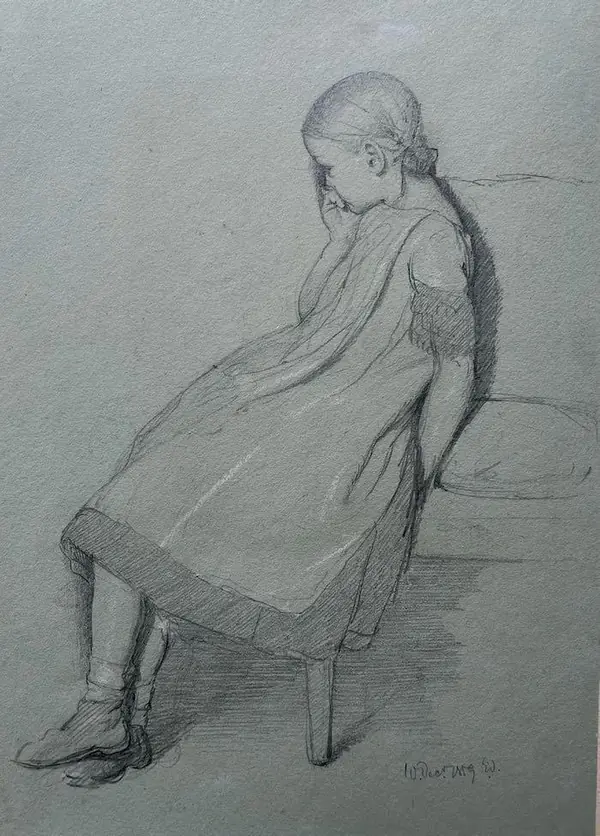
KT636
Watercolour over traces of pencil with touches of gum arabic and scratching out
21 x 29 cm.; 8 ¼ x 11 3/8 inches
Provenance
Agnew’s, (1891);
Private collection, Herefordshire until 2024
Samuel Jackson has been described as ‘the Father of the School’ of Bristol artists. His contemporary Francis Danby (1793-1861) wrote that ‘I know Jackson is a man of genius by being with him in Leigh Woods’ (see F. Greenacre and S. Stodard, ‘The Bristol Landscape-the Watercolours of Samuel Jackson’, 1986, p. 85).
In 1820s Bristol was booming, the end of the Napoleonic Wars contributing to its prosperity as a trading city, the port of Bristol second only to London. This was the moment the ‘Bristol School of Artists’ flourished; Jackson and Francis Danby were its best-known members. Their original contribution to art in Britain was founded in their plein air practise in the countryside around the city, Leigh Woods, the Nightingale Valley and the Avon Gorge.
Jackson was born in Bristol, the son of a partner in a firm of dry-salters with a Dutch grandmother, who dealt in the chemical products used in colour dyes and artists materials. It may be that in this business was the origin of the wide variety of pigments used in much of Jackson’s early work. Like many other Bristol artists Jackson travelled extensively and made frequent trips to Wales from 1825 through the 1830s and 1840s. In 1827 he visited Trinidad, St Vincent and Tobago in the West Indies. Scotland, the Lake District and Switzerland provided further subjects for his exhibited works. He lived in Bristol for his whole life becoming the elder statesman of the arts in the city.
Jackson’s work is well represented at the British Museum, Bristol City Art Gallery and the Yale Center for British Art amongst other institutions.
You Might Also Like
KT383Watercolour over pencil heightened with gum arabic and scratching out24.7 x 35.5 cm.; 9 7/8 x 14 inchesProvenance: Christopher and Rosemary Warren until 2020Exhibited: City of Bristol Museum and Art Gallery, ‘The Watercolours of Samuel Jackson 1794-1869’, 1986, no. 33 (private collection)This atmospheric and beautifully preserved watercolour dates from circa 1825. Jackson’s observation of gentle evening light and the reflections on the Avon are masterful. The well-recorded evening sketching meetings of the Bristol artists and amateurs in Leigh Woods at this time doubtless inspired Jackson to tackle this popular subject at dusk.Samuel Jackson has been described as ‘the Father of the School’ of Bristol artists. His contemporary Francis Danby (1793-1861) wrote that ‘I know Jackson is a man of genius by being with him in Leigh Woods…’(see F. Greenacre and S. Stodard, ‘The Bristol Landscape-the Watercolours of Samuel Jackson’, 1986, p. 85).His work is well represented at the British Museum, Bristol City Art Gallery and the Yale Center for British Art amongst other institutions.
View detailsSigned and dated l.r.: W. Callow.1833, watercolour over traces of pencil with scratching outProvenancePrivate collection U.K. until 2026This fine example of Callow’s work dates from the time he was sharing a studio in Paris with Thomas Shotter Boys at 19 Rue de Bouloi near the Louvre. He visited England during the summer and presumably travelled through Dover.
View details£2,250
Stamped with the artist’s stamp l.l., watercolour over pencil heighted with white on rough buff paper32.3 x 46.5 cm; 12 5/8 x 18 ¼ incheProvenance: Christie’s, London, the Artist’s Studio sale, March 13 -17, 1884 (13 gns);The Fine Art Society, London, April 1966;Hermione Hobhouse (1933-2014);By family descent until 2020Exhibited: Glasgow International Exhibition, 1888Literature: Delia Millar, 'The Victorian Watercolours in the Collection of Her Majesty The Queen', 2 vols., London, 1995, no. 3422Osborne House on the Isle of Wight was a summer retreat built for Queen Victoria and Prince Albert between 1845 and 1851, designed by Albert himself in the style of an Italian palazzo. The stone lions shown here at the foot of the steps, copied from the antique, were acquired in January 1851, and were in place by 9 March 1851. The groups of children possibly include Princess Helena and Princess Louise, described by their mother as 'looking extremely pretty in little blue silk polkas, with white silk hats' (Queen Victoria’s Journal, 15 August 1851).There is another smaller version of this watercolour in the Royal Collection dated August 1851 (RCIN 919847). The present drawing would seem to be the preliminary drawing as passages are unfinished. The version in the Royal Collection has an additional figure group at the bottom of the stairs. Leitch also drew two further watercolours of Osborne under construction drawn circa 1847 (RCIN 91982 and 91983). William Leighton Leitch was one of Queen Victoria's favourite watercolour artists, and she commissioned many watercolours from him for her View Albums. Leitch also taught watercolour to the Queen and her children, all of whom copied his work. He stayed at Osborne from 31 July 1851 and for most of August that year. It has been suggested that this drawing may have been made as a drawing lesson for some members of the Royal Family.Hermione Hobhouse was an architectural historian and preservation campaigner. During her distinguished career, during which she acted as secretary of ‘The Victorian Society’ from 1976-1983, she wrote numerous books, including Prince Albert: His Life and Work, 1983.Stamped with the artist’s stamp l.l., watercolour over pencil heighted with white on rough buff paper32.3 x 46.5 cm; 12 5/8 x 18 ¼ incheProvenance: Christie’s, London, the Artist’s Studio sale, March 13 -17, 1884 (13 gns);The Fine Art Society, London, April 1966;Hermione Hobhouse (1933-2014);By family descent until 2020Exhibited: Glasgow International Exhibition, 1888Literature: Delia Millar, 'The Victorian Watercolours in the Collection of Her Majesty The Queen', 2 vols., London, 1995, no. 3422
View detailsInscribed verso: Primrose Hill coloured on the spot by/Girtin, watercolour over pencil on oatmeal paper.19.7 x 48.7 cm.; 7 ¾ x 19 inchesProvenanceArthur Boney, his sale, Sotheby’s, 7 October 1947, lot 34, bought by P. & D. Colnaghi & Co. , London;Ray Livingston Murphy (1923-1953), New York, by 1950, his sale, Christie’s, 19 November 1985, lot 35; Robert Tear, OBE (1939-2011), his sale, Sotheby’s, 9 July 2014, lot 189;With Guy Peppiatt Fine Art;Private collection, U.K. until 2024LiteratureT. Girtin and D. Loshak, The Art of Thomas Girtin, 1954, no. 416, p. 191;G. Smith, Thomas Girtin (1775-1802): An Online CatalogueArchive and Introduction to the Artist, TG1761ExhibitedNew Haven, Yale University Art Gallery, Prospects, 1950, no. 18., pl. 9b;Guy Peppiatt Fine Art, London, British Drawings and Watercolours, 2015, no. 17This panoramic landscape has been identified as showing Primrose Hill in north London, on the basis of an inscription on the back of the drawing, and Thomas Girtin (1874–1960) and David Loshak consequently dated it to 1800–1801. The area was then undeveloped. It did not become a place of leisure and recreation until well into the nineteenth century, since when the rapid expansion of the city northwards changed the appearance of the landscape so greatly that it may never be possible to confirm the identification of the view with certainty.The work may well have been coloured on the spot, as the inscription suggests, as it is worked in a limited palette without much foreground detail.
View detailsSigned with initials l.r.: HBB, watercolour and bodycolour over pencil, inscribed verso: Siracuse and stamped with collector’s markProvenanceGilbert Davis (L. 757a.);Edward Seago, his estate sale at Christie’s, London 1 March 1977, lot 94;Where bought by B.M. Williams;Christie’s, London, 21 November 2007, lot 145, where acquired by the previous owner until 2025 Gilbert Davis (1899–1983) built up a large collection of watercolours in the middle of the twentieth century. He sold the bulk of his collection in 1959 to the Huntingdon Library and Botanical Gardens in San Marino, California. Edward Seago RBA, RWS (1910-1974) was one of the most popular British artists of 20th century, who painted in oils and watercolours.
View detailsSigned with monogram l.r., inscribed l.l.: near Calikut., watercolour heightened with touches of bodycolourProvenanceFranklin Lushington (1823-1901) and thence by descentLear was invited to India by his friend and patron Lord Northbrook who was appointed Viceroy in 1871, and his journey there was the last and longest of his life. He was overwhelmed by the colour and vitality of India and enjoyed the bustle of Viceregal life.Calicut, or present-day Kozhikode, is on the Malabar coast in Kerala and was a centre of the Indian spice trade. Edward Lear arrived there in October 1874, just as the monsoon began. He was warned about the dangers of contracting fever but stayed, despite the pouring rain, until the skies were clear enough to draw. He described the roads around the city as “of such redundant beauty one can hardly dream.” Franklin Lushington, Lear’s close friend and first owner of this drawing, was the son of Edmund Henry Lushington. He was appointed judge to the Supreme Court of Justice in the Ionian Islands in 1855 and Lear went with him to live in Corfu. They first met in Malta in 1849, where Franklin’s elder brother Henry was Chief Secretary to the government. On his death, Lear left all his papers to Lushington, who later destroyed most of them.
View detailsSamuel Palmer, RWS (1805-1881)La Vocotella near Corpo di Cava, ItalyPencil and watercolour heightened with bodycolour with scratching out 26.7 x 37.8 cm.; 10 ½ x 14 7/8 inchesProvenanceWith Agnew’s, London 2002, no. 53Anonymous sale Sotheby’s, London, 23 November 2006, lot 145;W/S Fine Art, ‘Andrew Wyld: Connoisseur Dealer’, Christie’s, London, 10 July 2012, lot 147;Timothy Clowes, his sale at Sotheby’s, London, 23 September 2021, lot 148;Where bought by a private collector until 2026Samuel and Hannah Palmer stayed at a small inn at Corpo di Cava on their Italian honeymoon in the summer of 1838. The inn overlooked a Benedictine monastery and a ravine. During this very happy period of his life, Palmer produced some of his finest watercolours, which combined the mysticism of his Shoreham work with more Italianate composition and structure. He told his friend George Richmond that it was here that he felt he was ‘no longer a mere maker of sketches, but an artist’ (E. Malins Samuel Palmer’s Italian Honeymoon, 1968, p. 73).This watercolour is constructed on classical lines with the receding serpentine path with a figure and is infused with the golden glow of Italian sunlight.A similar watercolour of the same place from a different viewpoint is in the collection of the Graves Art Gallery Sheffield (see R. Lister Catalogue Raisonné of the works of Samuel Palmer, 1988, no. 311, pp. 126-7, ill.). In a letter to her parents, written during August 1838, Hannah Palmer mentioned two views of Corpo di Cava by her husband. Presumably one is the Graves Art Gallery drawing and the present work may be the second which Raymond Lister records as untraced (R. Lister, Catalogue Raisonné of the Works of Samuel Palmer, Cambridge 1988, see no. 310).
View details