
Signed with initials l.l.: E.A., watercolour over traces of pencil heightened with bodycolour and stopping out, with touches of red chalk, in a period burr maple frame Sheet 38.9 x 27.6 cm.; 15 ¼ x 10 ¾ inches, painted area 33 x 18 cm.; 13 x 7 inches Provenance Christie’s, London, 3 February 2000, lot 160; Sotheby’s, Gleneagles, 30 August 2000, lot 1153; Private collection, London until 2023 Alexander is best known for his exquisite watercolours of flora, fauna and the natural world. Alexander studied at the Royal Institution, Edinburgh from 1887-8, and in Paris with the sculptor Emmanuel Frémier. In 1887-8 the artist travelled to Tangier with his father and fellow artists Pollock Nisbet and Joseph Crawhall. He returned to Egypt in 1892 and lived there for four years. After his return he married Dora, moved to just outside Musselburgh, and created a menagerie that he used for his work. Plants remained important subjects for his painting and, in 1909, he illustrated J. H. Crawford’s The Wild Flowers. In 1902 Alexander was elected an associate of the Royal Scottish Academy becoming a full member in 1913. He exhibited widely including at the Royal Scottish Academy, Royal Academy, Fine Art Society, Royal Watercolour Society and the Leicester Galleries. Alexander’s work is held in the Tate Gallery, Aberdeen Art Gallery, Dundee Art Gallery and by Fife Council.
SoldView details10 items
20th Century (SOLD)
Sold 20th Century — British 20th century works on paper and occasional oils from circa 1900-1950.


Signed with initials and dated l.r.: EA/1904, watercolour and bodycolour over traces of pencil on rough brown paper Image size 17.5 x 22.8 cm.; 6 7/8 x 9 inches, sheet size 22.5 x 27.5 cm.; 8 7/8 x 10 ¾ inches Frame size 37.5 x 43 cm.; 14 ¾ x 16 7/8 inches Provenance Private collection. U.K., until 2020 Alexander studied at the Royal Institution, Edinburgh from 1887-8, and in Paris with the sculptor Emmanuel Frémier. In 1887-8 the artist travelled to Tangier with his father and fellow artists Pollock Nisbet and Joseph Crawhall. He returned to Egypt in 1892, after his artistic studies, and lived on a houseboat on the Nile for 4 years, painting in the desert. This drawing appears to be of North Africa, the evocative rooftops an engaging subject on the characteristic oatmeal paper he often used. In 1902 Alexander was elected an associate of the Royal Scottish Academy becoming a full member in 1913. He exhibited widely including at the Royal Scottish Academy, Royal Academy, Fine Art Society, Royal Watercolour Society and the Leicester Galleries. Alexander’s work is held in the Tate Gallery, Aberdeen Art Gallery, Dundee Art Gallery and by Fife Council.
ReservedView details
Signed and dated l.r.: Edward Bawden/1948, pen and grey ink and watercolour 46 x 59 cm.; 18 x 23 inches Provenance Miss N.B. Allen, purchased in 1949 from the Leicester Galleries, London; Spink, K3 10536; Private collection, U.K. until 2022 Exhibited Leicester Galleries, London: ‘Works by Edward Bawden CBE, ARA’, February 1949, no. 1 Bawden lived in Great Bardfield in Essex from the 1930s to 1970 and was a central figure of the Great Bardfield Artists.
SoldView details
Signed l.r., watercolour 28 x 12 cm
SoldView details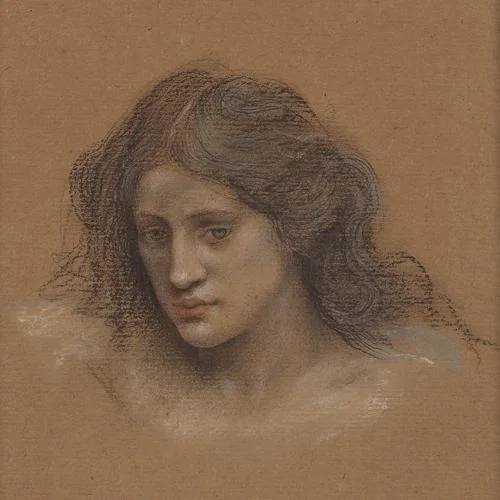
Evelyn De Morgan (1855 – 1919) The head of a woman Coloured chalks on buff paper 35.8 x 23.4 cm.; 14 1/8 x 9 ¼ inches Provenance Private collection U.K., by descent until 2024. This beautiful drawing of the head of a woman deep in thought may be a study for the figure of Purity in De Morgan’s 1914 painting 'The Vision', also known as ‘1914', an allegorical painting inspired by World War I. The work depicts two women representing Peace and Purity in the foreground, with a demon representing war behind them (private collection, with the Louise Whitford Gallery/David Hughes in 1981). De Morgan was a pacifist, deeply moved by the horrors of the Boer War (1899-1902) and World War I, who made over fifteen paintings criticising war.
SoldView details
Duncan Grant (1885-1978) The Blue Tablecloth Signed and dated l.l.: D. Grant/32, oil on canvas board Provenance Thomas Agnew & Sons, London (7524); sold to Isobel Jeans, 20 July 1932; Wyndham T. Vint, Bradford; Christie’s London, 16 July 2014, lot 102 where bought by the present owner Grant’s painting style was influenced by the French Post-Impressionist exhibitions organized in London by Roger Fry in 1910. He painted still lifes throughout his life, constantly juxtaposing different objects, fruit and plants on a tabletop. Here the skillfully painted blue tablecloth provides a backdrop to the carefully arranged bowl of fruit with black grapes, bananas and apples juxtaposed with a bottle, seen in many of his still lifes. A couple of red roses balance the composition. This still life was most probably painted at Charleston, Grant’s home in Sussex which he shared with Vanessa Bell. He moved there with his lover David Garnett and Bell’s two children Julian and Quentin. Their father Clive Bell was a frequent visitor, although he kept his permanent home in London. Agnew’s sold many paintings for Duncan Grant over the course of his lifetime.
SoldView details
Pencil 26.5 x 18 cm.; 10 1⁄2 x 7 1/8 inches Provenance Estate of the artist (his daughter Henrietta Phipps), until 2000; Davis & Langdale Company, New York, 2000; Private collection, from 2000 until 2023 Exhibited: Davis & Langdale Company, New York, 2000, Henry Lamb: Works on Paper, no. 13 [checklist] This compelling drawing was executed around 1930. Henry Lamb was born in Adelaide, Australia in 1883, shortly before his father moved the family to Manchester, where he spent his childhood. He studied medicine before abandoning this path to be an artist. At twenty-two he left for London to study under Augustus John and William Orpen at their Chelsea Art School. John was a particularly formative influence and Lamb moved to Paris with him a few years later. Lamb spent a couple of summers on the south coast of Brittany, in search of a more traditional way of life. This impulse drew Lamb to Gola Island in Northern Ireland two years later. In London in 1905, Lamb joined the Fitzroy Street Group and was a founding member of both the Camden Town Group and the London Group. He married Nina Forrest, or Euphemia, in 1906 but the marriage proved short-lived. He was friendly with the Bloomsbury Group, having known Vanessa Stephen and Clive Bell from his early days in London, but he often had little patience with them. He was close friends with the eminent critic and biographer Lytton Strachey and between 1912 and 1914 he painted his portrait, now held in the Tate and one of his greatest works. In the First World War, Lamb served as a doctor in the Royal Army Medical Corps in France, Salonika and Palestine; he was awarded the Military Cross. He was not an official war artist but drew extensively and the resulting oils are an important part of his oeuvre. In 1928 he married Lady Pansy Pakenham and moved to Coombe Bissett in Wiltshire. Lamb was appointed an official war artist for the Second World War, making portraits of soldiers and studies of servicemen at work across the South of England. Lamb was elected as an associate of the Royal Academy and a Trustee of both the National Portrait Gallery and the Tate at this time. He was finally awarded full membership of the Royal Academy in 1949. Interest in Lamb’s work has revived in recent years, and he has been the subject of recent exhibitions at Salisbury Museum and Poole Museum. His work can be found in many collections around the world, including the Tate, the Imperial War Museum, the Government Art Collection and the National Gallery of Canada.
SoldView details
Watercolour over pencil with a touch of bodycolour on brown paper 8 x 11 cm Provenance Holland & Holland
SoldView details
KT 490 SOLD Signed with initials and dated l.r.; A.T./April 3 1918, watercolour with bodycolour over pencil on green paper 18.7 x 14 cm.; 7 ½ x 5 ½ inches Private collection U.K. until 2021
SoldView details
SOLD Signed l.r.: A.T./oct.8.1918, watercolour over traces of pencil with touches of bodycolour on green paper 28 x 35.3 cm.; 11 x 13 7/8 inches Provenance The Moorland Gallery, Cork Street
SoldView details