
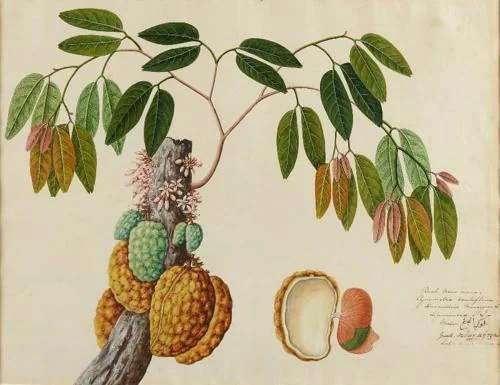
Inscribed l.r.: Buah Nam nam./Cynometra cauliflora. and with further botanical notes in Latin, Jawi and Greek, watercolour and bodycolour over traces of pencil with gum arabic, on laid paper watermarked: RUSE & TURNERS/1825 and with the Strasburg Lily 37.5 x 48.5 cm; 14 3/4 x 19 1/4 inches Buah Nam is a member of the family Fabaceae (legumes) native to Malaysia, a small, cauliflorous tree with a thick, heavily branched stem, and rather small flowers, about 1.2 cm across, that appear on the stem in clusters. The pod is edible with aromatic, juicy yellow pulp and large seeds. Provenance Sharon and Anne Hamlyn until 2019 These fine examples of watercolours by Chinese Artists of the Straits School are in the style of the Chinese artists who worked for Sir Stamford Raffles in Singapore and Major-General William Farquhar (c.1771-1839) who was Resident of Malacca from 1808-1818. The frequent movements of trade and personnel between India and China, via ports on the Malay peninsula including Malacca and Prince of Wales Island, meant that collectors frequently had both Indian and Chinese drawings in their collections. Henry Noltie has suggested that this school is named ‘Straits School’ (see Forgotten Masters Indian Painting for the East India Company, ed. W. Dalrymple, 2019, pp. 78-82). British patrons commissioned local Chinese artists to draw the flora and fauna of Malacca and the extensive botanical annotations in Jawi, the Malay script derived from Arabic, Romanised Malay, Latin and Greek and with reference to the Linnaean system of classification, created by Carl Linnaeus (1707-78) are typical of this material. The accumulation of natural history drawings by officials of the British East India Company gave rise to the term ‘Company School’, now out of favour, which has been used to describe the work of Indian or Chinese artists for British patrons. The distinctive style is a result of a fusion of two artistic traditions, the European with its desire for realism and the Asian taste for a more stylised approach. The eighteenth and early nineteenth century saw an enormous rise of interest in Europe in the study of natural history by both scientists and amateurs. A knowledge of the subject was considered to be an important part of a liberal education and many people studied ‘natural philosophy’ and the various branches of natural history. Accurate drawings were vital tools in classification as well as a reminder of the excited reaction to new discoveries.
SoldView details153 items
Landscapes (SOLD)
Sold Landscapes — British 18th, 19th and early 20th century works on paper depicting landscapes by leading artists of the golden age of British watercolour from Paul Sandby to Edward Lear and interesting examples by amateur artists of the period with a particular interest in rare views by artists who travelled widely. The gallery only handles works on paper in excellent condition.
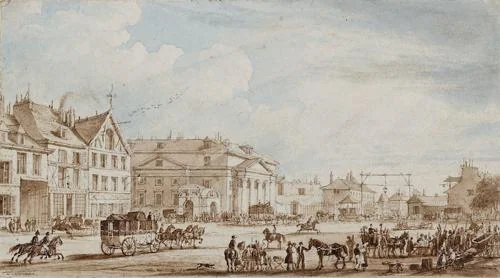
Signed l.l.: J Nash., pen and brown ink and watercolour over traces of pencil 8 x 14.4 cm.; 3 1/8 x 5 ¾ inches Framed size 22 x 28 cm.; 8 ½ x 11 inches Engraved By W. Taylor for Paris and its Environs, Displayed in a Series of Two Hundred Picturesque Views, from Original Drawings, Taken Under the Direction of A. Pugin, Esq. the Engravings Executed Under the Superintendence of Mr. C. Heath. With Topographical and Historical Descriptions, (1828 - 1831) This drawing dates from 1829 and records the building before 29 July 1830, when there was a famous fire at this site, causing significant damage. Joseph Nash was born in Great Marlow, Buckinghamshire. He was the eldest son of Okey Nash, who took holy orders and became the proprietor of the Manor House School, North End, Croydon where Nash was educated, and displayed early talent at drawing. Around 1827 Nash entered the architect’s office of Augustus Charles Pugin, at 105 Great Russell Street, Bloomsbury, London, to learn the art of architectural drawing. Two years later, he and his fellow apprentices accompanied Pugin on a trip to France toproduce drawings for Paris and its Environs (1830). He developed his skill as a lithographer, and also prepared Pugin’s drawings for Views Illustrative of the Examples of Gothic Architecture (1830).
SoldView details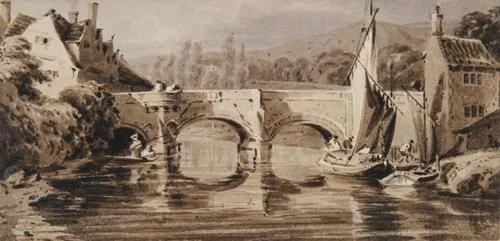
SOLD Brown wash over traces of pencil with scratching out and touches of gum arabic, signed or inscribed in pen and brown ink verso: Bishop Bridge/Norwich/, Thirtle, inscribed on old mount: Bishop’s gate/Norwich./Thurtell 10 x 20.9 cm Provenance: Augusta Raymond-Barker, Fairford Park, Gloucestershire; thence by family descent until 2016 Thirtle drew Bishop’s Bridge on many occasions. He exhibited the subject four times with the Norwich Society in 1806 (101), 1807 (36), 1811 (138) and 1817 (62). Five other views of the bridge are recorded: see Marjorie Allthorpe-Guyton, John Thirtle 1777–1839, 1977, pp. 44-5. Bishop’s Bridge over the Wensum is the only remaining medieval bridge in Norwich and was so named because it led directly to the Bishop’s Palace. It was probably built after 1275, when a patent was granted to the Prior to erect a gate ‘with a bridge 20 feet broad thereto adjoining’. It was controlled by the bishops until 1393, and later a rectangular tower was constructed which occupied most of the western half of the bridge; this was demolished at the end of the eighteenth century. The range of early gabled buildings to the north of the bridge were demolished in 1878; the Red Lion pub is still there today.
SoldView details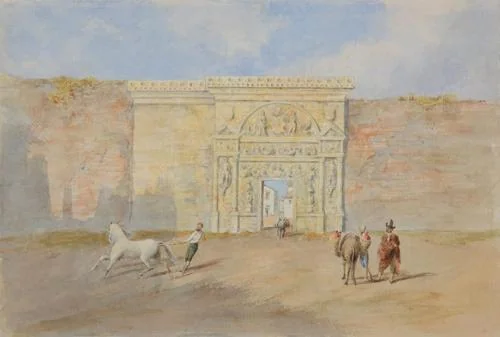
Signed with initials, inscribed and dated verso: G.D. 1836/Puerta Romana/Cordoba, watercolour over pencil 22 x 32 cm Provenance Bernard Williams Weller (1870-1944), journalist and critic George Dennis was an English artist, explorer and writer. He left school at 15 but was a prodigious linguist, who taught himself ancient Greek and Latin then learnt Spanish, French, Portuguese and several other languages. His intrepid spirit inspired his first visit to Spain in the 1830s. From Cadiz he travelled to Grenada through the Sierra Nevada, visiting Cacin, Alhama, the Tajo, the Sierra Tejada, Velez, Malaga and Ronda. He continued on to Gibraltar via Benadalid, Gaucin, Posada amongst other places and then finally returned to Cadiz. The roads were dangerous and he encountered difficulties with banditti. He also ventured further north visiting Tudela, Zaragoza, Toledo and Illesas. His first work, ‘A Summer in Andalucia’ (2 volumes) was published in 1839. Dennis travelled further in Italy and made an illustrated study of the cemeteries of Etruria, which was published in 1848 by the British Museum, London and he completed the first account of Etruscan sources in the modern era. He joined the Colonial Service later in life and became vice-consul to Sicily, and subsequently to Benghazi and Smyrna. He was a companion of the Order of St Michael and St George.
SoldView details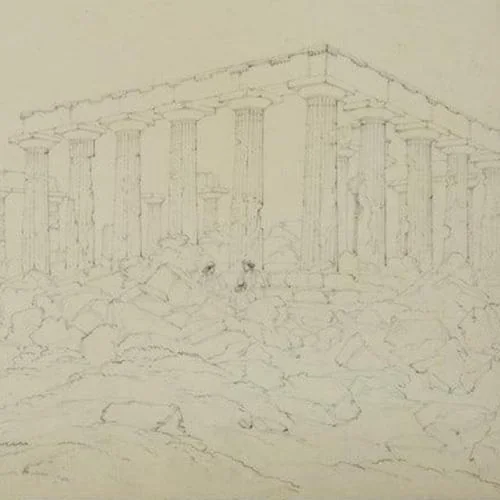
Graphite 38 x 55 cm This drawing, made with aid of a camera obscura, shows the picturesque temple of Jupiter Panhellenius, which stands on Mount Panhellion and commands a view of the Saronic Gulf. The temple is dedicated to Aphaia, a goddess whose cult was found only at Aegina, and it is one of the loveliest late Archaic temples in Greece. In 1811 C. R. Cockerell and Baron Haller von Hallerstein excavated the site and found the fallen pedimental sculpture from the temple, dating from circa 510 to 490 BC. Seventeen of the statues that they excavated were acquired by Ludwig I of Bavaria, and are today in the Glyptothek in Munich. Pomardi drew this view from the same spot on Mount Panhellion He and Dodwell evidently liked Aegina, and they produced nearly thirty drawings of the temple and its surroundings.
SoldView details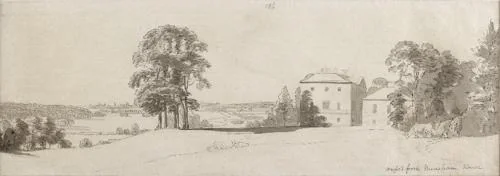
KT343 Inscribed l.r.: Oxford from Nuneham House and numbered 186, pen and grey ink and grey wash over pencil on laid paper, watermarked with the Strasburg lily 15.7 x 45.4 cm; 6 1/8 x 17 7/8 inches Framed in a gilt moulding Provenance: Iolo Williams, by descent in his family until 1999; W/S Fine Art, 100 British Drawings and Watercolours, 2008, no. 78 Exhibited: London, The Guildhall Art Gallery, Paul Sandby exhibition, 1960, no. 80 The Earl of Harcourt was an important patron of the artist. Stiff Leadbetter, the architect, built his new villa outside Oxford near Abingdon from 1756-1760. The house was designed to be fire-proof as the family had lost one of its members in a house fire some years before. Sandby was employed at Nuneham as a drawing master to the three children of the Earl, and whilst staying there, he designed one of the fireplaces for the new house. He painted the house and park in oils twice, and one of these large works was exhibited at the first Society of Artists’ exhibition in 1760. The present drawing was developed into a finished watercolour (in a private collection) which was engraved by Michael Angelo Rooker for The Copperplate Magazine in 1778.
SoldView details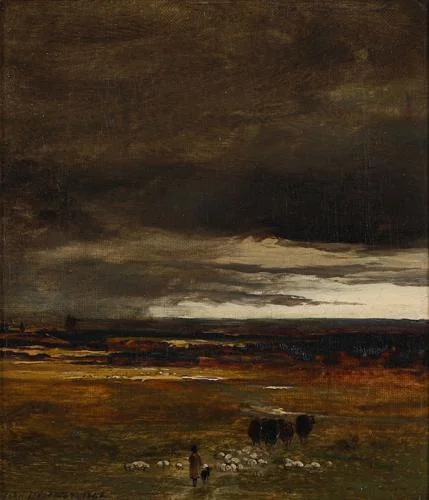
KT379 Signed and dated l.l.: John Dearman 1845, signed and inscribed on stretcher: Cattle crossing Merrow Down Guilford Surrey/storm passing off.Jn. Dearman 184., oil on paper laid down on canvas stamped PREPARED BY/CHARLES ROBERSON/LONG ACRE LONDON 18 x 15.4 cm.; 7 x 6 1/8 inches Frame size 28 x 26 cm.; 11 x 10 inches Provenance Christie’s, London (1002V); John Abbott (1937-2011) This delightful oil sketch captures a huge brooding sky with distant light breaking through which suggests that the storm is passing. The grandeur of nature is enhanced by the small figure of a shepherd with a flash of red at his neck, with his dog and flock of sheep, which draw the eye to the foreground. Virtuoso handling of the impasto of the landscape in the middle distance show the work of an artist spontaneously enjoying his paint. Dearman also records the weather effects on the stretcher in his neat hand. The artist lived in Camberwell, London in the 1830s and had a house in Guilford High Street. He exhibited at the Royal Academy between 1824-1856 and also showed often at the Royal Society of British Artists and the British Institution.
SoldView details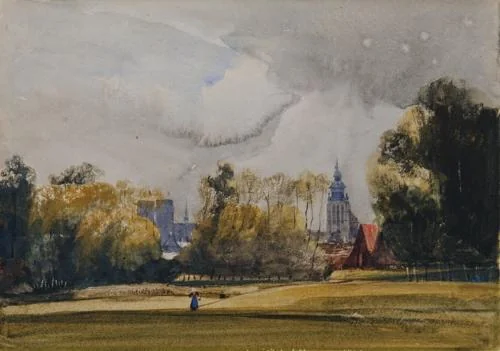
Watercolour with bodycolour and scratching out, inscribed verso in pencil: Hors du port de Hal. The distinctive tower of Notre Dame de la Chapelle, where Pieter Bruegel the Elder is buried, is seen on the right-hand side of the composition. It was built near the city walls in the twelfth century, although the remains today date from a century later. The nearby Porte de Hal is the only surviving fortified city gate of the walls of medieval Brussels. The two towers of Brussels cathedral balance the view to the left. Boys made several visits to Belgium in the late 1820s and early 1830s and was in Brussels during the Belgian Revolution of 1830. His wife Célestine was Belgian, her home either in or near Soignies. The artist’s virtuoso mastery of watercolour techniques is splendidly illustrated in the deft handling of the medium in this drawing. Provenance: The artist’s sale; John Manning, 8 Bury Street; Thomas Agnew & Sons, London; Anthony Molins, his sale at Sotheby’s London, 24 November 1977; Private collection, UK
SoldView details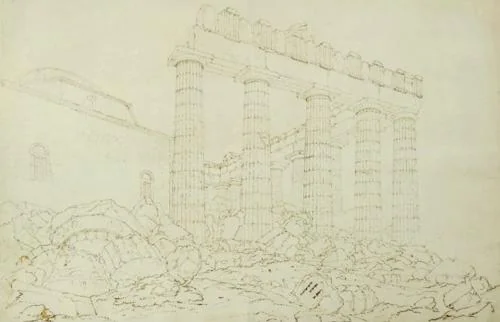
Signed and inscribed l.r.: PARTHENON./ATHENS/W.PAGE, pen and brown ink over traces of graphite 63.5 x 97 cm This drawing, made with the aid of a camera obscura, depicts the east end of the south side of the Parthenon and clearly shows the empty spaces left after the removal of the sculpted metopes in 1801 by Giovanni Battista Lusieri and his team, acting on the instructions of Lord Elgin. Edward Dodwell witnessed the removal of some of these metopes, which were fixed between the triglyphs, causing the destruction of the cornice which covered them, as it had to be thrown to the ground in order to lift them out. Most of the metopes on the south side depict Centaurs fighting Greeks, and the fifteen metopes in the British Museum today all come from here. The original position of eight of them is shown in this drawing and would have been of great interest to the British public. The Parthenon was used as a powder store by the Ottomans, who held the Acropolis during its bombardment by the Venetians in 1687. The attack inflicted significant structural damage on the building, as recorded in this drawing. The small mosque was built in the ruins circa 1700, and a minaret was made from the old bell-tower. The mosque was demolished in 1840.
SoldView details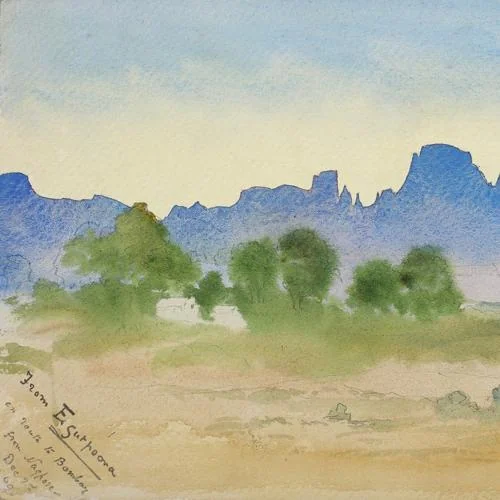
Inscribed and dated l.l.: From Egutpoora/en route to Bombay/from Nagpore/Dec 2nd/69, watercolour over pencil. The artist stopped in Nagpore ‘the city of the Naga’, or serpent, on the railway to Bombay, In the Himalayas, p. 569. For further work by this artist please click this catalogue link and enquire about availability.
SoldView details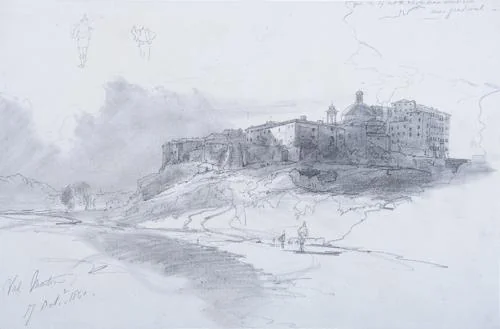
Inscribed and dated l.l.: Val Montone-17 Oct.br 1840., inscribed with artist’s notes, graphite 26 x 39.7 cm; 10 1/4 x 15 5/8 inches Provenance Sir Robin Darwin, R.A.; Lady Darwin; Spink, where bought by the present owner; Private collection, U.K. Exhibited Royal Academy, London, Edward Lear 1812-1888, 1985, no. 15i, ill p. 92 Lear went to Italy in the summer of 1837. For most of the next ten years the artist wintered in Rome and toured other parts of Italy during the summer. He spent the winter months in and around Rome making frequent visits to the Campagna. He wrote in a letter to his sister Ann that Val Montone was: one of the most elegant campagna towns and very curious: it is in a deep dell in the Latin valley- but rises on a mound- crowned with a superb church and castle-though the town itself is wretchedly poor…Fine trees are all around Val Montone- and it is altogether a delightfully quiet place (recorded in the 1930s typescript of the lost manuscript of Lear’s letters to Ann, 11 October 1838). Another view of Val Montone is included in Views in Rome and its Environs, 1841, plate 25. Sir Robert Vere ‘Robin' Darwin KCB CBE RA RSA PRWA NEAC (1910 – 1974) was a British artist and Rector of the Royal College of Art. He was the son of the golf writer Bernard Darwin and his wife the engraver Elinor Monsell and a great-grandson of the naturalist Charles Darwin.
SoldView details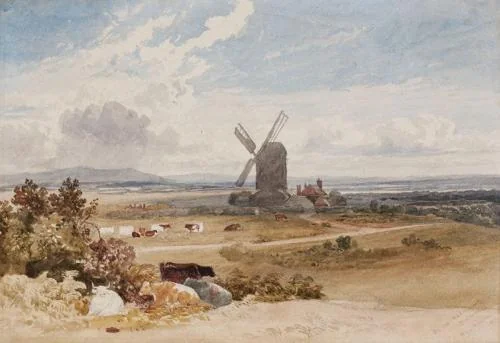
KT341 Signed, inscribed and dated l.r.: On the Holmwood/Dorking/H. Gastineau/1864(?), watercolour over pencil with touches of gum arabic 27 x 37.5 cm.; 10 5/8 x 14 ¾ inches A prolific and successful watercolourist, Gastineau travelled widely in the British Isles and abroad. He was based in Camberwell, London from 1827. Gastineau exhibited numerous views of Surrey throughout his long career. His work may be found in many UK museum collections.
SoldView details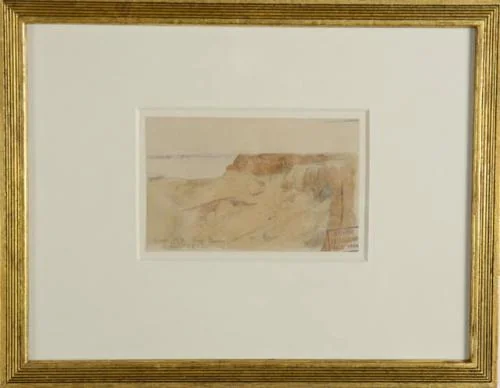
Inscribed and dated l.l.: Tombs of the Kings Thebes/15 Jan 1847 and stamped with atelier stamp inscribed and dated NICE 1954, watercolour over pencil 9.5 x 15 cm
SoldView details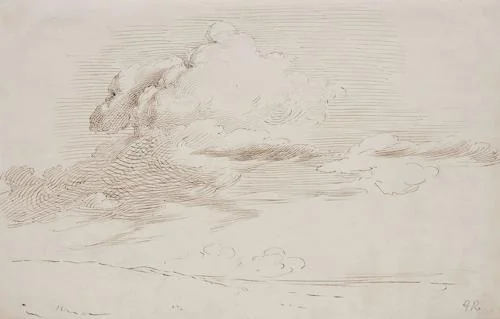
Signed with initials lower right: GR, pen and brown ink 13 by 20.9 cm; 5 ¼ x 8 ¼ inches Provenance: Cyril and Shirley Fry until 2021 This beautiful, spare drawing probably dates from the 1840s. Richmond added his initials in pencil to many of his drawings towards the end of his life.
SoldView details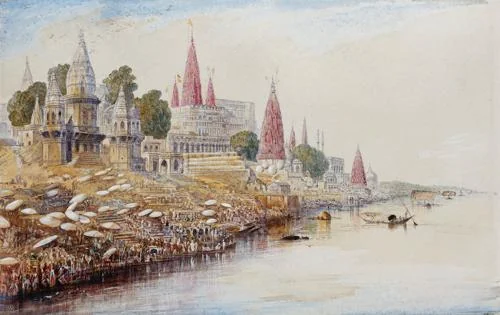
KT487 Signed with monogram l.l., watercolour over pencil heightened with bodycolour and gum arabic 25.5 x 40 cm.; 10 x 15 ¾ inches Provenance Sir Sacheverell Sitwell, Bt. (1897-1988); Francis Sitwell (1935-2004); By descent at Weston Hall, Northamptonshire until 2021 Lear was invited to India by his friend and patron Lord Northbrook who was appointed Viceroy in 1871, and his journey there was the last and longest of his life. He was overwhelmed by the colour and vitality of India and enjoyed the bustle of Viceregal life. After leaving Lord Northbrook, Benares was one of the first places Lear visited, arriving on 12th December 1873. Lear describes Benares in his ‘Indian Journal’, on December 13-14 1873, (ed. Ray Murphy, 1953, pp. 45-6): ‘Nothing short of a moving opera scene can give any idea of the intense and wonderful colour and detail of these Benares river banks… ‘Got a boat, a large one, for on one can have the last idea of this Indian city’s splendour without this arrangement. Utterly wonderful is the rainbow-like edging of the water with thousands of bathers reflected in the river. Then the colour of the temples, the strangeness of the huge umbrellas and the inexpressibly multitudinous details of architecture costume etc. Drew, more or less, as I was slowly row’d up and down the river…Howe well I remember the views of Benares by Daniell, R.A.; pallid, gray, sad solemn. I had always supposed this a place of melancholy or at least a staid and soberly-coloured spot, a gray record of bygone days,. Instead, I find it one of the most abundantly bruyant, and startlingly radiant of places full of bustle and movement. ‘ This drawing used to hang in Sir Sacheverell Sitwell’s study and dressing room at Weston Hall, Northamptonshire, where he did all his writing.
SoldView details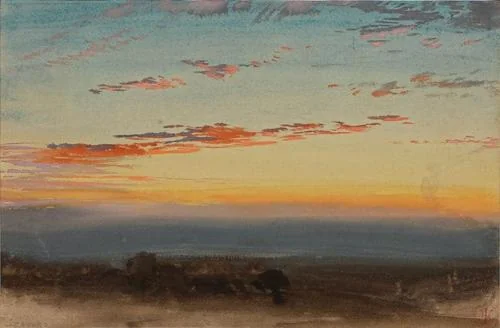
KT381 Signed with monogram l.r., inscribed with title l.l., watercolour with bodycolour and 16 x 25 cm; 6 ¼ x 9 ¾ inches Framed size 35.5 x 42 cm.; 14 x 16 ½ inches SOLD Provenance Martin Hardie (1875-1952); Christopher and Rosemary Warren, Bristol until 2020 Johnson was born in Birmingham where he studied under Samuel Restell Lines. He was then a pupil of William James Müller in London, accompanying him on Sir Charles Fellowes’ expedition to Lycia in 1843. On Johnson’s return to London he became a founder member of the Clipstone Street Academy, along with Müller, participating in its life drawing and painting sessions with a variety of models from the streets. Johnson made sketching trips with David Cox to North Wales from 1844. The artist was elected an associate member of the R.I. in 1868 and a full member two years later. His work can be found in many museum collections, including the British Museum, Victoria & Albert Museum and the Fitzwilliam Museum. Martin Hardie (1875-1952) was the author of the three-volume bible of British watercolourists Water-Colour Painting in Britain and a curator at the Victoria & Albert Museum. He was also an authority on print making on which he published extensively as well as a practising artist in both watercolour and etching.
SoldView details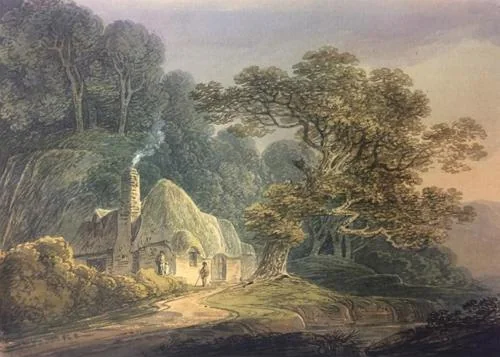
Sign in pen and brown ink verso: W. Payne, watercolour over traces of pencil with scratching out 21 x 29.5 cm Provenance Blair Castle, Blair Atholl, Scotland
SoldView details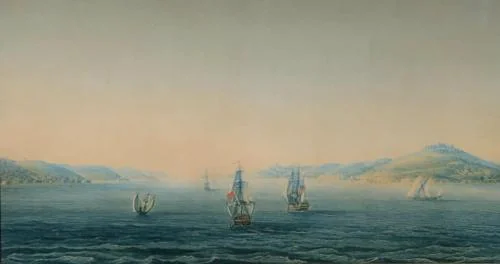
Inscribed l.l.: No 1, watercolour over traces of pencil with touches of gum arabic and scratching out, inscribed with title and numbered on reverse of backing: Vue de l’embouchure de la Mer Noire, further inscribed in white bodycolour on a strip originally below the watercolour, now attached to the reverse of the frame: Vue d’une partie du Bosphore où l’on decouvre dans le lointain l’embouchure de la mer noire 42 x 79 cm Provenance Private collection U.S.A., until 2016 Engraved ‘Le Voyage pittoresque de Constantinople et des rives du Bosphore d’après les dessins de M. Melling, architecte de l”Empereur Sélim III et dessinateur de la Sultane Hadidgé, sa soeur’, no. 44, published 1819, Paris, by Treutel and Würtz This recently rediscovered original watercolour by Melling for his Voyage is an exciting addition to his known oeuvre and presents the mouth of the Bosphorus as if seen from a ship on the water. The focus of Melling’s great print epic of 1819, ’Voyage picturesque de Constantinople et des rives du Bosphore’ was water, a reflection of the geographical situation of the city of Constantinople with its wide panoramas, and the unifying thread of his book. This precisely detailed, large and highly finished watercolour is probably the watercolour he provided for the engravers to work from. After training in his uncle’s atelier in Karlsruhe, Melling travelled in Italy, Egypt and to Smyrna, before finally arriving in Constantinople circa 1784 in the retinue of the Russian ambassador, Count Yakov Ivanovich Bulgakov. He spent time in the Russian palaces at Pera and Büyükdere and also taught drawing to the son of the Dutch ambassador (Walter, op cit., chap. 4 note 4). It was his design of the garden for the Danish ambassador Baron Frederik von Hübsch, native of Pera and head of the Galata Bank Hübsch and Timoni, a friend of Selim III, which led to his introduction to his sister Hatice Sultane. Melling worked for Hatice for most of his time in Constantinople, designing the garden for her Bosphorus palace and a pavilion for it with all its interior decoration. Elisabeth Fraser describes him as a ‘kind of artistic director in residence’ (op. cit. p. 131), overseeing everything from flowers to the design of luxury items. He lived in the wing of Hatice’s palace occupied by her husband Sayyid Ahmed Pasha and was as close to her as a court servant could become. Their correspondence records that Melling taught her the Latin alphabet and they communicated in an invented script of Ottoman Turkish transcribed into Latin characters based on Italian phonetics with a few Italian words. Sultan Selim then asked Melling to renovate his favourite palace on the Bosphorus at Besiktas where he built a kiosk, a gallery, an apartment for the Valide Sultana and a quay with a balustrade. There were plans for Melling to build a kiosk at Sarayburnu, and he expected to be named Selim’s official architect and designer, but the project was abandoned when the French invaded Egypt in 1798 and Melling lost his position around 1800. His unique position as an imperial insider, patronised by Hatice Sultane and Selim III himself, gave him a profound and rare insight into Ottoman society, and this privileged position allowed him to draw the imperial residences as well as the opportunity to draw and paint many views of the city. Melling moved to France with an introduction to Talleyrand, French minister of foreign affairs in Paris, and his lavish travel book, conceived in 1801, received significant official support in 12,000 francs worth of shares. This ambitious book, unusually large in size, (each print is 2 1/2 x 3 1/4 feet) comprises forty-eight prints (in etching and engraving) and special attention was taken over the quality of the engravings, text and paper. He contracted with the experienced engraver François Denis Née, who had worked with Choiseul-Gouffier, Cassas and d’Ohsson, in March 1803, to supervise the engraving process. On 7 December that year they signed a second contract with Treuttel and Würtz, the libraires-imprimeurs. In it Melling agreed to produce two versions of each image, an engraver’s version in black and white and a watercolour. Melling was forbidden from producing any competing work on Constantinople until a bound copy of his original watercolours was sold (see Boschma and Perot, op cit. pp.38-9). The publishers then took over the control of the book production of which 700 copies were projected. ‘Voyage pittoresque’ was sold by subscription and in thirteen livraisons from 1807-1819, three prospectuses were also produced in 1804, 1816 and 1819 as was a subscribers list which included many sovereigns; the kings of France, Spain and Sweden, the emperors of Austria and Russia, aristocrats, diplomats, dragomans and booksellers (see E. Fraser, op cit. pp 132-4). Melling and his publishers cultivated official connections at the highest level and in 1802 he met with the the three consuls then ruling France and presented two watercolours to Consul Bonaparte (now in the Musée Bonaparte at château Arenenberg on the Bodensee, see Boppe, op. cit, p. 252-255, ill.). They kept Napoleon abreast of the project, even sending the first livraision to him at his military camp in Poland and asking for his sponsorship and permission to dedicate the work to him. The plan seems to have worked as Napoleon’s personal interest in the project is recorded and evidence of its significance. Josephine was also presented with drawings from the first livraision at an audience at Saint Cloud in 1807 and she bought further watercolours by Melling the following year (of which four are now in the château Arenenberg). Drawings for the project were shown at Salon exhibitions in 1804, 1806, 1810 and 1812 and Melling won a gold medal in 1810. The ‘Voyage pittoresque’ was a departure from the other Ottoman travel books of the period in its detailed focus on Constantinople and its environs, linked by the Bosphorus. Choiseuel-Gouffier in his ‘Voyage picturesque de la Grèce’ focussed on Greece and antiquity, the Swedish diplomat and author d’Ohsson in his ‘Tableau General de l’Empire Othoman’, 1790, was primarily interested in Ottoman institutions,mosques, tombs, religious practices and history. The text of the ‘Voyage pittoresque’ makes frequent references to Melling’s long stay in Constantinople and his proximity to the court to add authority and authenticity to the work. The book made Melling’s reputation if not his fortune. Melling’s work is neatly described by Elisabeth Fraser (op cit. p. 136) as a ‘navigational narrative’, with over half the prints illustrating views along Istanbul’s major waterways, the Bosphorus Strait and the Golden Horn, reinforced by the descriptions of arrival in the accompanying text. The sequence of the images take the reader on a journey through the city and its environs approaching it via the water route from the Mediterranean. From Tenedos (Bozcaada) and the Aegean, continuing via the Dardanelles at the end of which Constantinople can be seen in the distance. The the city is approached and then about six plates show places within it, Galata, Pera, Eyüp, Tophane, Besiktas, Scutari and Topkapi. Then the voyage continues along the water onto the Golden Horn, up the Bosphorus and to the Black Sea, which defines the northern end of the river and the end of suburban Istanbul. The size of the prints reflect the panoramas and their uniformity increases the drama of the voyage. It also reflects the secular eighteenth century city with the Imperial centre firmly based around the Bosphorus (see S. Hamade, op cit.) Bibliography Auguste Boppe, ‘Les Peintres du Bosphore au XVIIIe siècle, Paris 1911, reprint Paris: ACR 1989; Stanford J. Shaw, Between old and new: the Ottoman Empire under Sultan Selim III, 1789-1807, Cambridge, Mass., 1971; Shrine Hamadeh, ‘The City’s Pleasures: Istanbul in the Eighteenth Century’, Seattle’: University of Washington Press, 2008; Cornelis Boshma and Jaques Perot, eds. Antoine-Ignace Melling, (1763-1831): Artiste voyageur, Paris, 1992; Elisabeth A. Fraser, ‘Mediterranean Encounters- Artists between Europe and the Ottoman Empire, 1774-1839’, Pennsylvania State University Press, 2017 I am grateful to Professor Elisabeth Fraser, for her comments about this watercolour from an image. My account owes much to her recent scholarship on the subject.
SoldView details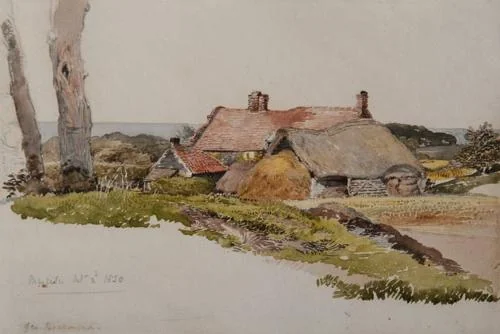
Signed and inscribed l.r.: Geo. Richmond./Margate. Oct 2d. 1850, watercolour over pencil with touches of gum arabic 18 x 26.2 cm; 7 x 10¼ inches Provenance: A. C. Richmond; A. W. Richmond, by family descent from the artist until 2018. Richmond continued to draw and paint landscapes throughout his successful career as a portraitist. These works remained private and stayed mainly in his family. This charming unfinished sketch has a directness which reflects his enjoyment of the opportunity for contemplation when drawing from nature. Richmond travelled to Margate at the end of August 1850 to join his wife Julia and their children and his friend the artist Charles West Cope and his family. 1 Julia had given birth to a daughter, Margaret, on 3 July, but the baby died of whooping cough on 10 October. Another watercolour, A Field near Margate , in the Oppé collection (Tate, T08272), has a red cottage with a red-tiled roof in the distance, which may be the farm in the present watercolour. A further, similar landscape of the same size (sold at Sotheby’s, 29 November 1975, lot 20) and also drawn on 2 October suggests Richmond must have enjoyed working outdoors that day. 1. Raymond Lister, George Richmond: A Critical Biography, 1981, p. 76.
SoldView details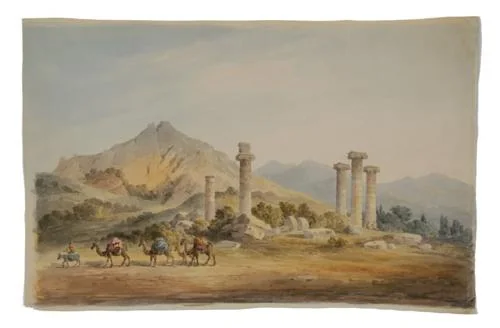
Inscribed verso: Temple of Cybele. Sardis, watercolour over traces of graphite on paper watermarked JWHATMAN TURKEY MILL 1828 36 x 56.5 cm This is a view of the temple from the east, with the Sardis acropolis in the background. Sardis was the capital of the Lydian Empire of the eighth century BC. It was a trading centre between the Greeks and the Persians, as the camel train in the drawing reflects, and became a Greek city state after 282 BC. The site is near the present-day village of Sart in the Manusa province of Turkey, about 45 miles east of Izmir. Cybele was the patron goddess of the city, and the temple is one of the earliest representations of the Ionic style. This watercolour is very faithful to the original topography of Sardis, without the dramatisation of the landscape usually found in eighteenth and nineteenth century views of the site. The contours and proportions of the city’s acropolis are perfectly observed, including a small salient on the left that is still called the ‘flying towers’, as are those of the range of Tmolos mountains to the right in the distance. Also drawn accurately is the small hill just behind the temple on which the archaeologist H. C. Butler built the excavation house in 1911, and which is still prominent today. By the time Page could have visited Sardis there were only three columns standing, as recorded by Cockerell who visited the site in 1812. Page may have copied the work of an earlier visitor in the eighteenth century, when Chandler records five standing columns. Cockerell records that the other two were blown up by a Greek who thought he might find gold in them.
SoldView details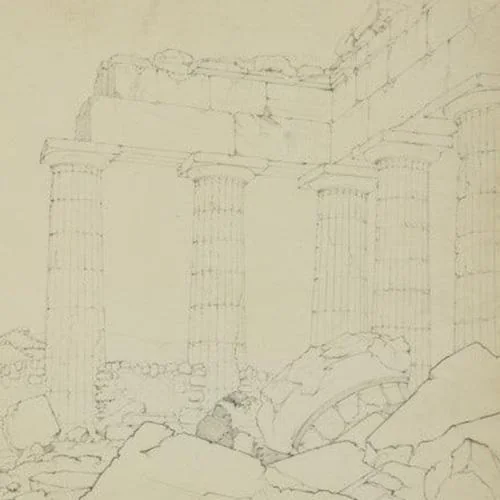
Inscribed u.l.: Parthenon. Athens-Erectheum, graphite 37.5 x 54.5 cm This drawing, made with the aid of a camera obscura, clearly shows the extent of the rubble of the fallen parts of the Parthenon. The drawing appears to have been carefully reinforced, presumably by Page at a later date. A more worked-up watercolour of this view measuring 20.3 x 29.8 cm was in the collection of J. H. Money in 1972. That work is signed and inscribed ‘ATHENS’ in block capitals similar to those which the artist uses in catalogue nos. 1 and 3. The Erectheion, which dates from the end of the fifth century BC, stands to the north of the Parthenon. Both temples were converted into Christian basilicas, thought to be in the seventh century AD, when the interiors were gutted.
SoldView details
Pen and brown ink and watercolour, inscribed with pencil numbers l.r. 4 x 11.6 cm.; 1 5/8 x 4 5/8 inches Lear’s diary of 5th May 1864 records that he was sketching at the Lake of Kourna, ‘very fine and Cumberlandish- in a nook at the foot of very high hills…11.15 Lunch is done: the wrens and titmice still sing-still. Zeriff [Turkish armed servant] hubblebubbles. The four Cretan creturs [sic] sleep, and the sun comes over the oak tree I lie beneath so I must move. Very delightful hours…’
SoldView details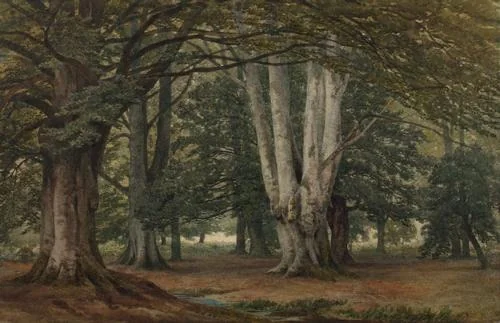
Watercolour with gum arabic, inscribed on original label on reverse of mount: Burnham Beeches/F.R. Lee 1851 32.2 x 49.5 cm; 12 5/8 x 19 1⁄2 inches Provenance Private collection, U.K. until 2022 The artist was born in Barnstaple, Devon and joined the Royal Academy Schools in 1818. He lived in Kent for a while before returning to Devon in the 1840s, having been elected a Royal Academician in 1838. Nature was his enduring inspiration and he enjoyed considerable commercial success in his own lifetime. The extensive use of gum arabic by the artist in this work creates the effect of an intense greenwood which makes an interesting comparison with the oils on paper in this catalogue. Lee collaborated with contemporaries such as Sir Edwin Landseer (1802-1873) and Thomas Sidney Cooper (1803-1902), providing the backgrounds for paintings in which they painted the figures or animals. Burnham Beeches in Buckinghamshire is an historic area of largely beech and oak woodland which has been regularly pollarded, with many trees which are several hundreds of years old. An area of outstanding natural beauty, the woods were popular with nineteenth century artists.
SoldView details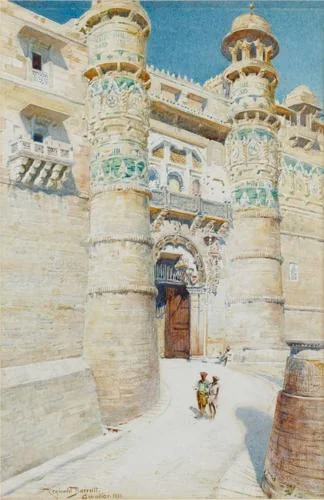
Signed, inscribed and dated l.l.: Reginald Barrett./Gwalior./1911, watercolour over traces of pencil, in a gilt frame 23.4 x 15.8 cm.; 9 ¼ x 6 ¼ inches Frame size 38 x 29 cm.; 14 7/8 x 11 ½ inches Provenance Hartnoll and Eyre; Private collection, U.K. until 2020 Barrett was a painter of landscapes and architectural subjects. He had been articled to the architect Norman Shaw and then studied in Paris under Lefèbvre and Bouguereau. He worked as an illustrator for The Graphic and The Daily Graphic. He was an inveterate traveller in the Middle East and Italy and was commissioned by Queen Victoria to paint her favourite view in Florence. From 1885 he exhibited at the Royal Academy, New Watercolour Society and New Gallery, becoming AWRS in 1901 and RWS in 1913. He was also a Fellow of the Royal Geographical Society. Barrett’s one-man shows A Collection of Watercolour Drawings Illustrating India and Egypt was held at the Fine Art Society in 1894 and Watercolours of India at the Leicester Galleries, London in 1912. The fort at Gwalior was the favourite building of Babur, the first Mughal emperor of India.
SoldView details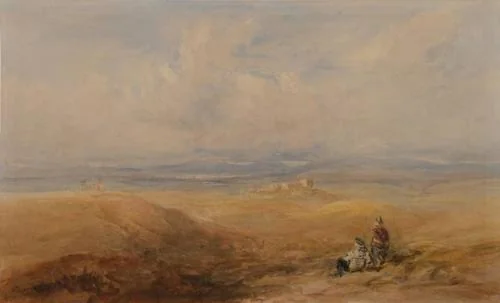
Signed l.l.: David Cox., watercolour over traces of pencil with touches of pen and black ink on buff paper 29.6 x 39 cm; 11 ¾ x 15 ⅜ inches Provenance: Agnew’s, London, 126th annual exhibition, March 1999, no. 63; The Flannery collection, UK, and by descent until 2018. This very freely drawn watercolour represents a transitional stage in the development of the important theme of ‘Peace and War’, one of David Cox’s major subjects. Two local men, one seated, one standing, watch a small troop of soldiers on the march in an extensive sweeping landscape under a huge sky, with Lancaster Castle in the middle distance and the waters of Morecambe Bay beyond. Unusually for Cox there is not much pencil underdrawing. Cox’s preoccupation with military activity during the very unsettled years of the 1830s and 1840s manifests itself after his 1838 trip with his wife to Seabrook, near Hythe in Kent, for six weeks. The artist made sketching trips along the coast of Kent, including one to Lympne, five miles from Hythe, resulting in Peace and War: Lympne Castle ( c. 1838, Birmingham Museums & Art Gallery). The present work, which is similar in style and feel to the Lympne watercolour, presumably dates from the same time, but shows the composition reversed and the distant focus of Lancaster Castle as in Lancaster: Peace and War, 1842 (Art Institute of Chicago). Most of Cox’s numerous ‘Peace and War’ subjects are set at Lancaster rather than Lympne and have more developed references to ‘War’ than the small troop of riders seen here on the top of the hill on the left. The theme is repeatedly treated by Cox at this period, resulting in his 1838 exhibits at the Society of Painters in Water-colours in London, Rocky Scene – Infantry on the March and Stirling Castle – Cavalry on the March and the 1839 Cavalry on the March. In 1848 the first work to be entitled Peace and War (Lady Lever Art Gallery, Port Sunlight, National Museums Liverpool) was exhibited at the Society of Painters in Water-colours.
SoldView details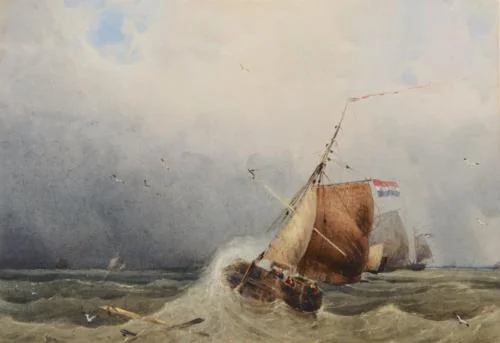
Signed on sail: Francia, watercolour over traces of pencil with scratching out and touches of bodycolour, numbered on old mount: No 81 14 x 20.4 cm Provenance Baron François Adolphe Akermann, régent of the Banque de France and his wife Louise Marie née Boquet de Saint-Simon, the Chateau de Coulonges, Rahay, Sarthe, France, by direct descent until 2018 This drawing comes from a friendship album started by Baron Akermann (1809-1890) for his wife after their marriage in 1836. There was a vogue for such albums in the nineteenth century and visitors would bring a drawing or watercolour as a symbol of friendship or to commemorate a visit. The magnificent leatherbound album contained an unmounted group of drawings and watercolours by artists such as Richard Parkes Bonington, Francia, William Wyld, Decamps, Vernet, Granville, Garneray, Coignet and others. The subjects ranged from marines to genre scenes, landscapes, still lifes, interiors.
SoldView details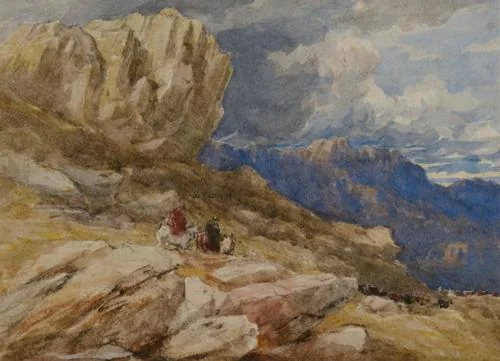
Watercolour over pencil heightened with bodycolour on‘Scotch’ paper, inscribed on old mount: ‘Vale of Dolwyddelan N.W.’ 21 x 29cm Provenance Sotheby’s, 25 November 1999, lot 70; Professor Anthony Bryer, 1999-2017 Cox painted Wales throughout his life but from 1842 his annual visits to North Wales and Betws-y-Coed became central to his oeuvre. He exhibited views of the Vale of Dolwyddelan in 1846, 1847 and 1851. His love for the wild and beautiful scenery of the area inspired his work and the present watercolour captures the drama of the landscape with the characteristic bravura of Cox’s later drawings.
SoldView details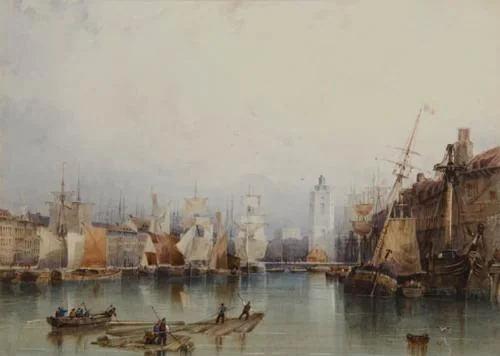
Signed c.r.: Francia, watercolour over traces of pencil with scratching out and touches of bodycolour, numbered verso: No 44. 20.4 x 29.4 cm Provenance Baron François Adolphe Akermann, régent of the Banque de France and his wife Louise Marie née Boquet de Saint-Simon, the Chateau de Coulonges, Rahay, Sarthe, France, by direct descent until 2018 An important addition to Francia’s known oeuvre, this drawing shows the busy port of Dunkirk with loggers moving their wood in the foreground in front of a variety of moored boats. The Leughenaer, or Liar’s Tower, on the right of the composition, is one of the most famous monuments in Dunkirk and continues to dominate the old port. It was erected by Jacques Desfontaines in 1405 and is Dunkirk’s oldest surviving building. Originally part of the port’s fortifications, it became Dunkirk’s first lighthouse at the end of the eighteenth century. The Leughenaer is 30 metres high and overlooks Minck Square, the site of the old fish market. Between 1814 and 1823 the top section with a search light was added to the tower. There is a drawing by Francia dating from around 1824, now in the collection of the Musée des Beaux-Arts, Dunkirk, which shows the tower from the quay on the right had side of the present watercolour (see Louis Francia’ Musée des Beaux-Arts, Calais 1988/89, no. 79). Francia was Bonington’s teacher whose work provides an important link between British and French watercolour painting in the early nineteenth century. A native of Calais, he left for London in 1788 after the outbreak of the French Revolution and remained until 1817. He established a practise as a drawing master in London and a reputation as a painter of marine and landscape watercolours. He attended the Monro ‘academy’, made sketching tours, was secretary of the Brothers, a sketching club of which Girtin was a member and was also secretary of the Associated Artists in Water Colours. He exhibited at the Royal Academy from 1795-1822. He returned to Calais in 1817. He gave Bonington his first professional lessons in watercolour in Calais as well as other artists including William Wyld, Eugène Isabey, Tesson and Collignon. British and French artists who passed through the town on a tour of the coast or en route to Paris or London would visit him. Baron François Adolphe Ackerman (1809-1890) was born in Paris and followed his grandfather and father into the world of finance becoming receveur général des Finances for the department of the Dordogne in 1834 at the age of twenty-five. He was an able financier and rebuilt the family estate at Coulonges, Rahay, Sarthe also becoming mayor of Rahay. He became deputy governor of the Banque de France in December 1870 and régent of the Banque de France on 27 January 1871, holding the office until his death. He was painted by Winterhalter. He and his wife had two daughters one of whom, Henrietta, married Vicomte Henri de Bouillé.
SoldView details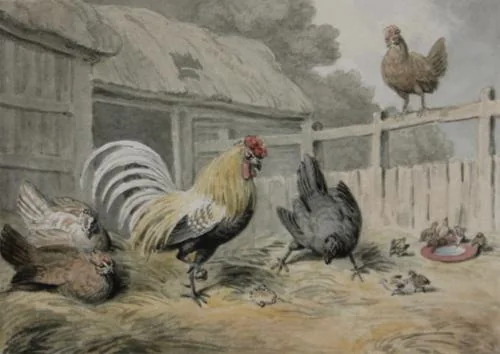
Signed l.c.: Howitt, pen and grey ink and watercolour over traces of pencil 13 x 18.3 cm The artist, who married the sister of Thomas Rowlandson, is acclaimed for his country subjects. His animal sketches were frequently done from life. Provenance: Henry Rogers Broughton, 2nd Baron Fairhaven (1800– 1973) Henry Rogers Broughton succeeded his older brother, Urban Huttlestone Broughton, as 2nd Baron Fairhaven in 1966. He was born in the United States and was educated at Harrow before joining the Royal Horse Guards in 1920. Both brothers were great collectors, and Henry put together one of the largest twentieth-century collections of paintings, drawings, gouaches and miniatures. He left a large bequest of 120 flower paintings, over 900 watercolours and drawings and 44 volumes of drawings by botanical artists such as Redouté and Ehret to the Fitzwilliam Museum, Cambridge – the Broughton Bequest.
SoldView details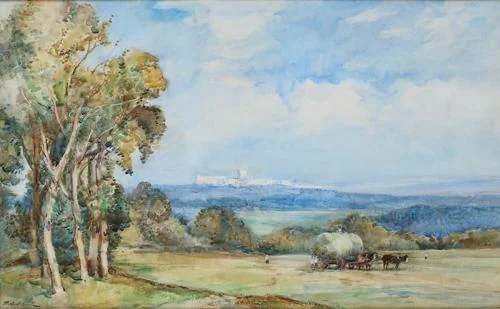
Signed l.l.: J Herbert Snell, watercolour with touches of white 28 x 43.5 cm.; 11 x 17 ¼ inches A tiny view from a similar vantage point by the artist was commissioned for the library in Queen Mary’s Doll’s House and is in the Royal Collection (RL 27382). Snell trained at Heatherley’s in London, Paris and Amsterdam and exhibited work at the Paris Salon as well as in London. He was a prolific painter and exhibited his work extensively including at the Glasgow Institute of Fine Art, the Royal Scottish Academy as well as the Royal Cambrian and Hibernian Academies. He was a regular exhibitor at the Royal Academy London and his work can be found in several public collections.
SoldView details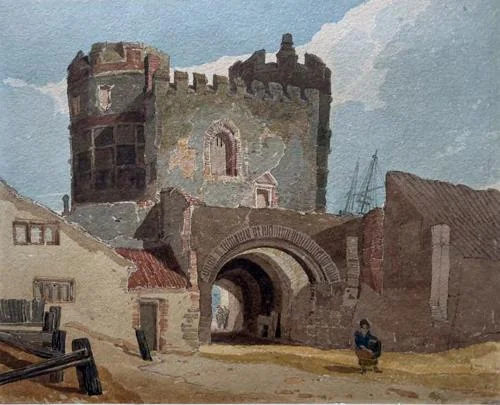
Watercolour over traces of pencil, inscribed in a later hand on old mount: North side of South Gate-Yarmouth, taken down in 1812. John Sell Cotman/ EXHIB 1812? 18.5 x 22.7 cm.; 7 ¼ x 8 15/16 inches Provenance Mrs Craig Henderson, her sale, Christie’s, London, 24 October 1960, (part) lot 56, bt. Spink; Mr & Mrs Giles Pilcher until 1987; With Agnew’s, London, 1992; Private collection until 2004; With W/S Fine Art; Private collection until 2018; With Guy Peppiatt Fine Art, 2019; Private collection, U.K. until 2024 Exhibited Probably Norwich Society of Artists, 1812, no. 63; Agnew’s, 119th Annual Exhibition of English Watercolours and drawings, 1992, no. 35; W/S Fine Art (Andrew Wyld), Landscape on Paper, June 2007, no. 23; Guy Peppiatt Fine Art, British Drawings and Watercolours, 2019,no. 25 Engraved Etched by Cotman as the last plate in Specimens of Norman and Gothic Architecture in the County of Norfolk, 1817 Cotman and his family moved to Yarmouth in April 1812 on the suggestion of Dawson Turner (1775-1858), his friend and patron. They lived at Bank House, Southtown, a mile from the centre of the town until 1823 when they returned to Norwich. The South Gate was destroyed later in 1812. There is a finished pencil drawing by Cotman of the subject in the Norwich Castle collection numbered 2363. https://www.museumscollections.norfolk.gov.uk/collections-object-page?id=NWHCM%20:%201932.105.25 In this atmospheric watercolour which is in exceptional condition, Cotman focuses his artistic attention on the massive body of the gatehouse, skilfully exploring the textures of the stone walls and the interplay of light, shade and colour using a restricted palette. He has deliberately focused on the gate and left the cottages in the foreground lightly washed in without adding further details. The delicately drawn masts of a couple of ships to the right of the tower allude to the proximity of the sea. The subject became well known through the popular etching produced in 1817 for Specimens of Norman and Gothic Architecture in the county of Norfolk. There is greater architectural detail in the print which is closer to the pencil drawing.
SoldView details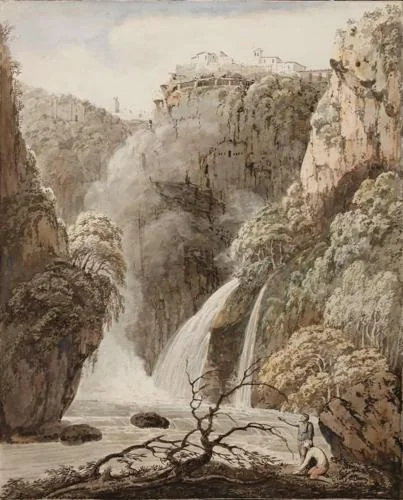
Signed, inscribed and dated in pencil on original mount: Jacob More Rome 1778/A VIEW OF THE CASCADE AT NEPTUN‘S [sic] GROTTO AT TIVOLI, pen and grey ink and watercolour over traces of pencil on laid paper(Image size) 45 x 36.3 cm.; 17 3⁄4 x 14 1⁄4 inchesFrame size 61 x 51 cm.; 24 x 20 inches Provenance: Martyn Gregory Gallery Exhibited: Lupton’s Gallery, Eton College, 27 May – 10 September 2009, no. 19 Born in Edinburgh, More settled in Rome in 1773 where he lived for twenty years, elected to the Accademia di San Luca in 1784. He achieved a reputation which surpassed all other British artists then working in Italy. More was hailed as the English Claude and charged increasingly high prices for his work. He sent paintings back to the Royal Academy in London regularly for exhibition. Waterfalls were much painted by More, their inherent drama suiting the concept of the Sublime (see Patricia R. Andrew, Jacob More Biography and a Checklist of Works: The Volume of the Walpole Society, 1989/1990, Vol. 55 (1989/1990), pp. 105-196). The cascades at Tivoli were one of the best-known sites of Italy. J.R. Cozens also sketched there in 1778, and many visitors marvelled at the huge quantity of water which crashed onto the black rocks below. Neptune’s Grotto or Lair was situated below the cascades, its cluster of mossy rocks a highly picturesque spot. More chose to paint himself in front of the Grotto in his self-portrait, which hangs in the Vasari Corridor of the Uffizi in Florence, its acceptance further enhancing his reputation.
SoldView details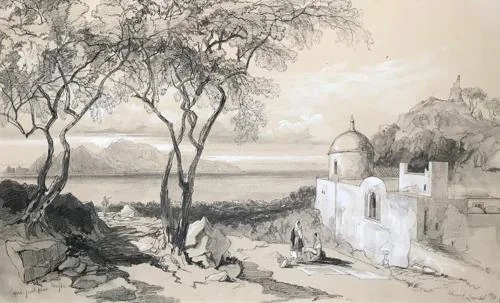
Signed and dated l.r.: Edward Lear del.1839, inscribed l.l.: Capri from above Massa., pencil heightened with white on buff paper 26 x 43 cm.; 10 ¼ x 16 7/8 inches Provenance Eugene Thaw, New York; sold on 26 February 1973 to David Carritt, London Lear spent his summers at the end of the 1830s travelling in Italy and first drew Massa in the summer of 1838 on 22nd August, a working drawing with extensive colour notes (Christie’s, 16 July 2014, lot 570, 10 x 14 inches). The present drawing relates quite closely to his first sketch. He returned to the subject again in 1840.
SoldView details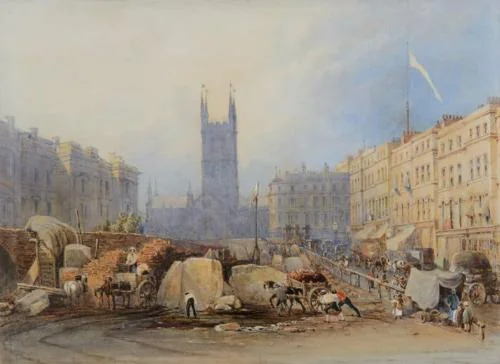
Signed and dated l.c.: Geo. Sidney Shepherd 1836, watercolour over traces of pencil with gum arabic, touches of bodycolour and scratching out, on card 31.3 x 43 cm This church was known as St. Mary Overy's until 1540. In 1904 it became the Cathedral church of the Diocese of Southwark. Construction in the foreground resulted in the building of a new churchyard wall with a railing and a further wall which is seen half built in the present watercolour. The wall of the present day St Thomas’s hospital can be seen on the left of the composition. George Sidney Shepherd, the eldest son, was a member of a talented family of London topographers. Throughout his career Shepherd was patronised by the celebrated interior designer, Frederick Crace, who became equally famous as a collector of views and maps of London. Crace commissioned him to produce watercolours of London buildings and locations, and also bought others from him. The fame of the Crace Collection acted as a springboard for Shepherd’s career, as he began to receive commissions from others, including Rudolph Ackermann. From around the time of its foundation in 1809, until its demise in 1828, Shepherd produced a series of street views for Ackermann’s magazine, The Repository of Arts, sometimes in collaboration with his younger brother, Thomas Hosmer Shepherd. The Crace Collection in the British Museum contains nearly 500 images by Shepherd, including 38 views of Edinburgh for Modern Athens!. His work is also represented in many other public collections, including Kensington & Chelsea Library and the V&A.
SoldView details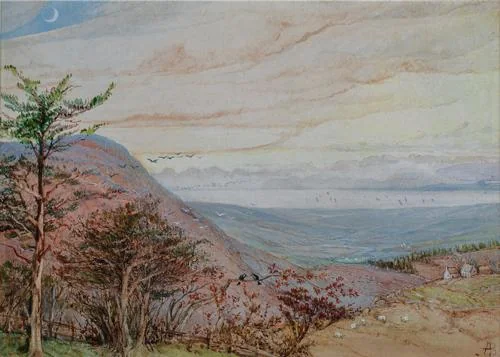
Signed with monogram l.r., watercolour over traces of pencil with scratching out, touches of bodycolour and white 25 x 35 cm.; 9 7/8 x 13 ¾ inches This romantic landscape is probably a view near Penkill Castle, a few miles northeast of Girvan in south Ayrshire which the artist inherited in 1865. She and her lover William Bell Scott spent their summers at Penkill, the castle perched on a promontory overlooking Penwhapple burn. The nearby Firth of Clyde was visible from the castle battlements.
SoldView details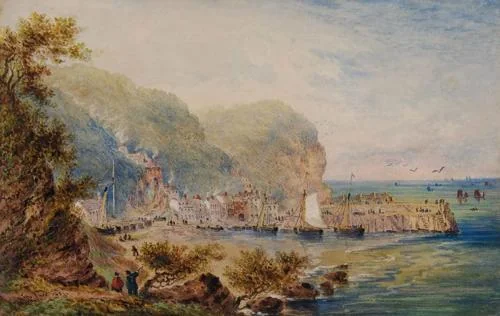
KT 193 SOLD Signed and dated l.l.: JM Ince 1851, watercolour over traces of pencil with stopping and scratching out, touches of bodycolour and gum arabic, inscribed in pencil verso in a later hand: Clovelly town & bay North Devon by Joseph Ince 1851 22 x 34.5 cm Provenance The Fine Art Society Ltd, 48th Exhibition, April 1968, no. 96; Private collection, UK This very fresh watercolour is a delightful example of a coastal view of one of north Devon’s most picturesque seaside villages, shown here as a busy working fishery. Ince studied with David Cox in Hereford before moving to London in 1826 when he started to exhibit at the Royal Academy. He moved first to Cambridge and then back to Presteigne in Wales in the 1830s where he was based for the rest of his life. His characteristic work is included in the drawings collections of most major museums.
SoldView details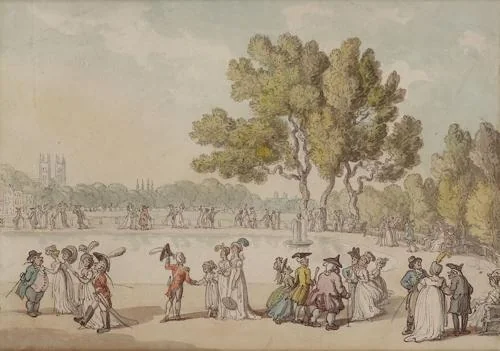
Pen and grey ink and watercolour, on the original mount 21.5 x 30.5 cm.; 8 1⁄2 x 12 inches, mount size 26.8 x 35.8 cm.; 10 1⁄2 x 14 inches Provenance Michael Tollemache Ltd., London; Private collection, U.K., purchased from the above, until 2023 This view from 1820s showing elegant figures perambulating is taken from the west end of the reservoir in Green Park which used to be in the northern corner of the park next to Piccadilly on the site of the present-day underground station. The towers of Westminster Abbey designed by Hawksmoor can be seen to the left of the composition and a little further along the four towers of St John Smith Square emerge above the trees. To the left of the Abbey are the buildings of Queen’s Walk. King’s Palace, now called Buckingham Palace can be seen to the left of the large oak tree in the middle of the drawing. Another smaller version of this subject is in the collection of the British Museum and is dated circa 1824. (https://www.britishmuseum.org/collection/object/P_1880-1113-2011 ).
SoldView details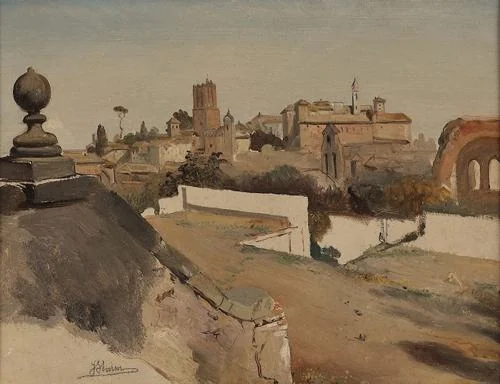
Signed l.l.: J Sturm, oil on paper laid down on canvas 24.5 x 31.5 cm; 9 5/8 x 12 1⁄4 inches Exhibited Hazlitt, Gooden & Fox, London, The Lure of Rome: Some Northern Artists in Italy in the Nineteenth Century, 31 October – 27 November 1979, cat. no. 66, pl. 36 Provenance Hazlitt, Gooden & Fox, London; Sir Jack & Lady Baer, Kensington, until 2022 This partially unfinished view of the rooftops of Rome on a hot sunny day is the only known oil sketch by Jacques Sturm. It is a pleasing study of light and atmosphere in the city. The artist was the son of a wigmaker and initially trained to follow in his father's footsteps. However, he simultaneously attended drawing lessons given by Pierre Maisonnet (1783-1823), the drawing teacher at the Luxembourg Academy. When Jean-Baptiste Fresez (1800-1867) replaced Maisonnet in 1824 he recognised Sturm's talent, and recommended him to Eugène Jobard (1792-1861), the Belgian court lithographer and photographer. The Belgian Revolution of 1830 brought an end to Jobard's business; however, undeterred, Sturm began to engrave portraits himself for a living. In 1836 he painted his first works in oil, exhibiting for the first time two years later in Liège, and in 1839 he exhibited at the Brussels Triennale. Sturm moved briefly to Paris to study painting in oils but soon returned to Brussels. It was around this time that his health began to deteriorate and so, seeking a milder climate, he moved to Rome in 1842. He lived there until his death in January 1844. This painting is one of apparently few examples from this period, possibly the only one to have been published, and is a superb example of an artist experimenting with oils plein air at a time when such works were largely meant only for the artists' personal use and collections. The present work's subject, the Torre delle Milizie may have had special associations for this Luxembourgeois artist, as it was used by Emperor Henry VII, also known as Henry of Luxembourg, as his main bastion against the 1312 Guelph invasion.
SoldView details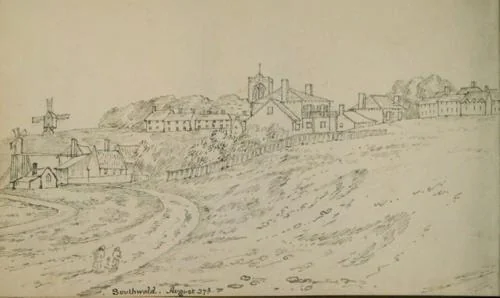
Including views of Walberswick; Southwold, August 27th; Dunwich Augt. 28th; Dunwich; Gateway, Grey Friars; Dunwich; Southwold (2); Cove Hythe, Sep 2d 1819; Boats and ships at anchor off Southwold or Walberswick; Walberswick Harbour; Dover castle; Buckden; Chillingham castle; On the Wye two miles below Monmouth; Tintern Abbey; Chepstow castle; Tintern Abbey; Chepstow; Fountains Abbey; castle at Meling; Norfolk; Shipping at sea (3) The sketchbook signed with initials and inscribed on the inside front cover: W.N. Southwold August 26th 1819, the majority of the drawings inscribed and dated as above, pen and grey, brown or black ink and pencil. The pages of the sketchbook each 14 x 22.5 cm, the sketchbook oblong 8vo., bound in half red roan over marbled boards, with an engraved pictoria.
SoldView details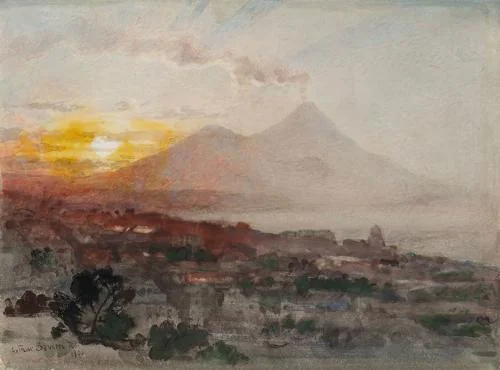
Signed and dated l.l.: Arthur Severn R.I./1906, watercolour over traces of pencil, with label attached to backing board. 27 x 37 cm.; 10 5/8 x 10 5/8 inches. Provenance: The Leicester Galleries, London, ‘Exhibition of Works by Arthur Severn, R.I’, June 1906, no. 30, where bought by George Allen Esq; The Court Gallery, East Molesey, Surrey; Sotheby's London, July 6, 2016, Lot 328. The son of Joseph Severn, the artist and friend of John Keats, the artist studied in Paris and Rome and first exhibited at the Royal Academy in London in 1862, at Whistler’s suggestion. He was a founder member of the Arts Club and a member of the Royal Institute of Oil Painters and the Royal Institute of Painters in Water Colours who exhibited widely throughout his career. Arthur married Joan Agnew, a cousin of John Ruskin in 1871. When Ruskin moved from Denmark Hill in South London to Brantwood on Coniston Water in the Lake District the Severns accompanied him and remained part of the household until his death. Arthur Severn's recollections of Ruskin, edited by James Dearden, were published in 1967 under the title The Professor.
SoldView details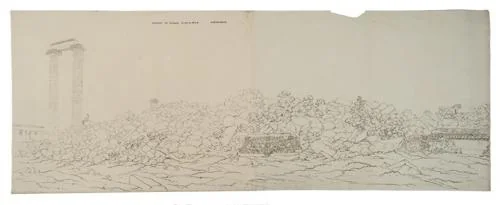
Inscribed with title u.c.: TEMPLE OF APOLLO DIDYMAEUS. HIERONDAS Pen and brown ink over traces of graphite, on two sheets, joined 43 x 114 cm The Temple of Apollo at Didyma (now Didim in Turkey), on the coast of Ionia, housed the most renowned oracle in the ancient world after Delphi and was the largest and most significant sanctuary on the territory of the city of Miletus. Destroyed by the Persians in 494 BC, the oracle was re-consecrated by Alexander the Great around 334 BC. A new peripteral temple, surrounded by a double file of Ionic columns, was started, although never finished. The village of Hieronda, also known as Ura, was built on the site and was referred to and stayed at by Richard Chandler, who led an expedition for the Society of the Dilettanti in1764–6. Extensive excavations on the site, led initially by the British and French and now by the Germans, have revealed most of the temple and much of the sacred way. The two standing columns in Page’s drawing, which was made with the aid of a camera obscura, can still be seen at the site today.
SoldView details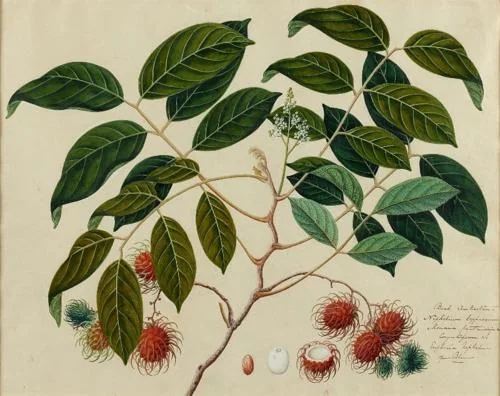
Inscribed l.r.: Buah rambootan./Nephelium lappaceum./Monaecia pentandria L. and with further botanical notes, watercolour and bodycolour over traces of pencil with gum arabic, on laid paper watermarked: RUSE & TURNERS/1825 and with the Strasburg Lily 38.2 x 48.7 cm; 15 x 19 inches Provenance Sharon and Anne Hamlyn until 2019 These fine examples of watercolours by Chinese Artists of the Straits School are in the style of the Chinese artists who worked for Sir Stamford Raffles in Singapore and Major-General William Farquhar (c.1771-1839) who was Resident of Malacca from 1808-1818. The frequent movements of trade and personnel between India and China, via ports on the Malay peninsula including Malacca and Prince of Wales Island, meant that collectors frequently had both Indian and Chinese drawings in their collections. Henry Noltie has suggested that this school is named ‘Straits School’ (see Forgotten Masters Indian Painting for the East India Company, ed. W. Dalrymple, 2019, pp. 78-82). British patrons commissioned local Chinese artists to draw the flora and fauna of Malacca and the extensive botanical annotations in Jawi, the Malay script derived from Arabic, Romanised Malay, Latin and Greek and with reference to the Linnaean system of classification, created by Carl Linnaeus (1707-78) are typical of this material. The accumulation of natural history drawings by officials of the British East India Company gave rise to the term ‘Company School’, now out of favour, which has been used to describe the work of Indian or Chinese artists for British patrons. The distinctive style is a result of a fusion of two artistic traditions, the European with its desire for realism and the Asian taste for a more stylised approach. The eighteenth and early nineteenth century saw an enormous rise of interest in Europe in the study of natural history by both scientists and amateurs. A knowledge of the subject was considered to be an important part of a liberal education and many people studied ‘natural philosophy’ and the various branches of natural history. Accurate drawings were vital tools in classification as well as a reminder of the excited reaction to new discoveries.
SoldView details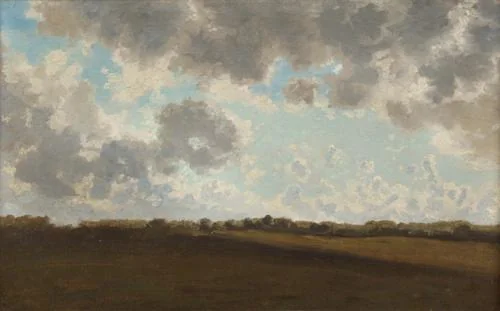
KT455 Auguste-Paul-Charles Anastasi (French 1820-1869) Etude de ciel, Le Berry, France Oil on paper laid down on canvas, inscribed with title on studio sale label attached to stretcher: Etude de ciel/Berry, further inscribed on a second later label: ARTUS/99/Étude De Ciel, stamped with the artist’s seal on the stretcher 24 x 38.5 cm.; 9 ½ x 15 ¼ inches Provenance The artist’s studio sale, Durand-Ruel, 3 - 8 March 1873, no. 132; Private collection, France until 2021 This sky study was done in the Berry region in the Loire Valley. Pin marks can be seen in the lower corners of the paper on which it is painted. The son of a painter of Greek origin, Auguste Paul Charles Anastasi was a pupil of Paul Delaroche and Camille Corot in Paris in the1840s. He began his career painting landscapes in the forest of Fontainebleau, joining the Barbizon school group. Anastasi regularly exhibited at the Paris Salons in 1850s and 1860s, showing landscapes of the countryside around Paris, Normandy, the Roman Campagna and Naples. He also worked as an engraver. In 1870 Anastasi became blind. His work can be found in many museums including the Musée d’Orsay, Paris and numerous French regional collections.
SoldView details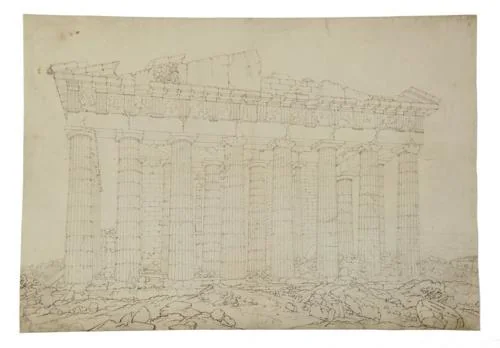
Signed and inscribed l.r.: PARTHENON/ATHENS. W. PAGE, pen and brown ink over traces of graphite 65.5 x 94.8 cm This meticulously observed drawing, made with the aid of a camera obscura, shows a close-up view of the western front of the Parthenon, with the sculpted frieze depicting Amazons fighting Greeks shown in detail. The two statues of the daughters of Kekrops, which stayed on the building until about 1980, can be seen on the pediment. A large, finished watercolour of this view (measuring 66 x 101.5 cm and signed and dated1841), with carefully drawn architectural detail, was presumably based on the present drawing, and is now in the collection of the American School of Classical Studies, Gennadius Library, Athens. This is almost certainly Page’s signed and dated Royal Academy exhibit of 1841, no. 1106, The west front of the Parthenon. The present drawing and catalogue no. 3 appear to be unique in Page’s known oeuvre, both for their large size and for being done on the spot.
SoldView details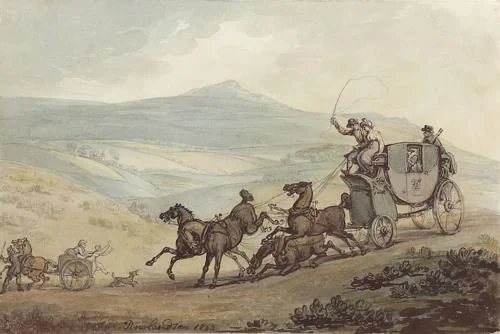
KT603A With signature and date 186/03, pen and black and grey ink over traces of pencil and watercolour, inscribed in pencil with title on original mount. 17 x 26 cm.; 63/4 x 10 ¼ inches Provenance Michael Edwin Sandys, 5th Baron Sandys (1855-1948) by descent to Lord and Lady Sandys, Ombersley Court, Worcestershire until 2023. The 5th Lord Sandys, known as Mikey to his friends, was an eccentric and a keen sportsman who drove coaches. He was a one-time part owner and coachman on the Surbiton to London route on which he ran a stagecoach called The Tally Ho!
SoldView details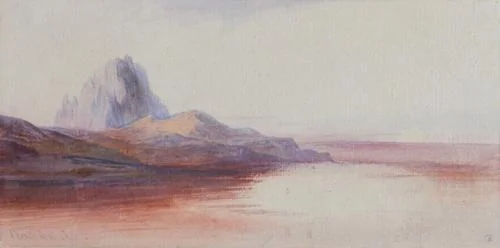
Signed with monogram l.r., inscribed l.l.: Pentedatilo, watercolour and bodycolour on laid paper 11.4 x 20.9 cm; 4½ x 8¼ inches Provenance: Private collection, UK, until 2018. Literature: Jasmine Jagger, ‘Moving Lines’, Apollo, December 2018, pp. 87–91, ill. p. 91. One seem’d all dark and red – a tract of sand, And someone pacing there along, Who paced for ever in a glimmering land, Lit with a low large moon. Alfred, Lord Tennyson, ‘The Palace of Art’ Lear’s close friendship of thirty-seven years with Tennyson inspired his ‘Painting=Sympathisations’, a proposed project of three hundred memories tied to three hundred poems, reflections of the relationship between painted word landscapes and written word paintings, described by Jasmine Jagger as open to a kind of synaesthesia. In her opinion, the finest examples of Lear’s poetrypainting can be found in the works he made of Pentedattilo. 1 Lear worked on the project on and off for thirty years, his drawings going through what he described as their egg, chrysalis and caterpillar stages. The final oil, or ‘butterfly’, of the painting of Pentedattilo was given by Lear to Tennyson’s oldest son Hallam and his bride Audrey as a wedding present, and was loved by the poet. Jagger suggests the present watercolour is the closest surviving version of this ‘butterfly’, with a distant speck of a hunched-over heron and its shadow replacing the figure seen in the multiple sketches of the subject. The lightly portrayed moon suggests the passage of time, and the dark lines over the sky have just faded. 2 The artist’s plan to illustrate Tennyson’s poems began to take shape in the summer of 1852, a couple of years after they met. Although their friendship had ups and downs, Lear’s affection for the poet’s wife, Emily, remained constant. Lear enjoyed selecting the lines of Tennyson’s poems on which to base his ‘Poetical Topographical’ project, and he began work on the scheme several times. In 1878 he finally got down to work in earnest, although the project was never completed, and Lear died with unfinished Tennyson canvases in his studio. Pentedattilo is an abandoned town in Calabria on Monte Calvario, a mountain whose shape once resembled that of five fingers: hence the name, from the Greek penta and daktylos (for five and fingers). It was badly damaged by an earthquake in 1783. Lear made a trip through southern Italy in 1847; his diary records his arrival on 30 July, at an elevated plateau whence the whole ‘Toe of Italy’ is finely discernible, a sea of undulating lines of varied forms down to the Mediterranean; a few towns glittered here and there, and towering over the southern extremity of land, a high cluster of rocks, the wild crags of Pentedátilo, particularly arrested our attention . 3 1. Jasmine Jagger, ‘Moving Lines’, Apollo, December 2018, pp. 87–91, ill. p. 91. 2. Ibid. 3. Edward Lear in Southern Italy: Journals of a Landscape Painter in Southern Calabria and the Kingdom of Naples, introduction by Peter Quennell, 1964, p. 41.
SoldView details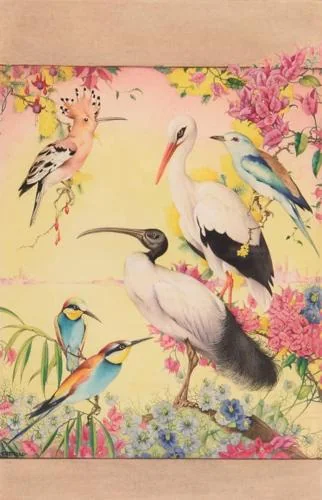
Signed l.l.: DETMOLD, watercolour over pencil with a brown line border 31.3 x 20.3 cm Provenance Alan Fortunoff, by descent until 2017 Detmold worked as a painter, illustrator and printmaker specialising in meticulous, intense images. He and his twin brother Charles were taken by their great-uncle to London zoo and the Natural History Museum to draw from an early age. Their uncle Henry Detmold, an artist, further encouraged their development and they absorbed the influence of Japanese printmakers, fashionable in the late 19th century. E.J. Detmold’s work is to be found in many museum collections including that of the British Museum, the V&A and the Fitzwilliam Museum, Cambridge. Alan Fortunoff (1933-2000) was an American department store magnate who transformed the Fortunoff Department Store. He formed a fine collection British nineteenth and twentieth century art.
SoldView details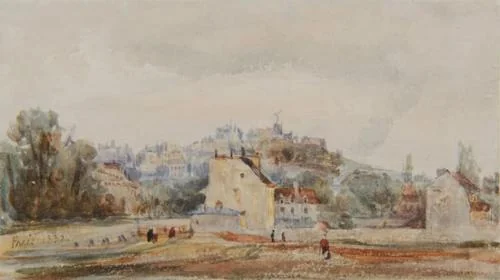
Inscribed l.r.: Paris 1832, watercolour 9.5 x 16.6 cm Provenance Sotheby’s, 13 March 1980, lot 59; David Messum, ‘Les Jeunes Romantiques’, Beaconsfield, June 1980; Private collection UK until 2018 Views of Paris are considered to be the most important subjects drawn by the artist. This delicate and spontaneous watercolour dating from 1832 shows Boys at the height of his powers exhibiting great subtlety in the treatment of light and space. 1832 was a turbulent year in Paris; in April and May there was an outbreak of cholera which left over 18,000 people dead including the liberal orator General Lamarque, whose funeral on 5th June and the subsequent uprising have been immortalised in Victor Hugo’s ‘Les Miserables’. Boys moved to Paris in the early to mid 1820s when British engravers were in demand. He met Bonington there and became his closest English friend during that artist’s final two years of life. He taught Bonington etching and was almost certainly one of his pupils in turn, and copied some of his work. By the early 1830s, when William Callow was Boys’ pupil and they shared a studio in Rue du Bouloy, Boys’s work had developed a style grounded in topographical accuracy with a sophisticated handling of watercolour. The present work illustrates how Paris at this date was significantly smaller than the city is now. The hill of Montmartre rose above the plain of the Seine outside the city walls. It was the site of a gypsum quarry and windmills where grain was ground for bread for the city. There was a telegraph station on the top of the hill which had been used by Napoleon to transmit orders to the French troops and to receive news.
SoldView details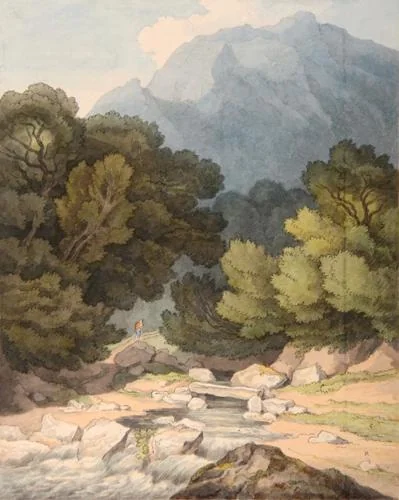
Inscribed with colour notes l.r., signed with initials, inscribed and dated on reverse of original backing: Downstone Rock from Saugh Mill.Devon./JWA Septr. 21.1831,/No. 18., pen and grey ink and watercolour with gum arabic, on original washline mount 21 x 16.7 cm; 8 ¼ x 6 ½ inches Provenance : With Andrew Wyld, London; The Flannery collection, UK, and by descent until 2018. Abbott was one of the best amateur watercolourists of the late eighteenth century. An Exeter surgeon and apothecary, he lived in the city until 1825. He exhibited paintings at the Royal Academy from 1793 and received contemporary acclaim for the style of his work. The artist John Downman said that Abbott ‘prefers his drawings before his paintings, as they are done with more spirit’. 1 In 1825 Abbott inherited Fordland, a Devon estate, from his uncle James White, an Exeter barrister and non-conformist, who was a close friend of Francis Towne. Abbott became a patron and pupil of Towne’s, and his linear style shows the artist’s influence. After he moved to Fordland, Abbott devoted himself to drawing. This view appears to show Dewerstone Rock seen from Shaugh Mill, near Shaugh Prior, on Dartmoor. Shaugh Mill was used for papermaking and stood by a stream of spring water. 2 In 1790 the papermaker was Richard Howard. It appears to have been a popular spot for artists to record, and was painted by J. F. Lewis and J. M. W. Turner amongst others. Another view by Abbott entitled Downstone Rock from a different aspect is in the collection of the Provost and Fellows of Eton College. 1. Joseph Farington, The Diary of Joseph Farington, republished 1978–1984; entry for 26 June 1804; vol. VI, p. 2362. 2. A. H. Shorter and R. L. Hills, Studies on the History of Papermaking in Britain, 1993. I am grateful to April Marjoram for her comments about this view.
SoldView details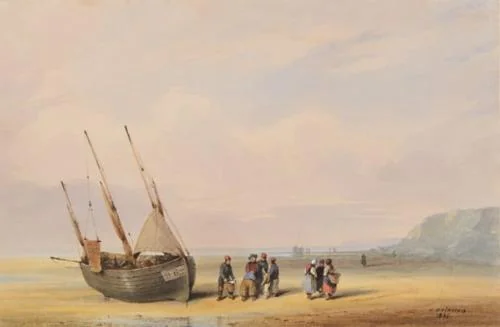
Signed and dated l.r.: A. Delacroix./1835, watercolour with touches of bodycolour and scratching out, numbered verso: No 16 15.6 x 23.9 cm Provenance: Baron François Adolphe Akermann, régent of the Banque de France and his wife Louise Marie née Boquet de Saint-Simon, the Chateau de Coulonges, Rahay, Sarthe, France, by direct descent until 2018 This drawing comes from a friendship album started by Baron Akermann (1809-1890) for his wife after their marriage in 1836. There was a vogue for such albums in the nineteenth century and visitors would bring a drawing or watercolour as a symbol of friendship or to commemorate a visit. The magnificent leather-bound album contained an unmounted group of drawings and watercolours by artists such as Richard Parkes Bonington, Francia, William Wyld, Decamps, Vernet, Granville, Garneray, Coignet and others. The subjects ranged from marines to genre scenes, landscapes, still lifes, interiors. The B on the boat is the identifying code for Boulogne. Baron François Adolphe Ackerman (1809-1890) was born in Paris and followed his grandfather and father into the world of finance becoming receveur général des Finances for the department of the Dordogne in 1834 at the age of twenty-five. He was an able financier and rebuilt the family estate at Coulonges, Rahay, Sarthe also becoming mayor of Rahay. He became deputy governor of the Banque de France in December 1870 and régent of the Banque de France on 27 January 1871, holding the office until his death. He was painted by Winterhalter. He and his wife had two daughters one of whom, Henrietta, married vicomte Henri de Bouillé.
SoldView details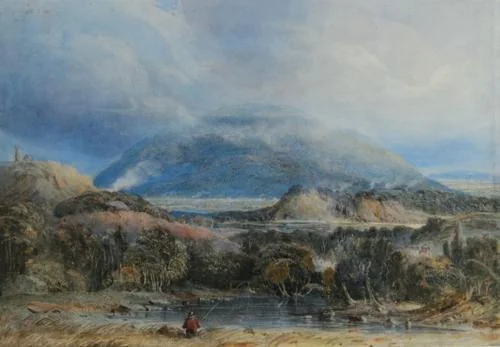
Watercolour over pencil heightened with bodycolour and scratching out 24.5 x 35.5 cm Provenance Sotheby’s, 13 July, 1989, lot 173, bought by Neuberg; Private collection, U.K. Legend has it that a giant called Gwendol Wrekin ap Shenkin ap Mynyddmawr had a grudge against the town of Shrewsbury and decided to flood it to kill all its inhabitants. He collected a giant-sized spade of earth and set off towards the town. When he was near Wellington he met a cobbler returning from Shrewsbury market with a large sack of shoes for repair. The giant asked him for directions, adding that he was going to dump his spade of earth in the River Severn and flood the town. "It's a very long way to Shrewsbury," replied the quick-thinking shoemaker. "Look at all these shoes I've worn out walking back from there!" The giant changed his mind and dumped the earth on the ground beside him, creating the Wrekin.
SoldView details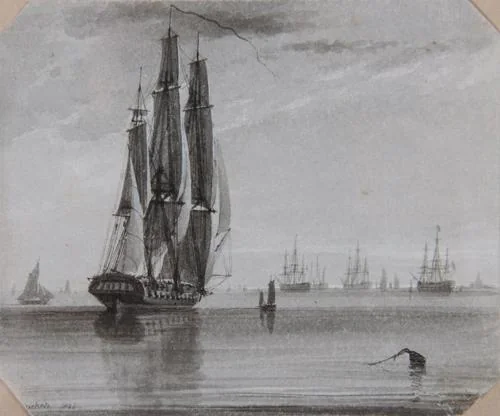
SOLD Two, one signed and dated l.r.: Whichelo 1826 and signed, inscribed and dated verso: A Frigate going from St Helens to Spithead./J. Whichelo 1826., pen and grey ink and grey wash on grey paper, the second with touches of white One with cut corners 10.8 x 13 cm, the other 9 x 2.9 cm Accompanied by copies of the drawings by Augusta Raymond-Barker. Augusta Raymond-Barker’s copies are very spirited renderings of the originals. Whichelo was marine and landscape painter to the Prince Regent by 1812. Provenance: Augusta Raymond-Barker, Fairford Park, Gloucestershire; thence by family descent until 2016
SoldView details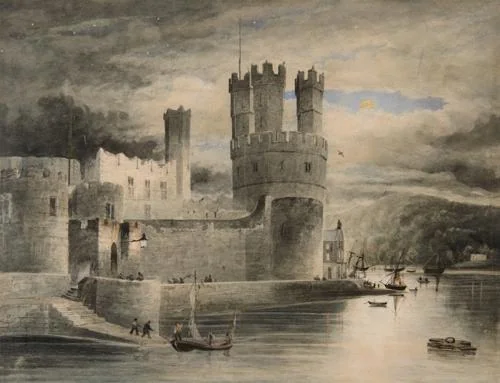
Watercolour over traces of pencil with touches of white, gum arabic and scratching out 36.5 x 47.3 cm Provenance The Oppé collection, Sotheby’s, 15 July 2016, lot 135 (as British School) Gastineau made many watercolours of Welsh subjects, some of which were engraved and published as Wales Illustrated in 1830–31. These included another version of this view, showing the Eagle Tower from a slightly different angle: see below. He exhibited two watercolours of Caernarvon Castle at the Old WaterColour Society (OWS), in 1830, no. 356 (possibly the present drawing), and again in 1847, no. 225. The artist was known for his successful moonlit watercolours, to which according to Roget he gave a characteristic mellowness by means of preliminary washes of warm colour: see J. L. Roget, A History of the Old WaterColour Society, 1891, reprinted 1972, p. 508.
SoldView details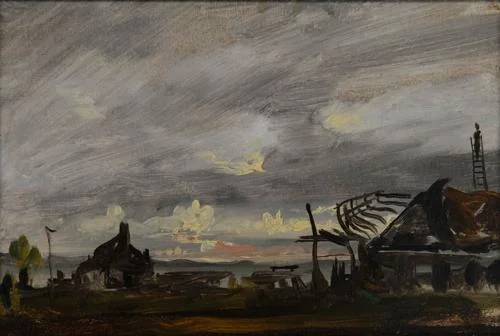
Oil on paper 12.6 x 19 cm; 5 x 7½ inches Provenance: James Danby, the son of the artist; With Anthony Reed, London, 1978; Christie’s, London, 7 June 2007, lot 97; With WS Fine Art, summer 2009, no. 19; The Flannery collection, UK, and by descent until 2018. Exhibited: Anthony Reed and Davis & Long, London and New York, English Sketches and Studies, 1978, no. 86; WS Fine Art, London, summer exhibition 2009, no. 19. Danby was a very keen sailor and also had a life-long interest in building boats. This dramatic sketch of an untidy boat yard under a heavy, brooding sky, drawn on the spot, may well record work on one of his own boats, The Chase . Danby lived on the Maer near Exmouth from 1846. It has been suggested that this work shows The Point in Exmouth, where the flag flew next to Ferry Cottage to indicate when and where the ferry crossed from Exmouth over to Starcross. 1 There were two boat building firms listed at The Point, on the other side of Ferry Cottage, one owned by John Hayman, where Danby’s boat The Chase was constructed in 1847–1848. This yacht provoked comment due to its innovative and unusually broad hollow keel. 2 Danby later built himself a yacht called the Dragon Fly in which he was shipwrecked off Axmouth in August 1860, the year before he died. Another oil sketch of a boat building shed, of a similar size and reminiscent of the work of Corot, is dated by Francis Greenacre to c. 1840. 3 Stylistically the present work may also be compared with a group of spontaneous sketches of the Exe and Exmouth dating from c. 1855. 4 They appear to be records of landscape and atmospheric effects done on the spot or very shortly afterwards. This group, many of which had inscriptions saying ‘Francis Danby ARA’ on the verso in James Danby’s hand, were bought from a member of the Danby family who lived near St Albans by a local dealer around 1930. 5 1. April Marjoram, by email communication with the author, October 2018. 2. Western Times, 30 June 1849. 3. F. Greenacre, ‘Francis Danby 1793–1861’, exhibition catalogue, City of Bristol Museum and Art Gallery and Tate Gallery, 1988, no. 52, p. 121. 4. Ibid., nos. 53–8. 5. Eric Adams, Francis Danby: Varieties of Poetic Landscape, 1973, no. 58; see F. Greenacre, op. cit., p. 123 (under no. 57).
SoldView details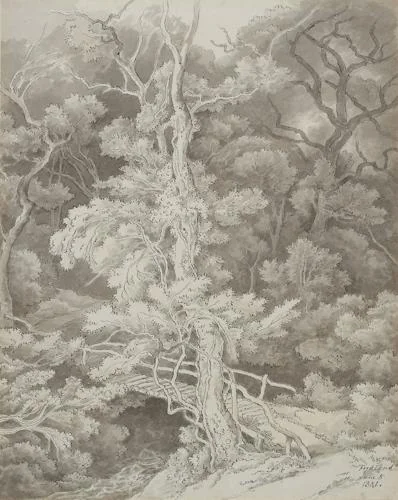
Inscribed l.l.: Fordland/June 5/1841, pen and grey ink and wash over traces of pencil 26.5 x 21.5 cm.; 10 3/8 x 8 ½ inches Abbott was one of the best amateur watercolorists of the late eighteenth century. An Exeter surgeon and apothecary, he lived in the city until 1825. He exhibited paintings at the Royal Academy from 1793 and received contemporary acclaim for the style of his work. The artist John Downman said that ‘he prefers his drawings before his paintings, as they are done with more spirit’ (J. Farington, Diary 26 June 1804; vol. VI, p. 2362). In 1825 the artist inherited the Devon estate of Fordland from his uncle James White a barrister and non-conformist. He delighted in drawing the woodland on his estate, developing the style he learnt from Francis Towne, his drawing master, with sophisticated handling of light and shade in the depiction of trees in monochrome.
SoldView details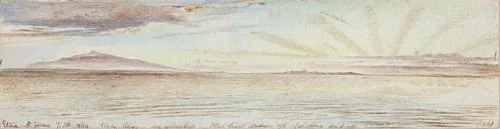
Inscribed ‘Etna 5 June 7pm 1864’ and with colour notes, numbered (183) l.r., pen and brown ink and watercolour, inscribed verso next below top/123 up/A (crossed out) A 6.7 x 27 cm.; 6 5/8 x 10 ½ inches Provenance Fine Art Society, where purchased on 30 June 1962 by Miss Rowell, Wylam, Northamptonshire, until 2022 The numbering on this drawing suggests that it was done by Lear on his way back from Crete in June 1864. Lear spent seven weeks on the island. His last drawing, done in Hania was numbered 179. The artist first visited Sicily in 1842 and again in 1847 with his travelling companion John Proby. On this occasion he was passing after his travels in Crete.
SoldView details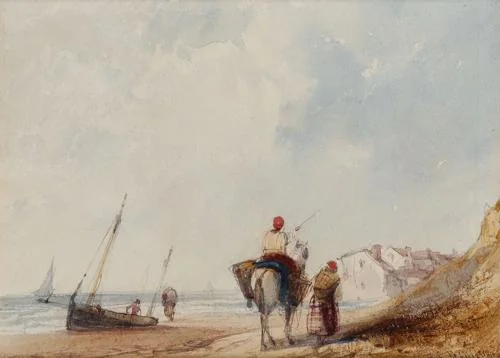
Signed l.r.: C. Bentley, watercolour over traces of pencil Provenance L.G. Duke; Spink & Son. Ltd.
SoldView details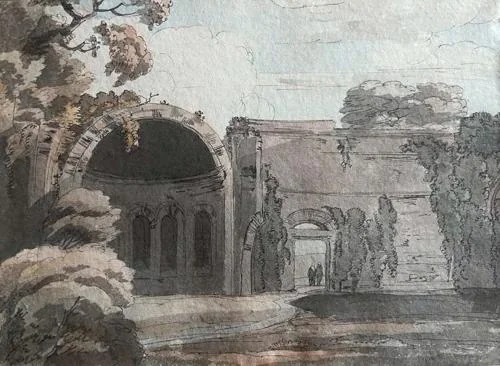
Signed and inscribed verso: No. 40/May 22 1781/Villa Adriano light on the right hand side afternoon/Francis Towne and numbered by Paul Oppé: 15 B.P., pen and brown ink and watercolour on laid paper 16.2 x 22.2 cm.; 6 ¼ x 8 ¾ inches Provenance John Herman Merivale (1770-1844) and thence by descent; With Squire Gallery, London, 1953, bt. Merivale for 50 gns; Sir William Worsley, Hovingham Hall, Yorkshire (1890-1973); By descent to Sir Marcus Worsley (1925-2012); With Guy Peppiatt; Private collection, U.K. until 2024 Literature Adrian Bury, Francis Towne, 1962, pp. 95 and 143; W.A. Worsley, Early English Water-Colours at Hovingham Hall, 1963, no. 68; Timothy Wilcox, Francis Towne, exhibition catalogue, 1997, p.58; Richard Stephens, A Catalogue Raisonné of Francis Towne (1739-1816), FT272 Exhibited Leeds City Art Gallery, Exhibition of Early English Watercolours, 1958, no.33; London, Oscar and Peter Johnson, Lowndes Lodge Gallery, Pictures and Drawings from Yorkshire Houses, April 1963, no.33 This drawing dates from Towne's most important tour to Italy in 1780-81. He arrived in Rome in October 1780 and left via the Alps for England in August 1781. Towne spent about three weeks in Tivoli and the surrounding area in May 1781. Tivoli had long held an attraction for visiting artists due to its combination of dramatic scenery and its link to the work of Claude and Dughet. Towne produced over forty drawings and watercolours while in Tivoli. `No.1' is dated 1st May and the present drawing, number 40, dated 22nd May, is one of the last. Nos. 40 to 42, all views of Hadrian's Villa, and dated between 20th and 22nd May, were all at one time in the Worsley collection at Hovingham Hall. Adrian Bury describes them evocatively as reflecting `the haunting solitude and melancholy of this relic of the great and humane Emperor, Hadrian (op. cit., p.95). Nine of Towne's exceptional Tivoli views are now in the British Museum and no. 39 from the group, a wash drawing of Neptune's Grotto, Tivoli, is in the Tate Gallery. Hadrian's Villa or Villa Adriana was constructed by the Emperor Hadrian in the early second century A.D. as a country retreat outside Rome. It fell into disrepair and in the 16th century, marble and statues from the Villa were used in the construction of the nearby Villa d'Este.
SoldView details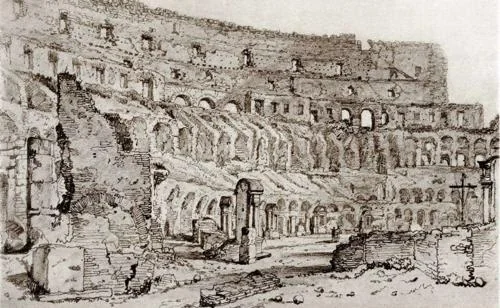
Pencil, inscribed 25.3 x 36 cm Provenance: Samuel Gillespie Prout, the artist’s son; Christie’s, 12 April 1880, lot 112 (12 guineas to the Fine Art Society) Exhibited: Fine Art Society, 148 New Bond Street, London, 1879–80, no. 71 Literature: John Ruskin, Notes by Mr. Ruskin on Samuel Prout and William Hunt illustrated by a Loan Collection of Drawings (Ruskin, Works, ed. Cook & Wedderburn, 1904–12, Vol. XIV, pp. 396 and 399). On page 399, Ruskin wrote, the drawing of the Coliseum at Rome, no. 71, has still higher claim to our consideration; in it were reserved, and in all points, rarer powers of expressing magnitude and solitude. It is so majestic in manner that it would quite have borne being set beside the photograph of Turner’s drawing at Farnley, had it been fair to match mere outline against a finished composition.
SoldView details
Windermere with the village of Bowness and the Langdale Pikes Watercolour over pencil, inscribed on original mount: Windermere, with the village of Bownesfs, in the original English Carlo section frame 30 x 41.6 cm.; 11 ¾ x 16 3/8 inches Provenance: Private collection Scotland, until 2019 Francis Nicholson Francis Nicholson was born in Pickering, Yorkshire on 14 November 1753, the son of a weaver. A founder member of the Society of Painters in Water-Colours he was dubbed ‘The Father of Watercolour Painting’ by his contemporaries. These beautiful drawings probably date from 1792-3 and represent the very best of his work, perfectly capturing the distinctive light and colour of the Lake District. He lived the first thirty years of his life in various Yorkshire towns, learning from local teachers and painting portraits and animals, mainly in oils. He made two visits to London and took lessons from C.N. Metz. In 1783 he settled in Whitby and took up landscape painting in watercolour, and first exhibited at the R.A. in 1789. An important early patron was Lord Bute who commissioned him to travel to the Isle of Bute to make a set of paintings. He toured the Lake District with Sir Henry and Lady Tuite circa 1795 and they remained important friends and patrons until Sir Henry’s death in 1805. Nicholson was commissioned by his patron Walter Fawkes of Farnley Hall in Yorkshire, also an important early collector of J.M.W. Turner, to provide him with numerous watercolours of views of the Lakes. Nicholson and Fawkes corresponded in 1798 on several occasions and Fawkes waxed lyrical about the artist’s work (R. Davies, “Francis Nicholson: Some Family Letters and Papers”, Old Water-Colour Society’s Club, 1930-1, Vol. VII, London 1931, pp. 15-30). Around this time Nicholson pioneered a new process of watercolour whereby he stopped out light areas with a mixture of beeswax and turpentine coloured with flake-white. This allowed the application of a wash, the removal of the solution in a few areas, further application of more washes, until the multiple washes gave depth to the shadows while the remaining areas were beautifully graded in tone. Finally the highlights were applied in brilliant colour. Nicholson demonstrated this technique to the Society of Arts in 1799. In the 'Transactions of the Society' later in the year watercolours done up to that time were described as ‘stained drawings’ and it was stated that Nicholson’s new method had produced a breakthrough allowing watercolours to be regarded as ‘proper paintings’ ('Transactions of the Society for the Encouragement of Arts etc', Vol. 17 (1799), p. 296). Nicholson resigned from the Society of Painters in Watercolours in 1813, comfortably off and to concentrate on his flourishing work as a drawing master. His professional success enabled him to develop experimental techniques in his later years and he was a pioneer in the development of lithography in England. In the Nicholson sale of 1844 lots 117-119 list 117 sketches of Cumberland and Westmoreland drawn between 1794 – 1807. Examples of Nicholson’s work can be found in most major British public collections. Bibliography R. Davies, 'Francis Nicholson: Some Family Letters and Papers', Old Water-Colour Society’s Club, 1930-1, Vol. VII, London 1931 B.S. Long, 'Francis Nicholson, Painter and Lithographer’, Walker’s Quarterly, no. 14, January 1924, Walker’s Galleries, London; G. Bell, C. Coulson and J. Dixon, ‘Francis Nicholson (1753-1844)’, 2012
SoldView details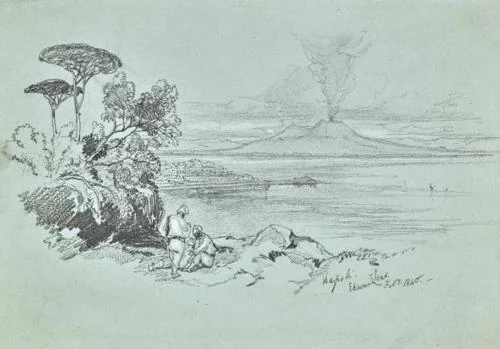
Signed, dated and inscribed l.r.: Napoli./EdwardLear./7.07.1840.-, pencil with white on blue paper 17 x 24 cm Provenance Private Collection, London until 2017 Lear lived in Rome from December 1837 until 1848 as part of an international community of artists, a happy and productive time in his artistic development. During the summers he travelled to other parts of Italy. This characteristic, crisp drawing heightened with white on blue paper is typical of his work of the period.
SoldView details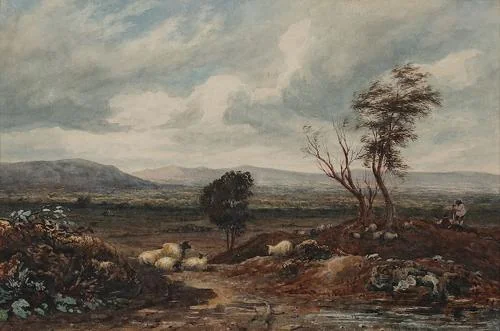
KT531 Signed l.r.: J.M. INCE 1839, signed and inscribed verso in pen and brown ink: View in Radnorshire/J. Ince, watercolour over traces of pencil with scratching out and stopping out 28 x 43.8 cm.; 11 x 17 inches This beautiful watercolour shows the influence of David Cox very clearly. Ince studied with David Cox in Hereford before moving to London in 1826 when he started to exhibit at the Royal Academy. He moved first to Cambridge and then in the 1830s back to Presteigne in Radnorshire, where he was based for the rest of his life.
SoldView details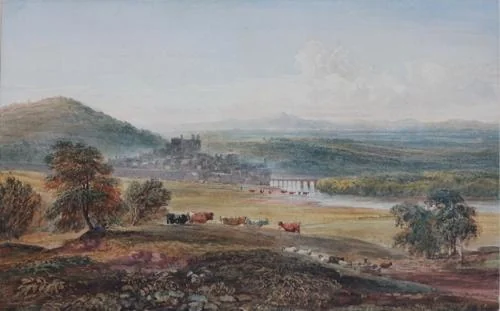
Signed l.r.: D. COX., watercolour over traces of pencil with scratching out and touches of gum arabic 21.3 x 34 cm.; 8 3/8 x 13 3/8 inches Provenance Guy D. Harvey-Samuel (1887-1960); Fine Art Society, Annual Exhibition of English Drawings and Watercolours, April 1960; no. 108; Private collection, U.K. until 2020 This sparkling watercolour in superb condition and dating from circa 1824 is a fine example of the fluent small-scale drawings with which Cox had commercial success in the mid to late 1820s. He wrote to William Radclyffe that he intended to devote more time to saleable smaller works, as his larger pictures were not finding buyers (Scott Wilcox points out that his discovery of the elegant small watercolours by Bonington at this date would have provided a compelling model (See Scott Wilcox, ed., Sun, Wind, and Rain: The Art of David Cox, exhibition catalogue, Yale Centre for British Art, p. 36). Cox drew several versions of this view; the closest to this one is a slightly larger drawing in the British Museum (1915,0313.6). Another version was engraved by William Radclyffe as plate XI in Thomas Roscoe’sWanderings and Excursions in South Wales in 1837 in which agricultural labourers and their horses replace the sheep and cattle in the foreground. Birmingham Museums and Art Gallery have a slightly smaller version with sheep in the foreground (1927P678 and see David Cox, Birmingham Museums and Art Gallery, 2008-9, no. 31).
SoldView details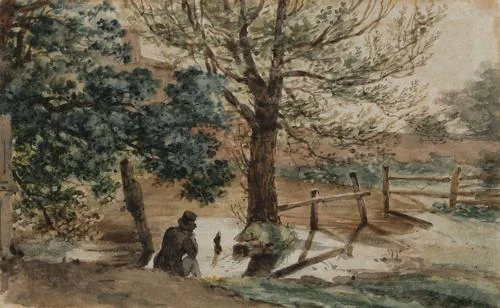
Watercolour 11.7 x 18.2 cm.; 4 ½ x 7 1/8 inches Provenance George Clive, Herefordshire, by descent; Spink; Sir John Gielgud, purchased from the above, his sale at Sotheby’s, London, 5 April 2001, lot 21
SoldView details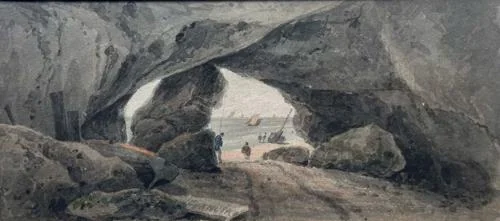
Signed l.c.: FRANCIA, watercolour over traces of pencil. 10 x 23 cm.; 4 x 9 inches Provenance Sir William Forbes, 7th Baronet, of Pitsligo (1773-1828), also of Colinton House, Greenhill House and Fettercairn House, Kincardineshire and by descent until 2017; With Abbott and Holder; Private collection U.K. until 2024 Francia was Bonington’s teacher whose work provides an important link between British and French watercolour painting in the early nineteenth century. A native of Calais, he left for London after the outbreak of the French Revolution and remained until 1817. He established a practise as a drawing master in London and a reputation as a painter of marine and landscape watercolours. He attended the Monro ‘academy’, made sketching tours, was secretary of the Brothers, a sketching club of which Girtin was a member and was also secretary of the Associated Artists in Water Colours. He exhibited at the Royal Academy from 1795-1822. He returned to Calais in 1817. Sir William Forbes, 7th Bt., began acquiring Old Master drawings as a young man, travelled to Italy in 1827 and formed an important collection of Old Master paintings later in life. He bought extensively from the posthumous sales of John McGouan (L. 1496), another significant Scottish collector, in 1803 and 1804. He was also an enthusiastic patron of British contemporary watercolourists.
SoldView details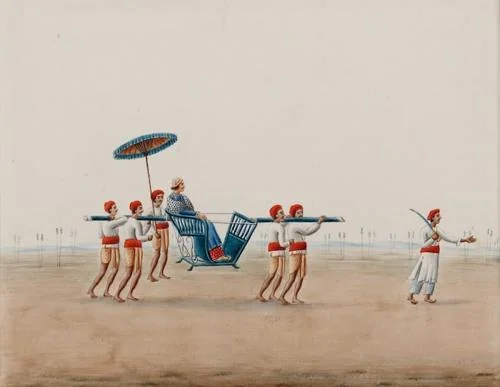
KT340 Watercolour heightened with bodycolour and gum arabic 14 x 17.5 cm; 5 ½ x 6 ¾ inches Provenance Covent Garden Gallery Shiva Lal ran an art shop in Patna and his work is characterised by the elongated limbs seen in the bearers of the palanquin and the delicate watercolour horizon in this drawing. Means of conveyance were one of the subjects in which he specialised. Further examples of his work can be found in the collection of the Victoria and Albert Museum.
SoldView details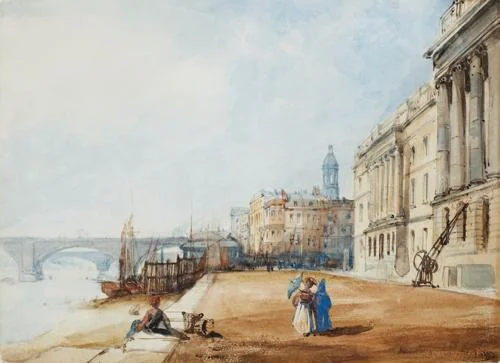
Watercolour over pencil with gum arabic and scratching out 23 x 31.5 cm.; 9 x 12 ½ inches Frame size 41 x 49 cm.; 16 ¼ x 19 ¼ inches Provenance Appleby Brothers;Private collection U.K. until 2021 This would appear to be the watercolour on which Boys’ lithograph of the subject for ‘London As It Is’, 1842, was based. A record of London in 1840s, the book was issued with plates which were hand-mounted in imitation of watercolours. Boys’ reputation was significantly enhanced by this publication. There are several differences between the final lithograph, which is in portrait format, and this watercolour, notably in the foreground where the figures are omitted in the lithograph in favour of a large group of packages with the loading machine moved from the side of the Custom House to the edge of the Thames, blocking the view of London Bridge.
SoldView details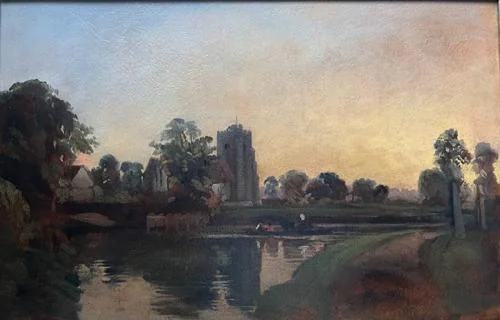
Oil on paper laid down on canvas 32 x 49 cm.; 12 ½ x 19 ½ inches Provenance Miss H.H. Tatlock, the artist’s granddaughter; C.K. Bloom; Percy Moore Turner (1877 – 1950); Sotheby’s, London, 2 May 1962, lot 133, where purchased by Agnew’s, London; Simon C. Dickinson, London, where purchased by the previous owner Exhibited Usher Art Gallery, Lincoln, Peter de Wint, 1937, no. 77; Agnew’s, London, Loan Exhibition of Paintings and Drawings by Peter de Wint, 1966, no. 66 This atmospheric oil on paper is most probably St Michael’s, Bray, on the Thames. De Wint made several watercolours of the church.
SoldView details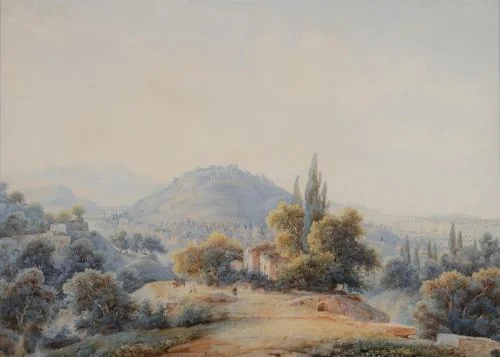
SOLD Signed and dated l.r.: Wolfensberger/Smyrna 1836, watercolour over pencil with scratching out 54.2 x 75.1 cm; 21 5/8 x 29 ½ inches This view of Smyrna from the outskirts of the city shows shipping moored in the bay and a number of individual buildings which are carefully drawn. Wolfensberger’s watercolour views of the Near East, Greece and Italy, are characterized by a topographical accuracy combined with a picturesque viewpoint and a distinctive soft palette. Born near Zürich, Johann Jacob Wolfensberger studied there with Heinrich Fuseli between 1814 and 1817, when he travelled to Italy where he lived in Naples, for several years, and also spent some time travelling in Sicily. In 1825 he was in Rome, where he befriended Horace Vernet, the director of the Académie de France. In Rome Wolfensberger was employed as a drawing teacher to the Marquess of Northampton, later President of the Royal Society. In 1829 he returned briefly to Zürich, where he lived with the painter Johann Conrad Zeller, before coming back to Rome in 1830. Between 1832 and 1835 Wolfensberger lived and worked in Athens, where he was employed by the French envoy the Baron de Rouen and the Austrian Baron Prokesch von Osten. During this time he visited Smyrna, Constantinople and Asia Minor in 1834. He also travelled with Joseph Count of Estourmel (1783-1853) in the early 1830s in Greece and Asia Minor. The illustrated book of the Count of Estourmel’s journey was published in 1844 entitled ‘Journal d’un Voyage en Orient. In 1838 an exhibition of two hundred of Wolfensberger’s views of Italy and Greece was held in Zürich. With the financial support of the Swiss bibliophile, scholar and collector Martin Bodmer, further exhibitions of his work took place in Vienna, Paris and London. A trip to London in 1840 resulted in a commission from the publisher Henry Fisher for a series of seventeen prints of Italian and Greek views. The artist’s marriage the following year to Hanna Dorothea Burdon, an Englishwoman, allowed him some financial security. Wolfensberger continued to make sketching trips around Europe; visiting Italy in 1843, Switzerland in 1844, and England and Scotland in 1846. Four years after he died from encephalitis in 1850, a biography of the artist was published by his widow. A large group of around five hundred drawings and watercolours by Wolfensberger can be found in the collection of the Kunstmuseum in St. Gallen. Further works by the artist are in the collections of the Kunsthaus, the ETH Graphische Samlung, Zurich and the Zentralbibliothek in Zurich.
SoldView details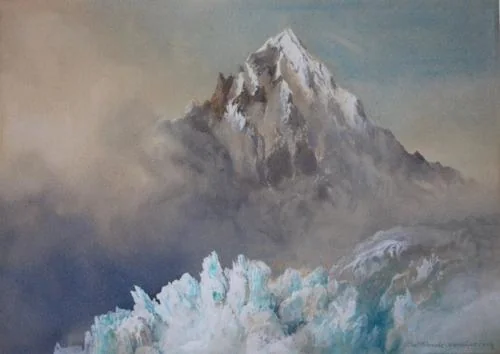
SOLD Signed, inscribed and dated l.r.: Dent Blanche RHWright 1912, watercolour over traces of pencil heightened with white 18.5 x 26 cm; 7 ¼ x 10 ¼ inches Framed in a silver moulding 32.5 x 42 cm.; 12 1/2 x 16 1/2 inches The Dent Blanche is one of the highest peaks in the Alps, familiar to those who have visited Zermatt, and marking the division between French and German speaking Switzerland. Popular with climbers, the summit is a converging point of three ridges, and it has four steep faces which rise over four glaciers. Wright was married to the fellow artist Catherine Wood (1857-1939).
SoldView details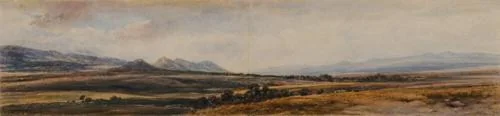
Inscribed verso: View in Cumberland F de Wint, watercolour, on two sheets, joined 15.2 x 64.7 cm; 6 x 25½ inches Provenance: Lady Lyons, her sale at Christie’s, London, 24 October 1960, lot 42; With Spink & Son Ltd, London, K3 1910; H. A. Molins, his sale at Sotheby’s, London, 22 November 2007, lot 143; With WS Fine Art, London, 2008; The Flannery collection, UK, and by descent until 2018. Exhibited: WS Fine Art, summer 2008, no. 34. This atmospheric panorama with a remarkably extensive uninterrupted vista dates from the 1830s and is a companion to A View of the Cumberland Hills from Patterdale , in the collection of the Whitworth Art Gallery, Manchester (D1924.63). Both watercolours are painted with wet, broad washes in the same palette on two sketchbook pages joined together, in the narrow panoramic format favoured by the artist, and are identical in size. They were presumably done on the spot. It seems highly probable that this watercolour is also of the fell region between Keswick and Penrith. De Wint is thought to have drawn these when visiting from the homes of his patrons the Howards of Leben or the Lonsdales of Lowther, with both of whom he stayed. The Gentleman’s Magazine obituary of the artist stated, His visits to the lakes of Westmerland [sic] and Cumberland produced many valuable sketches and drawings of picturesque scenery of a higher character; and his characteristic diligence in studying nature under all circumstances was never relaxed. 1 1. September 1849, p. 322, quoted in John Lord, ed., ‘Peter de Wint 1784–1849’, exhibition catalogue, Usher Art Gallery, Lincoln, 2007, p. 145.
SoldView details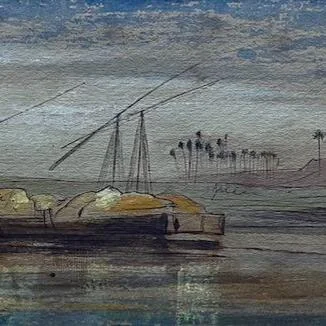
Dated l.l.: 1 PM. Jan 2 1867, numbered l.r.: 130 and inscribed with colour notes, pen and brown ink and watercolour heightened with bodycolour on buff paper 8 x 24.5 cm.; 3 1/8 x 9 5/8 inches Provenance Spink (K3/4703) This watercolour dates from Lear’s second trip up the Nile and his third visit to Egypt in the winter of 1866-1867, when he travelled with his Canadian cousin, Archie Jones. The men met in Luxor and visited Esneh, Edfu and Denderah, and had reached Philae by the end of January. Lear found his cousin irritating due to his habit of whistling and his lack of enthusiasm for the temples.
SoldView details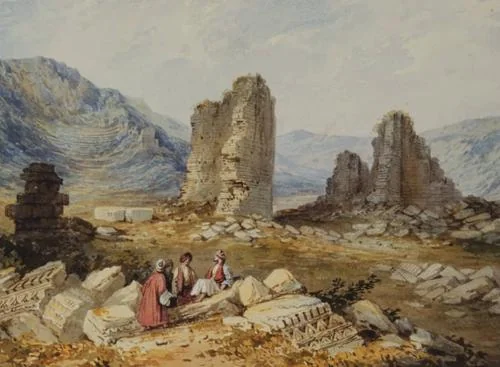
Watercolour over traces of graphite, inscribed verso: at Ephesus, possibly in a later hand 29.3 x 41.8 cm The harbour baths are situated in front of the theatre, which can be seen to the left behind them in this drawing. The area, which was originally built in the period of the Emperor Domitian (AD 81-96), also had a gymnasium, a sports area and meeting rooms. The holes in the brick are typical and show where the marble revetment was fixed. A similar view by Page, of almost identical size, but with sketchier figures and from a slightly different vantage point, is in the Victoria and Albert Museum.
SoldView details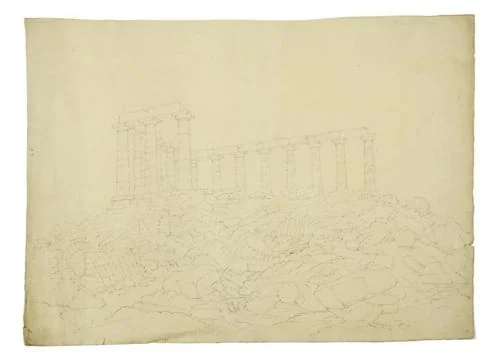
Inscribed u.r.: Cape Colonna, graphite on paper watermarked S & C WISE/1814 43.5 x 59.9 cm The early watermark on the paper of this drawing, made with the aid of a camera obscura, provides a terminus a quo, although it seems unlikely that Page drew this before his first Royal Academy exhibit of 1816, as he would probably still have been studying at the RA Schools in 1814. It is more likely that it is a sheet of paper which he took with him when he left on his travels. Cape Sounion, a promontory at the southernmost tip of the Attica peninsula, surrounded by the sea on three sides, is one of the loveliest sites in Greece. The Doric temple, seen here from the north-northwest, is dated to circa 440 BC. Dodwell wrote that the fallen columns are scattered about below the temple, to which they form the richest foreground.
SoldView details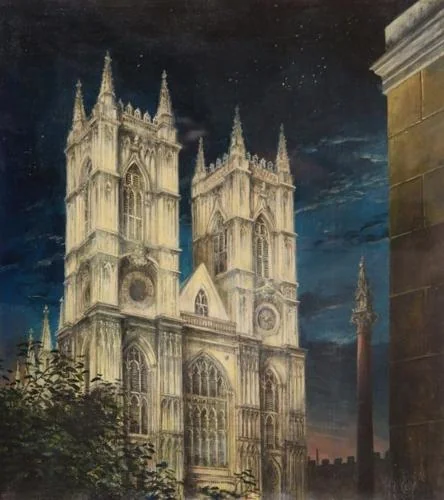
Signed twice l.r., oil on paper 34 x 30.2 cm; 13 2/5 x 11 9/10 inches Framed in a black polished frame A commission for the Dunlop Rubber Company Limited and used as a full-page advertisement in 1953 to commemorate the Coronation of Queen Elizabeth II in numerous publications including ‘The Queen’ and ‘The Illustrated London News’. A copy of one of the advertisements accompanies the painting. The accompanying text reads as follows: ‘God Save the Queen. Once again this is a year of splendour for the Abbey in Westminster, which was built for prayer and for the anointing of Kings and Queens. Once again the triumphant trumpets give silver tongue and the people cry out “God Save the Queen” and the soft English daylight gains glory from gold and silver and precious jewels. Here, in this sacred place, time adds rich colour to the tapestry of history, as a new Queen, Elizabeth II, is anointed, crowned and enthroned. When the Queen departs from the Abbey, and the great throng is dispersed and the air is still, the glory will still be there, enshrined in this holy place, guardian of our faith and of our royal Succession.’ Kelly was a New Zealand born painter, stage designer, graphic designer, interior designer and illustrator who lived in the UK from 1935. During World War II he served in the Royal Air Force as a navigating officer. He began to paint seriously in his spare time, his work influenced by the Surrealists and with a Romantic feel while always meticulously executed. He abandons nature’s topography and reinvents landscapes in a dreamlike world and his interest in architecture is often apparent in his paintings. His first one-man show was at the Lefevre Gallery in 1943, and its success led to another exhibition the following year, when pictures by Lucien Freud and Julian Trevelyan were shown in next door rooms. That year he received a commission to illustrate the art historian and critic Herbert Read’s ‘The Green Child’. Read was an early admirer of Kelly’s work and introduced him to a number of significant clients. The artist exhibited at Arthur Tooth from 1965-1974 and thereafter at Partridge Fine Art. Kelly was commissioned to paint murals and interior decoration in many of England’s most important houses, his good looks and charm fuelling his social popularity. At Castle Howard he executed four murals for the Garden Hall in 1982 and the ‘Kelly car’, a fairground-style train to take visitors around the grounds. His work enjoyed global acclaim, notably in the United States and as far away as Nepal where he decorated a room in the Royal Palace, Kathmandu. He also worked on developing architectural ideas, notably at Henbury Hall where he gothicised ‘The Cave’ for Sebastian de Ferranti and Highgrove where he refaced the Victorian facades and designed new plastered and pedimented frontispieces, returning the house to a more Georgian appearance for the Prince of Wales. He also painted murals in a number of Union Castle and Cunard liners. His work is included in the collections of Tate, Aberdeen Art Gallery and Museums, Southampton City Museum, Grosvenor Museum, Chester, Sheffield Museums and the National Trust. The R.W. Norton Art Foundation in Louisiana has a holding of his work and his archive is in the collection of the Museum of New Zealand. Literature Paintings by Felix Kelly. Introduction by Herbert Read, London, 1946 Michel Remy, Surrealism in Britain, Aldershot, 1999 Donald Bassett, Fix, The Life and Art of Felix Kelly, Darrow Press Donald Bassett, Felix Kelly, Herbert Read and Neo-Romanticism, British Art Journal - Vol. 8 No. 2, September 2007
SoldView details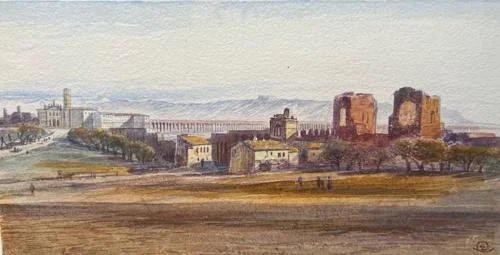
Signed with monogram l.r., watercolour over traces of pencil, inscribed on backboard: Lady Peyton /40 Wilton Crescent 10.2 x 20.4 cm.; 4 1/8 x 8 inches, framed size 28 x 37 cm.; 11 x 14 1/2 inches Provenance Lady Peyton, 40 Wilton Crescent, London; The Hon. Dorothy Gibbs, and thence by family descent; Christie’s, 17 November 2005, lot 103 £5800 In 1837, with financial assistance from his patron, Lord Derby (1775 -1851), the twenty-five-year-old Lear set off for Rome, where he was based for the following decade, which was a formative phase of his artistic development. During the summer months he would travel further afield in Italy, returning to Rome in the winter. Lear painted an oil sketch of this subject around 1839-1840, see Lady Strachey, The Letters of Edward Lear, 1907, p. 341. St John Lateran is considered to be the oldest church and Archbasilica in the world, founded by Pope Melchiade in 324 on the ruins of the villa of the Laterani family.
SoldView details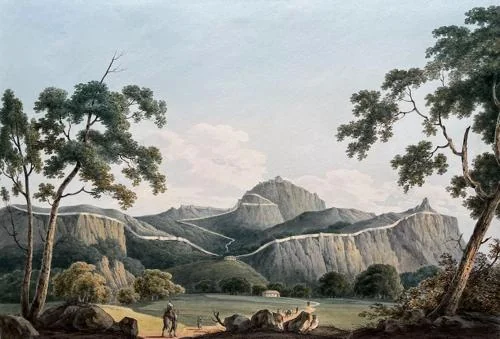
KT591 Watercolour over traces of pencil 32 x 47 cm.; 12 5/8 x 18 ½ inches Provenance Spink, London, ‘A Journey through India- Pictures of India by British Artists’, 9 October-1 November 1996, no. 30;Sotheby’s, London, 8 June 2000, lot 69;Private collection, U.K. until 2023 Justinian Gantz, described in the East India Gazette as 'Miniature Painter', was the son of the artist John Gantz. In addition to their work as draughtsmen for the East India Company, they may have practised as architects and ran a family lithographic press in Popham's Broadway, Chennai (M. Archer, British Drawings in the India Office Library, 1969, I, p.49, and J.R. Abbey, Travel in Aquatint and Lithography, 1957, II, no.445). Seven watercolours by Justinian Gantz of European houses in Chennai dating from 1832-1841 are in the collection of the British Library (M. Archer, op.cit., II, pp.604-606). The fortress of Gooty was an important British stronghold 269 miles from Chennai and 44 miles east of Bellary. It comprised a number of strong works, connected with each other on the summits of a cluster of hills and enclosing a space of level ground where the town was situated. Two fortified gateways gave access to the town to the south-west and north-west. A huge smooth rock to the north of the circle of hills ascended through 14 gateways and fortifications to form a citadel. This work was part of a group of views of southern India by Justinian and John Gantz included in the Spink exhibition in 1996.
SoldView details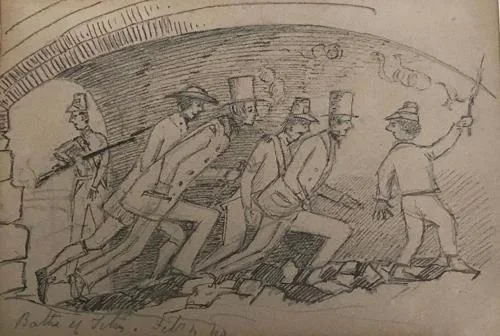
Inscribed and dated l.l.: Baths of Titus.Feb 4 40, pen and brown ink over pencil 8.6 x 12.4 cm; 3 3/8 x 4 7/8 inches
SoldView details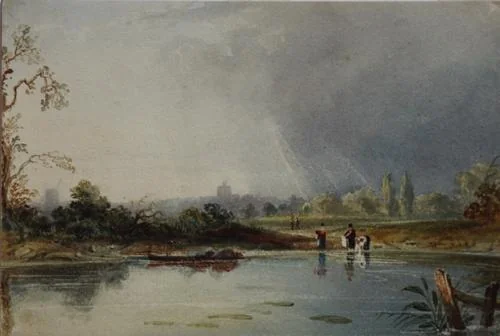
Watercolour over pencil with scratching out 13.9 x 20 cm The artist was the youngest son of Nathan Theodore Fielding. From c. 1827 to 1830 he lived in Paris, where he ran the family engraving business, at which William Callow worked. He collaborated with his brothers Thales and Theodore in England before returning to France, where he built up an extensive teaching practice, with pupils including members of the family of King Louis-Philippe. Provenance: Augusta Raymond-Barker, Fairford Park, Gloucestershire; thence by family descent until 2016
SoldView details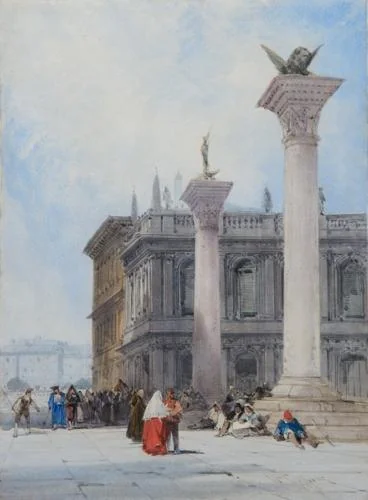
Signed and dated l.r.: Wm Callow/1870, watercolour over pencil with scratching out 37 x 27 cm; 14½ x 10⅝ inches Exhibited: The Society of Painters in Water-colours, 1870, The Piazzetta, Venice. This engaging watercolour shows the famous statues of the Lion of St Mark and St Theodore in the Piazzetta, which Callow draws teeming with life. A gondolier looking for business can be seen to the left of the composition while a lady in a red cloak and white shawl is in deep conversation with a soldier in the foreground, evoking characteristically Venetian pursuits. Venice was Callow’s inspiration and he returned to the city throughout his life, always staying at the Hotel Europa facing the Grand Canal. Another watercolour of the Piazzetta dated 1877 is in the collection of the city of Birmingham Museums and Art Gallery (1953P51).
SoldView details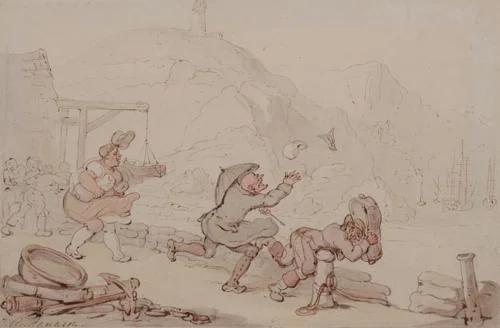
Signed or inscribed l.r., pen and grey ink and wash over traces of pencil 13 x 19.7 cm A drawing, Dr. Syntax alarmed by a whale, which shows Dr. Syntax losing his hat and wig to the wind, as in the present drawing, is in the collection of the Yale Center for British Art, New Haven, Paul Mellon Collection (see John Baskett and Dudley Snelgrove, The Drawings of Thomas Rowlandson in the Paul Mellon Collection, 1977, no. 321 ill.)
SoldView details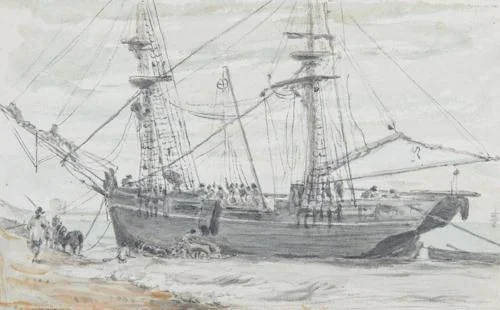
Inscribed beneath in brown ink: At Eastbourne 1848, watercolour over pencil with a brown line border, framed in a wooden moulding (Image) 12.5 x 20 cm; 4 7/8 x 7 3/4 inches Provenance Spink, 1980 The Italian artist, born in Cremona, settled in England in 1803, having travelled in Greece and Egypt with William Wilkins, R.A. His work has often been confused with that of Constable, particularly his coastal views which look quite similar. Examples of his work may be found at the British Museum, the V & A, Brighton Art Gallery and in several other museum collections.
SoldView details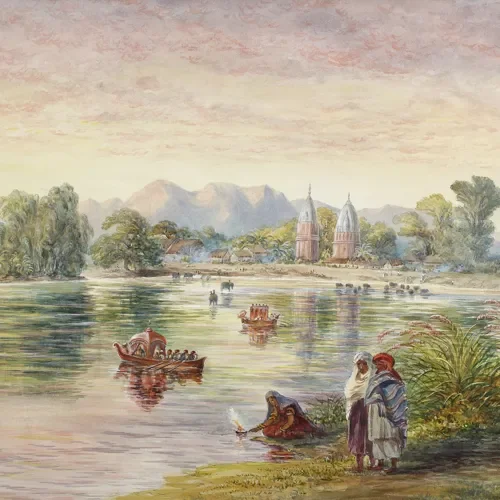
Signed, inscribed and dated l.r.: Hindoo Temple near Dehra/Himmalayas in the background-/Oct. 1869./C.F.G.C., watercolour over pencil with touches of white. Dehradun, the capital of Uttarakhand, is in the foothills of the Himalayas. On the banks of a river is a Hindu temple in front of which figures ride elephants through the shallow waters. On the riverbank, a woman performs the aarti, releasing a diya to float upon the waters as an offering. For further work by this artist please see the catalogue link and enquire about availability
SoldView details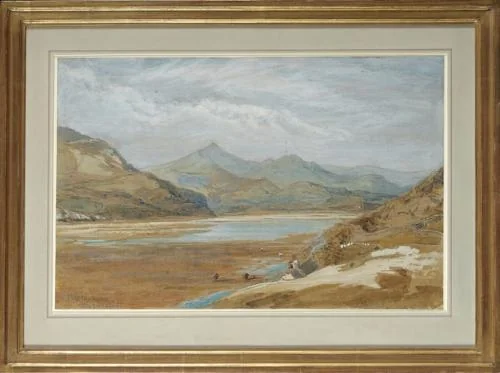
KT635 Signed with monogram, inscribe and dated in pencil l.l.: TRAETH MAWR/Sept 27th 55, watercolour over pencil heightened with white on buff paper 33.7 x 51.8 cm.; 13 3/8 x 20 3/8 inches Frame size 50 x 67 cm.; 19 5/8 x 26 3/8 inches Provenance Agnew’s, (DB5417) Private collection, Herefordshire, until 2024 James Holland OWS was born in Burslem, Staffordshire, where his father and other members of his family (including his brother Thomas, also an artist) were employed at the pottery works of William Davenport in Longport. James was employed there from the age of twelve, for seven years, painting flowers on pottery and porcelain. In 1819, Holland came to London where he continued to work as a pottery painter, but also gave lessons in drawing landscapes, architecture, and marine subjects. He first exhibited at the Royal Academy in 1824, became an associate exhibitor of The Society of Painters in Water Colours in 1835 and joined the Society of British Artists in 1843. In 1858 he was elected a full member of the Old Water Colour Society. Holland travelled extensively on the Continent between the 1830s and the 1850s, and he became known for his topographical works which were reproduced in the illustrated travel annuals of the day. He visited Venice, Milan, Geneva, and Paris, Portugal, Normandy and made tours of North Wales in 1850 and 1855. He exhibited prolifically during his lifetime and showed thirty-two pictures at the Royal Academy, ninety-one at the British Institution, and 108 at the Society of British Artists.
SoldView details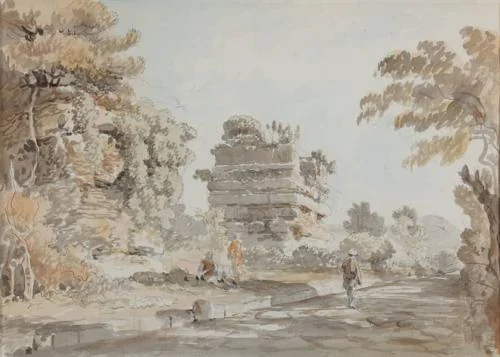
Watercolour over pencil on laid paper 37.5 x 53 cm.; 14 3⁄4 x 20 3⁄4 inches Frame size 60 x 74.5 cm; 23 5/8 x 29 1⁄4 inches Provenance: Thomas Agnew & Sons Ltd. Exhibited: Lupton’s Gallery, Eton College, 27 May – 10 September 2009, no. 11 Labruzzi, the son of a weaver, studied at, and was later received into, the prestigious Accademia di San Luca, one of the few Italians in Rome who worked mainly as a landscape artist. His studio was one of those usually visited by British Grand Tourists and his work enjoyed contemporary popularity and commercial success. He accompanied the antiquarian Sir Richard Colt Hoare (1758-1838), of Stourhead in Wiltshire, along the Via Appia from Rome to Brindisi in 1789, commissioned to sketch the monuments along the way. Bad weather and Labruzzi’s ill-health stopped the trip however, and the project was never completed, but he drew over two hundred and fifty views. His patron had intended to publish an account of the journey with prints and had the drawings bound in five volumes. Labruzzi made some more finished drawings in sepia, some modified for reproduction, and twenty-four plates etched by him were issued by Colt Hoare as 'Via Appia illustrate ab Urbe Romam ad Capuam', published in 1794 (see Timothy Clifford, 'Carlo Labruzzi the Grand Tour', 2012, Dickinson exhibition catalogue).
SoldView details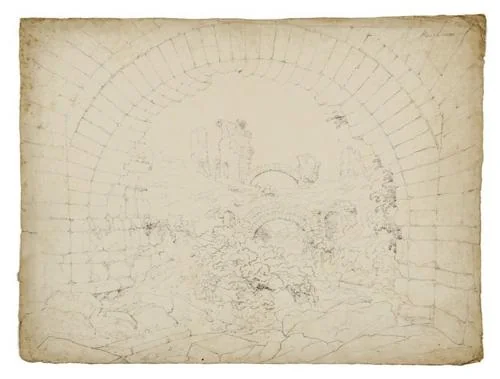
Inscribed u.r.: Ruins of [.....]/Pergamon, graphite 45.2 x 59.9 cm Cockerell described the ampitheatre as an extraordinary building. It stands in a narrow valley astride of a river. The two sides of the valley make the two ends of the oval, and the middle stands upon arches under which the river runs. It is half a mile from Pergamon. Near modern day Bergama in Turkey, Pergamon was a great centre of Greek culture and flourished under Eumenes II (197–159 BC), who was responsible for the construction of most of its main public buildings. It reached its heyday under Imperial Rome and grew hugely under Hadrian, with its sanctuary becoming one of the most important healing centres in the Roman world. Its library was second only to that of Alexandria. In 1842 Page exhibited at the Royal Academy a watercolour entitled Ruins of the Amphitheatre at Pergamos, Asia Minor, no. 892, which may be presumed to be based upon the present drawing, which was made with the aid of a camera obscura. Giovanni Battista Borra, the architect and artist who accompanied Robert Wood on his travels in Greece and the Levant in 1750–51, also drew this view.
SoldView details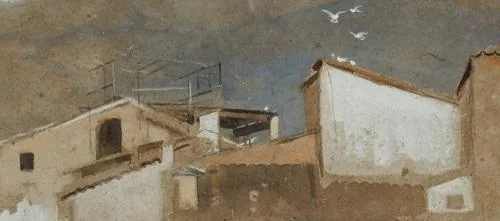
Signed with initials and dated l.r.: EA/1904, watercolour and bodycolour over traces of pencil on rough brown paper Image size 17.5 x 22.8 cm.; 6 7/8 x 9 inches, sheet size 22.5 x 27.5 cm.; 8 7/8 x 10 ¾ inches Frame size 37.5 x 43 cm.; 14 ¾ x 16 7/8 inches Provenance Private collection. U.K., until 2020 Alexander studied at the Royal Institution, Edinburgh from 1887-8, and in Paris with the sculptor Emmanuel Frémier. In 1887-8 the artist travelled to Tangier with his father and fellow artists Pollock Nisbet and Joseph Crawhall. He returned to Egypt in 1892, after his artistic studies, and lived on a houseboat on the Nile for 4 years, painting in the desert. This drawing appears to be of North Africa, the evocative rooftops an engaging subject on the characteristic oatmeal paper he often used. In 1902 Alexander was elected an associate of the Royal Scottish Academy becoming a full member in 1913. He exhibited widely including at the Royal Scottish Academy, Royal Academy, Fine Art Society, Royal Watercolour Society and the Leicester Galleries. Alexander’s work is held in the Tate Gallery, Aberdeen Art Gallery, Dundee Art Gallery and by Fife Council.
SoldView details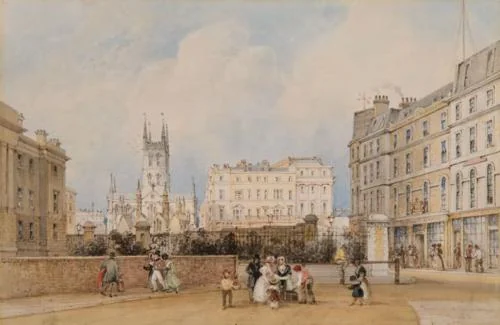
KT192 St. Saviour’s Church, Southwark, London Signed and dated l.r.: Geo. Sidney Shepherd 1839, watercolour over traces of pencil 17.5 x 26.8 cm This church was known as St. Mary Overy's until 1540. In 1904 it became the Cathedral church of the Diocese of Southwark. George Sidney Shepherd, the oldest son, was a member of a talented family of London topographers. On returning to England from France the Shepherd family settled in a neighbourhood close to the City Road. Throughout his career Shepherd was patronised by the celebrated interior designer, Frederick Crace, who became equally famous as a collector of views and maps of London. Crace commissioned him to produce watercolours of London buildings and locations, and also bought others from him. The fame of the Crace Collection acted as a springboard for Shepherd’s career, as he began to receive commissions from others, including Rudolph Ackermann. From around the time of its foundation in 1809, until its demise in 1828, Shepherd produced a series of street views for Ackermann’s magazine, ‘The Repository of Arts’, sometimes in collaboration with his younger brother, Thomas Hosmer Shepherd. From around 1818, Shepherd established himself as a book illustrator, with contributions to the part work, ‘Londina Illustrata' (1819-25), again in collaboration with his brother, Thomas, amongst others. Security and success soon arrived, with his first commission from the publisher, Jones & Co, based at the Temple of the Muses, Finsbury Square. The first part of ‘Metropolitan Improvements’ appeared in 1827, and comprised numerous steel engravings after drawings by Shepherd, with a commentary by the architect James Elmes. Its popularity not only ensured further commissions for Shepherd from Jones but ‘induced many publishers to embark on similar works’ (an unsigned review in the ‘Gentleman’s Magazine’ for March 1829, cited by J. F. C. Phillips, ‘Shepherd’s London’, London: Cassell 1976, page 11). The sequel to ‘Metropolitan Improvements’, entitled ‘London and its Environs’, began to appear in 1828. The Crace Collection in the British Museum contains nearly 500 images by Shepherd, including 38 views of ‘Edinburgh for Modern Athens!’. His work is also represented in many other public collections, including Kensington & Chelsea Library and the V&A.
SoldView details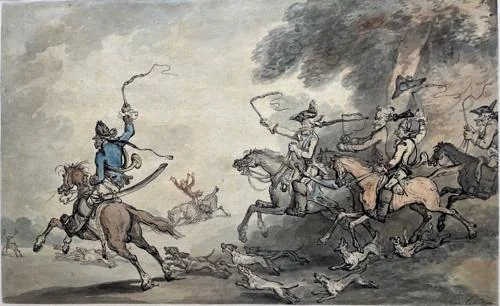
Signed l.r.: Rowlandson, pen and grey ink and watercolour over traces of pencil 22 x 36 cm; 8 3⁄4 x 14 1/2 inches Provenance The Rev. B.S. Allen, his sale, Sotheby’s 21 November 1984, lot 55 (bt. Morton Morris); Martyn Gregory Gallery; private collection until 2023 A smaller preparatory drawing in pen and grey wash of this subject by Rowlandson is in the collection of the Huntingdon Library and Art Museum (Sessler99A https://emuseum.huntington.org/objects/11899/a-french-hunt). This drawing dates from c. 1792, the date of another version of the subject which is in the collection of the British Museum, and formerly in the Schwerdt collection. This drawing includes an additional figure of a fallen rider in a red coat behind the leading rider- in the present composition this figure is drawn in the distance and has an additional rider at the end of the group of horsemen (https://www.britishmuseum.org/collection/object/P_1939-0714-138). Rowlandson’s caricatures of the French were amongst his most popular subjects and hunting also features frequently in his oeuvre.
SoldView details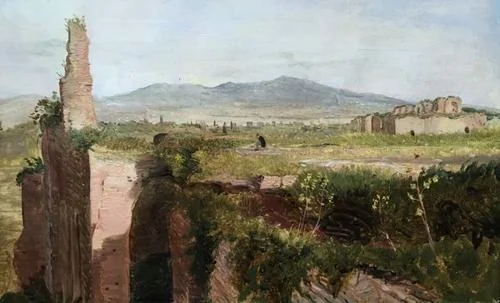
Inscribed on the reverse: Henry Acland from W (?) Severn- March 26 1839 – Drawn together May 1838 Oil on paper 25 by 39.5 cm., 9 3⁄4 by 15 1⁄2 in. Provenance: Given by Joseph or Walter Severn (b. 1830), to Sir Henry Wentworth Acland; By descent to his daughter, Sarah Angelina Acland; Purchased from her estate in 1931 by Sir Roger Mynors, and thence by descent This sparkling oil sketch of the top of the ruins of the Baths of Caracalla with the Alban hills beyond shows a seated figure, wearing a blue coat and grey trousers, drawing in the sunshine in May 1838. The inscription on the reverse suggests it was executed while Severn and Acland were sketching together at the Baths and that it was given to Acland when Severn visited England in June 1838. One of his aims was to find a school for his son Walter. Joseph Severn was the eldest son of a music teacher from Hoxton. At the age of 14 he became apprenticed to the engraver William Bond before entering the Royal Academy Schools in 1815. Here, in 1820, he was awarded the gold medal for historical painting for his ‘Una and the Red Cross Knight in the Cave of Despair’, which granted him a travelling scholarship. This coincided with the illness of his friend, the poet John Keats, and together they travelled to Rome in search of a better climate for the ailing poet. During the winter of 1820-21 Severn nursed Keats in their apartment near the Spanish Steps, his detailed letters from the period of great importance, but on 23 February 1821 Keats died. Severn remained in Rome, launching his own artistic career as a painter of landscapes, portraits and subject paintings. A companionable and likeable character, his large apartment in the Via de San Isidoro became an artistic centre for English visitors to Rome. In the winter of 1837 he met Sir Thomas and Lady Acland who were to become important patrons, and helped to promote his work in England. In 1838 their son, Henry, visited Severn in Rome. Sir Henry Wentworth Dyke Acland, later Regius Professor of Medicine at Oxford, became a great friend of Severn and his family. Acland gave his Oxford friend John Ruskin a letter of introduction to Severn when he visited Rome in 1840, resulting in another key relationship for the Severn family. The sketch remained in Acland’s collection in Oxford, passing along with the other contents of the house to his daughter, the pioneering photographer Sarah Angelina Acland. On the death of Sarah Acland in 1930, it was acquired by Sir Roger Mynors, then a fellow and classics tutor at Balliol. Severn remained in Rome for most of his life other than a spell in England from 1841-1861. With the help of William Gladstone, a patron, he became British Consul from 1860-72. He died in Rome in 1879 and, at his request, was buried next to Keats in the Protestant cemetery near Porta San Paolo and adjacent to the Pyramid of Cestius. Shelley, who died in 1822, lies nearby, and Severn’s posthumous portrait of him writing ‘Prometheus Unbound’ at the Baths of Caracalla of 1845 is on display at Brantwood. This portrait shows the same stretch of the Alban hills in the distance. Severn’s children, Walter, Arthur Joseph and Ann Mary Newton also became artists. Arthur Joseph was to marry Ruskin’s niece Joan Agnew and looked after him during his last years at Brantwood. The Baths of Caracalla were the second largest public baths in Rome, probably built between AD 211/212 and 216/217, during the reigns of emperors Septimius Severus and Caracalla. They were excavated in the 1780s and became a very popular sketching ground for visiting artists.
SoldView details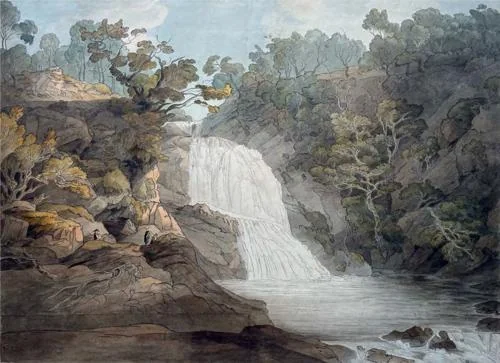
Signed and dated l.l.: No. 14/F. Towne delt/1777 and inscribed on the reverse of the original mount (attached to backboard): No. 14/A View of the Cataract of the Mothvaye/in Merionethshire North Wales/drawn on the spot by/Francis Towne/1777/London/Leicester Square/June 20th 1777, stamped with collector’s mark, pen and black ink and watercolour heightened with touches of bodycolour and scratching out on five sheets of paper joined, with watermark: I VILLEDARY. 31.8 x 43.2 cm.; 12 x 17 inches Provenance Bequeathed by the artist to James White (1745-1825); By bequest to John Herman Merivale, 1825, and by descent in the family to his granddaughter Emily Harriet Buckingham, 1915; By descent to her sister Frances Ann Laura Solly, 1923; With Thos. Agnew, London, from whom purchased by Wayland Wells Williams (188-1945); By descent to Mrs Elizabeth Williams Garstin (1897-1979) by1950; By descent to Mrs Cynthia Garstin Blackwell by 1962, her sale, Christie's London, 21 November 2007, lot 27, £31,700, to Andrew Wyld; His sale Christie’s 10 July 2012, lot 60; With Guy Peppiatt Fine Art; Private collection, U.K. until 2024 Exhibited London, Old Water-Colour Society, no. 46 as 'Cataract of the Mothvay'; London, Agnew's, Exhibition of Selected Watercolour Drawings by Artists of the Early English School, February - March 1922, no.120, lent by Emily Buckingham; Manchester, Agnew's, The 49th Exhibition of Selected Watercolour Drawings by Artists of the Early English School In Aid of the Manchester Royal Infirmary, November to December 1922, no. 7; Manchester, Agnew's, The Fiftieth Annual Exhibition of Selected Water Colour Drawings, November to December 1923, no. 22; Boston, Museum of Fine Arts, Special Loan Exhibition of Paintings, Prints and Drawings from New England Collections, not dated, no. 632; Yale, Yale University Art Gallery, Prospects: An Exhibition of English Landscape Watercolors from English and American Private Collections, 1950, no. 60, lent from the Wayland Wells Williams Collection by Mrs Elizabeth Williams Garstin; London, W/S Fine Art Andrew Wyld, 2008 and 2009 Summer exhibitions, no. 9 Literature Adrian Bury, Lone Star of Watercolour Painting, London, 1962, p. 151; Timothy Wilcox, Francis Towne, London, 1997, p. 43, fig. 14; Richard Stephens, A Catalogue Raisonné of Francis Towne (1739-1816), FT079 This substantial, exceptionally well-preserved watercolour dates from Towne’s first major sketching tour outside his native Devon to North Wales in June and July 1777 with his friend the lawyer James White. Wales was becoming a fashionable destination for tourists and the sublime landscape and medieval buildings provided many appealing subjects for artists. Towne’s numbered works from this tour start with Shropshire views (no. 1, a view of Bridgenorth dated 20th June) and end with views of Somerset (no. 54, a view of Glastonbury Abbey). Richard Stephens (op. cit.) has researched the itinerary and suggests that after Bridgenorth Towne travelled to Wenlock and then on to Shrewsbury via the Wrekin. By 27 June he was at Bala and then he headed south-west over the Cambrian Mountains to Machynlleth. The next week saw him sketching around Cadair Idris and Dolgelly and by 6 July he was near Tan y Bwlch. A few days later he headed towards Caernarvon, via Aberglaslyn and Llyn Cwellyn. From Caernarvon he took the coastal road to Conwy. He followed the River Clwyd south-east to Denbigh and then went on to Llangollen before starting to make his way home. Towne used sheets of differing sizes on this tour and this drawing is executed on one of the largest.
SoldView details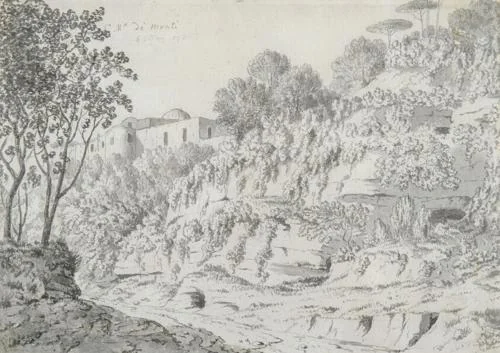
Inscribed and dated u.l.: Sa Ma de’ Monti/6 May 1781, pencil and grey wash on laid paper 18.8 x 26.4 cm; 7 3/8 x 10 3/8 inches Provenance Iolo Williams (1890-1962); Leger, 1992; Private collection, U.K., purchased from the above Exhibited Marble Hill House, Twickenham,Thomas Jones, 1970, no. 52; Leger,British Landscape Painting, 4 March - 3 April,1992, no. 25 Thomas Jones was born at Trefonnen near Llandrindod in Radnorshire. At the request of his uncle, he attended Jesus College, Oxford, in order to enter the church, but in 1761 Jones went to London and enrolled at Shipley's drawing school. By March 1763, Jones had decided to pursue landscape painting and persuaded Richard Wilson (1713-1782) to take him as an apprentice. He subsequently established a thriving landscape practice. However, despite his success in London, Jones hankered after Italy. Jones had long wanted to travel to Italy; a favourite project that had been in agitation for some years, and on which my heart was fixed (A.P. Oppé, ed., Memoirs of Thomas Jones , Walpole Society, XXXII, 1946-1948, p. 37). This may have been heightened by the example of Richard Wilson, whose artistic success had been assured by the Italian scenes he painted on his return to England after six years in Rome in the 1750s. Jones had studied and copied his sketches and studies during his apprenticeship. However, for years his trip to the continent had been thwarted by mounting debts and his parents' disapproval of the scheme and Jones did not leave until October 1776. Jones was greatly affected by the changing landscape and light as he travelled through France to Italy. After a brief stay in Florence, he arrived in Rome on 27 November 1776. In his lively and informative memoirs, Jones refers to Wilson’s influence when expressing his joy at travelling through Italy and entering Rome, the: new and uncommon Sensations I was filled [with] on my first traversing this beautiful and picturesque Country ... It appeared Magick Land - In fact I had copied so many Studies of the great Man, & my Old Master, Richard Wilson ... that I insensibly became familiarized with Italian Scenes, and enamoured of Italian forms ( ibid. p. 55). From May 1780 to August 1783 Jones was based in Naples and delighted in the picturesque scenery on the road to Santa Maria dei Monti, a monastery to the east of Naples of which a number of drawings by him are known. He was influenced by the fashionable work of Salvator Rosa, with its treatment of banditti in rocky landscapes. His old friend Francis Towne arrived in Naples in March 1781, and, in his memoirs, Jones describes their trip along the wild road to the monastery : I was able to conduct him to many picturesque scenes of my own discovery, entirely out of the common road of occasional Visiters, either Cavaliers or Artists (Thomas Jones, ibid . p. 102). He drew the road many times- ten are listed in the 1970 Marble Hill catalogue- and further examples are included in the collections of the Tate, the Yale Center for British Art, New Haven and the Rhode Island School of Design, Providence. Two other drawings of the subject executed on 6 May, the same day as the present drawing, one coloured and one pencil and grey wash, are in the collection of the Whitworth Art Gallery, Manchester. They are of a similar size to the present work and a grey wash drawing (D2002.14) is taken from almost the same spot. Jones further recorded how he felt about this place in his Memoirs on 2nd June 1781 and another incident which he and Towne had experienced: I proceeded to meet Pars..at an Osteria in the road to S’a M’a de Monti- in this hollow Way is a most beautiful series of picturesque Objects, which I discovered by Accident in one of my perambulations-Here may visibly be traced the scenery that Salvator Rosa formed himself on-Only taking away Pine trees, which were, perhaps planted since his time, and which indicate a state of cultivation not suited to his gloomy mind, with the addition of Water and a few Banditti-And every hundred yards present you with a new sand perfect composition of that Master- When Towne was in Naples I took him with me to see this romantic place, with which he seemed much delighted- but the following whimsical incident put a stop to further explorations at that time and which I forgot to mention in its proper place- Proceeding up the valley whose boundaries contracted more and more as we advanced, increasing in proportion the Gloominess of the Scene; We arrived at a Spot, which might very properly have been termed the Land of Darkness & the Shadow of Death…Here, says I, Mr Towne, is Salvator Rosa in perfection we only want Banditti to compleat the picture- I had scarcely uttered these words when turning round a projection of the rocks, we all at once pop’d upon three ugly-looking fellows dressed in the fantastic garb of the Shirri di Campagna, with long knives cutting up a dead jackAss.-…Towne started back as if struck by an electric shock, strongly impressed, I suppose, with our late adventure on the Coast of Baja-‘I’ll go no further’, says he, with a most solemn face, adding with a forced smile, that however he might admire such scenes in a Picture- he did not relish them in Nature- (ibid. pp. 104-5). Thomas Jones’s reputation has soared in recent years, notably after the 2003 landmark exhibition Thomas Jones (1742-1803) An Artist Rediscovered (at the National Museum of Wales, Cardiff, the National Gallery, London, and the Whitworth Art Gallery, Manchester) reinstated his reputation as one of the most idiosyncratic and innovative eighteenth-century British artists. Iolo Williams (1890-1962) was the author of Early English Watercolours (published in 1952), one of the bibles of the field. He left a large part of his collection to the British Museum, but this drawing was held back. He took a keen interest in Welsh matters, serving on the Council of the National Museum of Wales and on the Welsh Committee of the Arts Council.
SoldView details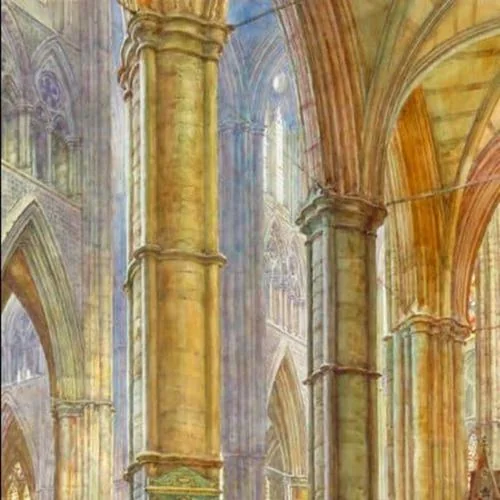
Signed and dated 1916 l.r., watercolour over traces of pencil with scratching out 76 x 49 cm The artist worked as a designer for Morris & Co. under Burne Jones who admired his work. From 1878-1893 he worked for Ruskin, drawing continental buildings, and until around 1908 he continued doing this for other patrons. The founding of the Society for the Protection of Ancient Buildings by William Morris and other members of the Pre-Raphaelite brotherhood in 1877 put Rooke’s talent to good use as his attention to architectural detail is always meticulous. Rooke also drew many British buildings. This watercolour shows the wooden pews in use in the Abbey at this time and also the light fittings. There are examples of Rooke’s work in many British public collections, notably the British Museum, Fitzwilliam Museum, Cambridge and the City Art Gallery, Manchester.
SoldView details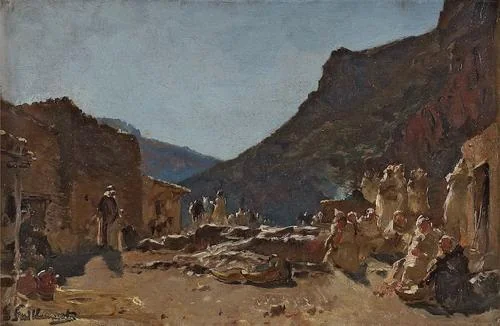
Stamped l.l.: G. Guillaument, oil on panel, three labels attached to reverse of original frame 15.5 x 24 cm Provenance Alfred Kulka (1868-1926), Jägendorf, bequeathed to his sister Valerie Heissfeld, (1876-1938); Lotte Heissfeld (1907-1983) a Christmas gift from her mother, 1936; On her death left to the mother of the present owner, by descent until 2022 Guillaumet was a leading French Orientalist painter. From 1857 he studied under François-Édouard Picot and Félix Barrias at the École des Beaux-Arts. He won the second prize in the Prix de Rome for historical landscape in 1861 and set off for Italy. In Marseille he was delayed by a storm and by chance took a boat for Alger. He was entranced by Algeria and its light. During this first journey he made a large quantity of drawings and studies. Between 1862 and 1884 Guillaumet returned to Algeria on ten or eleven trips, spending several months there each time, travelling around the country, living either in villages, or in Kabyle ksour (fortified villages) or with nomads. He also accompanied French expeditionary columns, as in 1864 and witnessed raids and the repression of insurrections. He wrote of his admiration for the landscape and his empathy for the population. Inspired by Fromentin’s works, he wrote texts about his Oriental experiences that appeared in the 'Nouvelle Revue' starting in 1879 and were later published together in an illustrated volume ‘Tableaux Algériens’ published posthumously in 1888. Guillaumet, who at first had a studio at Sèvres, settled permanently in Paris in 1885. He lived there with Cécile Neinlist (1838-1929) whom he married in 1879 and with whom he had a son, Édouard, born in 1866. He exhibited regularly at the Salon from 1861 to 1880. He enjoyed early success and the French state acquired several of his pictures of rural and nomadic Algeria for the Luxembourg and provincial museums. After his premature death a first retrospective exhibition was organized at the Paris École des Beaux-Arts in 1888. (1) His work may be found in Paris at the Musée d’Orsay and the Louvre. In Algeria, works by him are also on view in the public collections of the National Fine Arts Museum of Alger, at the National Museum Cirta in Constantine and the Zabana National Museum of Oran. He was the subject of a monographic exhibition’ L’Algérie de Gustave Guillaumet (1840-1887)’, (2) at the Musée des Beaux-Arts of La Rochelle, the Musée des Beaux-Arts of Limoges and at La Piscine in Roubaix (9 March – 2 June 2019). The Kulka-Heissfeld collection was formed by Richard Kulka (1863- 1931) the son of a Jewish industrialist with textile factories in Jägerndorf who moved to Vienna and became a lawyer. The paintings in the collection were mainly 19th and early 20th century landscapes. On his death he left 1/3 of his collection to his sister Adele Kulka and 2/3 to Valerie Heißfeld. Valerie and her daughter Lotte left Vienna in 1938 after the Anschluss with some of the collection. They applied for export applications for numerous works of art and succeeded in taking many with them. Lotte succeeded in fleeing to England on 1 March 1939 with around 25 pictures, of which this is one. Her mother and aunt, Adela Kulka, perished at the concentration camp at Theresienstadt. Exposition des œuvres de G. Guillaumet: au profit d’un monument à élever à la mémoire de F. Bonvin, Paris, École Nationale des Beaux-Arts, 7 to 31 January 1888.[↩] Marie Gautheron (dir.), L’Algérie de Gustave Guillaumet (1840-1887), exh. cat. 2018-2019 Musée des Beaux-Arts de La Rochelle, Musée des Beaux-Arts de Limoges and La Piscine de Roubaix, 2018.[↩]
SoldView details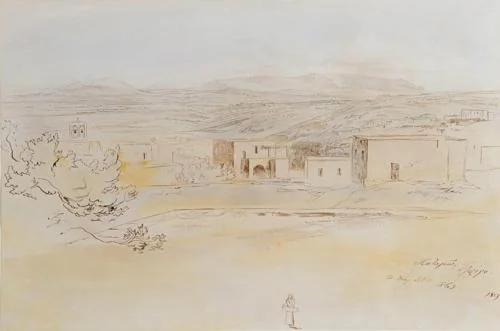
Inscribed in pen and brown ink with location in Greek l.r. and dated: 21. May 5 P.M. 1863 and again in pencil and numbered 189, further extensively inscribed with colour notes and comments, pen and brown ink and watercolour over pencil, inscribed and numbered verso: 159/Lon…? 32 x 48 cm; 12 1/2 x 18 7/8 inches This view is taken looking across the northern part of the village, from northeast towards the southwest. Mt. Myrmingari can be seen in the centre background, and Aghia Elessa is the rise to the left. Lear’s extensive journal entry for 21st May 1863 finds him rising at 4 am and drawing much of the morning. After a lunch of cold fowl, old lettuce, ‘biled’ eggs and bad wine he continued climbing, enjoying the views until he reached the house of Pruestos where he sketched on the terrace in a high wind until 5 pm and lodged for the night. He noted that the Potamite women were tall and seems to have drawn one in the foreground of this drawing. Lear undertook a tour of the Ionian Islands (other than Corfu) from 3rd April to 4th June 1863, shortly before the British left the Ionian Islands and their incorporation into Greece in 1864. He used the drawings for a book, ‘Views in the Seven Ionian Islands’, which was published in London in December 1863.
SoldView details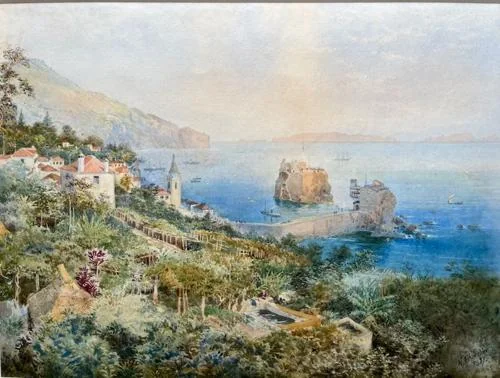
Signed and dated l.r.: N. Chevalier/1887., watercolour over pencil with scratching out 36 x 48.5 cm.; 14 1/8 x 19 1/8 inches Provenance Private collection, U.K. until 2023 Born in St Petersburg of a Swiss father and Russian mother, Chevalier moved to Switzerland in 1845 where he studied at the drawing academy affiliated with the Musée Arlaud in Lausanne before studying architecture at the Academy of Fine Arts in Munich. He travelled to London in 1851 to see the Great Exhibition, where he also trained as a lithographer and exhibited watercolours at the Royal Academy. Chevalier arrived in Melbourne in 1854 and found employment on the magazine Melbourne Punch. Alongside his work as a commercial illustrator he also published in 1865 a portfolio of 12 landscape prints, the earliest examples of chromolithography in Australia. Chevalier visited New Zealand in 1865–66, making extensive records of his tour, which he exhibited in Christchurch and Dunedin and in Melbourne at the Intercolonial Exhibition of 1866–67, as well as at the Paris Salon in 1868. When Queen Victoria’s second son, the Duke of Edinburgh, arrived in Melbourne in 1867 as part of his world tour, Chevalier accompanied the royal party as correspondent for The Illustrated Australian News. Later, he was invited to join the Duke’s entourage for the voyage back to England. His sketches and watercolours documenting the journey were exhibited at the Crystal Palace and at the South Kensington Museum in 1872. After settling in London in 1870, Chevalier received numerous commissions from the royal family. He also travelled routinely to Switzerland to paint. His influence on the development of the fine arts in Australia remained strong. Towards the end of his life Chevalier spent his winters in Madeira, where his final watercolours were made. This view shows Loo Rock in Funchal Bay and gives an evocative sense of the terraces of the city in the late 1880s.
SoldView details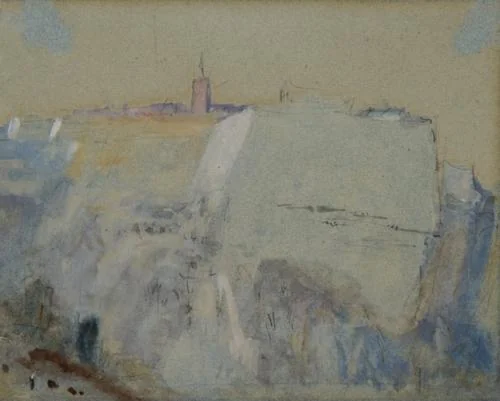
Watercolour with touches of white over pencil on blue paper 14 x 17.3 cm The second son of Hercules Sharpe, the artist was educated at Harrow. After leaving Cambridge, where he read mathematics, he decided to become an artist and studied in Rome for three years. On the death of his elder brother he inherited the Brabazon name and estates in Ireland. He spent his summers in England and his winters travelling in Europe and, from the 1860s, further afield. In 1891 Sargent persuaded him to have an exhibition at the Goupil Gallery, and as a result in his old age he was at the forefront of the modern movement. He was most influenced by Turner, Cox, Müller and de Wint, and his style owes much to Turner’s late work. Turner drew several views of Luxembourg on his Meuse–Moselle tour of 1839, and a watercolour from a similar viewpoint is in the Turner Bequest at Tate Britain (TB CCXXX1 0), although it is unlikely that Brabazon would have seen this work.
SoldView details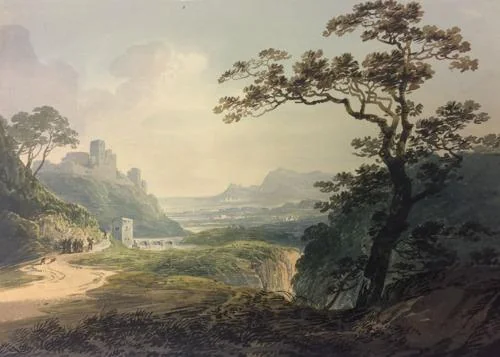
KT197B Signed verso in pen and brown ink: W. Payne, watercolour over pencil 21.1 x 29.7 cm Provenance Blair Castle, Blair Atholl, Scotland
SoldView details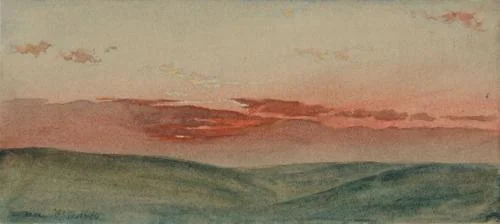
Signed with monogram and dated l.r. and inscribed and dated l.l.: Sunrise Nov 12.1874, watercolour with touches of white and pink bodycolour 25 x 28 cm Provenance Walter Coleridge Richmond, the artist’s son, by family descent Richmond was the son of the miniaturist Thomas Richmond, who enrolled at the Royal Academy Schools in December 1824 at the age of 15. His earliest influences were the Keeper of the R.A., Henry Fuseli and William Blake, whom he met in 1825. Although his major output was portraiture, a genre he chose to meet his family responsibilities, Richmond returned to the subject of sunrises and sunsets throughout his life. A similar watercolour of the same size dated May 1874 and inscribed ‘Recollection of an evening sky’ is in the collection of the Huntington Library, San Marino. In 1872 he painted an oil entitled ‘Sunrise over the sea at Margate’ (see R. Lister, George Richmond, 1981, p. 101).
SoldView details