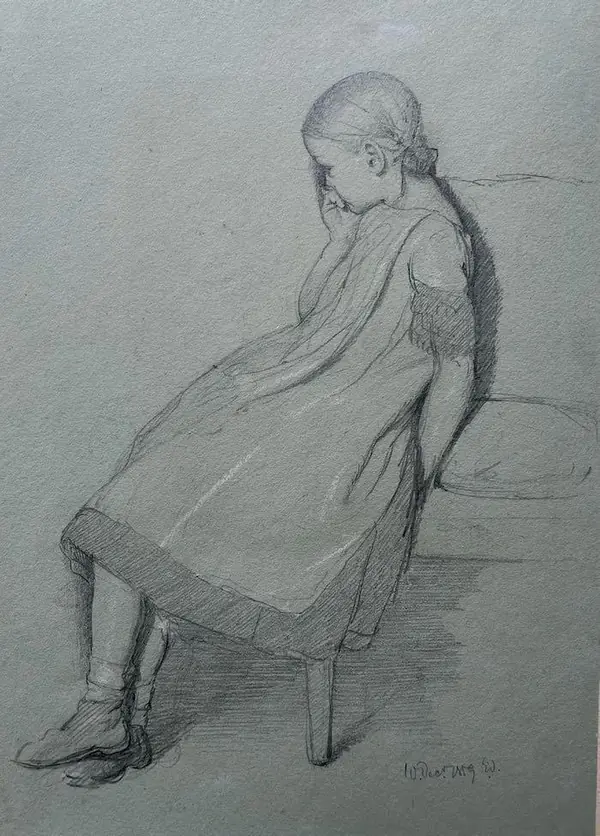
Inscribed verso: At Dulwich, sepia wash
15.5 x 11.3 cm.; 6 1/8 x 4 3/8 inches
This drawing was executed while Cox was living in Dulwich between 1809 - 1813, in the house beside the windmill on Dulwich Common.
Exhibited
Dulwich Picture Gallery, ‘Bicentenary Exhibition’, catalogue no. 4;
Dulwich Picture Gallery, ‘Dulwich Past and Present’, summer 1993
Provenance
The Carnegie family;
By descent to Lord Rosehill;
Anthony Reed, English Drawings and Paintings, Cork Street, London W1;
Sotheby’s, 1 April 1993, lot 75;
Barbara Brind;
By descent until 2022
You Might Also Like

Inscribed l.r.: Bruges, watercolour7.6 x 11.4 cm; 3 x 4½ inchesProvenanceSpink & Son Ltd, London, K3/1890b, part of a group purchased from Appleby Brothers, 2 August 1960.This spontaneous, on-the-spot sketch was presumably done when Cox visited Bruges in 1826. His first trip to the Continent was organised by his brother-in-law Mr Gardener, an agent for the sale of government ordnance maps who had premises at 163 Regent Street, London. Gardener persuaded Cox and his son David Cox Jr to accompany him on a business trip to Brussels. The party travelled from Dover to Calais and then, travelling by diligence, on to Dunkerque, Bruges and Brussels. Cox evidently liked the caps worn by the market women in Belgium as he sketched them again in Brussels.1 1.See N. Neil Solly, Memoir of the Life of David Cox, 1873, reprinted 1973, p. 49.
View details
Signed and dated l.l.: David Cox. 1836, watercolour over pencil with scratching out18 x 26 cmIn the summer of 1836 Cox spent a few weeks at Rowsley, painting at Haddon Hall. He made several watercolours of elegant figures in seventeenth century costume strolling on the terrace there to which the present work relates. Although the present work does not appear to be of Haddon, it fits in with this period of his oeuvre.
View details
Signed l.l.: David Cox., watercolour over traces of pencil with touches of pen and black ink on buff paper29.6 x 39 cm; 11 ¾ x 15 ⅜ inchesProvenance: Agnew’s, London, 126th annual exhibition, March 1999, no. 63; The Flannery collection, UK, and by descent until 2018.This very freely drawn watercolour represents a transitional stage in the development of the important theme of ‘Peace and War’, one of David Cox’s major subjects. Two local men, one seated, one standing, watch a small troop of soldiers on the march in an extensive sweeping landscape under a huge sky, with Lancaster Castle in the middle distance and the waters of Morecambe Bay beyond. Unusually for Cox there is not much pencil underdrawing.Cox’s preoccupation with military activity during the very unsettled years of the 1830s and 1840s manifests itself after his 1838 trip with his wife to Seabrook, near Hythe in Kent, for six weeks. The artist made sketching trips along the coast of Kent, including one to Lympne, five miles from Hythe, resulting in Peace and War: Lympne Castle ( c. 1838, Birmingham Museums & Art Gallery).The present work, which is similar in style and feel to the Lympne watercolour, presumably dates from the same time, but shows the composition reversed and the distant focus of Lancaster Castle as in Lancaster: Peace and War, 1842 (Art Institute of Chicago). Most of Cox’s numerous ‘Peace and War’ subjects are set at Lancaster rather than Lympne and have more developed references to ‘War’ than the small troop of riders seen here on the top of the hill on the left.The theme is repeatedly treated by Cox at this period, resulting in his 1838 exhibits at the Society of Painters in Water-colours in London, Rocky Scene – Infantry on the March and Stirling Castle – Cavalry on the March and the 1839 Cavalry on the March. In 1848 the first work to be entitled Peace and War (Lady Lever Art Gallery, Port Sunlight, National Museums Liverpool) was exhibited at the Society of Painters in Water-colours.
View details
KT587Signed and dated l.l.: D. Cox/1824, watercolour over pencil22.6 x 28.9 cm.; 8 ¾ x 11 3/8 inchesProvenanceColnaghi (exhibited as ‘In the Wye Valley’);Viscount Eccles (1905-1994);Abbott and Holder; from where acquired byPeter Roberts until 2023ExhibitedProbably the Society of Painters in Water-Colours, 1824, no. 289, Hay Field – View near HerefordThis charming watercolour is a fine example of the fluent small-scale drawings with which Cox had commercial success in the mid to late 1820s.He wrote to William Radclyffe that he intended to devote more time to saleable smaller works, as his larger pictures were not finding buyers (Scott Wilcox points out that his discovery of the elegant small watercolours by Bonington at this date would have provided a compelling model (See Scott Wilcox, ed., Sun, Wind, and Rain: The Art of David Cox, exhibition catalogue, Yale Centre for British Art, p. 36).The castellated church in in middle distance may well be modelled on St Peter’s, Lugwardine. The building to the right of the church bears a passing resemblance to Sufton Court (which is not so close to the church). Cox was an artist, not a topographer, and frequently modified landscapes and landmarks to suit his artistic vision.Viscount (David) Eccles (1905-1994) had a fine collection of 18th and 19th century British drawings. He was a politician who organised the coronation of Queen Elizabeth II. After being sacked by Harold Macmillan in July 1962 he went back into business, first as a director of Courtaulds and later as chairman of West Cumberland Silk Mills.Peter Roberts was a school master and collector of English watercolours who taught English at Oundle School until his retirement in 2007.
View details
Watercolour over pencil with scratching out18.2 x 22.8 cm.; 7 ¼ x 9 1/8 inchesProvenanceQuentin and Molly Bridge until 2020ExhibitedMartyn Gregory, British Watercolours & Drawings, 2020, no. 8This charming early drawing by Cox dates to circa 1815. A woman and a child can be seen collecting water in a bucket from a stream near a wooden bridge by a cottage. The child appears to be wearing a black Welsh hat.
View details
Oil on paper laid down on board, inscribed on reverse of board: George Mason ARA and stamped with a Christie’s stencil21 x 21 cm.; 8 ¼ x 8 ¼ inchesProvenanceThe artist’s studio sale, Christie’s, 15 February 1873, lot 91, where bought byGeorge Dunlop Leslie, RA (1835-1921); his daughter Lydia Leslie, By descent to T. L. Twidell ExhibitedStoke-on-Trent Museum & Art Gallery, George Heming Mason, 1982, cat. no 20 (ill) (lent by T.W. Twidell). ExhibitedGeorge Heming Mason, City Museum & Art Gallery, Stoke-on-Trent, 1 May – 12 June 1982; Walker Art Gallery, Liverpool, 26 June – 31 July, The Fine Art Society, London 9 August – 4 September, cat. 20 (ill.)The sympathetic white horse is yoked in the Italian manner in this lively oil sketch and can be presumed to have been executed in Italy.
View details
Signed with monogram l.r., inscribed l.l.: near Calikut., watercolour heightened with touches of bodycolourProvenanceFranklin Lushington (1823-1901) and thence by descentLear was invited to India by his friend and patron Lord Northbrook who was appointed Viceroy in 1871, and his journey there was the last and longest of his life. He was overwhelmed by the colour and vitality of India and enjoyed the bustle of Viceregal life.Calicut, or present-day Kozhikode, is on the Malabar coast in Kerala and was a centre of the Indian spice trade. Edward Lear arrived there in October 1874, just as the monsoon began. He was warned about the dangers of contracting fever but stayed, despite the pouring rain, until the skies were clear enough to draw. He described the roads around the city as “of such redundant beauty one can hardly dream.” Franklin Lushington, Lear’s close friend and first owner of this drawing, was the son of Edmund Henry Lushington. He was appointed judge to the Supreme Court of Justice in the Ionian Islands in 1855 and Lear went with him to live in Corfu. They first met in Malta in 1849, where Franklin’s elder brother Henry was Chief Secretary to the government. On his death, Lear left all his papers to Lushington, who later destroyed most of them.
View details
Watercolour over traces of pencil on Creswick paper31 x 48.3 cm.; 12 ¼ x 19 inchesProvenanceChristie’s, London, the Artist’s sale, 27 May 1850, lot 378;Christie's London, April 25, 1995, 116;Bill Thomson, Albany Gallery until 2021De Wint first visited Shropshire in 1829-1830 and exhibited a number of Shropshire views throughout his career. He had two major patrons there, Lord Clive at Oakley Park near Ludlow, not far from the Clee Hills, and Edward Cheney of Badger Hall.
View details
Samuel Palmer, RWS (1805-1881)La Vocotella near Corpo di Cava, ItalyPencil and watercolour heightened with bodycolour with scratching out 26.7 x 37.8 cm.; 10 ½ x 14 7/8 inchesProvenanceWith Agnew’s, London 2002, no. 53Anonymous sale Sotheby’s, London, 23 November 2006, lot 145;W/S Fine Art, ‘Andrew Wyld: Connoisseur Dealer’, Christie’s, London, 10 July 2012, lot 147;Timothy Clowes, his sale at Sotheby’s, London, 23 September 2021, lot 148;Where bought by a private collector until 2026Samuel and Hannah Palmer stayed at a small inn at Corpo di Cava on their Italian honeymoon in the summer of 1838. The inn overlooked a Benedictine monastery and a ravine. During this very happy period of his life, Palmer produced some of his finest watercolours, which combined the mysticism of his Shoreham work with more Italianate composition and structure. He told his friend George Richmond that it was here that he felt he was ‘no longer a mere maker of sketches, but an artist’ (E. Malins Samuel Palmer’s Italian Honeymoon, 1968, p. 73).This watercolour is constructed on classical lines with the receding serpentine path with a figure and is infused with the golden glow of Italian sunlight.A similar watercolour of the same place from a different viewpoint is in the collection of the Graves Art Gallery Sheffield (see R. Lister Catalogue Raisonné of the works of Samuel Palmer, 1988, no. 311, pp. 126-7, ill.). In a letter to her parents, written during August 1838, Hannah Palmer mentioned two views of Corpo di Cava by her husband. Presumably one is the Graves Art Gallery drawing and the present work may be the second which Raymond Lister records as untraced (R. Lister, Catalogue Raisonné of the Works of Samuel Palmer, Cambridge 1988, see no. 310).
View details
Charles Gore (1729-1807)A view of the East front of Arundel Castle, West Sussex, seen from the Bowling GreenInscribed l. r.: Arundel Castle taken from the Platform or/Bowling Green by Charles Gore Esq 1781 and indistinctly inscribed in pencil u. r.: Arundel Castle Sufsex/1781Watercolour over touches of pencil on laid paper, with a Whatman watermark19.6 by 49 cm., 7 ¾ by 19 ¼ inchesProvenanceIolo Williams (1890-1962); And by descent until sold Sotheby's, London, 13 July 1989, lot 5; Private collection;With Guy Peppiatt Fine ArtThe bowling green is the name for the square earthworks located, with the fishponds, on the east side of the castle. They were probably made originally to improve the castle’s defences during the Civil War. Used as a bowling green in eighteenth century, as shown in the drawing by Charles Gore, today a rose garden can be found here. The Hon. Charles Gore was the son of a Lincolnshire landowner and educated at Westminster. He married a wealthy heiress of a shipbuilding company and learnt to draw and design ships. Gore travelled extensively in Europe, sketching with the German artist Jacob Philipp Hackert (1737-1807). Gore copied marine oils, completed the unfinished drawings of other artists, and also developed his own style having acquired an expert knowledge of the sea. His interest in classical antiquities led Charles Gore to join Hackert and Richard Payne Knight on their expedition to Sicily from April to June 1777.In 1779 Gore returned to England and became a member of the Dilettanti Society in 1781. He painted a series of panoramic views of Sussex including the current drawing. The family returned to the Continent in 1782 and he settled in Weimar in 1791 with his daughter Eliza. Examples of Gore's work can be found in the British Museum, the National Maritime Museum, Greenwich and the Goethe-Nationalmuseum, Weimar.
View details