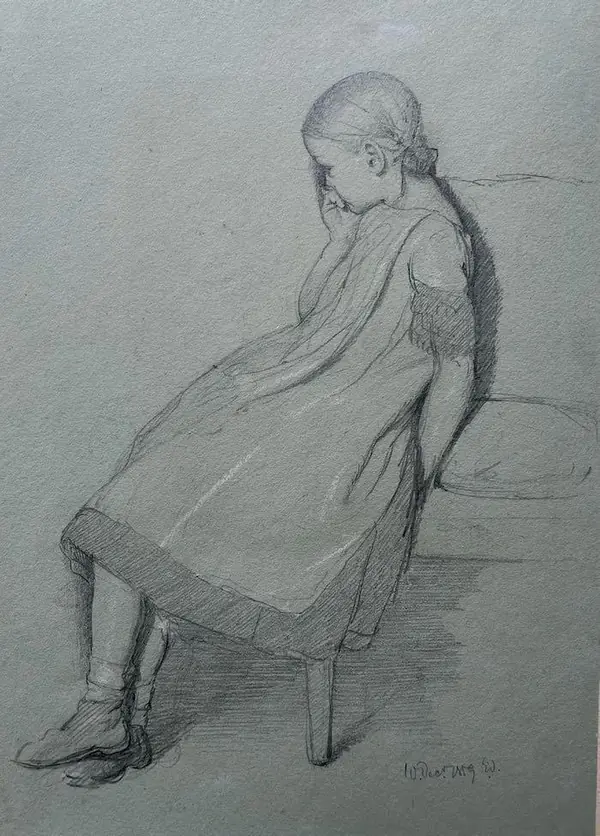
Signed with initials lower right: GR, pen and brown ink
13 by 20.9 cm; 5 ¼ x 8 ¼ inches
Provenance: Cyril and Shirley Fry until 2021
This beautiful, spare drawing probably dates from the 1840s. Richmond added his initials in pencil to many of his drawings towards the end of his life.
You Might Also Like

Signed and dated in gold paint l.l.: Geo Richmond.1834, watercolour over pencil heightened with white and gold and touches of gum arabic35.3 x 25.1 cm.; 13 ¾ x 9 7/8 inchesProvenanceBy descent in the family of the sitter until 2015;Their sale, Bonhams, London, 24 November 2015, lot 95;Private collection, U.K.LiteratureR. Lister, George Richmond A Critical Biography, 1981, p. 162, nos. 203 and 204The sitter wears the uniform of the Madras Horse Artillery, and the Order of the Bath Companion’s breast badge, and is standing in an Indian landscape with his hand upon a cannon.Lieutenant Colonel Sir Charles Hopkinson was born on September 14th, 1783, in Grantham, Lincolnshire. He had a distinguished career in the service of the East India Company and commanded the Company's artillery during the First Anglo-Burmese War (1824-1826). He was made a Companion of the Most Honourable Military Order of The Bath and subsequently knighted for his services. He died in December 1864.The Madras Army was the army of the Presidency of Madras and run by the East India Company until 1858. It was finally merged into the Indian army in 1895.After his marriage to Julia Tatham in 1831 George Richmond turned to portrait painting. He quickly established a fashionable painting practise and became one of the most fashionable portrait painters of his time.
View details
Watercolour over pencil20.5 x 38 cm.; 8 1/8 x 15 inchesProvenanceWalter Coleridge Richmond (1852-1931), the son of the artist, by descent;With Radnorshire Fine ArtRichmond continued to draw and paint landscapes throughout his successful career as a portraitist. These works remained private and stayed mainly in his family. This beautiful sketch has a directness which reflects his enjoyment of the opportunity for contemplation when drawing from nature.
View details
Graphite, with a collector’s mark l.r.14 x 19.7 cm; 5 1/2 x 7 3/4 inchesProvenance: Xavier Haas, c.1937; Professor Anne Crookshank until 2017Infernal ghosts, and hellish furies, round/Environ’d thee; some howl’d; some yell’d, some shriek’d/Some bent at thee their fiery darts, while thou/Sat’st unappall’d in calm and sinless peace.John Milton, Paradise Regained, Book 4This small but highly detailed drawing was done in late 1794 or early 1795, when Romney began to work on the subject of ‘The Temptation of Christ’, producing intense pencil sketches for a project that he barely began to realise in oils. The poet William Hayley’s son Thomas claims credit for having suggested this theme to Romney, which was inspired by a passage in Milton’s Paradise Regained [Book 4, lines 422-5].Christ can be seen seated at the bottom right of this strong drawing, with the fiends of Satan whirling around his head. There are other studies of this subject in the collection of the Yale Centre for British Art, New Haven (see Alex Kidson, George Romney 1734-1802, London 2002, p. 228).John Romney claimed that his father’s projected canvas measured about 16 by 12 feet, which would have been by far the largest painting he ever conceived, and that it was ‘equal in original conception and wild fancy to any thing ever produced by any artist..had he finished [it] it would have ranked him with Michel Angelo’ (see Romney, Rev. John, Memoirs of the Life and Works of George Romney..’, London 1830, p. 245). The rolled canvas upon which there was a nearly finished head of Christ and the beginning of Satan’s head was sent to Christie’s in April 1807 for the studio sale, was never unrolled due to its size, and subsequently disappeared.Xavier Haas was a Parisian dealer of the Galerie Haas et Gross, who formed the greatest collection of Romney drawings after the break-up of the artist’s studio.Anne Crookshank (1927-2016) was Emeritus Professor of art history at Trinity College, Dublin and played a major role in the development of the study of Irish art.
View details
Inscribed (recto): T Von Holst, pencil and pen and brown ink, verso: pencil, on laid paper with a partial Strasburg Lily watermark, laid down on a brown sheet numbered 1027.2 x 21.4 cm; 10 3⁄4 x 8 1⁄2 inchesProvenanceJohn Welch Etherington Rolls (1807-1870);By family descent to Lady Shelley Rolls, her sale at Sotheby’s, London,12 June 1959;P. & D. Colnaghi;Private collection U.K. until 2019Von Holst’s drawing of the seated woman, recto, is after a figure in Raphael’s ‘Miraculous Draft of Fishes’; the drawing for the tapestry cartoon is in the Albertina, Vienna. A print was made after the drawing, which von Holst probably copied. The figure of the standing female on the recto is a characteristic Holst pose, derived from Vincenzo Danti’s bronze statue of Venus in the Palazzo Vecchio, Florence (see Max Browne, The Romantic Art of Theodor von Holst 1810-44, 1994, p.15).The drawing on the verso illustrates a scene inspired by a Gothic novel such as The Mysteries of Udolpho by Ann Radcliffe, published in 1794. One of the most popular novels of its day, its main character Emily St. Aubert, a virtuous and beautiful young woman, undertakes a series of dramatic adventures; she escapes from captivity at the hands of a cruel villain in a brooding castle to freedom.The brown card inlay on which the present drawing is contained is from the Rolls album, a large leather-bound album which forms the largest-known group of drawings by the artist. The family lived at The Hendre in Monmouthshire, where they also had at least five oils by von Holst. They were also involved with the theatre and opened their own in the grounds.The pencil inscription “T. Von Holst’ appears on almost all the drawings in the album and is effectively its collection mark.
View details
Oil on board, inscribed verso: Grindlay, inscribed on old backing paper by one of Edward Grindlay’s children: An early James Gunn/My father admired it in the/Studio so James framed it/and gave it to him22.4 x 14.2 cm.; 8 7/8 x 5 5/8 inchesFrame size 34 x 24 cm.; 13 3/8 x 9 ½ inchesProvenanceGiven by the artist to Edward Grindlay;By descent until 2021This beautiful view of the Place de la Concorde was done in 1911-1912 when Gunn studied at the Académie Julian in Paris under Jean Paul Laurens. It is previously unrecorded and a significant addition to his rare small pictures of Paris.While in Paris Gunn started to make tonally delicate panels of the city on small boards, using a muted palette reminiscent of Whistler, capturing street scenes with tiny figures drawn with a few strokes of the brush. He also made regular visits to the Louvre to draw from the Old Masters and rented a room at 2 bis rue Perel. His small pictures of Paris are not numerous and are highly sought after.Gunn has painted this work from near the centre of the Place de la Concorde, looking towards the eastern end of the Champs Elysées, with the Grand Palais visible behind the trees of the Jardin des Champs-Elysées. The statue on the plinth is one of the famous Chevaux de Marly by Guillaume Costou, brought from the Chateau de Marly in 1719 and now in the Louvre.James Gunn attended drawing lessons from the age of five. He studied at the Glasgow School of Art, the Edinburgh College of Art before he went to Paris. Gunn returned to Edinburgh in 1912 and also spent time in London. Early in 1914, at the instigation of the London dealer W.B. Paterson, he travelled widely in Europe, sending pictures back home, and revisiting Paris and Étretat. He enlisted with the Artists Rifles in 1915.Gunn gave a speech to the Glasgow Art Club in November 1955 and reminisced about his early career,‘…In Paris I studied at the Académie Julian under Jean Paul Laurens…I returned from Paris with a collection of sketches made in the streets and by the river. Many of these passed through the house of Anna. There they were seen and some were purchased by a dealer from Bond Street, W.B. Paterson, brother of the distinguished Scottish Academician, James. He gave me a contract, paid me a retaining fee and I undertook to provide him with not less than thirty pictures a year. At his instigation I went to Spain at the beginning of 1914. There I travelled, seeing and painting, till the echoes from Sarajevo warned that the good days were soon to end’.Edward ‘Teddy’ Grindlay and Gunn met in 1917 towards the end of WWI when they were commissioned into the 10th Scottish Rifles, the beginning of a life-long friendship. Gunn’s drawings of his fellow officers were published in a book ‘The 10th Battalion, The Cameronians (Scottish Rifles): a Record and a Memorial 1914-1918’.Grindlay saw this oil sketch in Gunn’s studio and admired it, so the artist had it framed and gave it to his friend. Edward and his wife Evelyn were both painted by Gunn who also painted a conversation piece of their house at 1 Newton Grove, Bedford Park in London in 1927. They later moved to Westcott near Dorking. They owned many paintings and drawings by Gunn who used his friend as a model for Maurice Baring in his famous conversation piece with Hilaire Belloc and G.K. Chesterton, which is now in the National Portrait Gallery, London (NPG3654). He received commissions from many of the leading figures of the day and painted the Royal Family in another famous conversation piece at Royal Lodge, Windsor (NPG3778).Gunn had a successful career as a portrait painter and in 1961 was elected a member of the Royal Academy.
View details
Watercolour on laid paper, with exhibition label attached to backboard15 x 32.5 cm.; 6 x 12 3⁄4 inchesProvenanceMiss Bostock, companion to Miss H.H. Tatlock, the artist’s granddaughter;Christie’s, 12 September 1941, lot 29;Where purchased by Thomas Agnew & Son Ltd., London;Sold to a private collector 18 May 1942;Private collection, Wiltshire until 2023ExhibitedUsher Art Gallery Lincoln, Peter De Wint Exhibition, 1937, no. 146Horsemen can be seen in the foreground of this freely drawn, spare landscape, which exemplifies Peter de Wint’s brilliance and delicacy in the laying of washes.
View details
KT633Fragments of a colossal statue at the Memnonium, Thebes Signed l.l.: 'David Roberts. R.A.' and inscribed and dated 'Memnonium, Thebes Dec. 5th, 1838', further inscribed l.r.: 'Dimensions of the statue/Between the shoulders [?] 26 feet/Circumference of the Head 54"/Shoulder to the elbow 13" [5]', watercolour over pencil heightened with bodycolour on blue-grey paper 32.7 x 48.9 cm; 12 7/8 x 19 ¼ inchesPROVENANCEPossibly David Roberts; Christie's, London, 13-20 May, 1865, lot 67 as 'Thebes: Fragments of the Colossus of Rameses'; Anonymous sale; Sotheby's, London, 15 March 1990, lot 42; with Spink, London, 1990; Christie's, London, 16 November 2006, lot 128This temple on the west bank of the Nile at Luxor, was visited twice by Roberts during his voyage on the Nile in 1838. On the outward journey, on the way to Abu Simbel, he had visited all the temples on both sides of the Nile at Luxor, and on 21 October hired donkeys to visit the ruins at Gurnah on the west bank, noting in his journal: 'The head and shoulders of the Memnon lying on the ground is enormous one can only wonder how it got there - the trouble of dislodging it must have been almost equal to the erection ...'.The present drawing was executed on the return journey when he was on the west bank of the river at Luxor from 3 to 5 December 1838. Roberts noted in his Journal 'I have been very industrious today, thanks to a Thunder Storm, a most uncommon thing in this part of the world - The sun was quite obscured and the peals of thunder were very loud accompanied with rain.... Made four large coloured sketches two of the Memnonium and two of Medinet Habou.' (Eastern Journal, National Library of Scotland).The present drawing was executed on the spot, although it is possible that the colouring was completed later during the trip. This drawing was used as the basis for the drawing which was eventually lithographed.This temple was called the Memnonium or the Tomb of Osymandyas, one of the names of Rameses II, the king to whom it was dedicated. It is now more commonly known as the Ramesseum and is the temple from which another colossal head was taken to the British Museum, where it inspired Shelley's famous sonnet Ozymandias.
View details
Henry Pilleau (1813-1899)The Dead SeaSigned with monogram l.l., watercolour 21 x 38 cm.; 8 ¼ x 15 inchesProvenancePresented to Queen Victoria in 1887 for her Golden Jubilee by the Royal Society of Water-Colour PaintersPilleau served with 16th Lancers. He is best known for his colourful watercolours and prints of Egypt. He visited Egypt in 1840s with Lieutenant -Colonel Sir George Everest (1790-1866), Surveyor-General of India, presumably on the men’s way to India. Pilleau’s ‘Sketches in Egypt’ comprising 12 lithographs was published in London in 1845 by Dickinson and dedicated to Everest. It comprises text and colourful plates of famous views and sites. Everest, a Welsh surveyor and geographer, after whom Mount Everest was named, served as the Surveyor General of India (1830–1843) and worked on the Great Trigonometric Survey of India.This watercolour left the Royal collection in the early twentieth century together with a substantial number of other works on paper, and there is no documentation for this with the Royal Collection. The other works whose details are recorded on the sheet of Windsor notepaper attached to the backboard were also dispersed at this time ( from the Royal Cambrian Academy of Art gift, Llyn Crafnant by D.W. Barker (the rendering of his name as ‘Banken’ suggests that someone was inaccurately copying from another source); Time-Honoured Lancaster by R. Aspinwall; and A Breezy Day by R. Short).
View details
Signed l.l.: W Muller/1839., oil on panel43.5 x 27 cm.; 17 x 10 5/8 inchesProvenanceThomas Agnew & Sons, London;Anonymous sale Sotheby’s, London, 10 November 1982, lot 49;Noortman & Brod, New York, 1983;Anonymous sale, Christie’s, New York, 10 February 1998 lot 160;Matthew Rutenberg, New York, until 2020ExhibitedNoortman & Brod, 18th and 19th Century Paintings, April – May 1983, New York, June - July 1983, LondonThis spirited painting executed with great bravura was done shortly after the artist’s return from Egypt in 1839. Müller arrived in Egypt by steamer in November 1838. He was one of the first established European artists to visit Egypt and was there at the same time as David Roberts, although neither knew of the other’s presence there.Müller was exhilarated by his arrival in the bustling metropolis of Cairo and was particularly intrigued by the slave market, which he described as ‘one of my most favourite haunts’ (W. J. Müller, ‘An Artist’s Tour of Egypt’, Art-Union 1, London, 1839, pp. 131-2).Müller is the best-known artist of the Bristol School. His German father settled in the city and was the first curator of the Bristol Institution, the forerunner of the Bristol Museum and Art Gallery. His early exposure to art led to a short apprenticeship with James Baker Pyne and a friendship with the Reverend James Bulwer (1749-1879), a pupil of John Sell Cotman, whose collection of Norwich School drawings Müller would have known.In 1833 Müller was one of the founders of the Bristol Sketching Club and his travels began the following year with visits to Holland, Germany and Venice. His 1838 trip started in Athens before he continued to Cairo. In 1840 he visited France and in 1843 he went to Lycia at the same time as Sir Charles Fellows’ expedition, during which he produced some of his finest watercolours. He died at the age of 43 after his return from Turkey.Following Müller’s death, prices of his oil paintings rose dramatically in the salerooms. Articles on his work appeared regularly and in 1875 N. Neal Solly, the biographer of David Cox, wrote a long biography. In 1896 the Birmingham Museum and Art Gallery held a retrospective of 192 of Müller’s paintings, watercolour and drawings. His reputation was kept alive in Bristol where the 150th anniversary of his birth in 1962 was celebrated with an exhibition at Bristol Art Gallery, while in 1984 Tate Gallery held a show of his French and Lycian watercolours. In 1991 a major retrospective was held at Bristol Museum and Art Gallery, who hold the most comprehensive collection of his work, organised by Francis Greenacre, the renowed authority on Müller and the Bristol School.
View details
Signed with initials and dated l.r.: J.B. April 7 18.., pen and grey ink and grey wash16.2 x 21.2 cm.; 6 3/8 x 8 3/8 inchesLiteratureDr A. Sneddon, ‘Representing Magic in Modern Ireland, Belief, History and Culture,’, CUP, 2022, ill. fig. 1In Britain and Ireland amongst ordinary people popular belief in witches remained strong up until the twentieth century. This drawing appears to depict a consultation with a cunning person or white witch. A stock part of 18th and 19th century country life, these commercial, multifarious magical practitioners provided local communities with a range of services for a small fee, such as un-witching, fortune-telling, and divination. They could gain quite serious reputations and some prospered. The position gave them status in their local communities. The 'witch' seems to have a good-natured face and her bonnet is not peaked, and a cat is perched benignly on it. The old woman is seated, a horse skull above her chair and consulting a magical book or grimoire: the ownership of such expensive objects often added to the allure and kudos of cunning-folk. The family are approaching her in a deferential way (the man holds his hat, his wife looks expectant) to ask her help. The girl looks frightened, is she seeing the real witch, the cause of their maladies? After all, cunning-folk were often brought in to counter black or harmful magic.Boyne left Co. Down for London at the age of nine with his father and was apprenticed to the engraver William Byrne. He joined a company of strolling players until 1781 and thereafter established a drawing school.Boyne’s caricatures which provide an amusing insight into British contemporary life can be found in many public collections including the British Museum, the Victoria and Albert Museum, The Fitzwilliam Museum and the Yale Center for British Art, New Haven.With thanks for Dr Andrew Sneddon for his comments on this drawing.
View details