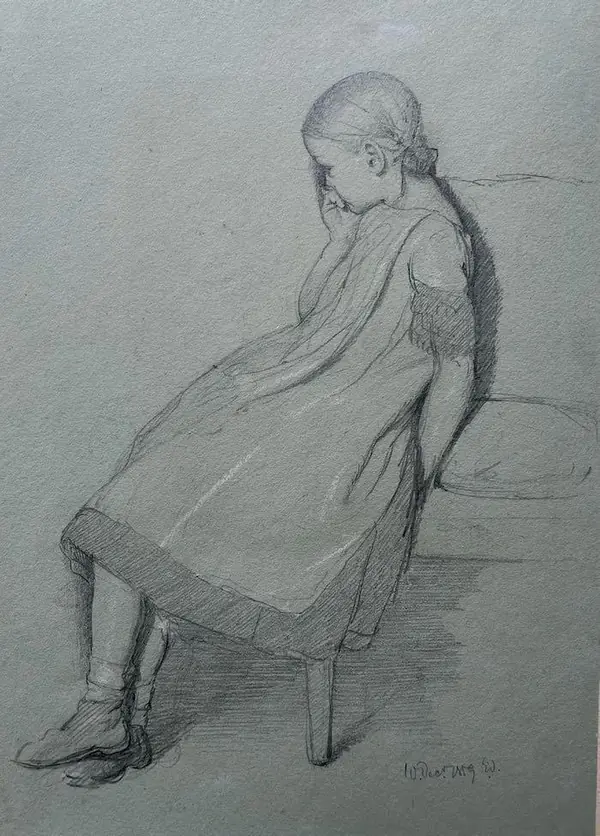
Brown wash heightened with bodycolour over traces of pencil
Sight size 12 x 8 cm; 4 ¾ x 3 ¼ inches
Framed in the original gilt moulding 30.5 x 23.5 cm.; 12 x 9 1/4 inches
The artist studied in Paris with William Bouguereau and Jean-Léon Gérome. He exhibited both in Paris and at the Royal Academy and Society of British Artists in London where he lived in St John’s Wood. He also exhibited his work with the London dealers Vicars Brothers.
Seymour specialized in Orientalist work, taking his cue from Gérome, and may be presumed to have visited North Africa from where the majority of his Orientalist subjects are taken. He favoured working in brown washes which he worked up with bodycolour to achieve an intense and dramatic finish.
You Might Also Like

Pencil9 x 15 cm.; 3 ½ x 6 inchesProvenanceThe artist's studio sale, Christie's, 8 - 15 May 1874, bt. by Thomas Agnew & Sons Ltd. (23366);J.M.M., a Christmas present from C. 1962
View details
Two, each signed l.l.and l.r., each inscribed l.c.: F. Concolr./life and F. Ocelot.of.Albany./Life, watercolour over pencilEach approx. 25 x 17.5 cm.; 9 ¾ x 6 7/8 inchesThe artist was self-taught and specialised in drawings of animals and field sports.From a wealthy Quaker family, Howitt took up art professionally when he encountered financial difficulties and became a drawing master in Ealing.He married Thomas Rowlandson's sister Elizabeth in 1779 and was part of Rowlandson's circle together with George Morland, Henry Wigstead and J.R. Smith.
View details
Watercolour over pencil20.5 x 38 cm.; 8 1/8 x 15 inchesProvenanceWalter Coleridge Richmond (1852-1931), the son of the artist, by descent;With Radnorshire Fine ArtRichmond continued to draw and paint landscapes throughout his successful career as a portraitist. These works remained private and stayed mainly in his family. This beautiful sketch has a directness which reflects his enjoyment of the opportunity for contemplation when drawing from nature.
View details
KT488Signed and inscribed on the old backing board attached to reverse: View of Shipton on Charwell [sic]-Evening.\W. Turner./Oxfd., watercolour over traces of pencil25.6 x 41 cm.; 10 x 16 inchesProvenanceW/S Fine Art Ltd., ‘Watercolours and Drawings’, June 2005, no. 47;Private collection U.K. until 2021This view shows the manor house and part of the estate of the artist’s uncle, William Turner, and the church of Holy Cross, amongst the trees to the right of the house. The artist built the church, in fourteenth -century style, at the expense of his uncle. It is thus an intensely personal work in which the artist depicts his home and the only building he designed.William Turner Senior had supported the artistic training of his nephew after his father died. In 1804 he bought the estate of Shipton-on-Cherwell with its manor house and park, as seen in the present watercolour. In 1809 the young artist recorded his address as Shipton (Martin Hardie, ‘William Turner of Oxford’, The Old Water-Colour Society’s Club, IX, 1932, p. 2).Turner first exhibited at the Royal Academy in 1807 and in January 1808 he became the youngest associate of the Society of Painters in Water Colours and was elected a full member in November of that year.The church, which seems to be Turner of Oxford’s only architectural work, dates from 1831. The artist was buried there at his death in 1862 and in 1896 a screen was erected in his memory.Some of the artist’s most celebrated watercolours are of water lilies on the River Cherwell, and from 1835 he sent a number to the exhibitions at the Society of Painters in Water Colours. The earliest of these, now in the collection of the Yale Center for British Art (B1981.24), shows the church at Shipton-on-Cherwell in the trees in the distance, a focal point of the composition.
View details
Signed l.r.: W. HUNT, pencil, tiny sketches of figures and a list verso, on wove paper12 x 8.4 cm.; 7 ¼ x 4 ¾ inchesProvenance: Cyril and Shirley Fry until 2021Literature: J. Witt, 'William Henry Hunt (1790-1864)', 1982, no. 370Exhibited: 'Hunt Exhibition Fry Collection', 1967, no. 17 (1)This drawing dates from circa 1820. Hunt drew the same girl on another occasion in a similar pose (Rossetti Collection, J. Witt, ibid. no. 492).
View details
Signed l.l.: E. Lear, pencil with watercolour23 x 17.7 cm.; 9 x 7 inchesThese charming, quirky drawings are characteristic early works by Lear, dating from the late 1820s or early 1830s when he was establishing himself as an ornithological artist. They relate to a group of drawings which Lear gave to Mrs Godfrey Wentworth, who supported his employment by the Zoological Society in 1831, and whom he credited with launching him as an artist. They are imaginary, fanciful subjects drawn with not a little humour, resembling the stylised watercolours of birds painted on late eighteenth century porcelain. Robert McCracken Peck has made the interesting suggestion that Lear and his sister Ann may have been thinking of approaching ceramics companies with them (see Robert McCracken Peck, The Natural History of Edward Lear, 2016, pp. 27-9).Two surviving family albums from the late 1820s, containing a mixture of similar natural history subjects by Edward Lear and his sisters Ann and Sarah, are in the collection of the Houghton Library, Harvard University (MS Typ 55.4 and 55.27).Sir Edward Strachey was a man of letters and friend of Lear’s, who wrote an introduction to Nonsense Songs in 1895. He lived at Sutton Court, Chew Magna in Somerset and was a neighbour of Lear’s close friend Chichester Fortescue, the Liberal politician whom Lear first met in Rome in 1845.
View details
Charles Gore (1729-1807)A view of the East front of Arundel Castle, West Sussex, seen from the Bowling GreenInscribed l. r.: Arundel Castle taken from the Platform or/Bowling Green by Charles Gore Esq 1781 and indistinctly inscribed in pencil u. r.: Arundel Castle Sufsex/1781Watercolour over touches of pencil on laid paper, with a Whatman watermark19.6 by 49 cm., 7 ¾ by 19 ¼ inchesProvenanceIolo Williams (1890-1962); And by descent until sold Sotheby's, London, 13 July 1989, lot 5; Private collection;With Guy Peppiatt Fine ArtThe bowling green is the name for the square earthworks located, with the fishponds, on the east side of the castle. They were probably made originally to improve the castle’s defences during the Civil War. Used as a bowling green in eighteenth century, as shown in the drawing by Charles Gore, today a rose garden can be found here. The Hon. Charles Gore was the son of a Lincolnshire landowner and educated at Westminster. He married a wealthy heiress of a shipbuilding company and learnt to draw and design ships. Gore travelled extensively in Europe, sketching with the German artist Jacob Philipp Hackert (1737-1807). Gore copied marine oils, completed the unfinished drawings of other artists, and also developed his own style having acquired an expert knowledge of the sea. His interest in classical antiquities led Charles Gore to join Hackert and Richard Payne Knight on their expedition to Sicily from April to June 1777.In 1779 Gore returned to England and became a member of the Dilettanti Society in 1781. He painted a series of panoramic views of Sussex including the current drawing. The family returned to the Continent in 1782 and he settled in Weimar in 1791 with his daughter Eliza. Examples of Gore's work can be found in the British Museum, the National Maritime Museum, Greenwich and the Goethe-Nationalmuseum, Weimar.
View details
Signed l.r.: W HUNT, watercolour with bodycolour on artist’s board16 x 20.3 cm; 6 1/4 x 8 inchesPrimroses were a favourite subject of Hunt’s, and one which he frequently exhibited in the 1840s and 1850s.Hunt was born with a deformation of his legs which restricted his movement and he worked mainly from the studio, as painting outside was difficult for him. He specialised in carefully drawn smale-scale still lifes like this one as a result and pioneered new techniques of watercolour, using stipple techniques in subtle colour combinations and achieving a brightness of colour by overlaying washes over white gouache.
View details
Signed with initials in pencil l.r.: HBB, watercolour24 x 17 cm.; 9 ½ x 6 ¾ inchesProvenancePietro Raffo, until 2022£2200This watercolour shows the influence of J.M.W. Turner, whose watercolour studies were copied by Brabazon.
View details£ 2,200

Pen and black ink over pencilEach 13 x 21 cm.; 5 x 8 ½ inchesProvenanceJ.M. Hunter, purchased from The Fine Art Society 22 November 1968 until 2023ExhibitedThe Fine Art Society Ltd., London, 'Edward Bawden, CBE, RA - Recent works', 1968LiteratureClaudia Roden, 'A Book of Middle Eastern Food', published by Thomas Nelson, London, 1968, with photographs by Pinkard, and black and white illustrations at the head of each chapter by Edward Bawden.These are the original drawings used to illustrated Claudia Roden’s (b. 1936) first cookery book on Middle Eastern food which mixed Bawden’s playful drawings with modern food photography and revolutionised Western attitudes to the cuisines of the Middle East and North Africa. It was substantially expanded and published in a new edition in 1986. She is the author of ten popular and critically-acclaimed cookery books and has a particular interest in the social and historical background of cooking.Bawden lived in Great Bardfield in Essex from the 1930s to 1970 and was a central figure of the Great Bardfield Artists.
View details