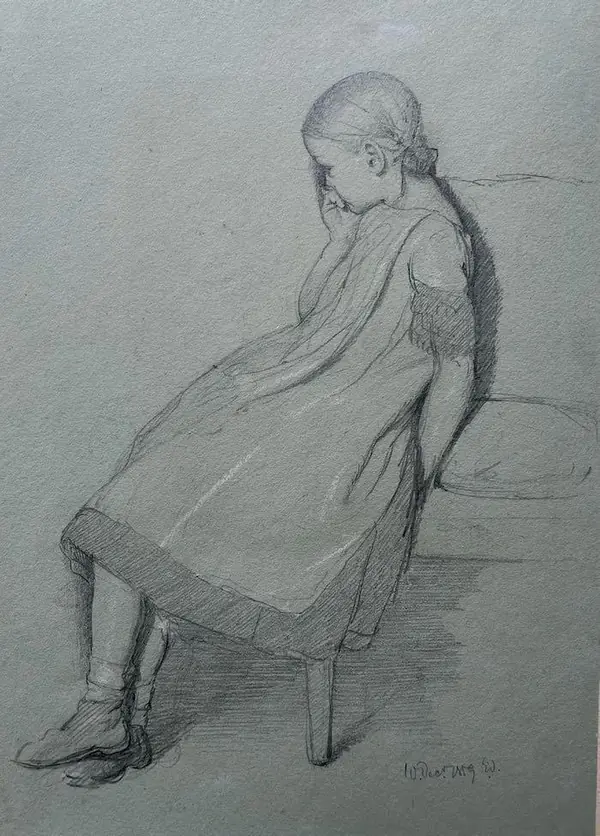
Pencil
17.8 x 17.7 cm; 7 x 7 inches
Provenance: M. D. E. Clayton-Stamm, by descent until 2018.
Evelyn De Morgan, who attended the Slade School of Art, was influenced by George F. Watts and Edward Burne-Jones and by the work of her uncle John Roddam Spencer Stanhope. She often visited Stanhope in Florence, where she developed a love of the work of Botticelli and Quattrocento art. She first exhibited at the Grosvenor Gallery in 1877. In 1887 she married the ceramicist William De Morgan, with whom she often wintered in Florence.
It has been suggested that this may be a preliminary study for a figure in her painting The Red Cross, 1916, in the collection of the De Morgan Foundation.
Her work is held in many national collections including the Walker Art Gallery, Liverpool; the National Trust properties Wightwick Manor, Wolverhampton, and Knightshayes Court, Devon; the Russell-Cotes Art Gallery and Museum, Bournemouth; the National Portrait Gallery, London; and the Southwark Art Collection, London.
Maxwell David Eugene Clayton-Stamm was an authority on the work of William De Morgan (on whom he published extensively), Pre-Raphaelite ceramics and the Blake-Varley sketchbook of 1819. He was a collector and bibliophile.
You Might Also Like
One hundred and forty-four drawings on sixty-eight pages, laid into an album bound in vellum, the fly leaf with a large label inscribed: Miss Stones/First Efforts/plates.71The drawings are of various sizes, on laid paper, each page 31.5 x 19.7 cm.; 12 1⁄4 x 7 3⁄4 inchesProvenancePrivate collection, U.K.;Private sale by Sotheby’s Australia, January 25 2001; Patrick Dockar-Drysdale (1929-2020)ExhibitedTate Britain, 'Now you See Us- Women Artists in Britain 1520-1920', May - October 2024, ill. p.42, p. 205Sarah Stone was the daughter of James Stone, a fan painter and is thought to have assisted her father. The family lived in London.The dated drawings in this album suggest that Stone executed many of them when she was ten or eleven years old and identify her as something of a child prodigy. This album contains many copies from drawing books which were a popular means of allowing an artist to develop their technique by copying. The number of drawings and the repetition of certain subjects reflect a systematic approach and a determination to improve and there are drawings after Holbein, Ribera and Boucher, the minor details may be after Le Brun.One of the drawings is inscribed ‘The New Drawing Book‘ which could be a reference to Francis Vivares, A New Drawing Book, in the Manner of Chalk fit for Youth to Draw after. 6 sepia soft ground etchings, by W. Hebert after Vanloo and Boucher, 4to. Frans. Vivares. Sept. 1759. The plates in this were in the manner of red chalk.The range of subjects in the present album suggests Stone was using one of the compilation drawing books, such as Carrington Bowles, The School of Art; or, most compleat Drawing-Book extant: consisting of an extensive series of well chosen examples, selected from the designs of those eminent masters, Watteau, Boucher, Bouchardson, Le Brun, Eisen, &c. engraved on sixty copper plates, and performed in a method which expresses the manner of handling the chalk, 1765 and later editions.
View detailsSigned l.r.: W. HUNT, pencil, tiny sketches of figures and a list verso, on wove paper12 x 8.4 cm.; 7 ¼ x 4 ¾ inchesProvenance: Cyril and Shirley Fry until 2021Literature: J. Witt, 'William Henry Hunt (1790-1864)', 1982, no. 370Exhibited: 'Hunt Exhibition Fry Collection', 1967, no. 17 (1)This drawing dates from circa 1820. Hunt drew the same girl on another occasion in a similar pose (Rossetti Collection, J. Witt, ibid. no. 492).
View detailsPencil on laid paper, partially watermarked and countermarked 181914.5 x 10.9 cm.; 5 ¾ x 4 ¼ inchesProvenance: Cyril and Shirley Fry until 2021Literature: J. Witt, 'William Henry Hunt (1790-1864)', 1982, no. 369Exhibited: 'Hunt Exhibition Fry Collection', 1967, no. 17 (2)This work dates from c. 1820.
View detailsDaniel Maclise , R.A. (1806-1870)A seated girl reading in a doorwayPencil13.5 x 8 cm.; 5 ¼ x 3 1/8 inchesProvenanceCovent Garden Gallery Ltd.Daniel Maclise was born in Cork to a family of Scottish descent. After a brief period working in a bank, Maclise’s passion for drawing led him to pursue a career in art which he studied at the Cork Society of Arts.He moved to London in 1826 to attend the Royal Academy where he excelled as a student, particularly in life drawing and history painting. He began exhibiting in the RA in 1829, was made an associate in 1830, and an academician in 1840.
View detailsSigned with initials l.r., pen and brown ink14.5 x 12 cm.; 5 ½ x 4 ¾ inchesProvenance:Mrs F.L. Evans;With Colnaghi, 1951, catalogue no. 59Duncan Beresford-Jones until 2000The Shah of Persia presented a group of Arabian horses to the Prince Regent, commemorated in a painting of 1819 by H.B. Chalon (Tate Britain, TO2357). Landseer was also attracted to the subject and two versions of oils of an Arabian stallion with an Attendant in Persian dress are known, see Richard Ormond, Sir Edwin Landseer, 1982, p. 54.The Shah sent an Ambassador, Mirza Abdul Hassan Shiraz, to London in 1819 to discuss with Lord Castlereagh, the Foreign Secretary, aspects of the Anglo-Persian treaty concluded by Sir Gore Ouseley in Tehran in 1812, and more recently revised. That treaty had established an Anglo-Persian alliance against a possible Franco-Russian one and the Shah was hoping for positive assurances that England would protect Persia in the event of a Russian invasion.The Ambassador left Tehran in October 1818 laden with presents from the Shah, including eighteen selected Arabian horses for the Prince Regent. The horses travelled with the Ambassador to Constantinople and then the British government organised their transport to London, an expensive undertaking arranged by a Mr George Willcox and costing over £1500. The presentation of the Shah’s gifts was listed in The Times of 24 May and took place at Carlton House, the Prince Regent’s London residence. There are seven horses pictured in Chalon’s painting, and it is not known how many of them survived the journey, but the present drawing presumably shows one of them.Mirza Abdu Hassan Shiraz’s visit aroused considerable social and popular attention but the visit was not a success, as following the defeat of Napoleon and the conclusion of an alliance with Russia the British no longer attached much importance to their Persian alliance.
View detailsInscribed l.r.: Bruges, watercolour7.6 x 11.4 cm; 3 x 4½ inchesProvenanceSpink & Son Ltd, London, K3/1890b, part of a group purchased from Appleby Brothers, 2 August 1960.This spontaneous, on-the-spot sketch was presumably done when Cox visited Bruges in 1826. His first trip to the Continent was organised by his brother-in-law Mr Gardener, an agent for the sale of government ordnance maps who had premises at 163 Regent Street, London. Gardener persuaded Cox and his son David Cox Jr to accompany him on a business trip to Brussels. The party travelled from Dover to Calais and then, travelling by diligence, on to Dunkerque, Bruges and Brussels. Cox evidently liked the caps worn by the market women in Belgium as he sketched them again in Brussels.1 1.See N. Neil Solly, Memoir of the Life of David Cox, 1873, reprinted 1973, p. 49.
View detailsSigned and inscribed verso: Far away in Cloudland/BWSpiers/And when the smoke ascends on high/Then thou behold'st the vanity of worldly stuff/Gone with a puff/thus think, and smoke tobacco-/G.W.-Smoking Spiritualised, watercolour over pencil heightened with gum arabic and touches of white, and further inscribed on original backing: B.W. Spiers Far Away13.5 x 18cm; 5 1/2 x 7 1/8 inchesBenjamin Walter Spiers (1845-1894) was an idiosyncratic painter of studio still lives who lived in London, at 70 Hereford Road in Bayswater, where the current watercolour may have been drawn. He crammed his antiquarian pictures with books, furniture, objects and paintings a number of which reappear in several of his still lifes. He often drew corners of interiors of his favourite antique shops in London’s Wardour Street. The bust and the chair shown in the present work appear in several of his compositions. He was captured here by an artist with the initials G W who has caught him relaxing with a cigarette in his studio. Spiers often penned a verse to accompany a picture, as in the present work.It is amusing seeing the tables turned and the artist drawn as the subject of his own studio interior. Spiers’ extraordinary fidelity in his own painting and his eclectic taste makes him the leading exponent of a particular type of 19th century interior painting. The dealer and scholar Christopher Wood considered him to be ‘one of the most remarkable painters of still-life in English Art’ (see C. Wood, ‘Knicknacks and silly Old Books’, 'Country Life', 10 June 1993, pp. 124-125).Christie’s London had a large group of Spiers work for sale on 14 December 2016. In one of these works 'Worthless old knickknacks and silly old books', based on the poem 'The Cane-Bottom'd Chair' by Thackeray, the same painting of Gainsborough's (lost) 'Cottage Children', which hangs over the fireplace in the present work, can be seen.Spiers was interested in possessions rather than objects of nature and his curiosity for antiquarian objects, books, maps, prints and china is displayed with trompe-l’oeil accuracy in his watercolours. The same objects repeatedly appear which suggests that Spiers owned them.Little is known about Spiers’ life. He lived in London, first at 17 Hereford Street, Bayswater, and then at Longwood in Acol Road, West Hampstead. He is thought to be related to Richard Phené Spiers, the architect, whose brother, Walter Spiers was a curator of the Soane Museum. He exhibited at the Royal Academy from 1876 to 1891, and 'The Times' Academy notice for 27 June 1881 says of his two exhibited works, ‘We consider these two works to be the gems of the water- colour gallery.’Christie’s London 14 December 2019, lot 80
View detailsSigned and dated u.r.: Mancinelli/Geny (?). 1882, pencil16.8 x 14.3 cm; 6.6 x 5.6 inchesProvenance: David M. Daniels and Stevan Beck Baloga, their sale at Sotheby’s 29 October 2002, lot 116Exhibited: Shepherd Gallery, R.J.M. Olsen, ‘Italian 19th Century Drawings and Watercolours, An Album: Camuccini & Minardi to Mancini & Balla,’, Spring 1976, no. 155, ill. p. 45;The American Federation of Arts, ‘Italian Drawings 1780-1890’, March 1980-January 1981, no 84This is an exceptionally fine drawing by this Italian portrait painter who lived for most of his life in Naples where he was honorary Professor of the Institute of Fine Arts. His subjects included Umberto I and Margherita di Savoia (1884) and other Italian aristocrats, as well as Orientalist and historical work.
View detailsSigned l.l.: W Muller/1839., oil on panel43.5 x 27 cm.; 17 x 10 5/8 inchesProvenanceThomas Agnew & Sons, London;Anonymous sale Sotheby’s, London, 10 November 1982, lot 49;Noortman & Brod, New York, 1983;Anonymous sale, Christie’s, New York, 10 February 1998 lot 160;Matthew Rutenberg, New York, until 2020ExhibitedNoortman & Brod, 18th and 19th Century Paintings, April – May 1983, New York, June - July 1983, LondonThis spirited painting executed with great bravura was done shortly after the artist’s return from Egypt in 1839. Müller arrived in Egypt by steamer in November 1838. He was one of the first established European artists to visit Egypt and was there at the same time as David Roberts, although neither knew of the other’s presence there.Müller was exhilarated by his arrival in the bustling metropolis of Cairo and was particularly intrigued by the slave market, which he described as ‘one of my most favourite haunts’ (W. J. Müller, ‘An Artist’s Tour of Egypt’, Art-Union 1, London, 1839, pp. 131-2).Müller is the best-known artist of the Bristol School. His German father settled in the city and was the first curator of the Bristol Institution, the forerunner of the Bristol Museum and Art Gallery. His early exposure to art led to a short apprenticeship with James Baker Pyne and a friendship with the Reverend James Bulwer (1749-1879), a pupil of John Sell Cotman, whose collection of Norwich School drawings Müller would have known.In 1833 Müller was one of the founders of the Bristol Sketching Club and his travels began the following year with visits to Holland, Germany and Venice. His 1838 trip started in Athens before he continued to Cairo. In 1840 he visited France and in 1843 he went to Lycia at the same time as Sir Charles Fellows’ expedition, during which he produced some of his finest watercolours. He died at the age of 43 after his return from Turkey.Following Müller’s death, prices of his oil paintings rose dramatically in the salerooms. Articles on his work appeared regularly and in 1875 N. Neal Solly, the biographer of David Cox, wrote a long biography. In 1896 the Birmingham Museum and Art Gallery held a retrospective of 192 of Müller’s paintings, watercolour and drawings. His reputation was kept alive in Bristol where the 150th anniversary of his birth in 1962 was celebrated with an exhibition at Bristol Art Gallery, while in 1984 Tate Gallery held a show of his French and Lycian watercolours. In 1991 a major retrospective was held at Bristol Museum and Art Gallery, who hold the most comprehensive collection of his work, organised by Francis Greenacre, the renowed authority on Müller and the Bristol School.
View detailsInscribed with artist’s shorthand and dated 35 c.r., pencil7.2 x 15.1 cm.; 2 ¾ x 5 7/8 inchesProvenanceThe Manning Galleries Ltd., January 1972;Private collection until 2023
View details