Signed l.l.: M E Cotman/April 23 1827, inscribed l.r.: Raby Park Durham/E of Darlingtons, pencil
34.5 x 24 cm.; 13 ½ x 9 3/8 inches
Provenance
Dr Henry Lowe and Judy Lowe (née) Cotman until 2023
You Might Also Like

KT579Signed l.l.: M E Cotman 1831, watercolour with scratching out and stopping out29.5 x 36.6 cm.; 11 ¾ x 14 3/8 inchesProvenanceBy family descent to Grahame Cotman (1878-1938);Susan Gay Wiltshire, née Cotman (d.2022)ExhibitedNorwich Castle Museum, ‘Exhibition of Norwich School Pictures’, 1927, no. 151This work was lent to the Norwich Castle Museum exhibition in 1927 by Grahame Cotman and probably depicts shipping off the Norfolk coast.Miles Edmund was John Sell Cotman’s eldest son and his closest collaborator, his work often very similar to that of his father. He is particularly famed for his seascapes in watercolour of which the present work is a fine, exhibited, example. He was born in Norwich and spent his childhood and adolescence in Great Yarmouth, learning from his father. He exhibited with the Norwich Society of Artists from 1823, when the family returned to Norwich, and assisted his father with a drawing school run from the family home.He married Elizabeth Juby in 1842 and they had three children. The family lived in North London in the early 1850s but returned to Norfolk a few years later, where Cotman continued to paint and teach.M.E. Cotman’s work can be found in many public collections including the British Museum and Norwich Castle Museum & Art Gallery.
View details
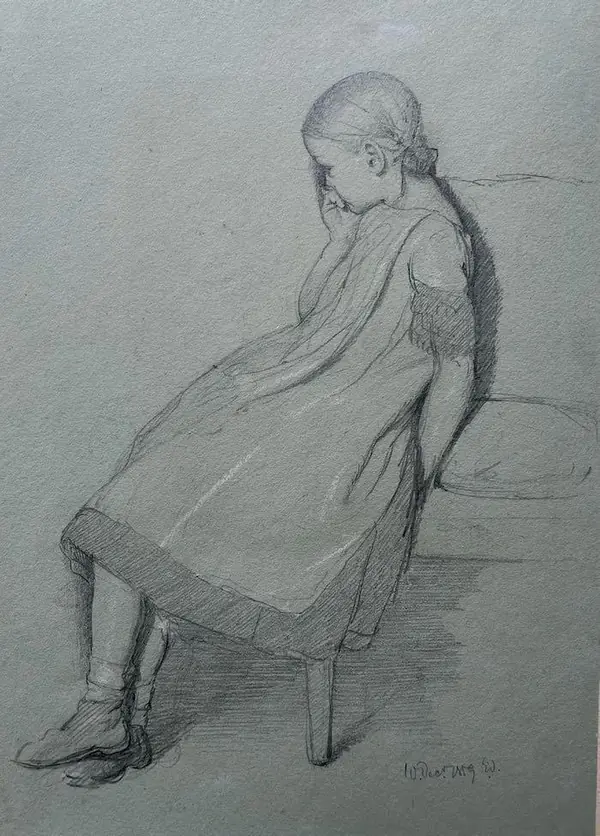
KT609Signed and dated l.l.: M.E. Cotman/June .18th, pencil, in a 19th century burr maple frame33 x 24.5 cm.; 13 x 9 5/8 inchesProvenanceDr Henry Lowe and Judy Lowe (née) Cotman until 2023
View details£ 1,750

Oil on paper laid down on canvas15.1 x 21.6 cm.; 6 x 8 ½ inchesFrame size 25.5 x 32 cm.; 10 x 12 ½ inchesEngravedBy the artist as a lithograph on chine collé, printed by Charles Motte, 1828, plate 8Newton Fielding produced a series of lithographs of mammals which were printed by Charles Motte in 1828.The artist was the youngest son of portrait painter Nathan Theodore Fielding. From 1827 to 1830 he lived in Paris, where he ran the family engraving business, at which William Callow worked. He was closely associated with the Anglo-French circle of artists centred around Bonington and Delacroix.He collaborated with his brothers Thales and Theodore in England before returning to France where he built up an extensive teaching practice, with pupils including members of the family of King Louis- Philippe. He published a number of teaching manuals and lived in France until his death.
View details
Extensively inscribed and dated in pencil and in pen and brown ink: Quarries of Assouan AM 11.30- 1 PM January 27.1867 all one color [sic] pinky drab oker [sic], numbered (242) and with further colour notes, pen and brown ink and watercolour over pencil heightened with white29 x 53 cm.; 11 3/8 x 20 ¾ inchesProvenanceMrs R.K. Judges;The Fine Art Society, January 1993, where bought byMartin Davies (1924-2023)This beautifully drawn watercolour dates from Lear’s second trip up the Nile and his third visit to Egypt in the winter of 1866-1867, when he travelled with his Canadian cousin, Archie Jones. The men met in Luxor and visited Esneh, Edfu and Denderah, and had reached Philae by the end of January. Lear found his cousin irritating due to his habit of whistling and his lack of enthusiasm for the temples.It was nevertheless a productive trip for the artist, who made many drawings. He was particularly interested in the country between the First and Second Cataracts which was new to him. Another drawing from this trip dating from 30 January of the first Cataract is numbered 267 (formerly in the collection of Dayton International), indicating that he produced twenty-five drawings in 3 days. He wrote to Lady Waldegrave on 9th March 1867 that the Nubian desert was, ‘a sad, stern, uncompromising landscape, dark ashy purple lines of hills, piles of granite rocks, fringes of palm, and ever and anon astonishing ruins of oldest temples’ (Vivien Noakes, Edward Lear: Selected Letters, London, 1988, pp. 208-209).This detailed view accurately depicts the ancient granite quarries at Aswan mined by the ancient Egyptians. A line of unfinished carved granite can be seen lying in the sand in the background. When the construction of the Aswan Dam began in 1960, it became apparent that the ancient temples and surrounding area would be submerged and destroyed by the rising waters of the newly created Lake Nasser. UNESCO led an international fund-raising campaign to relocate them to higher ground by 1968.Martin Davies (1924-2023) was the President of the Egypt Society of Bristol, who visited and photographed the second cataract twice in 1960s before the Aswan Dam was moved. He amassed an interesting collection of views of Egypt.
View details
Signed l.l.: W Muller/1839., oil on panel43.5 x 27 cm.; 17 x 10 5/8 inchesProvenanceThomas Agnew & Sons, London;Anonymous sale Sotheby’s, London, 10 November 1982, lot 49;Noortman & Brod, New York, 1983;Anonymous sale, Christie’s, New York, 10 February 1998 lot 160;Matthew Rutenberg, New York, until 2020ExhibitedNoortman & Brod, 18th and 19th Century Paintings, April – May 1983, New York, June - July 1983, LondonThis spirited painting executed with great bravura was done shortly after the artist’s return from Egypt in 1839. Müller arrived in Egypt by steamer in November 1838. He was one of the first established European artists to visit Egypt and was there at the same time as David Roberts, although neither knew of the other’s presence there.Müller was exhilarated by his arrival in the bustling metropolis of Cairo and was particularly intrigued by the slave market, which he described as ‘one of my most favourite haunts’ (W. J. Müller, ‘An Artist’s Tour of Egypt’, Art-Union 1, London, 1839, pp. 131-2).Müller is the best-known artist of the Bristol School. His German father settled in the city and was the first curator of the Bristol Institution, the forerunner of the Bristol Museum and Art Gallery. His early exposure to art led to a short apprenticeship with James Baker Pyne and a friendship with the Reverend James Bulwer (1749-1879), a pupil of John Sell Cotman, whose collection of Norwich School drawings Müller would have known.In 1833 Müller was one of the founders of the Bristol Sketching Club and his travels began the following year with visits to Holland, Germany and Venice. His 1838 trip started in Athens before he continued to Cairo. In 1840 he visited France and in 1843 he went to Lycia at the same time as Sir Charles Fellows’ expedition, during which he produced some of his finest watercolours. He died at the age of 43 after his return from Turkey.Following Müller’s death, prices of his oil paintings rose dramatically in the salerooms. Articles on his work appeared regularly and in 1875 N. Neal Solly, the biographer of David Cox, wrote a long biography. In 1896 the Birmingham Museum and Art Gallery held a retrospective of 192 of Müller’s paintings, watercolour and drawings. His reputation was kept alive in Bristol where the 150th anniversary of his birth in 1962 was celebrated with an exhibition at Bristol Art Gallery, while in 1984 Tate Gallery held a show of his French and Lycian watercolours. In 1991 a major retrospective was held at Bristol Museum and Art Gallery, who hold the most comprehensive collection of his work, organised by Francis Greenacre, the renowed authority on Müller and the Bristol School.
View details
Inscribed l.r.: Bruges, watercolour7.6 x 11.4 cm; 3 x 4½ inchesProvenanceSpink & Son Ltd, London, K3/1890b, part of a group purchased from Appleby Brothers, 2 August 1960.This spontaneous, on-the-spot sketch was presumably done when Cox visited Bruges in 1826. His first trip to the Continent was organised by his brother-in-law Mr Gardener, an agent for the sale of government ordnance maps who had premises at 163 Regent Street, London. Gardener persuaded Cox and his son David Cox Jr to accompany him on a business trip to Brussels. The party travelled from Dover to Calais and then, travelling by diligence, on to Dunkerque, Bruges and Brussels. Cox evidently liked the caps worn by the market women in Belgium as he sketched them again in Brussels.1 1.See N. Neil Solly, Memoir of the Life of David Cox, 1873, reprinted 1973, p. 49.
View details
Signed l.l.: John, pencil and black chalk45.5 x 30.5 cm.; 17 7/8 x 12 inchesProvenanceLady Hornby (1934-2021)ExhibitedAugustus John, Olympia, 23-28 February 1999, no. 61 (no catalogue)This freely drawn, captivating drawing dates from c. 1904-1906. It epitomises the qualities of John’s fluent draughtsmanship and his ability to capture the essence of a sitter with apparent ease. Its immediacy, sureness and simplicity place it amongst his finest female portraits.Sheran Cazalet was the daughter of Peter Cazalet, Queen Elizabeth, the Queen Mother’s, racing trainer. Her grandparents, William and Maud Cazalet, were friends of Augustus John. She married Sir Simon Hornby in 1968. He was the last family member to serve as chairman of WH Smith and served as chairman of the Design Council; he died in 2010. The couple lived at The Ham, Oxfordshire, where they assembled a collection of twentieth century works on paper, created a beautiful garden and entertained in style. Many of the contents of The Ham were sold at Christie’s, London, in 2012.
View details
Pencil9 x 15 cm.; 3 ½ x 6 inchesProvenanceThe artist's studio sale, Christie's, 8 - 15 May 1874, bt. by Thomas Agnew & Sons Ltd. (23366);J.M.M., a Christmas present from C. 1962
View details
Stamped with studio stamp l.r. and inscribed: Venice, watercolour15 x 23.5 cm.; 5 7/8 x 5 ½ inches, framed size 32 x 39 cm.; 12 1/2 x 15 1/4 inchesFrom an album of watercolours by the artist.Johnson was born in Birmingham where he studied under Samuel Restell Lines. He was then a pupil of William James Müller in London from circa 1842/3-1845, accompanying him to Lycia at the time of Sir Charles Fellowes’ expedition in 1843. The artists travelled for around eight months, spending time in Xanthus, Pinara and Tlos before going to to Rhodes and Smyrna and presumably visited Venice at this time. Johnson, like Müller, continued to work on subjects from this trip after his return to England.On Johnson’s return to London, he became a founder member of the Clipstone Street Academy, along with Müller, participating in its life drawing and painting sessions with a variety of models from the streets. Johnson made sketching trips with David Cox to North Wales from 1844.The artist was elected an associate member of the R.I. in 1868 and a full member two years later. His work can be found in many museum collections, including the British Museum, Victoria & Albert Museum and the Fitzwilliam Museum.
View details£ 2,750

Inscribed l.l.: TRENANT SIR E. BULLERS., pen and grey ink and watercolour over traces of pencil14 x 23.3 cm; 5 ½ x 9 1/8 inchesProvenanceJ.A.D. Bridger, his sale at Sotheby’s London, 24 January 1951, lot 150; bought by Thomas Agnew & Sons Ltd.; H.M. Langton; Spink & Son Ltd., K3/1993;Exhibited Thomas Agnew & Sons Ltd., 80th Annual Exhibition of Water-colour Drawings (January – March 1953), no. 85Rowlandson worked extensively in the West Country early in his career and made annual tours. He usually stayed with his friend and patron Matthew Michell, a banker, who had an estate at Hengar near Bodmin in Cornwall.Sir Edward Buller, 1st Baronet (24 December 1764 – 15 April 1824) was an officer in the Royal Navy who served during the American War of Independence, and the French Revolutionary and Napoleonic Wars. He was MP for East Looe in Cornwall from 1802-1820. He lived at Trenant Park in East Cornwall.
View details