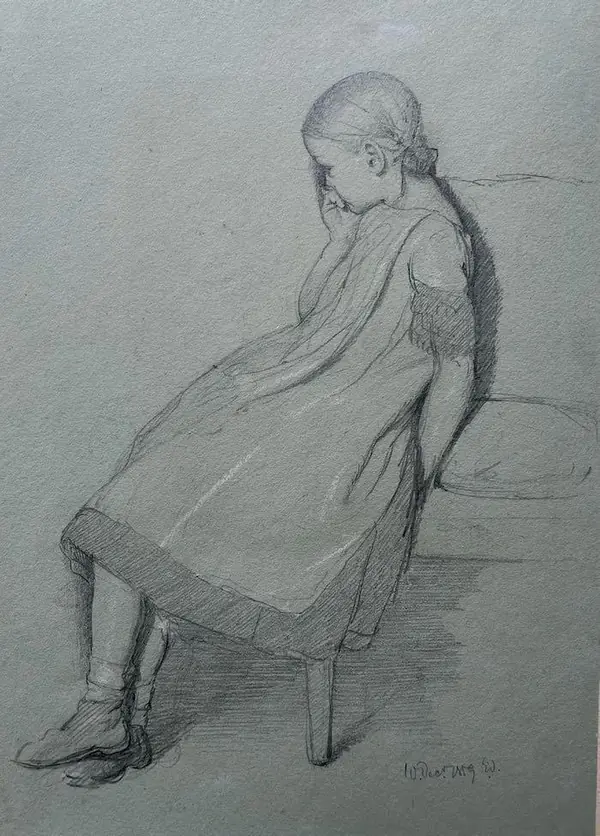
Signed and dated l.lr.: Edward Lear del./1838, pencil and black chalk heightened with white on green paper
24.7 x 40.5 cm.; 9 ¾ x 16 inches
Provenance
Private collection, U.K. until 2025
Lear set out for Italy in the summer of 1837. For most of the next ten years the artist wintered in Rome and toured other parts of Italy during the summer. This delicately drawn sheet shows the influence of James Duffield Harding. The carefully drawn trees are probably in the Roman Campagna.
You Might Also Like

KT734Edward Lear (British 1812-1888)Sunset at Philae, EgyptInscribed and dated l.r.: Philae. Feby. 3. 1854/from Biggeh. Sunset. P 18 and extensively further inscribed with colour notes, pen and brown ink and watercolour over traces of pencil33 x 50 cm.; 13 x 19 ¾ inchesProvenanceAppleby Brothers, 27 William IV Street, Trafalgar Square, London, no. M2139;Private collection, U.K. until 2026Lear visited Philae for the second time in late January and early February 1854. He had intended to travel up the Nile with the artist Holman Hunt but left Cairo earlier than expected when the opportunity arose after Christmas 1853, having met Thomas Seddon (1821-1856) and the explorer Sir Richard Burton (1821-1890). His views of the island were often taken from a vantage point which situated it in the landscape, showing the First Cataract, the rocky barrier that divided ancient Egypt from Nubia and the Nile. Here he enjoys painting the rocks in different shades of grey as the sun goes down, its light illuminating the temple with a golden glow. Lear spent ten days exploring the island and set up camp in the Temple of Isis. Many parties of English travellers visited, and Lear entertained some of them with dinner and music on the Temple Terrace. He adored the place and wrote that it was ‘more like a real fairy island than anything else I can compare it to. It is very small, & was formerly all covered with temples, of which the ruins of 5 or 6 now only remain. The great Temple of Isis, on the terrace of which I am now writing, is so extremely wonderful that no words can give the least idea of it. The Nile is divided here into several channels, by other rocky islands, & beyond you see the desert & the great granite hills of Assouan’ (Lear in a letter to his sister Ann, 7th February 1854, quoted in V. Noakes, ‘Edward Lear’, 1988, p, 124). He made many drawings of Philae, including a similar work dated a day later, 4 February 1854, from a different vantage point which is in the Ashmolean Museum. Lear painted Philae in oils around twenty times. He wrote on his 1867 trip that ‘In no place- it seems to me, can the variety & simplicity of colours be so well studied as in Egypt; in no place are the various beauties of shadow more observable, or more interminably numerous (Diary, 25.ii.67).Bigeh is an island and archaeological site in the Nile, formerly in the First Cataract of the river and it controlled the access to ancient Upper Egypt and Nubia. It was sacred to the ancient Egyptians who believed that Osiris was buried on the island. Its sacred temple was only accessible to priests. When the construction of the Aswan Dam began in 1960, it became apparent that the ancient temples and surrounding area would be submerged and destroyed by the rising waters of the newly created Lake Nasser. An international fund-raising campaign by UNESCO led to their relocation to higher ground by 1968.
View details
Signed with monogram l.r., inscribed l.l.: near Calikut., watercolour heightened with touches of bodycolourProvenanceFranklin Lushington (1823-1901) and thence by descentLear was invited to India by his friend and patron Lord Northbrook who was appointed Viceroy in 1871, and his journey there was the last and longest of his life. He was overwhelmed by the colour and vitality of India and enjoyed the bustle of Viceregal life.Calicut, or present-day Kozhikode, is on the Malabar coast in Kerala and was a centre of the Indian spice trade. Edward Lear arrived there in October 1874, just as the monsoon began. He was warned about the dangers of contracting fever but stayed, despite the pouring rain, until the skies were clear enough to draw. He described the roads around the city as “of such redundant beauty one can hardly dream.” Franklin Lushington, Lear’s close friend and first owner of this drawing, was the son of Edmund Henry Lushington. He was appointed judge to the Supreme Court of Justice in the Ionian Islands in 1855 and Lear went with him to live in Corfu. They first met in Malta in 1849, where Franklin’s elder brother Henry was Chief Secretary to the government. On his death, Lear left all his papers to Lushington, who later destroyed most of them.
View details
Inscribed and dated l.r.: Patti 4 July 1847, inscribed: sloping towards x which is a very deep stuffy vegetable dell and with colour notes, numbered 212, pen and brown ink with pencil20.2 x 44.5 cm.; 8 1/8 x 17 ½ inches, framed size 37 x 60.5 cm.; 14 1/2 x 23 3/4 inchesProvenanceMary Ann Streeter (1932-2023), Boston, by descent until 2025£5500Lear travelled to Sicily between May 3 and July 15, 1847, with John Joshua Proby, later the 2nd Earl of Carysfort. They were to make two other tours together that year, to Calabria and Naples.Patti is a village in North-Eastern Sicily in the province of Messina between Milazzo and Capo Calvà, which includes the ancient Graeco-Roman village of Tindari with its famous Sanctuary.After graduating from Radcliffe College (Harvard University) with a degree in Fine Arts, Mary Ann Streeter moved to London for a year and started buying Lear watercolours in the late 1950s. She built up a large collection of Lear’s work.
View details£5,500

Pen and brown ink and watercolour, inscribed with pencil numbers l.r.4 x 11.6 cm.; 1 5/8 x 4 5/8 inchesLear’s diary of 5th May 1864 records that he was sketching at the Lake of Kourna, ‘very fine and Cumberlandish- in a nook at the foot of very high hills…11.15 Lunch is done: the wrens and titmice still sing-still. Zeriff [Turkish armed servant] hubblebubbles. The four Cretan creturs [sic] sleep, and the sun comes over the oak tree I lie beneath so I must move. Very delightful hours…’
View details
Extensively inscribed and dated in pencil and in pen and brown ink: Quarries of Assouan AM 11.30- 1 PM January 27.1867 all one color [sic] pinky drab oker [sic], numbered (242) and with further colour notes, pen and brown ink and watercolour over pencil heightened with white29 x 53 cm.; 11 3/8 x 20 ¾ inchesProvenanceMrs R.K. Judges;The Fine Art Society, January 1993, where bought byMartin Davies (1924-2023)This beautifully drawn watercolour dates from Lear’s second trip up the Nile and his third visit to Egypt in the winter of 1866-1867, when he travelled with his Canadian cousin, Archie Jones. The men met in Luxor and visited Esneh, Edfu and Denderah, and had reached Philae by the end of January. Lear found his cousin irritating due to his habit of whistling and his lack of enthusiasm for the temples.It was nevertheless a productive trip for the artist, who made many drawings. He was particularly interested in the country between the First and Second Cataracts which was new to him. Another drawing from this trip dating from 30 January of the first Cataract is numbered 267 (formerly in the collection of Dayton International), indicating that he produced twenty-five drawings in 3 days. He wrote to Lady Waldegrave on 9th March 1867 that the Nubian desert was, ‘a sad, stern, uncompromising landscape, dark ashy purple lines of hills, piles of granite rocks, fringes of palm, and ever and anon astonishing ruins of oldest temples’ (Vivien Noakes, Edward Lear: Selected Letters, London, 1988, pp. 208-209).This detailed view accurately depicts the ancient granite quarries at Aswan mined by the ancient Egyptians. A line of unfinished carved granite can be seen lying in the sand in the background. When the construction of the Aswan Dam began in 1960, it became apparent that the ancient temples and surrounding area would be submerged and destroyed by the rising waters of the newly created Lake Nasser. UNESCO led an international fund-raising campaign to relocate them to higher ground by 1968.Martin Davies (1924-2023) was the President of the Egypt Society of Bristol, who visited and photographed the second cataract twice in 1960s before the Aswan Dam was moved. He amassed an interesting collection of views of Egypt.
View details
Signed l.l.: E. Lear, pencil with watercolour, gum arabic and pen and black ink17.7 x 23 cm.; 7 x 9 inchesThese charming, quirky drawings are characteristic early works by Lear, dating from the late 1820s or early 1830s when he was establishing himself as an ornithological artist. They relate to a group of drawings which Lear gave to Mrs Godfrey Wentworth, who supported his employment by the Zoological Society in 1831, and whom he credited with launching him as an artist. They are imaginary, fanciful subjects drawn with not a little humour, resembling the stylised watercolours of birds painted on late eighteenth century porcelain. Robert McCracken Peck has made the interesting suggestion that Lear and his sister Ann may have been thinking of approaching ceramics companies with them (see Robert McCracken Peck, The Natural History of Edward Lear, 2016, pp. 27-9).Two surviving family albums from the late 1820s, containing a mixture of similar natural history subjects by Edward Lear and his sisters Ann and Sarah, are in the collection of the Houghton Library, Harvard University (MS Typ 55.4 and 55.27).Sir Edward Strachey was a man of letters and friend of Lear’s, who wrote an introduction to Nonsense Songs in 1895. He lived at Sutton Court, Chew Magna in Somerset and was a neighbour of Lear’s close friend Chichester Fortescue, the Liberal politician whom Lear first met in Rome in 1845.
View details
Signed l.r.: E. Lear, pencil with watercolour and touches of gold23 x 17.7 cm.; 9 x 7 inchesProvenance (for all the bird drawings)Sir Edward Strachey, Bt., (1812-1901) and by descent to the previous ownersThe drawings are available individually or as a groupThese charming, quirky drawings are characteristic early works by Lear, dating from the late 1820s or early 1830s when he was establishing himself as an ornithological artist. They relate to a group of drawings which Lear gave to Mrs Godfrey Wentworth, who supported his employment by the Zoological Society in 1831, and whom he credited with launching him as an artist. They are imaginary, fanciful subjects drawn with not a little humour, resembling the stylised watercolours of birds painted on late eighteenth century porcelain. Robert McCracken Peck has made the interesting suggestion that Lear and his sister Ann may have been thinking of approaching ceramics companies with them (see Robert McCracken Peck, The Natural History of Edward Lear, 2016, pp. 27-9).Two surviving family albums from the late 1820s, containing a mixture of similar natural history subjects by Edward Lear and his sisters Ann and Sarah, are in the collection of the Houghton Library, Harvard University (MS Typ 55.4 and 55.27).Sir Edward Strachey was a man of letters and friend of Lear’s, who wrote an introduction to Nonsense Songs in 1895. He lived at Sutton Court, Chew Magna in Somerset and was a neighbour of Lear’s close friend Chichester Fortescue, the Liberal politician whom Lear first met in Rome in 1845.
View details
Signed l.l.: E. Lear, pencil with watercolour23 x 17.7 cm.; 9 x 7 inchesThese charming, quirky drawings are characteristic early works by Lear, dating from the late 1820s or early 1830s when he was establishing himself as an ornithological artist. They relate to a group of drawings which Lear gave to Mrs Godfrey Wentworth, who supported his employment by the Zoological Society in 1831, and whom he credited with launching him as an artist. They are imaginary, fanciful subjects drawn with not a little humour, resembling the stylised watercolours of birds painted on late eighteenth century porcelain. Robert McCracken Peck has made the interesting suggestion that Lear and his sister Ann may have been thinking of approaching ceramics companies with them (see Robert McCracken Peck, The Natural History of Edward Lear, 2016, pp. 27-9).Two surviving family albums from the late 1820s, containing a mixture of similar natural history subjects by Edward Lear and his sisters Ann and Sarah, are in the collection of the Houghton Library, Harvard University (MS Typ 55.4 and 55.27).Sir Edward Strachey was a man of letters and friend of Lear’s, who wrote an introduction to Nonsense Songs in 1895. He lived at Sutton Court, Chew Magna in Somerset and was a neighbour of Lear’s close friend Chichester Fortescue, the Liberal politician whom Lear first met in Rome in 1845.
View details
Signed l.c.: E. Lear, pencil with watercolour, pen and black ink and touches of gold17.7 x 23 cm.; 7 x 9 inchesThese charming, quirky drawings are characteristic early works by Lear, dating from the late 1820s or early 1830s when he was establishing himself as an ornithological artist. They relate to a group of drawings which Lear gave to Mrs Godfrey Wentworth, who supported his employment by the Zoological Society in 1831, and whom he credited with launching him as an artist. They are imaginary, fanciful subjects drawn with not a little humour, resembling the stylised watercolours of birds painted on late eighteenth century porcelain. Robert McCracken Peck has made the interesting suggestion that Lear and his sister Ann may have been thinking of approaching ceramics companies with them (see Robert McCracken Peck, The Natural History of Edward Lear, 2016, pp. 27-9).Two surviving family albums from the late 1820s, containing a mixture of similar natural history subjects by Edward Lear and his sisters Ann and Sarah, are in the collection of the Houghton Library, Harvard University (MS Typ 55.4 and 55.27).Sir Edward Strachey was a man of letters and friend of Lear’s, who wrote an introduction to Nonsense Songs in 1895. He lived at Sutton Court, Chew Magna in Somerset and was a neighbour of Lear’s close friend Chichester Fortescue, the Liberal politician whom Lear first met in Rome in 1845.
View details
Signed and dated l.r.: Edward Lear. Del 1842, inscribed l.l.: Villa Adriana., pencil heightened with white24 x 36.7 cm.; 9 3/8 x 14 3/8 inchesProvenancePhillip’s, London, 11 November 1997, lot 45; Private collection U.K. until 2023£8500Lear set out for Italy in the summer of 1837. For most of the next ten years the artist wintered in Rome and toured other parts of Italy during the summer. This crisply drawn view with white highlights of the Villa Adriana is a fine example of the artist’s pencil drawing, which he favoured early in his Italian soujourn and shows the influence of James Duffield Harding.A related drawing of the Villa Adriana in upright format is in the collection of the British Museum (P_1892-1119-15). The same figures can be seen in the foreground and the compositional emphasis is on the trees on the right of the composition.Situated on a low plain on the slopes of the Tiburtine Hills, Hadrian’s Villa was the largest villa of the Roman Empire, built over an area of more than one hundred hectares.
View details£8,500