
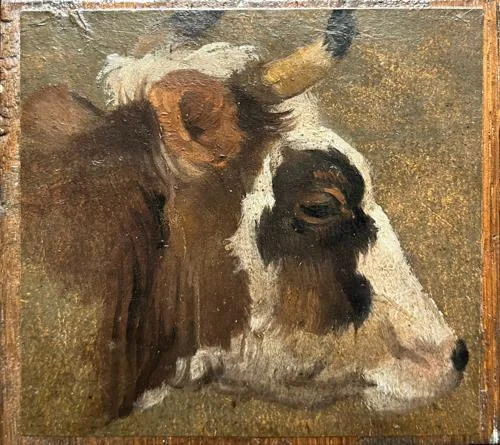
English School circa 1830 The head of a brown cow Oil on paper laid down on panel 9 x 8.7 cm.; 3 ½ x 3 3/8 inches Framed size 21 x 21 cm.; 8 ¼ x 8 ¼ inches Provenance Private collection, U.K.
View details21 items
A Box of Delights
A Box of Delights
Use arrow keys to navigate, Enter to select, Escape to close
Artist A-Z
Artist Z-A
Random
Recent Items
Title A - Z
Title Z - A

Watercolour over pencil 14.8 x 22 cm.; 8 x 8 ¾ inches Provenance Iolo Williams (1890-1962) The Italian artist, born in Cremona, settled in England in 1803, having travelled in Greece and Egypt with William Wilkins, R.A. His work has often been confused with that of Constable, particularly his coastal views which look quite similar. Examples of his work may be found at the British Museum, the V&A, Brighton Art Gallery and in several other museum collections.
View details£ 950
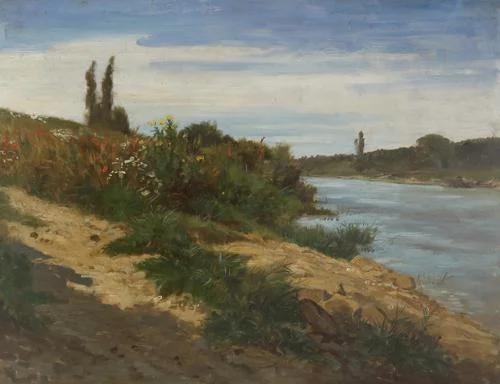
KT454 August-Paul-Charles Anastasi (French 1820-1889) Berge et rivière, neuve Bougival, France Oil on board, inscribed with title on artist’s studio sale label attached to verso: Berge et riviere/neuve Bougival, with artist’s seal 27 x 35.5cm.; 10 5/8 x 14 inches Provenance The artist’s studio sale, Durand-Ruel, 3-8 March, 1873, no. 203; Private collection, France until 2021 Bougival is a small town on the Seine to the west of Paris, popular with 19th century painters.
View details£ 3,500
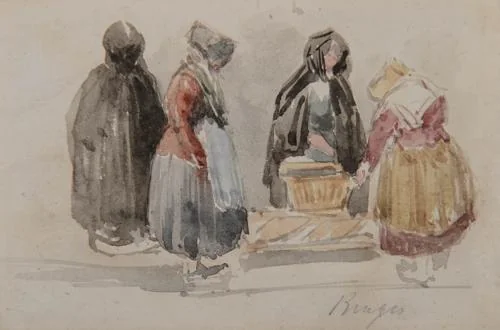
Inscribed l.r.: Bruges, watercolour 7.6 x 11.4 cm; 3 x 4½ inches Provenance Spink & Son Ltd, London, K3/1890b, part of a group purchased from Appleby Brothers, 2 August 1960. This spontaneous, on-the-spot sketch was presumably done when Cox visited Bruges in 1826. His first trip to the Continent was organised by his brother-in-law Mr Gardener, an agent for the sale of government ordnance maps who had premises at 163 Regent Street, London. Gardener persuaded Cox and his son David Cox Jr to accompany him on a business trip to Brussels. The party travelled from Dover to Calais and then, travelling by diligence, on to Dunkerque, Bruges and Brussels. Cox evidently liked the caps worn by the market women in Belgium as he sketched them again in Brussels.1 1. See N. Neil Solly, Memoir of the Life of David Cox, 1873, reprinted 1973, p. 49.
View details£ 1,800
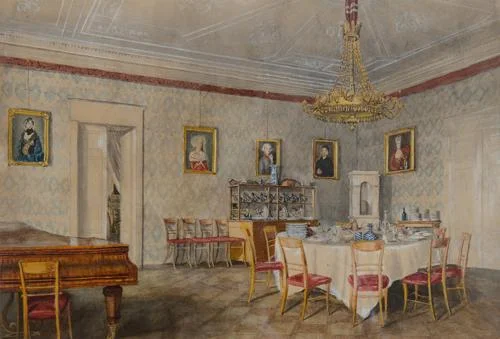
German School mid 19th Century The dining room at Kolešovice (Kolleschowitz), Bohemia, Czech Republic Watercolour over traces of pencil heightened with bodycolour and touches of gold, inscribed verso: Speiszimmer in Kolleschowitz/Wallis, in a gold-leaf frame with a ribbed moulding 30.5 x 44 cm; 46 x 59.5 cm framed Provenance Paul Walter, U.S.A. Kolešovice is near Rakovnic in central Bohemia and became part of Czechoslovakia at the end of World War II. This room is presumably one of the dining rooms of Kolešovice Castle, the home of the Wallis family from 1724. Georg Olivier, Count von Wallis (1671-1743) a field-marshal of Irish descent in the service of the Holy Roman Empire, and the last Habsburg regent of the Kingdom of Serbia (1738-1739), bought the estate of Kolleschowitz in 1724 and restored the mid 16th century castle, collecting Old Master paintings and creating a large library. His descendant Stefan Olivier von Wallis built a Neo-Renaissance new castle next to the old one in the 19th century and created a large English-style landscape garden. Today the buildings are used as an old people’s home. The interior contains fashionable Biedermeier furniture, a French style chandelier, porcelain and glass under the watchful gaze of a clutch of ancestral portraits hanging on the wallpaper. The drawing belonged to Paul Walter, the New York collector whose collection was dispersed by Christie’s in 2017. His parents Fred and Anna Walter were co-founders of the New Jersey industrial instruments firm Thermo Electric. They instilled in him a love of art which saw him become active in the art world of New York, as a collector and patron of the Metropolitan Museum of Art and the Museum of Modern Art.
View details£ 2,400
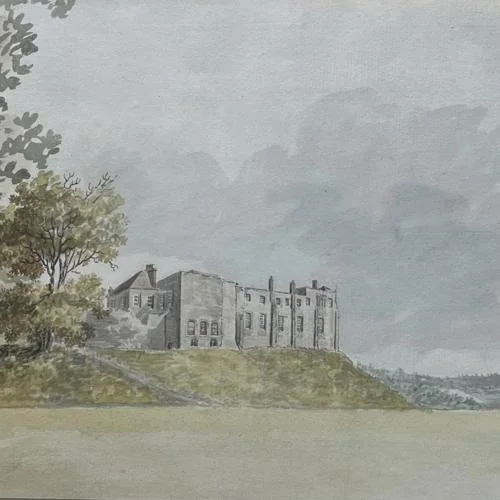
Charles Gore (1729-1807) A view of the East front of Arundel Castle, West Sussex, seen from the Bowling Green Inscribed l. r.: Arundel Castle taken from the Platform or/Bowling Green by Charles Gore Esq 1781 and indistinctly inscribed in pencil u. r.: Arundel Castle Sufsex/1781 Watercolour over touches of pencil on laid paper, with a Whatman watermark 19.6 by 49 cm., 7 ¾ by 19 ¼ inches Provenance Iolo Williams (1890-1962); And by descent until sold Sotheby's, London, 13 July 1989, lot 5; Private collection; With Guy Peppiatt Fine Art The bowling green is the name for the square earthworks located, with the fishponds, on the east side of the castle. They were probably made originally to improve the castle’s defences during the Civil War. Used as a bowling green in eighteenth century, as shown in the drawing by Charles Gore, today a rose garden can be found here. The Hon. Charles Gore was the son of a Lincolnshire landowner and educated at Westminster. He married a wealthy heiress of a shipbuilding company and learnt to draw and design ships. Gore travelled extensively in Europe, sketching with the German artist Jacob Philipp Hackert (1737-1807). Gore copied marine oils, completed the unfinished drawings of other artists, and also developed his own style having acquired an expert knowledge of the sea. His interest in classical antiquities led Charles Gore to join Hackert and Richard Payne Knight on their expedition to Sicily from April to June 1777. In 1779 Gore returned to England and became a member of the Dilettanti Society in 1781. He painted a series of panoramic views of Sussex including the current drawing. The family returned to the Continent in 1782 and he settled in Weimar in 1791 with his daughter Eliza. Examples of Gore's work can be found in the British Museum, the National Maritime Museum, Greenwich and the Goethe-Nationalmuseum, Weimar.
View details£ 1,500

KT516 Signed l.l.: h. Harpignies and indistinctly dated 70, watercolour 12 x 16 cm.; 4 ¾ x 6 ¼ inches Provenance Thomas Agnew & Sons, London, no. 26164, cat. No. 19; By descent from the purchaser The artist was a landscape painter of the Barbizon school. After following his family’s wish for him to go into business he started to study art in his late twenties. Following a few years in Italy he returned to France and fell in with Corot and the other artists of the Barbizon school. He and Corot travelled to Italy together in 1860. He exhibited regularly at the Salon from 1861. His work can be found in many of the world’s major museums.
View details£ 2,750
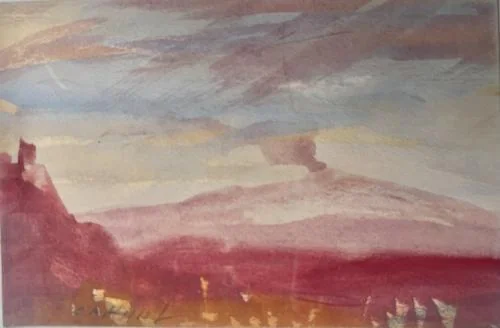
Cecil Arthur Hunt, RWS (1873-1965) Mount Etna, Sicily Signed in pencil l.l.: C.A. Hunt, watercolour, inscribed on label attached to backboard: From Cecil & Phyllis Hunt/Christmas 1954/Etna 9 x 13,5 cm.; 3 ½ x 5 5/8 inches Frame size 15 x 29 cm.; 6 x 11 3/8 inches Provenance Agnew’s; Private collection UK Hunt and his wife, Phyllis made many trips to Sicily, an island which inspired the artist. They always stayed at the Casa Cuseni, the villa in Taormina belonging to his friend and art critic, R. H. Kitson, the painter and critic, who he first met at Cambridge. Casa Cuseni is now a museum and is, perhaps, best known for its dining room designed by Sir Frank Brangwyn (1867 – 1956).
View details£ 780
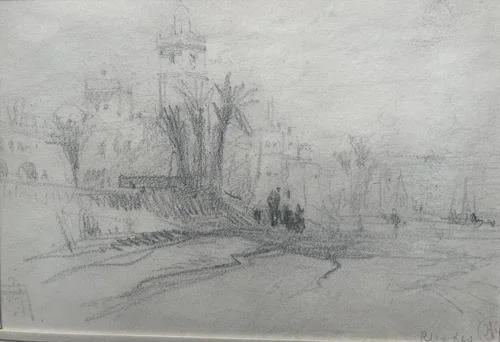
KT649B Harry John Johnson (1826-1884) Rhodes Stamped with studio stamp l.r. and inscribed: Rhodes, pencil 14 x 21 cm From a collection of watercolours by the artist
View details£ 575
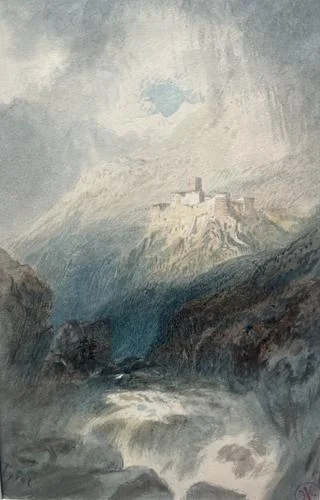
KT649B Harry John Johnson (1826-1884) Tirol Watercolour over traces of pencil heightened with white and scratching out, with studio stamp l.r. 23 x 15 cm.; 9 x 6 inches
View details£ 575

Stamped with studio stamp l.r. and inscribed: Venice, watercolour 15 x 23.5 cm.; 5 7/8 x 5 ½ inches, framed size 32 x 39 cm.; 12 1/2 x 15 1/4 inches From an album of watercolours by the artist. Johnson was born in Birmingham where he studied under Samuel Restell Lines. He was then a pupil of William James Müller in London from circa 1842/3-1845, accompanying him to Lycia at the time of Sir Charles Fellowes’ expedition in 1843. The artists travelled for around eight months, spending time in Xanthus, Pinara and Tlos before going to to Rhodes and Smyrna and presumably visited Venice at this time. Johnson, like Müller, continued to work on subjects from this trip after his return to England. On Johnson’s return to London, he became a founder member of the Clipstone Street Academy, along with Müller, participating in its life drawing and painting sessions with a variety of models from the streets. Johnson made sketching trips with David Cox to North Wales from 1844. The artist was elected an associate member of the R.I. in 1868 and a full member two years later. His work can be found in many museum collections, including the British Museum, Victoria & Albert Museum and the Fitzwilliam Museum.
View details£ 2,750
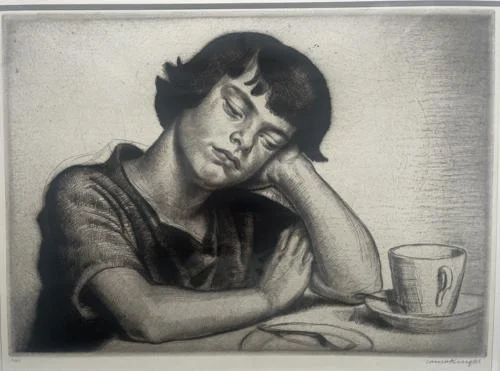
KT682 Laura Knight, DBE, RA, RWS (1877 - 1970) Susie, 1928 Etching, 18/40, signed in pencil in margin l.r., editioned l.l., published 1928 Plate size 25 x 45 cm.; 9 ¾ x 17 ¾ inches Framed size 47 x 56 cm.; 18 ½ x 22 inches Susie was the daughter of a fisherman from Mousehole, Cornwall, near Lamorna where Knight lived. She also features in Knight's 1929 painting Susie and the Wash Basin (Harris Museum & Art Gallery, PRSMG : P356).
View details£ 2,200
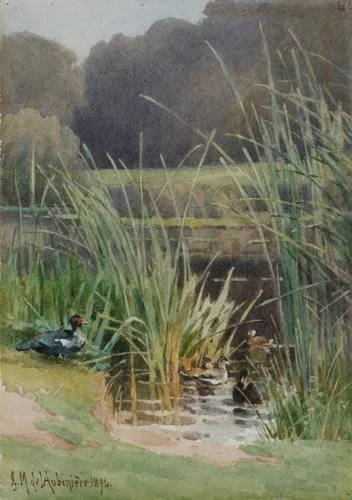
Georgina Martha de L'Aubiniere (1848-1930) Ducks at the edge of a lake Signed and dated l.l.: G.M. de l’Aubinière. 1894, watercolour over traces of pencil with scratching out 25.3 x 17.8 cm.; 10 x 7 inches
View details£ 1,200
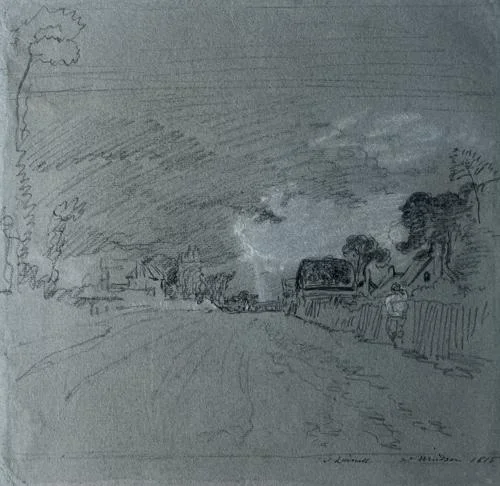
KT741 John Linnell (1792-1882) Near Windsor Signed, inscribed and dated l.r.: J Linnelll Nr Windsor 1815, pencil with white on blue paper 26.8 x 27.2 cm.; 10 5/8 x 10 ¾ inches Mount size 40 x 40 cm.; 15 3/4 x 15 3/4 inches Provenance Cheffins, Cambridge, 26 November 2015, lot 398, where bought by Professor David Bindman (1940-2025)
View details£ 1,750

Slave Girl of the Cape Signed with initials on border l.r.: F .Y. (?) M, and inscribed l.c.: Slave Girl of the Cape, watercolour on wove paper, with a laid paper border watermarked 1801 Drawing size 20.3 x 14.6 cm.; 8 1/8 x 5 ¾ inches, with border 25.8 x 20.2 cm.; 10 1/8 x 8 inches This drawing came from a now disbound English album which contained works on paper from the late 18th and early 19th centuries. Slavery in South African began around 1650 when the Cape colony was controlled by the Dutch East India Company (VOC) when Cape Town was founded as a supply port for their shipping. The trade continued until the eventual abolition of slavery in the Colony, by then under British rule, in 1834. The British had banned trading in slaves between her colonies in 1807 but the final emancipation was delayed until 1834.
View details£ 2,500
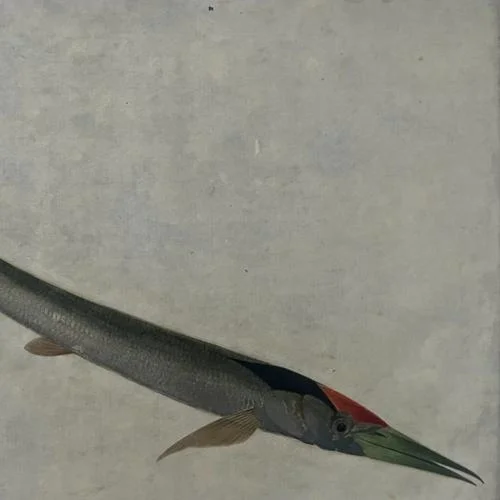
Chinese School early 19th Century A fish with a pointy nose Watercolour with silver on pith paper, unframed 21 x 31 cm.; 8 ¼ x 12 ¼ inches Mount size 35 x 48 cm.; 13 3/4 x 18 3/4 inches Provenance Sir John Witt (1907-1982), by descent until 2022
View details£ 620
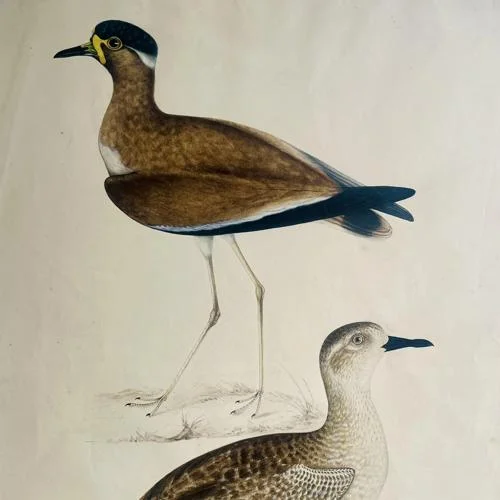
KT518A English School mid 19th Century A Yellow Wattled Lapwing and a Black-bellied Plover (in winter plumage) Watercolour over pencil heightened with gum arabic, unframed 50 x 32 cm.; 19 ¾ x 12 ½ inches
View details£ 650
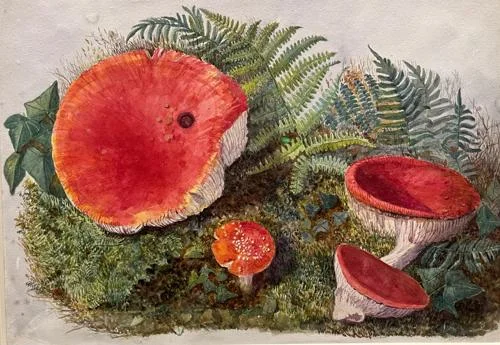
KT727 English School, 1870s Russula emetica, commonly known as the sickener Watercolour 25.5 x 35.6 cm.; 10 x 14 inches In the 1870s the Keswick Sketching Club, an amateur art group in the Lake District was founded by John William Oddie (1839–1923) with the support of John Ruskin (1819–1900). This drawing was made by one of its members. Keswick Sketching Club is believed to have been instigated in the 1870s by the artist and designer John William Oddie (1839–1923), who lived at Lyzzick Hall, Keswick. Oddie studied at Wadham College, Oxford in the 1860s and became a Life Fellow at Corpus Christi College. It appears that it was Oddie who facilitated Ruskin's obtaining rooms at Corpus, where he was admitted as an Honorary Fellow. Oddie and Ruskin were in regular contact, and in 1874 Oddie enlisted Ruskin's assistance with Keswick Sketching Club. Ruskin responded with enthusiasm as the club's activities gave him opportunity to put into practice what he was promoting in his Oxford Drawing School and his various drawing manuals. Ruskin advises Oddie on sketching exercises for the Club, and writing to Oddie in 1874 he states that 'certainly there is one exercise — which I must send you example of Outline of a strawberry leaf'. In April 1875 Ruskin sends his critique to the Club, writing: 'To the Members of the Keswick Sketching Club, / In the work of the Club generally I find the sense of colour excellent, the industry great; the ability in many cases beyond that of most professed artists, several pieces of texture and local hue being given with singular feeling and skill.' In the 1880s Ruskin and Oddie continued their involvement in art teaching in the Lakes, founding the Keswick School of Industrial Arts. Oddie later established the Lyzzick Hall Art School.
View details£ 1,100

Two, bodycolour, one on paper watermarked: SMITH & ALLNUTT 1815 Each 20.5 x 33.5 cm Provenance: Mrs Baldock The artists of the Patna School specialised in the depiction of everyday activities for their British patrons. Traditionally described as the work of the Company School (reflecting the patronage of the East India Company employees) this unique genre evolved as the painting styles of Western and Mughal traditions merged.
View details£ 2,400
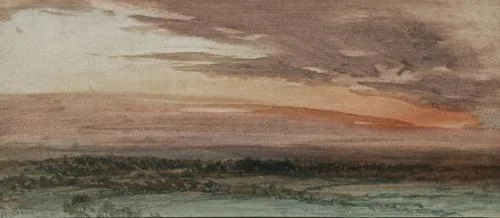
KT282 Arthur Severn (1842-1931) Sunset over a wooded landscape, probably at Coniston Water Signed l.l.: A. Severn, watercolour, inscribed on backing paper: 'This picture is by Arthur Severn/and was given to me in exchange/for a song in 1904’, in the original gilt frame 9 x 20.4 cm; 3 3/4 x 8 inches Framed size 18 x 29 cm.; 7 1/8 x 11 1/4 inches Severn loved to draw sunsets and this is a delightful example of his work, most probably drawn from near Brantwood where he lived with John Ruskin.
View details£ 1,250
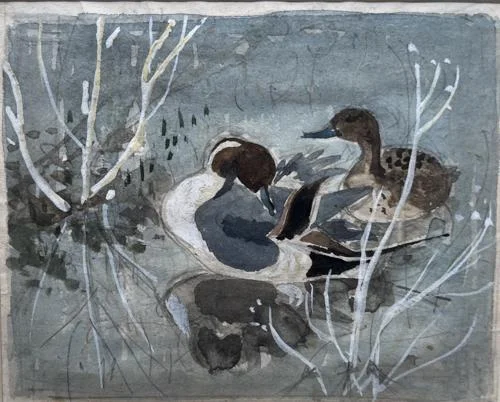
KT601 Charles Frederick Tunnicliffe, OBE, RA (1901-1977) Sketch for a pair of pintail ducks Watercolour over pencil heightened with white Sight size 9 x 11 cm.; 7 ½ x 4 ¼ inches Provenance Private collection, UK, sold at Christies South Kensington, London, 3 November 2010, part lot 57 Guy Peppiatt Fine Art
View details