SOLD
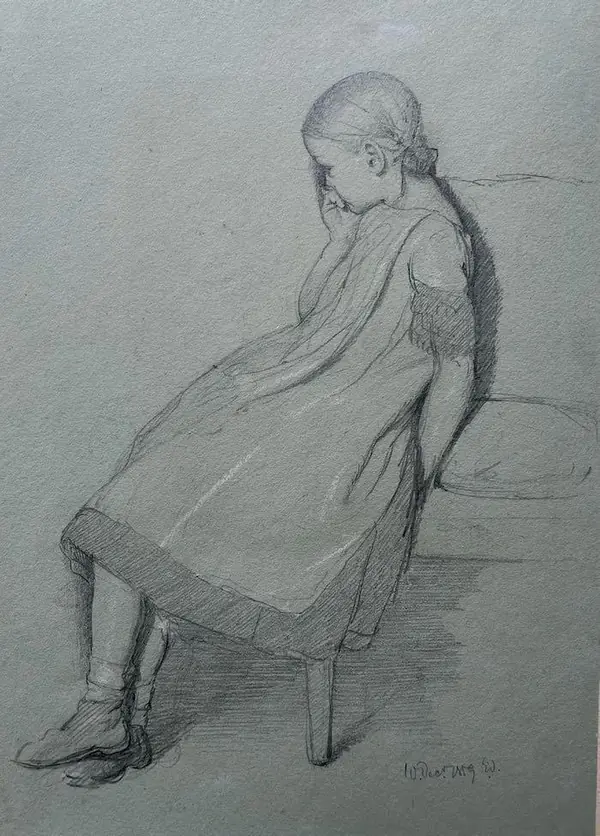
Signed and dated in pen and brown ink: William Strutt/Aug.t.31st./89., pencil
17.8 x 27 cm.; 7 x 10 5/8 inches
Provenance
The Redfern Gallery Ltd. Summer Exhibition, 1955, no. 21; sold to
John Bensusan-Butt, September 7, 1955;
Private collection, U.K. until 2020
Strutt, born in Devon, was from a family of artists. He studied in Paris and made many drawings of animals throughout his career during which he travelled extensively. He visited Australia in 1850, New Zealand in 1856 and returned to England in 1862.
His work is highly prized in the Antipodes and his most famous painting Black Thursday, 6 February. 1851, painted later in 1864, which depicts animals and men fleeing from a bush fire, is one of the treasures of the State Library of Victoria. His work can be found in several other Australian and New Zealand museums and several monographs have been written about his time there.
He was a Fellow of the Zoological Society and he drew animals throughout his career.
You Might Also Like

Oil on panel22 x 27 cm.; 8 ¾ x 10 5/8 inchesProvenanceThe artist’s widow, Lady Kelly; Michael Parkin Fine Art Ltd; From whom purchased by J.G. Cluff, private collection U.K. until 2022Born in London of Irish descent, Kelly was educated at Cambridge University, later living and studying art in Paris where he met Degas, Monet, Renoir and Sickert. Whistler was also an early influence as were Cézanne and Gaugin.Kelly was an enthusiastic traveller, visiting many countries from Egypt to China. His sketches of his travels are pleasingly spontaneous and tend to be painted more freely than his finished portraits.He became a successful society portraitist whose sitters included Somerset Maugham, whom he painted several times, and he undertook numerous state portraits. Kelly is represented in many public collections, including the Tate, which holds seven works. He had retrospective exhibitions at the Leicester Galleries in 1950 and in 1957 at the RA. He was elected RA in 1930, was the Academy's Keeper from 1943-45 and President, defeating Augustus John in the election, from 1949-54. Kelly held a number of official positions, such as membership of the Royal Fine Arts Commission, 1938-43, and was knighted in 1945. Between 1909 and 1970 Kelly exhibited over 300 works at the RA. During his lifetime his work became well known through popular prints.
View details
Extensively inscribed and dated in pencil and in pen and brown ink: Quarries of Assouan AM 11.30- 1 PM January 27.1867 all one color [sic] pinky drab oker [sic], numbered (242) and with further colour notes, pen and brown ink and watercolour over pencil heightened with white29 x 53 cm.; 11 3/8 x 20 ¾ inchesProvenanceMrs R.K. Judges;The Fine Art Society, January 1993, where bought byMartin Davies (1924-2023)This beautifully drawn watercolour dates from Lear’s second trip up the Nile and his third visit to Egypt in the winter of 1866-1867, when he travelled with his Canadian cousin, Archie Jones. The men met in Luxor and visited Esneh, Edfu and Denderah, and had reached Philae by the end of January. Lear found his cousin irritating due to his habit of whistling and his lack of enthusiasm for the temples.It was nevertheless a productive trip for the artist, who made many drawings. He was particularly interested in the country between the First and Second Cataracts which was new to him. Another drawing from this trip dating from 30 January of the first Cataract is numbered 267 (formerly in the collection of Dayton International), indicating that he produced twenty-five drawings in 3 days. He wrote to Lady Waldegrave on 9th March 1867 that the Nubian desert was, ‘a sad, stern, uncompromising landscape, dark ashy purple lines of hills, piles of granite rocks, fringes of palm, and ever and anon astonishing ruins of oldest temples’ (Vivien Noakes, Edward Lear: Selected Letters, London, 1988, pp. 208-209).This detailed view accurately depicts the ancient granite quarries at Aswan mined by the ancient Egyptians. A line of unfinished carved granite can be seen lying in the sand in the background. When the construction of the Aswan Dam began in 1960, it became apparent that the ancient temples and surrounding area would be submerged and destroyed by the rising waters of the newly created Lake Nasser. UNESCO led an international fund-raising campaign to relocate them to higher ground by 1968.Martin Davies (1924-2023) was the President of the Egypt Society of Bristol, who visited and photographed the second cataract twice in 1960s before the Aswan Dam was moved. He amassed an interesting collection of views of Egypt.
View details
Signed, inscribed and dated u.r.,: John Tunnard/F. 13 63, watercolour and gouache with stopping out and scratching out, original label attached to backboard, in original frame19.2 x 27.8 cmProvenance: McRoberts and Tunnard, London 3 March 1964, sold 15 April 1964 to a private collector;Their sale Bonhams, 1 July 2009, lot 44Literature: Tunnard ledger 63/4-F: 13;Peat and B.A. Whitton, John Tunnard, His Life and Works, 1997, p. 197, no. 810Peat and Whitton note that the artist's later painting had a more assured quality. Tunnard distilled his early mathematical precision and added a more atmospheric feeling, ‘this is most noted in the swiftly executed smaller gouaches'.
View details
Pen and brown ink and watercolour, inscribed with pencil numbers l.r.4 x 11.6 cm.; 1 5/8 x 4 5/8 inchesLear’s diary of 5th May 1864 records that he was sketching at the Lake of Kourna, ‘very fine and Cumberlandish- in a nook at the foot of very high hills…11.15 Lunch is done: the wrens and titmice still sing-still. Zeriff [Turkish armed servant] hubblebubbles. The four Cretan creturs [sic] sleep, and the sun comes over the oak tree I lie beneath so I must move. Very delightful hours…’
View details
Pen and black ink over pencilEach 13 x 21 cm.; 5 x 8 ½ inchesProvenanceJ.M. Hunter, purchased from The Fine Art Society 22 November 1968 until 2023ExhibitedThe Fine Art Society Ltd., London, 'Edward Bawden, CBE, RA - Recent works', 1968LiteratureClaudia Roden, 'A Book of Middle Eastern Food', published by Thomas Nelson, London, 1968, with photographs by Pinkard, and black and white illustrations at the head of each chapter by Edward Bawden.These are the original drawings used to illustrated Claudia Roden’s (b. 1936) first cookery book on Middle Eastern food which mixed Bawden’s playful drawings with modern food photography and revolutionised Western attitudes to the cuisines of the Middle East and North Africa. It was substantially expanded and published in a new edition in 1986. She is the author of ten popular and critically-acclaimed cookery books and has a particular interest in the social and historical background of cooking.Bawden lived in Great Bardfield in Essex from the 1930s to 1970 and was a central figure of the Great Bardfield Artists.
View details
Inscribed and dated l.l.: Monte Generoso/1879, and further inscribed with colour notes, pen and brown ink over pencil25 x 51.5 cm; 9 7/8 x 20 1/4 inches£8500Lear returned to Varese and Monte Generoso, on the border between Italy and Switzerland between lakes Lugano and Como, from June 29 to September 22 1879. He stayed at Mendrisio, across the Swiss border in Ticino. He enjoyed sketching the views south across the plains, as in the present watercolour and the mountains stretching up to the Alps. Marianne North the botanical artist came to Como towards the end of his stay and they made a trip to Monte Civita near Monza together.This drawing is taken from a similar vantage point to that of an oil of the same subject dated 1880 in the collection of the Ashmolean Museum (WA196.39).An unpublished poem “The Lays of the Octopods’ about the perils of mass tourism at Monte Generoso has recently come to light in the British Library.
View details£ 8,500

Pencil on laid paper, partially watermarked and countermarked 181914.5 x 10.9 cm.; 5 ¾ x 4 ¼ inchesProvenance: Cyril and Shirley Fry until 2021Literature: J. Witt, 'William Henry Hunt (1790-1864)', 1982, no. 369Exhibited: 'Hunt Exhibition Fry Collection', 1967, no. 17 (2)This work dates from c. 1820.
View details
Oil on board, inscribed verso: Grindlay, inscribed on old backing paper by one of Edward Grindlay’s children: An early James Gunn/My father admired it in the/Studio so James framed it/and gave it to him22.4 x 14.2 cm.; 8 7/8 x 5 5/8 inchesFrame size 34 x 24 cm.; 13 3/8 x 9 ½ inchesProvenanceGiven by the artist to Edward Grindlay;By descent until 2021This beautiful view of the Place de la Concorde was done in 1911-1912 when Gunn studied at the Académie Julian in Paris under Jean Paul Laurens. It is previously unrecorded and a significant addition to his rare small pictures of Paris.While in Paris Gunn started to make tonally delicate panels of the city on small boards, using a muted palette reminiscent of Whistler, capturing street scenes with tiny figures drawn with a few strokes of the brush. He also made regular visits to the Louvre to draw from the Old Masters and rented a room at 2 bis rue Perel. His small pictures of Paris are not numerous and are highly sought after.Gunn has painted this work from near the centre of the Place de la Concorde, looking towards the eastern end of the Champs Elysées, with the Grand Palais visible behind the trees of the Jardin des Champs-Elysées. The statue on the plinth is one of the famous Chevaux de Marly by Guillaume Costou, brought from the Chateau de Marly in 1719 and now in the Louvre.James Gunn attended drawing lessons from the age of five. He studied at the Glasgow School of Art, the Edinburgh College of Art before he went to Paris. Gunn returned to Edinburgh in 1912 and also spent time in London. Early in 1914, at the instigation of the London dealer W.B. Paterson, he travelled widely in Europe, sending pictures back home, and revisiting Paris and Étretat. He enlisted with the Artists Rifles in 1915.Gunn gave a speech to the Glasgow Art Club in November 1955 and reminisced about his early career,‘…In Paris I studied at the Académie Julian under Jean Paul Laurens…I returned from Paris with a collection of sketches made in the streets and by the river. Many of these passed through the house of Anna. There they were seen and some were purchased by a dealer from Bond Street, W.B. Paterson, brother of the distinguished Scottish Academician, James. He gave me a contract, paid me a retaining fee and I undertook to provide him with not less than thirty pictures a year. At his instigation I went to Spain at the beginning of 1914. There I travelled, seeing and painting, till the echoes from Sarajevo warned that the good days were soon to end’.Edward ‘Teddy’ Grindlay and Gunn met in 1917 towards the end of WWI when they were commissioned into the 10th Scottish Rifles, the beginning of a life-long friendship. Gunn’s drawings of his fellow officers were published in a book ‘The 10th Battalion, The Cameronians (Scottish Rifles): a Record and a Memorial 1914-1918’.Grindlay saw this oil sketch in Gunn’s studio and admired it, so the artist had it framed and gave it to his friend. Edward and his wife Evelyn were both painted by Gunn who also painted a conversation piece of their house at 1 Newton Grove, Bedford Park in London in 1927. They later moved to Westcott near Dorking. They owned many paintings and drawings by Gunn who used his friend as a model for Maurice Baring in his famous conversation piece with Hilaire Belloc and G.K. Chesterton, which is now in the National Portrait Gallery, London (NPG3654). He received commissions from many of the leading figures of the day and painted the Royal Family in another famous conversation piece at Royal Lodge, Windsor (NPG3778).Gunn had a successful career as a portrait painter and in 1961 was elected a member of the Royal Academy.
View details
KT633Fragments of a colossal statue at the Memnonium, Thebes Signed l.l.: 'David Roberts. R.A.' and inscribed and dated 'Memnonium, Thebes Dec. 5th, 1838', further inscribed l.r.: 'Dimensions of the statue/Between the shoulders [?] 26 feet/Circumference of the Head 54"/Shoulder to the elbow 13" [5]', watercolour over pencil heightened with bodycolour on blue-grey paper 32.7 x 48.9 cm; 12 7/8 x 19 ¼ inchesPROVENANCEPossibly David Roberts; Christie's, London, 13-20 May, 1865, lot 67 as 'Thebes: Fragments of the Colossus of Rameses'; Anonymous sale; Sotheby's, London, 15 March 1990, lot 42; with Spink, London, 1990; Christie's, London, 16 November 2006, lot 128This temple on the west bank of the Nile at Luxor, was visited twice by Roberts during his voyage on the Nile in 1838. On the outward journey, on the way to Abu Simbel, he had visited all the temples on both sides of the Nile at Luxor, and on 21 October hired donkeys to visit the ruins at Gurnah on the west bank, noting in his journal: 'The head and shoulders of the Memnon lying on the ground is enormous one can only wonder how it got there - the trouble of dislodging it must have been almost equal to the erection ...'.The present drawing was executed on the return journey when he was on the west bank of the river at Luxor from 3 to 5 December 1838. Roberts noted in his Journal 'I have been very industrious today, thanks to a Thunder Storm, a most uncommon thing in this part of the world - The sun was quite obscured and the peals of thunder were very loud accompanied with rain.... Made four large coloured sketches two of the Memnonium and two of Medinet Habou.' (Eastern Journal, National Library of Scotland).The present drawing was executed on the spot, although it is possible that the colouring was completed later during the trip. This drawing was used as the basis for the drawing which was eventually lithographed.This temple was called the Memnonium or the Tomb of Osymandyas, one of the names of Rameses II, the king to whom it was dedicated. It is now more commonly known as the Ramesseum and is the temple from which another colossal head was taken to the British Museum, where it inspired Shelley's famous sonnet Ozymandias.
View details
Peter Paillou (c. 1720-1790)A pair of snipe and a kingfisher in a landscapeWatercolour over pencil on wove paper35.2 x 44 cm.; 13 ¾ x 17 ¼ inchesProvenanceSotheby’s London, 9 November 1995, lot 19; where bought by James Hall, his collection, no. 70 until 2022The artist’s life is not well documented, but he is believed to have come to Britain from France in the first half of 18th century. London based, he worked for the famous Welsh naturalist and antiquarian Thomas Pennant (1726-1798), drawing birds. His son, Peter Paillou Jr. was a miniature and portrait painter.
View details