

Archibald Thorburn An owl
8 cm / 3 ⅛ in
11 cm / 4 ⅜ in
- Reference
- 11019
- Category
- Birds & Animals / 20th Century
Watercolour over pencil with a touch of bodycolour on brown paper
8 x 11 cm
Provenance
Holland & Holland
Watercolour over pencil with a touch of bodycolour on brown paper
8 x 11 cm
Provenance
Holland & Holland

Signed l.r.: W. HUNT, pencil, tiny sketches of figures and a list verso, on wove paper12 x 8.4 cm.; 7 ¼ x 4 ¾ inchesProvenance: Cyril and Shirley Fry until 2021Literature: J. Witt, 'William Henry Hunt (1790-1864)', 1982, no. 370Exhibited: 'Hunt Exhibition Fry Collection', 1967, no. 17 (1)This drawing dates from circa 1820. Hunt drew the same girl on another occasion in a similar pose (Rossetti Collection, J. Witt, ibid. no. 492).
View details
Signed l.l.: E. Lear, pencil with watercolour23 x 17.7 cm.; 9 x 7 inchesThese charming, quirky drawings are characteristic early works by Lear, dating from the late 1820s or early 1830s when he was establishing himself as an ornithological artist. They relate to a group of drawings which Lear gave to Mrs Godfrey Wentworth, who supported his employment by the Zoological Society in 1831, and whom he credited with launching him as an artist. They are imaginary, fanciful subjects drawn with not a little humour, resembling the stylised watercolours of birds painted on late eighteenth century porcelain. Robert McCracken Peck has made the interesting suggestion that Lear and his sister Ann may have been thinking of approaching ceramics companies with them (see Robert McCracken Peck, The Natural History of Edward Lear, 2016, pp. 27-9).Two surviving family albums from the late 1820s, containing a mixture of similar natural history subjects by Edward Lear and his sisters Ann and Sarah, are in the collection of the Houghton Library, Harvard University (MS Typ 55.4 and 55.27).Sir Edward Strachey was a man of letters and friend of Lear’s, who wrote an introduction to Nonsense Songs in 1895. He lived at Sutton Court, Chew Magna in Somerset and was a neighbour of Lear’s close friend Chichester Fortescue, the Liberal politician whom Lear first met in Rome in 1845.
View details
Signed and dated l.r.: SOPHIA BEALE/1869, watercolour heightened with bodycolour and gum arabic34.5 x 60 cm; 13 ¾ x 23 ½ inchesProvenanceBrightwell’s, Leominster, 12 January 2004; where purchased byPaddy Docker-Drysdale (1929-2020);By descent until 2022This substantial landscape of Heidelberg is a fine example of a detailed Pre-Raphaelite landscape. The skillful use of bodycolour applied with a dry brush creates a pleasing richness which combined with the play of dappled sunlight on the mossy rocks in the foreground and the careful selection of colours elevates the view well above topography.Beale was born in London to Frances, née Smith, and Lionel John Beale, a surgeon. Her sister, Ellen Brooker Beale, was also an artist with whom she collaborated. Sophia and Ellen Beale went to Queen’s College School, London and took art lessons at the popular Leigh’s Academy run by the artist Matthew Leigh. They copied extensively after the Old Masters and antiquities in the National Gallery and British Museum.From 1860 to 1867 the two sisters shared a studio on Long Acre in Covent Garden. In 1869 Sophia Beale travelled in Germany and France, when the present work was drawn, and in 1872 she returned to Paris, where she took classes run for women at Charles Joshua Chaplin’s (1825-1891) studio (where Mary Cassatt also studied), financing her studies by working at M. Bertin’s studio. On her return to London, Beale used the money she had earned in Paris to open an art school in Albany Street, near Regent’s Park, teaching the latest Parisian techniques.Beale was a feminist and in 1889 among the two thousand signatories to the ‘Declaration in Favour of Women's Suffrage’ formulated by the Central Committee for Women’s Suffrage. Beale also advocated for the Royal Academy and the universities to allow greater access for women.The artist exhibited extensively during her lifetime at the Society of British Artists in Sussex Street, where she showed around thirty works, while she also had four works accepted by the Royal Academy between 1863 and 1887. Between 1868 and 1882 she exhibited at the Royal Hibernian Academy and with the Society of Women Artists from 1860 to 1881. She published four books, A guide to the Louvre (1883), The Amateur’s Guide to Architecture (1887), The Churches of Paris from Clovis to Charles X (1893) and her autobiography, Recollections of a Spinster Aunt (1908). She also wrote articles including a review of the 1894 exhibition ‘Fair Women’ at the Grafton Gallery in London for The American Architect and Building News (1876-1908), Boston 45, no. 975 (see Meaghan Clark, Fashionability, Exhibition Culture and Gender Politics: Fair Women, 2021, p. 21).
View details
Signed and dated l.r.: W. Callow.1833, watercolour over traces of pencil with scratching outProvenancePrivate collection U.K. until 2026This fine example of Callow’s work dates from the time he was sharing a studio in Paris with Thomas Shotter Boys at 19 Rue de Bouloi near the Louvre. He visited England during the summer and presumably travelled through Dover.
View details£ 2,250

Watercolour and bodycolour, signed and inscribed verso: Castle of Kilchurn on Lough Awe/Western Highlands of Scotland/T. Walmsley and inscribed in another contemporary hand: J. Kemble, unframed37.1 x 50.4 cm; 141⁄2 x 19 3⁄4 inchesProvenanceThe Leger Galleries Ltd., London, 1965;Private collection, U.K. until 2020Walmsley was born in Dublin into a military background. After a quarrel with his family, he moved to London and worked as a scene painter at the Royal Opera House. In 1788, he returned to Ireland for two years to work at the Crow Street Theatre. The inscription ‘J. Kemble’ may be a reference to the actor John Philip Kemble (1757-1832).Walmsley regularly exhibited landscapes at the R.A., including many of Wales, Ireland, Scotland and the Isle of Wight. Much of his work was aquatinted and published. At the end of his life he retired to Bath. Examples of his drawings may be found in the British Museum, the V&A, the Ashmolean in Oxford and many other institutions.
View details
Pencil on laid paper, partially watermarked and countermarked 181914.5 x 10.9 cm.; 5 ¾ x 4 ¼ inchesProvenance: Cyril and Shirley Fry until 2021Literature: J. Witt, 'William Henry Hunt (1790-1864)', 1982, no. 369Exhibited: 'Hunt Exhibition Fry Collection', 1967, no. 17 (2)This work dates from c. 1820.
View details
Pencil9 x 15 cm.; 3 ½ x 6 inchesProvenanceThe artist's studio sale, Christie's, 8 - 15 May 1874, bt. by Thomas Agnew & Sons Ltd. (23366);J.M.M., a Christmas present from C. 1962
View details
Pen and grey ink and watercolour over traces of pencil with touches of white18.9 x 29 cmThere are three drawings (on two sheets) for the eating room at Fairford in the Sir John Soane’s Museum dating from 1789–90 (SM (5) 80/1/65 recto & verso (6) 81/2/99). They aim to remodel the room to make the wall panels more balanced, to use the same cornice as the main stair - case and to remodel the existing chimneypiece.Provenance: Augusta Raymond-Barker, Fairford Park, Gloucestershire; thence by family descent until 2016
View details
KT523Pen and grey ink and watercolour over pencil on laid paper watermarked J WHATMAN, inscribed verso in pencil: Inscribed on old mount/near Chepstow/William Day30x 39 cm.; 11 ¾ x 15 3/8 inchesProvenanceCyril FryThis exceptionally fresh drawing is a lovely example of the work of William Day, an accomplished amateur artist, who exhibited at the Royal Academy between 1782 and 1801 as an Honorary Exhibitor. The late Judy Egerton wrote an article about him in The Connoisseur, July 1970, pp. 176-185. It is not known for certain when Day met John Webber, the Swiss-born artist who is famous for accompanying Captain Cook on his last expedition to the South Seas between 1776 and 1780.The Connoisseur article notes, without giving a source, that the friendship between the two artists “began about 1787”. Day and Webber were sketching together in the Wye valley in 1788, which is the first time that pairs of views by the two artists of the same subject are known to exist. Two watercolours by Webber of Chepstow Castle dated 1788, which are now in the Whitworth Art Gallery, University of Manchester (D.1900.12 & D.1970.77) (see Charles Nugent, British Watercolours in the Whitworth Art Gallery, 2003, p. 282) correspond to two watercolours by Day which were acquired by Chepstow Museum in 2012.A family note lists Day’s interest in the following order:’ Geology, Minerology and Painting’ and he formed one of the earliest private collections of minerals in England. His collection was carried on by his son William Day (1797-1849) and his grandson and passed to the Hampstead Central Library where it was destroyed by bombing during WWII.
View details£ 2,800

Henry Lamb (Australian/British 1883 – 1960)Inscribed l.r.: Edwin John, pencilProvenanceThe Estate of the artist;Davis & Langdale Company, New York (DLA 3328);Where purchased by Sarah John (1946 - 2024);Bequeathed to the present ownerThis drawing dates from c. 1913-1915. Edwin John (1905-1978) was the fourth son of Augustus John and Ida and was born in Paris. After a brief career as a middleweight boxer he became a watercolourist. He inherited the estate of his aunt Gwen and did much to secure her posthumous reputation.Henry Lamb was born in Adelaide, Australia in 1883. He studied medicine in Manchester before abandoning it in1905 to train as an artist. At twenty-two he left for London to study under Augustus John and William Orpen at their Chelsea Art School at 72 Flood Street. They held weekly classes in life drawing and painting, still life, figure composition, landscape and decorative painting.He was a talented student and he and John formed a strong friendship. For a while Lamb imitated John’s bohemian manner of dress, wore gold earrings and grew his hair longer. He also began to draw like John. Lamb was a frequent visitor to the John household into 1930s and became close to Dorelia (with whom he had an affair) and to the children who he encouraged to draw.This drawing also has echoes of the work of Stanley Spencer. Spencer (like John) had studied at the Slade from 1908-1912 under Henry Tonks. Lamb and Spencer met in 1913 and were close friends for a while. Another drawing of Edwin from this period was with Piano Nobile in 2024 (Augustus John and the First Crisis of Brilliance, 26 April –13 July 2024, no. 12).
View details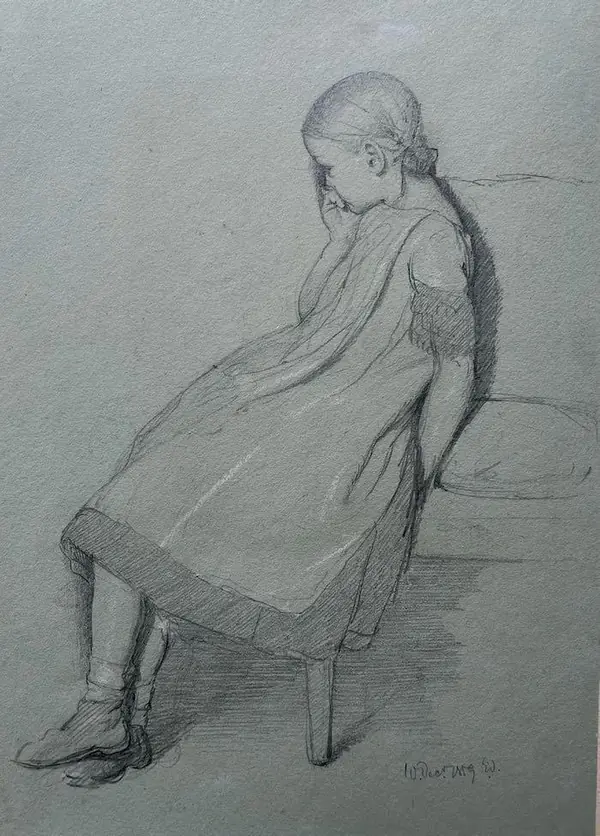
Subscribe to receive details of our new events, complimentary fair tickets and catalogues.


