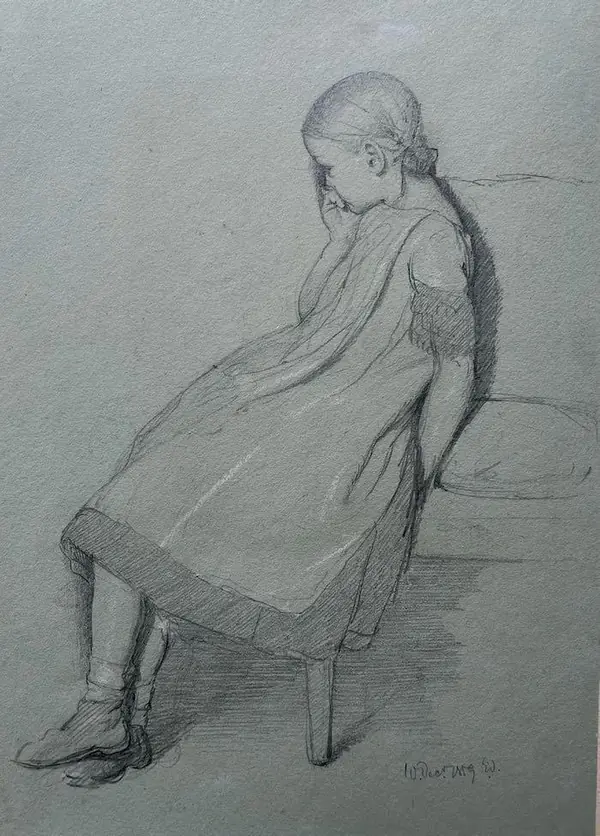
Pen and grey ink and watercolour over pencil
11 x 17.2 cm.; 4 ¼ x 6 ¾ inches
Provenance: Sotheby’s, London, 29 October 1964, lot 248; Ann Spokes Symonds, Oxford
Ann Symonds worked for the Fine Art Society in 1960s.
You Might Also Like

Thomas Rowlandson (1756-1827) A sheep in wolf’s clothing Pen and brown ink and watercolour over traces of pencil 17 x 14.2 cm.; 6 ¾ x 6 ½ inches Frame size 32.5 x 29 cm.; 12 ½ x 11 ½ inches Provenance The Leger Galleries Ltd., August 1961; Private collection U.K. until 2021 Exhibited The Leger Galleries Ltd, August 1961 This amusing, mildly erotic, drawing, which dates from c. 1805-1820, illustrates a subject which Rowlandson drew often throughout his career. The young beauty donning men’s clothes is clearly the dominant figure in the composition which shows an ageing man ogling the progress of her toilette from around the doorway and an old crone assisting her. There is ambiguity in the subject which may show an elopement or, more likely, an actress preparing for the stage. In late eighteenth century comedies an actress who dresses as a man to meet her lover is a frequent plot device. The present drawing may represent either such a scene or an actress in her dressing room putting on her costume in preparation for this. The bottle lends weight to the possibility of this being a theatrical subject which may be compared with the 1810 print ‘Dramatic demireps at their morning rehearsal’ which contains numerous bottles [link]. A further example of Rowlandson tackling a similar subject can be found in ‘dressing for a masquerade’ in the collection of the Barber Institute [link], a subject after which a print was made in 1788, ‘Cyprians; Dressing for a Masquerade’.
View details
Inscribed l.l.: TRENANT SIR E. BULLERS., pen and grey ink and watercolour over traces of pencil 14 x 23.3 cm; 5 ½ x 9 1/8 inches Provenance J.A.D. Bridger, his sale at Sotheby’s London, 24 January 1951, lot 150; bought by Thomas Agnew & Sons Ltd.; H.M. Langton; Spink & Son Ltd., K3/1993; Exhibited Thomas Agnew & Sons Ltd., 80th Annual Exhibition of Water-colour Drawings (January – March 1953), no. 85 Rowlandson worked extensively in the West Country early in his career and made annual tours. He usually stayed with his friend and patron Matthew Michell, a banker, who had an estate at Hengar near Bodmin in Cornwall. Sir Edward Buller, 1st Baronet (24 December 1764 – 15 April 1824) was an officer in the Royal Navy who served during the American War of Independence, and the French Revolutionary and Napoleonic Wars. He was MP for East Looe in Cornwall from 1802-1820. He lived at Trenant Park in East Cornwall.
View details
Thomas Rowlandson (1757-1827) Soldiers on parade, France Pen and grey ink and watercolour over traces of pencil, inscribed: Depot de Gardes Françoise 14.4 x 23.4 cm.; 5 33/4 x 9 ¼ inches Provenance Richard Green Ltd Rowlandson frequently painted military subjects and here he draws English soldiers standing to attention while passers-by walk past unperturbed carrying on their daily activities. The dépôt de Gardes françaises was the Parisian barracks for the elite regiment of troops which protected the French Royal family and was disbanded in 1789 when the soldiers joined the Revolutionary troops.
View details
Pen and grey ink and watercolour and pencil 27.4 x 43.1 cm.; 10 3⁄4 x 17 inches Provenance Christie’s, London, 21 November 2002, lot 20; where bought by the previous owner; Private collection, U.K., until 2022 The present work is a significant example of Rowlandson’s landscape draughtsmanship. It probably dates from the same time as a smaller view of Glastonbury showing the abbey from the main street and marketplace of the town in the collection of the Victoria & Albert Museum (Dyce Collection) which was etched by the artist as plate 24 of Rowlandson's World in Miniature, No. 2, 1816. Rowlandson has used a certain amount of artistic license in his interpretation of the topography.
View details
Pen and brown and grey ink and watercolour over traces of pencil, bears inscription and date 22 x 36 cm.’ 8 ½ x 14 1/8 inches Provenance Maurice Dear, Southampton; Private collection, U.K., until 2025 Rowlandson drew boating scenes such as this one on many occasions, this work probably dates from c. 1810-1820. The river is teeming with a variety of craft and passengers and the nearby pub doing a roaring trade.
View details
Stamped with studio stamp l.r. and inscribed: Venice, watercolour 15 x 23.5 cm.; 5 7/8 x 5 ½ inches, framed size 32 x 39 cm.; 12 1/2 x 15 1/4 inches From an album of watercolours by the artist. Johnson was born in Birmingham where he studied under Samuel Restell Lines. He was then a pupil of William James Müller in London from circa 1842/3-1845, accompanying him to Lycia at the time of Sir Charles Fellowes’ expedition in 1843. The artists travelled for around eight months, spending time in Xanthus, Pinara and Tlos before going to to Rhodes and Smyrna and presumably visited Venice at this time. Johnson, like Müller, continued to work on subjects from this trip after his return to England. On Johnson’s return to London, he became a founder member of the Clipstone Street Academy, along with Müller, participating in its life drawing and painting sessions with a variety of models from the streets. Johnson made sketching trips with David Cox to North Wales from 1844. The artist was elected an associate member of the R.I. in 1868 and a full member two years later. His work can be found in many museum collections, including the British Museum, Victoria & Albert Museum and the Fitzwilliam Museum.
View details£ 2,750

Signed with initials l.r., pen and brown ink 14.5 x 12 cm.; 5 ½ x 4 ¾ inches Provenance: Mrs F.L. Evans; With Colnaghi, 1951, catalogue no. 59 Duncan Beresford-Jones until 2000 The Shah of Persia presented a group of Arabian horses to the Prince Regent, commemorated in a painting of 1819 by H.B. Chalon (Tate Britain, TO2357). Landseer was also attracted to the subject and two versions of oils of an Arabian stallion with an Attendant in Persian dress are known, see Richard Ormond, Sir Edwin Landseer, 1982, p. 54. The Shah sent an Ambassador, Mirza Abdul Hassan Shiraz, to London in 1819 to discuss with Lord Castlereagh, the Foreign Secretary, aspects of the Anglo-Persian treaty concluded by Sir Gore Ouseley in Tehran in 1812, and more recently revised. That treaty had established an Anglo-Persian alliance against a possible Franco-Russian one and the Shah was hoping for positive assurances that England would protect Persia in the event of a Russian invasion. The Ambassador left Tehran in October 1818 laden with presents from the Shah, including eighteen selected Arabian horses for the Prince Regent. The horses travelled with the Ambassador to Constantinople and then the British government organised their transport to London, an expensive undertaking arranged by a Mr George Willcox and costing over £1500. The presentation of the Shah’s gifts was listed in The Times of 24 May and took place at Carlton House, the Prince Regent’s London residence. There are seven horses pictured in Chalon’s painting, and it is not known how many of them survived the journey, but the present drawing presumably shows one of them. Mirza Abdu Hassan Shiraz’s visit aroused considerable social and popular attention but the visit was not a success, as following the defeat of Napoleon and the conclusion of an alliance with Russia the British no longer attached much importance to their Persian alliance.
View details
Signed l.l.: John, pencil and black chalk 45.5 x 30.5 cm.; 17 7/8 x 12 inches Provenance Lady Hornby (1934-2021) Exhibited Augustus John, Olympia, 23-28 February 1999, no. 61 (no catalogue) This freely drawn, captivating drawing dates from c. 1904-1906. It epitomises the qualities of John’s fluent draughtsmanship and his ability to capture the essence of a sitter with apparent ease. Its immediacy, sureness and simplicity place it amongst his finest female portraits. Sheran Cazalet was the daughter of Peter Cazalet, Queen Elizabeth, the Queen Mother’s, racing trainer. Her grandparents, William and Maud Cazalet, were friends of Augustus John. She married Sir Simon Hornby in 1968. He was the last family member to serve as chairman of WH Smith and served as chairman of the Design Council; he died in 2010. The couple lived at The Ham, Oxfordshire, where they assembled a collection of twentieth century works on paper, created a beautiful garden and entertained in style. Many of the contents of The Ham were sold at Christie’s, London, in 2012.
View details
Watercolour over pencil 20.5 x 38 cm.; 8 1/8 x 15 inches Provenance Walter Coleridge Richmond (1852-1931), the son of the artist, by descent; With Radnorshire Fine Art Richmond continued to draw and paint landscapes throughout his successful career as a portraitist. These works remained private and stayed mainly in his family. This beautiful sketch has a directness which reflects his enjoyment of the opportunity for contemplation when drawing from nature.
View details
Signed, inscribed and dated l.r.: Cave on the Island/of Elephanta/Dec 9th. 69 and further signed by another, watercolour over pencil. The artist visited the famous Hindu temple carved into the rockface on the island of Elephanta. Constructed between the fifth and sixth century, the temple is part of the ‘City of Caves’ devoted to the cult of Shiva. For further work by this artist please see the catalogue link and enquire about availability.
View details