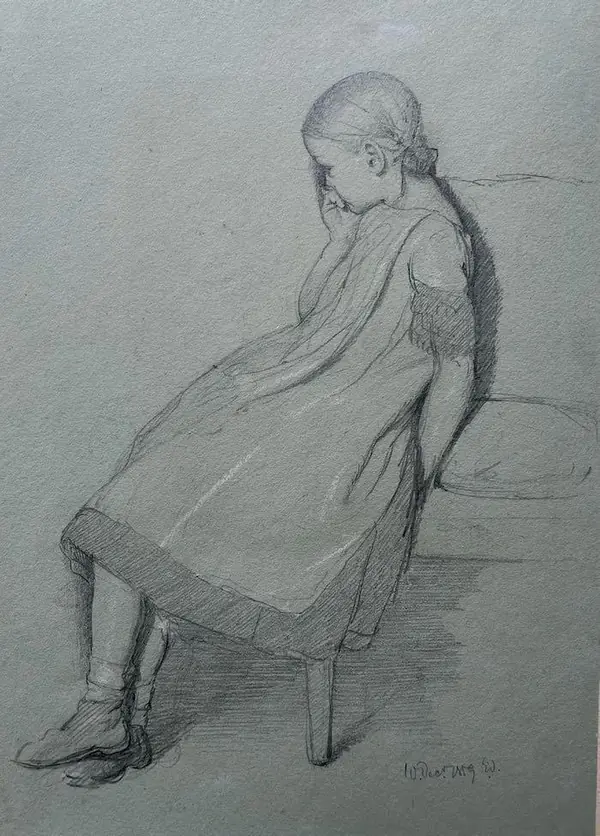
Signed with initials l.l., watercolour over pencil with touches of bodycolour on grey paper 17 x 26 cm.; 6 ¾ x 10 ¼ inches Exhibited Leger Galleries, London, November 1973; Private collection U.K. until 2022 The second son of Hercules Sharpe, the artist was educated at Harrow. After leaving Cambridge where he read Maths he decided to become an artist and studied in Rome for three years. On the death of his elder brother he inherited the Brabazon estates (and name) in Ireland. He spent his summers in England and his winters travelling in Europe and, from the 1860s, further afield. The artist visited India three times, in 1870, 1875 and 1876. In 1891 Sargent persuaded him to have an exhibition at the Goupil Gallery and, as a result, in his old age he was at the forefront of the modern movement.
View details9 items
India
British 18th, 19th and early 20th century landscape and portrait watercolours, drawings and paintings of India and its flora and fauna and works by Indian artists. The gallery specialises in historical material created at the time of the East India Company and has a particular interest in the work of native artists working in the European style.


KT582 Extensively inscribed in the artist’s shorthand, pen and brown ink, stamped verso with collector’s mark 14 x 20 cm.; 5 ½ x 8 inches Provenance Sir Bruce Ingram, OBE, MC (1877-1963), L. 1405a.; Michael Appleby of St James’s, by descent until 2023 The extensive shorthand reads: [upper left] ‘Masula boat leaving with water carried to ships in the roads /’, [upper right] ‘The sky… / … not out’, ‘The wet foam of the surf The light part of the picture / ‘, [lower left]; ‘Sand’; [lower right] ‘This part not the surf Boat all wet / all the figures reflected in stronger /The colour is to(o) ex... the same as the sea’. There was no harbour at Madras at this time so the masula boats had to row a long distance out from the shore to the Indiamen anchored out in the ‘roads'. The figures are a combination of boatmen and women with waterpots on their heads, loading the boat with water for the ships. The flat-bottomed masula boats, made from planks of mango wood sewn together with coconut fibres, were used to row passengers to and from the ships as well as for supplies. During the western monsoon season at the end of the year the surf could be quite violent and if the flag on the flagstaff of Fort St. George was lowered, ships were unloaded of cargo or passengers at their own risk. Chinnery arrived in Madras in 1802 and was to stay for four and a half years. The lively draughtsmanship shown in the present drawing is typical of his style at this period. Sir Bruce Ingram was a journalist and editor of ‘The Illustrated London News’ from 1900. He was particularly interested in marine drawings and collected over three thousand, including over six hundred drawings by the Van de Velde. For further information about his collecting see Luke Herrmann and Michael Robinson, 'Burlington Magazine', May 1963, 'Sir Bruce Ingram as a collector of drawings'.
View details
William Wallace Collett-Mason (1895-1957) A young Indian man in military uniform and a turban holding a bayonet Pencil, black chalk and watercolour 57 x 36 cm.; 22 ½ x 14 ¼ inches This work was most probably drawn in the Jhelum area of the Punjab, now in Pakistan, near the border with Kashmir. From May 1921, Jhelum hosted the 10th Battalion of the newly reorganised 1st Punjab Regiment. The subject may be a soldier or a member of the Balochistan police force. His turban is in the style of the "Kulla Wali Pagh" which includes a "Cone Cap", which was worn by Punjabi Muslims. Head and shoulders portrait in profile of Supharas Khan from Jhelum with a comb in his hair Pencil and black chalk, with a sketch of his torso verso 56.5 x 35.5 cm.; 22 ¼ x 14 inches The sitter Supharas Khan came from the Jhelum area of the Punjab, now in Pakistan, near the border with Kashmir. Head and shoulders portrait of Supharas Khan, wearing a shirt and with a comb in his hair Inscribed l.l.: Subharas Khan. 26/Punjab. From jelhum, pencil, with a sketch l.l. 56.5 x 35.5 cm.; 22 ¼ x 14 inches The sitter is drawn from the front. The Jhelum area of the Punjab is now in Pakistan, near the border with Kashmir. From May 1921, Jhelum hosted the 10th Battalion of the newly reorganised 1st Punjab Regiment. Head and shoulders portrait of Supharas Khan, wearing a shirt with a comb in his hair Inscribed l.l: S, pencil 56.5 x 35.5 cm.; 22 ¼ x 14 inches Portrait of a young Indian man wearing a turban Signed l.r.: COLLET-MASON -, pencil 56.5 x 35.5 cm.; 22 ¼ x 14 inches Provenance By descent in the family of the artist until 2025
View details
Watercolour over traces of pencil heightened with gum arabic and stopping out 12.7 x 21.2 cm.; 5 x 8 2/8 inches Provenance Martyn Gregory Fine Art This colourful watercolour dates from 1833-4 and is based on a sketch made on the spot by Commander Robert Elliot, R.N. (1790-1849) in the early 1820s. Several professional watercolour artists copied his sketches, amongst them Thomas Shotter Boys, David Cox, William Purser, Samuel Prout and Clarkson Stanfield, and their watercolours were engraved and published in 1834-5 as Views in India, China, and on the Shores of the Red Sea. The present watercolour was not engraved, but other views made for this series by Cotman are in the collection of the Victoria and Albert Museum, London and the Harris Museum and Art Gallery, Preston. The Elephanta Caves, on Elephanta Island off Mumbai are a UNESCO World Heritage Site, famous for their rock-architecture and carvings. This watercolour is taken from inside the most famous cave.
View details
Signed, inscribed and dated l.r.: Cave on the Island/of Elephanta/Dec 9th. 69 and further signed by another, watercolour over pencil. The artist visited the famous Hindu temple carved into the rockface on the island of Elephanta. Constructed between the fifth and sixth century, the temple is part of the ‘City of Caves’ devoted to the cult of Shiva. For further work by this artist please see the catalogue link and enquire about availability.
View details
This group of nineteen distinctive depictions of fruit and vegetables from South-East Asia are inscribed with titles in Indian English (possibly in Romanised Hindi) and drawn on European laid paper which is variously watermarked. There are three different numbering systems on the sheets. Many of the fruit and vegetables, such as the durian, are more commonly found in South-East Asia rather than on the Indian subcontinent, suggesting that it is possible that the drawings may have been made for a European patron in South-East Asia. Stylistically the drawings have many of the characteristics of the ‘Straits School’, a hybrid Indo-Chinese style. The accumulation of natural history drawings by officials of the British East India Company gave rise to the term ‘Company School’, now out of favour, which has been used to describe the work of Indian or Chinese artists for British patrons. The distinctive style is a result of a fusion of two artistic traditions, the European with its desire for realism and the Asian taste for a more stylised approach. The work of Chinese artists is rarer than that of Indian artists and tends to be a little later in date. British patrons commissioned local artists to draw the flora and fauna of India and other areas of South-East Asia. Such work is typically annotated with botanical notes in native script, romanised versions of native descriptions, Latin and with reference to the Linnaean system of classification, created by Carl Linnaeus (1707-78). The eighteenth and early nineteenth century saw an enormous rise of interest in Europe in the study of natural history by both scientists and amateurs. A knowledge of the subject was considered to be an important part of a liberal education and many people studied ‘natural philosophy’ and the various branches of natural history. Accurate drawings were vital tools in classification as well as a reminder of the excited reaction to new discoveries being made all over the known world. The collecting of specimens was the basis of most natural history drawings, plants were pressed and dried and the drawings recorded the specimen in its living shape and colours. This group of fruit and vegetables are found in various parts of South-East Asia. Some are common others are less well known. The collection is presented mounted in a hand-made solander box. Brinjala (Aubergine) Inscribed l.r.: Brinjala and numbered ninety-five, N106 and 96, watercolour, bodycolour and gum arabic on wove paper 31.7 x 20.5 cm.; 12 ½ x 8 1/8 inches Aubergine is known as brinjal in South-East Asia. Mangosteen Inscribed l.r.: mongostan, numbered ninety-seven. N 97 and 101, watercolour and gum arabic on laid paper watermarked IFD 31.7 x 20.5 cm.; 12 ½ x 8 1/8 inches Mangosteens grow in South East Asia, particularly in Indonesia. It is a juicy, slightly acidic fruit and it is also used in traditional medicine. Ratahouli (pepper) Inscribed l.c.: Ratahouli, numbered ninety-five, N107 and 1010, watercolour and gum arabic on laid paper watermarked HIS/GD 33 x 23 cm.; 13 x 9 inches Cashew Inscribed Rajab, numbered ninety-eight, N109 and 1012, watercolour and gum arabic on laid paper 33 x 23 cm.; 13 x 9 inches The cashew tree is a tropical evergreen tree that produces the cashew seed and the cashew accessory fruit. The nut can be seen growing from the bottom of the fruits in the drawing, both green and then brown once it has ripened. Jambu Air (Szygium Aqueum) Inscribed l.c.: jambol, numbered A Hundred, N111 and 1019, watercolour and gum arabic on laid paper watermarked HIS 33 x 23 cm.; 13 x 9 inches This is a special of the brush cherry tree; its common names include watery rose apple and bell fruit. Chilli Inscribed l.r.: fjoli, numbered ninety-one, N100 and 105, watercolour and gum arabic on laid paper watermarked with a crest 33 x 23 cm.; 13 x 9 inches Pomegranate Inscribed l.r. ramangh, numbered A hundred and three, N114 and 1019, watercolour and gum arabic on laid paper watermarked HIS 33 x 23 cm.; 13 x 9 inches Papaya Watercolour and gum arabic inscribed l.r. papaya, numbere ninety-nine, N100 and 1013, on laid paper watermarked with a crest 32.5 x 23 cm.; 12 ½ x 9 inches Durian Inscribed l.r.: doorian, numbered eighty-five, N94 and 96, watercolour and gum arabic on laid paper 32.7 x 23 cm.; 12 ¾ x 9 inches The durian, with its spiny outer shell and moist, pungent flesh can weigh up to seven pounds. These large fruits grow on trees, have a short period of ripeness and their cultivation is difficult. The durian is famously not allowed on public transport in Singapore on account of its unpleasant smell. Lobed tropical tomato Inscribed l.r.: samati, numbered ninety, N100 and 109, watercolour with touches of gum arabic on laid paper 32 x 21 cm.; 12 ½ x 8 ¼ inches Berlimbing Inscribed l.r.: blinbingh, numbered A hundred and two, N113 and No 16, on laid paper watermarked HIS 33 x 23 cm.; 12 ¾ x 9 inches Berlimbing, also known as bling bling or berling berling, is a sour fruit used in curries. Buah Chiku (Sapodilla, Chikoo, Sapota or Naseberry) Inscribed l.r.: boa sawa, numbered ninety-three, N104 and 104, watercolour and gum arabic with touches of bodycolour on laid paper partially watermarked with the Strasburg Lily 33 x 23 cm.; 13 x 9 inches This appears to be Buah Sawo or Chiku, but the identification of this plant is open to question. Ban Branjahr (?) Inscribed l.r.: Ban Branjarh (?), numbered eight eight, N90 and 102, watercolour, bodycolour and gum arabic on laid paper, watermarked 31.7 x 20.5 cm.; 12 ½ x 8 1/8 inches This plant has not been identified. Lotus Inscribed l.c.: Fratil, numbered ninety-seven, N108 and 1011, watercolour and gum arabic, watermarked with a crest 33 x 23 cm.; 13 x 9 inches This drawing shows the lotus head with seeds after it has flowered. It is the seed of plants in the genus Nelumbo and the seeds are used in Asian cooking and traditional medicine. Melon (probably watermelon) Inscribed l.r.: patuka, numbered ninety-two N103 and 106, watercolour and gum arabic on laid paper 33 x 23 cm.; 13 x 9 inches Mango Inscribed l.r.: Manga, numbered A Hundred and one, N112 and 1015, watercolour and gum arabic 31.7 x 20.5 cm.; 12 ½ x 8 1/8 inches Longan Inscribed l.r.: froita lanja, numbered eight nine, N99 and 103, watercolour and gum arabic on laid paper watermarked with a crest 32.2 x 21 cm.; 12 ½ x 8 ¼ inches Rambutan Inscribed l.r.: frouita kafri, numbered eighty-six, N96 and 100, watercolour and gum arabic 32 x 21 cm.; 12 ½ x 8 ¼ inches Buah Gowok (Syzgium polycephalum) Inscribed l.r.: rambutan and numbered eighty-five, watercolour and gum arabic and pencil on laid paper 31.7 x 20.5 cm.; 12 ½ x 8 1/8 inches
View details
Signed with monogram l.r., inscribed l.l.: near Calikut., watercolour heightened with touches of bodycolour Provenance Franklin Lushington (1823-1901) and thence by descent Lear was invited to India by his friend and patron Lord Northbrook who was appointed Viceroy in 1871, and his journey there was the last and longest of his life. He was overwhelmed by the colour and vitality of India and enjoyed the bustle of Viceregal life. Calicut, or present-day Kozhikode, is on the Malabar coast in Kerala and was a centre of the Indian spice trade. Edward Lear arrived there in October 1874, just as the monsoon began. He was warned about the dangers of contracting fever but stayed, despite the pouring rain, until the skies were clear enough to draw. He described the roads around the city as “of such redundant beauty one can hardly dream.” Franklin Lushington, Lear’s close friend and first owner of this drawing, was the son of Edmund Henry Lushington. He was appointed judge to the Supreme Court of Justice in the Ionian Islands in 1855 and Lear went with him to live in Corfu. They first met in Malta in 1849, where Franklin’s elder brother Henry was Chief Secretary to the government. On his death, Lear left all his papers to Lushington, who later destroyed most of them.
View details
Signed and dated in gold paint l.l.: Geo Richmond.1834, watercolour over pencil heightened with white and gold and touches of gum arabic 35.3 x 25.1 cm.; 13 ¾ x 9 7/8 inches Provenance By descent in the family of the sitter until 2015; Their sale, Bonhams, London, 24 November 2015, lot 95; Private collection, U.K. Literature R. Lister, George Richmond A Critical Biography, 1981, p. 162, nos. 203 and 204 The sitter wears the uniform of the Madras Horse Artillery, and the Order of the Bath Companion’s breast badge, and is standing in an Indian landscape with his hand upon a cannon. Lieutenant Colonel Sir Charles Hopkinson was born on September 14th, 1783, in Grantham, Lincolnshire. He had a distinguished career in the service of the East India Company and commanded the Company's artillery during the First Anglo-Burmese War (1824-1826). He was made a Companion of the Most Honourable Military Order of The Bath and subsequently knighted for his services. He died in December 1864. The Madras Army was the army of the Presidency of Madras and run by the East India Company until 1858. It was finally merged into the Indian army in 1895. After his marriage to Julia Tatham in 1831 George Richmond turned to portrait painting. He quickly established a fashionable painting practise and became one of the most fashionable portrait painters of his time.
View details
Two, bodycolour, one on paper watermarked: SMITH & ALLNUTT 1815 Each 20.5 x 33.5 cm Provenance: Mrs Baldock The artists of the Patna School specialised in the depiction of everyday activities for their British patrons. Traditionally described as the work of the Company School (reflecting the patronage of the East India Company employees) this unique genre evolved as the painting styles of Western and Mughal traditions merged.
View details