
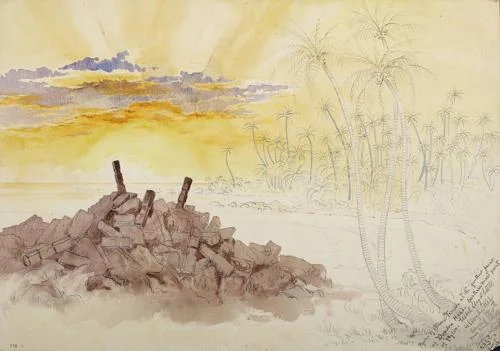
Signed, inscribed and dated l.r.: Ruins of the Temple at the furthest/point of Dondra Head. Southernmost point/of Ceylon. CFGC./Nov 7th/1873, and signed by Isabel Lloyd Hill, H Lloyd Hill, Edward Elliott, Mary Emily Elliott, and various others, numbered l.l.: 138A. watercolour and pencil 35.5 x 50.5 cm.; 14 x 19 ¾ inches This was one of many beautiful sunsets witnessed by the artist in Ceylon. Dondra is on Sri Lanka’s south coast, east of Matara.
View details123 items
Landscapes
British 18th, 19th and early 20th century works on paper depicting landscapes by leading artists of the golden age of British watercolour from Paul Sandby to Edward Lear and interesting examples by amateur artists of the period with a particular interest in rare views by artists who travelled widely. The gallery only handles works on paper in excellent condition.
Use arrow keys to navigate, Enter to select, Escape to close
Artist A-Z
Artist Z-A
Random
Recent Items
Title A - Z
Title Z - A

Oil on paper laid down on canvas 15.1 x 21.6 cm.; 6 x 8 ½ inches Frame size 25.5 x 32 cm.; 10 x 12 ½ inches Engraved By the artist as a lithograph on chine collé, printed by Charles Motte, 1828, plate 8 Newton Fielding produced a series of lithographs of mammals which were printed by Charles Motte in 1828. The artist was the youngest son of portrait painter Nathan Theodore Fielding. From 1827 to 1830 he lived in Paris, where he ran the family engraving business, at which William Callow worked. He was closely associated with the Anglo-French circle of artists centred around Bonington and Delacroix. He collaborated with his brothers Thales and Theodore in England before returning to France where he built up an extensive teaching practice, with pupils including members of the family of King Louis- Philippe. He published a number of teaching manuals and lived in France until his death.
View details
Numbered l.c.: 28, watercolour over traces of pencil 20.5 x 26.5 cm.; 8 x 10 ½ inches The Italian artist, born in Cremona, settled in England in 1803, having travelled in Greece and Egypt with William Wilkins, R.A. His work has often been confused with that of Constable, particularly his coastal views which look quite similar. Examples of his work may be found at the British Museum, the V&A, Brighton Art Gallery and in several other museum collections.
View details
Inscribed and dated l.l.: Ponte Nomentano. June 21st. Rome, watercolour over pencil, stamped with Michael Ingram’s collector’s mark on old mount 12.5 x 17.5 cm.; 4 7/8 x 6 7/8 inches, framed size 27 x 32 cm.; 10 1/2 x 12 1/2 inches Provenance Bought in Bath by Michael Ingram, his sale at Sotheby’s 8 December 2005, lot 236, where bought for a princely collection in the Middle East until December 2024 Roberts visited Rome and Naples in 1853. He greatly enjoyed Rome and produced many drawings and oil paintings as a result of his stay. The bridge was erected at the point where the via Nomentana crossed the Aniene river, a tributary of the Tiber, at the foot of Monte Sacro. Roberts drew the large travertine arch and the medieval crenelated fortification. Restored several times over the centuries, it was much painted by visiting artists. Michael Ingram inherited his passion for collecting drawings from his uncle Sir Bruce Ingram, OBE, MC (1877-1963, L. 1405a) and modelled his collector’s mark on that of his uncle.
View details£ 5,200
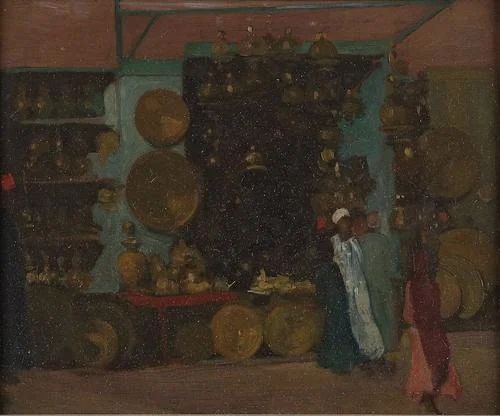
Oil on panel 22 x 27 cm.; 8 ¾ x 10 5/8 inches Provenance The artist’s widow, Lady Kelly; Michael Parkin Fine Art Ltd; From whom purchased by J.G. Cluff, private collection U.K. until 2022 Born in London of Irish descent, Kelly was educated at Cambridge University, later living and studying art in Paris where he met Degas, Monet, Renoir and Sickert. Whistler was also an early influence as were Cézanne and Gaugin. Kelly was an enthusiastic traveller, visiting many countries from Egypt to China. His sketches of his travels are pleasingly spontaneous and tend to be painted more freely than his finished portraits. He became a successful society portraitist whose sitters included Somerset Maugham, whom he painted several times, and he undertook numerous state portraits. Kelly is represented in many public collections, including the Tate, which holds seven works. He had retrospective exhibitions at the Leicester Galleries in 1950 and in 1957 at the RA. He was elected RA in 1930, was the Academy's Keeper from 1943-45 and President, defeating Augustus John in the election, from 1949-54. Kelly held a number of official positions, such as membership of the Royal Fine Arts Commission, 1938-43, and was knighted in 1945. Between 1909 and 1970 Kelly exhibited over 300 works at the RA. During his lifetime his work became well known through popular prints.
View details
Extensively inscribed and dated in pencil and in pen and brown ink: Quarries of Assouan AM 11.30- 1 PM January 27.1867 all one color [sic] pinky drab oker [sic], numbered (242) and with further colour notes, pen and brown ink and watercolour over pencil heightened with white 29 x 53 cm.; 11 3/8 x 20 ¾ inches Provenance Mrs R.K. Judges; The Fine Art Society, January 1993, where bought by Martin Davies (1924-2023) This beautifully drawn watercolour dates from Lear’s second trip up the Nile and his third visit to Egypt in the winter of 1866-1867, when he travelled with his Canadian cousin, Archie Jones. The men met in Luxor and visited Esneh, Edfu and Denderah, and had reached Philae by the end of January. Lear found his cousin irritating due to his habit of whistling and his lack of enthusiasm for the temples. It was nevertheless a productive trip for the artist, who made many drawings. He was particularly interested in the country between the First and Second Cataracts which was new to him. Another drawing from this trip dating from 30 January of the first Cataract is numbered 267 (formerly in the collection of Dayton International), indicating that he produced twenty-five drawings in 3 days. He wrote to Lady Waldegrave on 9th March 1867 that the Nubian desert was, ‘a sad, stern, uncompromising landscape, dark ashy purple lines of hills, piles of granite rocks, fringes of palm, and ever and anon astonishing ruins of oldest temples’ (Vivien Noakes, Edward Lear: Selected Letters, London, 1988, pp. 208-209). This detailed view accurately depicts the ancient granite quarries at Aswan mined by the ancient Egyptians. A line of unfinished carved granite can be seen lying in the sand in the background. When the construction of the Aswan Dam began in 1960, it became apparent that the ancient temples and surrounding area would be submerged and destroyed by the rising waters of the newly created Lake Nasser. UNESCO led an international fund-raising campaign to relocate them to higher ground by 1968. Martin Davies (1924-2023) was the President of the Egypt Society of Bristol, who visited and photographed the second cataract twice in 1960s before the Aswan Dam was moved. He amassed an interesting collection of views of Egypt.
View details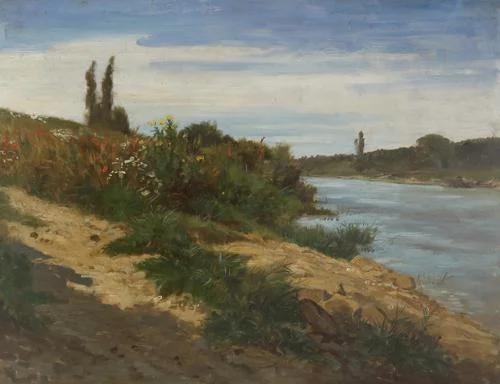
KT454 August-Paul-Charles Anastasi (French 1820-1889) Berge et rivière, neuve Bougival, France Oil on board, inscribed with title on artist’s studio sale label attached to verso: Berge et riviere/neuve Bougival, with artist’s seal 27 x 35.5cm.; 10 5/8 x 14 inches Provenance The artist’s studio sale, Durand-Ruel, 3-8 March, 1873, no. 203; Private collection, France until 2021 Bougival is a small town on the Seine to the west of Paris, popular with 19th century painters.
View details£ 3,500

Watercolour over pencil 14.8 x 22 cm.; 8 x 8 ¾ inches Provenance Iolo Williams (1890-1962) The Italian artist, born in Cremona, settled in England in 1803, having travelled in Greece and Egypt with William Wilkins, R.A. His work has often been confused with that of Constable, particularly his coastal views which look quite similar. Examples of his work may be found at the British Museum, the V&A, Brighton Art Gallery and in several other museum collections.
View details£ 950

KT453B Inscribed and dated in pencil verso: Tring Hill/ 1791, oil on paper 12.8 x 19 cm.; 5 1/16 x 7 ½ inches Frame size 29 x 34 cm.; 11 1/4 x 13 ¼ inches Provenance Mr Nicholson, Oxford, until 1942, when acquired by Edward Croft-Murray, CBE, (1907-1980); Jill Croft-Murray until 2020; Woolley and Wallis, The Edward Croft-Murray Collection, 11 August 2021, lot 421 This spontaneous oil sketch originally came from an album of oil sketches from nature, executed in 1790s and assembled by the artist for his own pleasure, inscribed ‘Studies from nature by G. Garrard’. Five further examples of his oil sketches of locations in and around London are in the collection of Tate Gallery.
View details
Inscribed l.l.: TRENANT SIR E. BULLERS., pen and grey ink and watercolour over traces of pencil 14 x 23.3 cm; 5 ½ x 9 1/8 inches Provenance J.A.D. Bridger, his sale at Sotheby’s London, 24 January 1951, lot 150; bought by Thomas Agnew & Sons Ltd.; H.M. Langton; Spink & Son Ltd., K3/1993; Exhibited Thomas Agnew & Sons Ltd., 80th Annual Exhibition of Water-colour Drawings (January – March 1953), no. 85 Rowlandson worked extensively in the West Country early in his career and made annual tours. He usually stayed with his friend and patron Matthew Michell, a banker, who had an estate at Hengar near Bodmin in Cornwall. Sir Edward Buller, 1st Baronet (24 December 1764 – 15 April 1824) was an officer in the Royal Navy who served during the American War of Independence, and the French Revolutionary and Napoleonic Wars. He was MP for East Looe in Cornwall from 1802-1820. He lived at Trenant Park in East Cornwall.
View details
Signed l.l.: Louise Rayner, watercolour over pencil heightened with bodycolour and gum arabic 46.5 x 33 cm.; 18 3/8 x 13 inches The artist was born in Matlock Bath, Derbyshire, the daughter of Samuel and Ann Rayner who were both professional artists. The most talented of six children, who all worked as artists, Louise studied painting from the age of fifteen, first with her father, and subsequently with George Cattermole, Edward Nieman, David Roberts and Frank Stone. She specialised in watercolour and her streetscapes capture the flavour of city life in 1870s and 1880s and are architecturally detailed. In 1851, when Louise was ten, the family moved to London and, except when travelling, she spent much of her life there. She would often accompany her architect brother Richard on his business trips and paint . As a result, Louise was widely travelled, both in Britain and in northern France. She most enjoyed visiting old cathedral cities and market towns, and is acclaimed for her views of Chester, London, Hastings, Tewksbury, Warwick, Edinburgh, Wrexham, Shrewsbury as well as Salisbury. By 1865 she had moved to Chester where she spent many years working and teaching painting. She lodged at the home of Robert Shearing (who owned a chemist's shop in Watergate Street) and his wife Mary Anne at 2 Ash Grove, in what was then a secluded rural location outside the city. In 1910, she and her sister Margaret, who had lodged with her for a time in Chester, moved to Tunbridge Wells. When Margaret died, in 1920, Louise moved for the last time to Southwater Road, St Leonard's-on-Sea, Sussex, and died there on 8th October 1924, aged 92. She never married. For over half a century, Louise was a regular exhibitor at the Royal Academy, the Old and the New Watercolour Societies, the Society of British Artists, Suffolk Street Gallery, the British Institution, the Society of Female Artists, the Dudley Gallery, the Birmingham Society of Artists and the Walker Art Gallery, Liverpool. Her work can be found in many public collections including the Grosvenor Museum, Chester, the Russell-Cotes Art Gallery and Museum, Bournemouth, Derby Museum and Art Gallery and the Salisbury Museum.
View details
Watercolour over pencil heightened with bodycolour on thick cream paper 12.8 x 17.7 cm; 5 ⅛ x 7 inches Provenance: Frances Foster, the artist’s second wife. This delightful sketch is unusually spontaneous for the artist and shows the influence of John Ruskin. Huge skies are a frequent component of Birket Foster’s more finished watercolours.
View details
KT493 Watercolour over traces of pencil, inscribed in pen and dark brown ink verso: 58/Sketch Cozens (crossed out)/J. Varley 15 x 24.5 cm.; 6 x 9 5/8 inches Provenance C.L.N. Miles Esq; Spink (K3 7052); Private collection U.K. until 2021 This intriguing drawing has been attributed to John Robert Cozens and John Varley in the past. It bears a resemblance to one of Edward Dayes Icelandic subjects and can be compared with the view of Mount Hekla in the collection of Eton College https://catalogue.etoncollege.com/object-fda-d-183-2010 This drawing was probably based on an on-the-spot sketch of Iceland, made circa 1800-1810, as would have been the case for the view of Mount Hekla in the Eton collection. Hekla is one of Iceland’s most active volcanoes located in the south of the country. The influence of Girtin and Turner, can be seen in the treatment of the sky and the mountains, and is a resemblance to the work on which Turner and Girtin collaborated has been suggested. Stylistically the lower half of this work seems to look back to the blot techniques of Alexander Cozens. I am grateful to Ian Warrell and Greg Smith for their comments on this drawing.
View details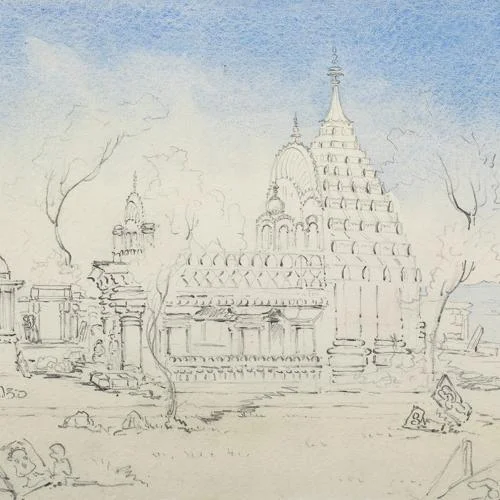
Hindoo Temple, Jubblepore (Jabalpur) Inscribed and dated l.l.: Hindoo Temple/built before the Christian Era/at the Marble Rocks/Jubblepore-/Nov. 30th/69, pencil with watercolour 17 x 35 cm.; 6 ¾ x 13 ¾ inches This temple in Behdaghat, Jabalpur, is a Chausath Yogini Temple, dedicated to the worship of yoginis, specifically honouring female divinity. The circular wall surrounding the temple is decorated by 84 niches in which sculpted yoginis are visible. The artist encountered this impressive site en route to see the famous ‘Marble Rocks’ of the sacred Nerbudda river, In the Himalayas, p 596.
View details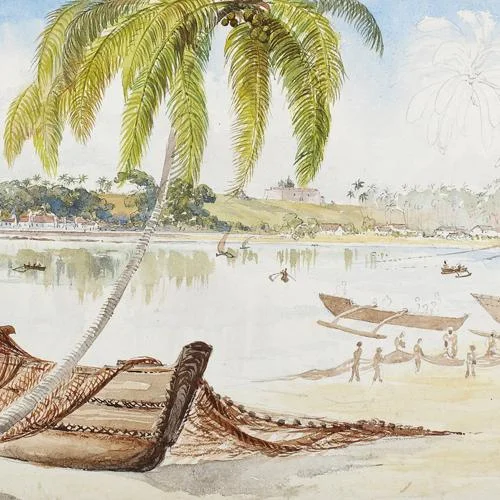
Tangalla (Tangalle) Signed, inscribed and dated l.r.: Tangalla/C.F. Gordon Cummming./Nov. 22nd 1873, and signed by J.H. Campbell, Isabell Lloyd Hill and H. Lloyd Hill, watercolour over pencil 25 x 75 cm.; 9 ¾ x 29 ½ inches The artist and her party visited the District Judge at Tangalle, ‘a hospitable Scotsman’ who lived in an old bungalow by the sea. Tangalle was ‘a pretty little seaside town’ about twenty miles away east of Matara, on Sri Lanka’s south coast, where the artist was staying. She writes about ‘the charms of that shore, with the quaintly-built canoes, with great outriggers and nets hung up to dry, and the picturesque groups of brown figures…’ Two Happy Years, p. 454.
View details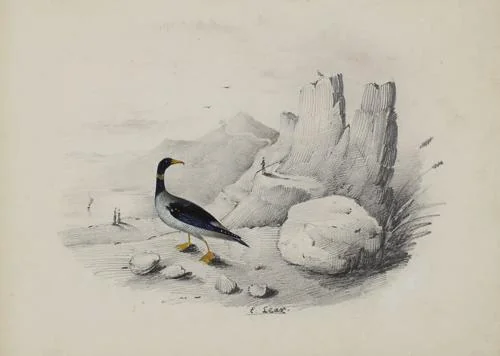
Signed l.c.: E. Lear, pencil with watercolour, pen and black ink and touches of gold 17.7 x 23 cm.; 7 x 9 inches These charming, quirky drawings are characteristic early works by Lear, dating from the late 1820s or early 1830s when he was establishing himself as an ornithological artist. They relate to a group of drawings which Lear gave to Mrs Godfrey Wentworth, who supported his employment by the Zoological Society in 1831, and whom he credited with launching him as an artist. They are imaginary, fanciful subjects drawn with not a little humour, resembling the stylised watercolours of birds painted on late eighteenth century porcelain. Robert McCracken Peck has made the interesting suggestion that Lear and his sister Ann may have been thinking of approaching ceramics companies with them (see Robert McCracken Peck, The Natural History of Edward Lear, 2016, pp. 27-9). Two surviving family albums from the late 1820s, containing a mixture of similar natural history subjects by Edward Lear and his sisters Ann and Sarah, are in the collection of the Houghton Library, Harvard University (MS Typ 55.4 and 55.27). Sir Edward Strachey was a man of letters and friend of Lear’s, who wrote an introduction to Nonsense Songs in 1895. He lived at Sutton Court, Chew Magna in Somerset and was a neighbour of Lear’s close friend Chichester Fortescue, the Liberal politician whom Lear first met in Rome in 1845.
View details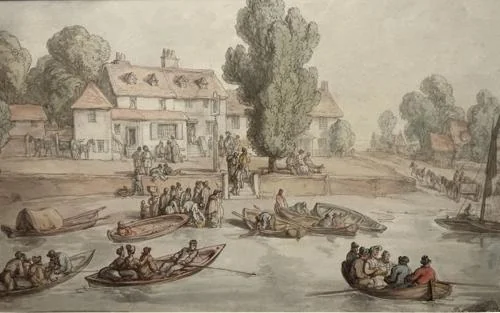
Pen and brown and grey ink and watercolour over traces of pencil, bears inscription and date 22 x 36 cm.’ 8 ½ x 14 1/8 inches Provenance Maurice Dear, Southampton; Private collection, U.K., until 2025 Rowlandson drew boating scenes such as this one on many occasions, this work probably dates from c. 1810-1820. The river is teeming with a variety of craft and passengers and the nearby pub doing a roaring trade.
View details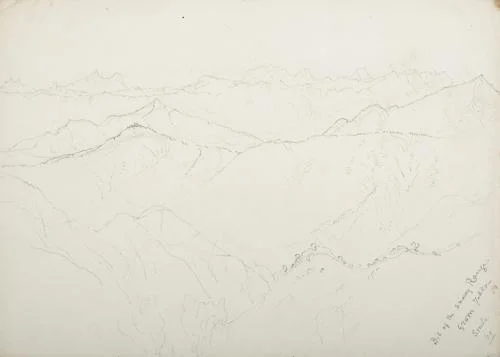
Bit of the snowy range from Yakko, Simla Inscribed and dated l.r.: Bit of the snowy Range/from Yakko-/Simla/69, pencil 26 x 36.2 cm.; 10 ¼ x 14 ¼ inches The artist, an intrepid mountaineer, noted her disappointment at the optical scale of this mountain range in her book In the Himalayas. She wrote of how ‘we had expected to find ourselves close to the snows’ and yet saw, ‘peaks of glittering snow, which seem only like crested waves on the sea-line.’ Nevertheless ‘after a while we learned to know and love each line of that picture,’ In the Himalayas, p 299.
View details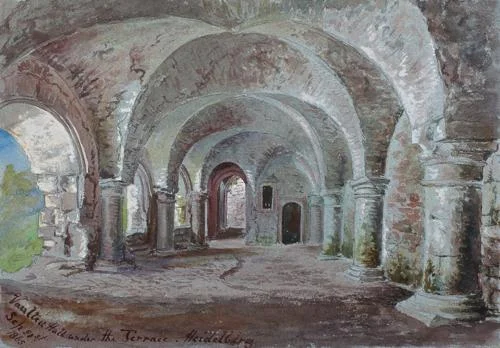
Vaulted Hall under the Terrace, Heidelberg, Germany Inscribed and dated l.l.: Vaulted Hall under the Terrace. Heidelberg/Sep 21st/1865, watercolour over pencil with bodycolour on blue paper 17.2 x 25.5 cm.; 6 ¾ x 10 inches Heidelberg Castle is one of the most important Renaissance buildings in Northern Europe. The residence of the Counts Palatine of the Rhine dates back to 1225 and was largely rebuilt in the sixteenth century. It was badly damaged by the French army in the course of the War of the Grand Alliance, or the Nine Year’s War (1688 - 1697), and was finally ruined by two devastating lightening strikes in 1764.
View details
Signed, inscribed and dated on original label attached to backboard: Dulverton.Somerset/JWA May 30 1800, pen and black ink and watercolour on wove paper 25 x 16.5 cm.; 9 3⁄4 x 6 1⁄2 inches Provenance H.L.Bradfer-Lawrence; Andrew Wyld, his sale at Christie’s, London, 10 July 2012, lot 57, where bought by the present owner Exhibited W/S Fine Art, London, Summer 2006, no. 13; W/S Fine Art, London, Summer 2009, no. 11 Abbott was one of the best amateur watercolorists of the late Eighteenth Century. A surgeon and apothecary, he lived in Exeter until 1825. He exhibited paintings at the Royal Academy from 1793, receiving contemporary acclaim for the style of his work. The artist John Downman said that ‘he prefers his drawings before his paintings, as they are done with more spirit’ (J. Farington, Diary 26 June 1804; vol. VI, p. 2362). In 1825 Abbott inherited Fordland, a Devon estate, from his uncle James White, an Exeter barrister, Nonconformist and close friend of Francis Towne. Abbott became a patron and pupil of Towne’s, and his linear style shows the artist’s influence. After moving to Fordland he devoted himself to drawing. Dulverton is in west Somerset, on the edge of Exmoor and just over the border from Devon. This view, little changed today, looks east from near the bridge over the river Barle. Harry Bradfer-Lawrence (1887-1965) was an antiquary and manuscript collector. From King’s Lynn, he became chairman of United Breweries in 1960.
View details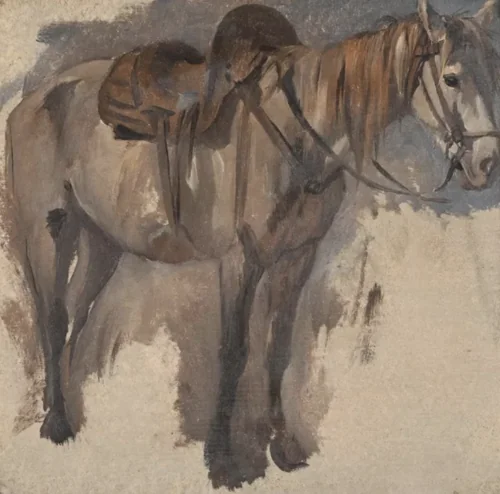
Oil on paper laid down on board, inscribed on reverse of board: George Mason ARA and stamped with a Christie’s stencil 21 x 21 cm.; 8 ¼ x 8 ¼ inches Provenance The artist’s studio sale, Christie’s, 15 February 1873, lot 91, where bought by George Dunlop Leslie, RA (1835-1921); his daughter Lydia Leslie, By descent to T. L. Twidell Exhibited Stoke-on-Trent Museum & Art Gallery, George Heming Mason, 1982, cat. no 20 (ill) (lent by T.W. Twidell). Exhibited George Heming Mason, City Museum & Art Gallery, Stoke-on-Trent, 1 May – 12 June 1982; Walker Art Gallery, Liverpool, 26 June – 31 July, The Fine Art Society, London 9 August – 4 September, cat. 20 (ill.) The sympathetic white horse is yoked in the Italian manner in this lively oil sketch and can be presumed to have been executed in Italy.
View details
KT499 Johann Jakob Wolfensberger (Swiss 1797-1850) The Temple of Olympian Zeus, with the Acropolis beyond and the Temple of Hephaistos, Athens A pair, the Hephaisteion signed and dated l.l.: Wolfensberger 1845, watercolour over traces of pencil with touches of gum arabic and scratching out Each 52 x 75.4 cm Provenance Private collection, U.S.A. until 2022 This pair of impressive watercolours are fine examples of the largest format used by the Swiss artist who made a contemporary name for himself as a result of his travels in Greece and the Ottoman Empire in 1840s. The temple of Zeus Olympios was begun in the Doric order in the sixth century BC under the Peisistradid tyranny but was discontinued after its fall. A new version in the Corinthian order was begun by Antiochos IV of Syria (175-164 BC). When it was completed around 300 years later, circa AD 131 – 2, in Hadrian’s reign, it was by far the biggest building in Athens. The brick structure upon the architrave of the two western columns of the middle range is supposed to have been built as an aerial retreat around 1209 by Nicholas de la Roche, the canon of Athens. It was removed circa 1870. The temple of Hephaistos, God of smiths and other crafts, was built on the edge of the Athens marketplace to celebrate the city’s powers in the arts and conceived as a sister temple to the Parthenon. Built in the Doric order it is attributed to an unknown architect working circa 450-430 BC. Born near Zürich, Johann Jacob Wolfensberger studied there with Heinrich Fuseli between 1814 and 1817, when he travelled to Italy where he lived in Naples, for several years, and spent some time travelling in Sicily. In 1825 he was in Rome, where he befriended Horace Vernet, the director of the Académie de France. In Rome Wolfensberger was employed as a drawing teacher to the Marquess of Northampton, later President of the Royal Society. In 1829 he returned briefly to Zürich, where he lived with the painter Johann Conrad Zeller, before coming back to Rome in 1830. Between 1832 and 1835 Wolfensberger lived and worked in Athens, where he was employed by the French envoy the Baron de Rouen and the Austrian Baron Prokesch von Osten. During this time, he visited Smyrna, Constantinople and Asia Minor in 1834. He also travelled with Joseph Count of Estourmel (1783-1853) in the early 1830s in Greece and Asia Minor. The illustrated book of the Count of Estourmel’s journey was published in 1844 entitled ‘Journal d’un Voyage en Orient’. In 1838 an exhibition of two hundred of Wolfensberger’s views of Italy and Greece was held in Zürich. With the financial support of the Swiss bibliophile, scholar and collector Martin Bodmer, further exhibitions of his work took place in Vienna, Paris and London. A trip to London in 1840 resulted in a commission from the publisher Henry Fisher for a series of seventeen prints of Italian and Greek views. The artist’s marriage the following year to Hanna Dorothea Burdon, an Englishwoman, allowed him some financial security. Wolfensberger continued to make sketching trips around Europe, visiting Italy in 1843, Switzerland in 1844, and England and Scotland in 1846. Four years after he died from encephalitis in 1850, a biography of the artist was published by his widow. A large group of around five hundred drawings and watercolours by Wolfensberger can be found in the collection of the Kunstmuseum in St. Gallen. Further works by the artist are in the collections of the Kunsthaus, the ETH Graphische Samlung, Zurich and the Zentralbibliothek in Zurich.
View details
Two, bodycolour, one on paper watermarked: SMITH & ALLNUTT 1815 Each 20.5 x 33.5 cm Provenance: Mrs Baldock The artists of the Patna School specialised in the depiction of everyday activities for their British patrons. Traditionally described as the work of the Company School (reflecting the patronage of the East India Company employees) this unique genre evolved as the painting styles of Western and Mughal traditions merged.
View details£ 2,400

Signed l.l.: E. Lear, pencil with watercolour 23 x 17.7 cm.; 9 x 7 inches These charming, quirky drawings are characteristic early works by Lear, dating from the late 1820s or early 1830s when he was establishing himself as an ornithological artist. They relate to a group of drawings which Lear gave to Mrs Godfrey Wentworth, who supported his employment by the Zoological Society in 1831, and whom he credited with launching him as an artist. They are imaginary, fanciful subjects drawn with not a little humour, resembling the stylised watercolours of birds painted on late eighteenth century porcelain. Robert McCracken Peck has made the interesting suggestion that Lear and his sister Ann may have been thinking of approaching ceramics companies with them (see Robert McCracken Peck, The Natural History of Edward Lear, 2016, pp. 27-9). Two surviving family albums from the late 1820s, containing a mixture of similar natural history subjects by Edward Lear and his sisters Ann and Sarah, are in the collection of the Houghton Library, Harvard University (MS Typ 55.4 and 55.27). Sir Edward Strachey was a man of letters and friend of Lear’s, who wrote an introduction to Nonsense Songs in 1895. He lived at Sutton Court, Chew Magna in Somerset and was a neighbour of Lear’s close friend Chichester Fortescue, the Liberal politician whom Lear first met in Rome in 1845.
View details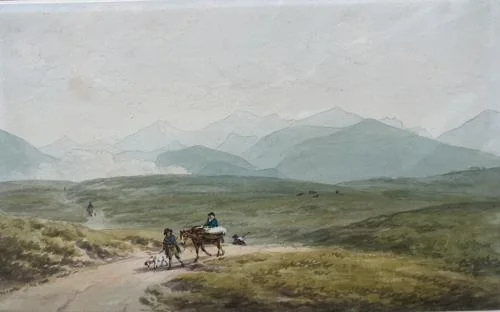
Inscribed on original label now attached to backboard: General Distant View of the Carnarvonshire Mountains, seen from the road beyond Llangerniew,/going by the Vale of the Elwyn from St Asaph to Llanrwst-Principal in this Towering Group, are Moel Siabod, Snowdon, The Glyders/ and Trevaon Denbighshire, watercolour over pencil. 13 x 20.8 cm.; 5 1/8 x 8 ¼ inches Provenance George Greville, 2nd Earl of Warwick (1746-1816), no. 17, part of an album sold at Sotheby’s, 17 June 1936; With Leger Galleries, 1980; Christie’s, London, 20 November 1984, lot 113, where bought by a private collector, until 2024 Smith seems to have been fascinated by the Welsh countryside and dated drawings, often inscribed ‘taken on the spot’, point to visits nearly every year from 1784-1798, after his return from Italy. The artist was born in Cumberland and patronised by 2nd Earl of Warwick who sponsored his travels to Italy in 1776 and whose name became the artist’s sobriquet. Smith spent five years in Rome and Naples, befriending William Pars and Thomas Jones, in whose Memoirs he is frequently referenced. He travelled home in 1781 through Switzerland with Francis Towne and was among the most admired watercolourists of his day.
View details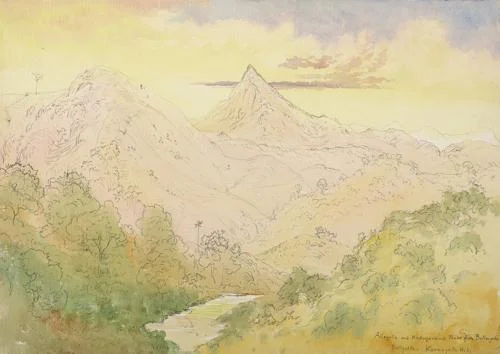
Sunset with the Allegalla and Kaduganawa Peaks from Bellongalla, Bellgodde, Kornegalle Hills Inscribed l.r.: Allegalla and Kaduganawa Peaks from Bellongalla./Bellgodde. Kornegalle Hills, and further inscribed: coffee and with colour notes, watercolour over pencil 35.5 x 50.5 cm.; 14 x 19 ¾ inches The artist stayed with Bessie Farr, whom she met on her journey to Ceylon, who was travelling to her future husband Tom Farr. They lived at Oolanakanda, ‘perched very high on the majestic Allegalla Peak, at the foot of a mighty crag, and overlooking a billowy sea of mountain ranges. …from there we could see in the far distance the other great mountain of Ceylon… “Adam’s Peak”, but to the Singhalese ..the “Sri-Pada’, Memories, pp. 211-212. Bellongalla is west of Kandy, the site of Sri Lanka’s first tea estate.
View details
Pen and black ink over pencil Each 13 x 21 cm.; 5 x 8 ½ inches Provenance J.M. Hunter, purchased from The Fine Art Society 22 November 1968 until 2023 Exhibited The Fine Art Society Ltd., London, 'Edward Bawden, CBE, RA - Recent works', 1968 Literature Claudia Roden, 'A Book of Middle Eastern Food', published by Thomas Nelson, London, 1968, with photographs by Pinkard, and black and white illustrations at the head of each chapter by Edward Bawden. These are the original drawings used to illustrated Claudia Roden’s (b. 1936) first cookery book on Middle Eastern food which mixed Bawden’s playful drawings with modern food photography and revolutionised Western attitudes to the cuisines of the Middle East and North Africa. It was substantially expanded and published in a new edition in 1986. She is the author of ten popular and critically-acclaimed cookery books and has a particular interest in the social and historical background of cooking. Bawden lived in Great Bardfield in Essex from the 1930s to 1970 and was a central figure of the Great Bardfield Artists.
View details
Pen and grey ink and wash, inscribed verso and dated: Kerswell Oct.3.1812 23.7 x 37 cm.; 9 ¼ x 14 ½ inches Provenance Private collection, U.K. until 2025 Kerswell is a hamlet in the Teignbridge district of Devon north-east of Exeter.
View details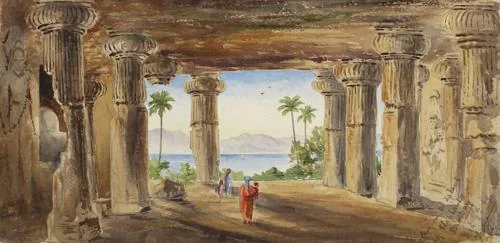
Signed, inscribed and dated l.r.: Cave on the Island/of Elephanta/Dec 9th. 69 and further signed by another, watercolour over pencil. The artist visited the famous Hindu temple carved into the rockface on the island of Elephanta. Constructed between the fifth and sixth century, the temple is part of the ‘City of Caves’ devoted to the cult of Shiva. For further work by this artist please see the catalogue link and enquire about availability.
View details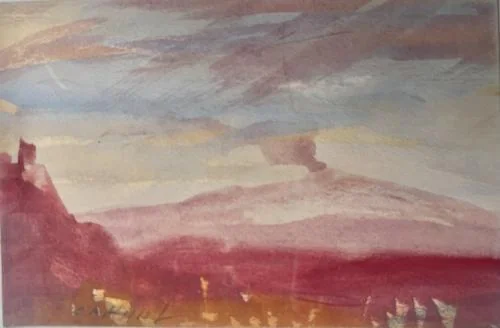
Cecil Arthur Hunt, RWS (1873-1965) Mount Etna, Sicily Signed in pencil l.l.: C.A. Hunt, watercolour, inscribed on label attached to backboard: From Cecil & Phyllis Hunt/Christmas 1954/Etna 9 x 13,5 cm.; 3 ½ x 5 5/8 inches Frame size 15 x 29 cm.; 6 x 11 3/8 inches Provenance Agnew’s; Private collection UK Hunt and his wife, Phyllis made many trips to Sicily, an island which inspired the artist. They always stayed at the Casa Cuseni, the villa in Taormina belonging to his friend and art critic, R. H. Kitson, the painter and critic, who he first met at Cambridge. Casa Cuseni is now a museum and is, perhaps, best known for its dining room designed by Sir Frank Brangwyn (1867 – 1956).
View details£ 780
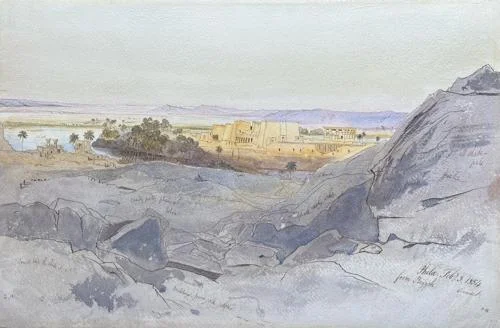
KT734 Edward Lear (British 1812-1888) Sunset at Philae, Egypt Inscribed and dated l.r.: Philae. Feby. 3. 1854/from Biggeh. Sunset. P 18 and extensively further inscribed with colour notes, pen and brown ink and watercolour over traces of pencil 33 x 50 cm.; 13 x 19 ¾ inches Provenance Appleby Brothers, 27 William IV Street, Trafalgar Square, London, no. M2139; Private collection, U.K. until 2026 Lear visited Philae for the second time in late January and early February 1854. He had intended to travel up the Nile with the artist Holman Hunt but left Cairo earlier than expected when the opportunity arose after Christmas 1853, having met Thomas Seddon (1821-1856) and the explorer Sir Richard Burton (1821-1890). His views of the island were often taken from a vantage point which situated it in the landscape, showing the First Cataract, the rocky barrier that divided ancient Egypt from Nubia and the Nile. Here he enjoys painting the rocks in different shades of grey as the sun goes down, its light illuminating the temple with a golden glow. Lear spent ten days exploring the island and set up camp in the Temple of Isis. Many parties of English travellers visited, and Lear entertained some of them with dinner and music on the Temple Terrace. He adored the place and wrote that it was ‘more like a real fairy island than anything else I can compare it to. It is very small, & was formerly all covered with temples, of which the ruins of 5 or 6 now only remain. The great Temple of Isis, on the terrace of which I am now writing, is so extremely wonderful that no words can give the least idea of it. The Nile is divided here into several channels, by other rocky islands, & beyond you see the desert & the great granite hills of Assouan’ (Lear in a letter to his sister Ann, 7th February 1854, quoted in V. Noakes, ‘Edward Lear’, 1988, p, 124). He made many drawings of Philae, including a similar work dated a day later, 4 February 1854, from a different vantage point which is in the Ashmolean Museum. Lear painted Philae in oils around twenty times. He wrote on his 1867 trip that ‘In no place- it seems to me, can the variety & simplicity of colours be so well studied as in Egypt; in no place are the various beauties of shadow more observable, or more interminably numerous (Diary, 25.ii.67). Bigeh is an island and archaeological site in the Nile, formerly in the First Cataract of the river and it controlled the access to ancient Upper Egypt and Nubia. It was sacred to the ancient Egyptians who believed that Osiris was buried on the island. Its sacred temple was only accessible to priests. When the construction of the Aswan Dam began in 1960, it became apparent that the ancient temples and surrounding area would be submerged and destroyed by the rising waters of the newly created Lake Nasser. An international fund-raising campaign by UNESCO led to their relocation to higher ground by 1968.
View details
KT311 b Signed and inscribed on original mount: La Porte./Keswick Lake-/Pocklington Island./Crosthwaite Church./Skiddaw, watercolour over pencil 22.7 x 37.7 cm; 9 x 14 7/8 inches Provenance: Christie’s, London, 17 November 1970, lot 10;The Pemberton collection bought from the above sale, until 2019 Laporte was a drawing master who exhibited work at the Royal Academy and British Institution from 1779. Dr Thomas Monro was one of his pupils. He published several manuals on landscape watercolour painting, the most famous of which 'The Progress of a Water-Coloured Drawing', c. 1802, went into several editions. It showed fourteen stages in the outline and colouring of a watercolour. He visited the Lakes in the 1790s and there are a number of drawings by him in the collection of The Wordsworth Trust, of which several are of Derwentwater. His work can also be found in the collections of the Tate, the British Museum and the Whitworth Art Gallery.
View details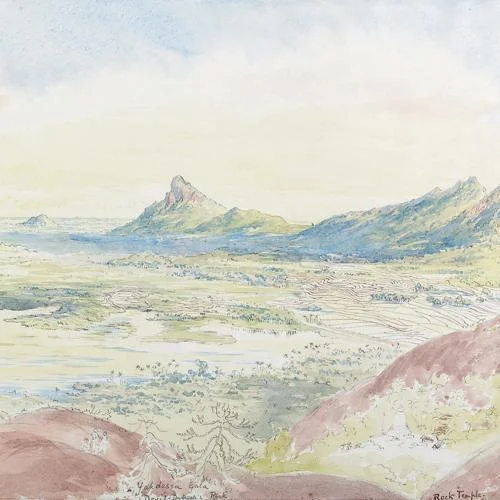
Kurunégala from the top of the Rock Signed, inscribed and dated l.r.: Kurunégala from the top of the Rock/C.F Gordon Cumming./April 18th 1874/Nalunde Hills/Rock Temple/Yakdessa Gala/Devil Dancers Rock/140, and signed by three others including G.J. Julungalle (?), watercolour over pencil 29 x 66.5 cm.; 11 3/8 x 26 ¼ inches Kurunegalla, 58 miles north east of Colombo, was Sri Lanka’s capital from 1293 to 1341, and the site of an extensive royal complex, which included the palace of the tooth relic. The town and lake lie at the base of a large red rock shaped like a giant beetle, three miles long. The countryside is a mixture of paddy fields and palms. Plumbago mining (an historic name for graphite) took place here.
View details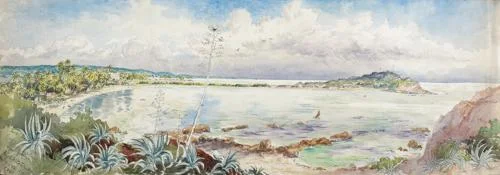
Fort Frederick from Trincomalee Signed, inscribed and dated l.r.: Fort Frederick from Trincomalee./Oct. 23 1873/CF.GC and signed by Hugh W. Colombo, Agnes Jermyn, John Campbell and George William …, watercolour over pencil 22.8 x 65 cm.; 8 7/8 x 25 ½ inches The advent of severe thunderstorms caused the Bishop of Colombo to become unwell and he therefore had to abandon his plans to travel from Trincomalee to Jaffna, the northern tip of Sri Lanka. The party embarked on the Government steamship Serendib towards Batticaloa and Galle, in order to return to Colombo as directly as possible.
View details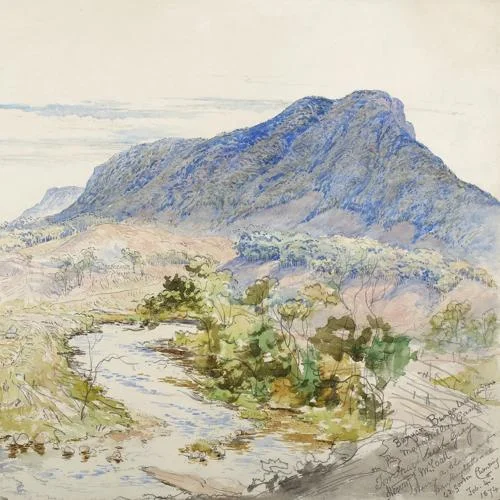
Bunyan Bungalows on the Mahaweli Ganga Signed, inscribed and dated l.r.: Bunyan Bungalows & Stone/on the Mahamilla (Mahaweli) Ganga/C.F.Gordon Cumming/Feb/ 4th./1874, further inscribed with notes and signed by: Tom Gray, Sarah Gray, Henry J.M. Coall, Henry A. Claremont, Evan Knighttonce, watercolour over pencil 39 x 62 cm.; 15 3/8 x 24 ¼ inches The Mahaweli is Sri Lanka’s longest river,’which, rising near Adam’s Peak, wanders through the mountains untill it reaches Kandy, the mountain capital, whence, descending to the plains, it travels northwards, a total distance of 134 miles, and finally enters the sea by several branches near Trincomalee, Two Happy Years in Ceylon, p. 102.
View details
Signed on rowing boat: S.H. Grimm 1772, pen and grey ink and watercolour over traces of pencil on laid paper, inscribed on original mount with title, two gallery labels attached to backboard Oval, 31 x 38 cm; 12 1/4 x 14 15/16 inches Framed in a gilt frame 41 x 50 cm.; 16 x 19 5/8 inches Provenance: Frost and Reed, 9 August 1948; Robert Victor Cooke; Athelhampton House, Dorchester; by descent to Sir Robert Cooke; Patrick Cooke, until 2019 Grimm was born in Switzerland and moved to London in 1768 having spent three years in Paris. He made a number of views along the Thames shortly after his arrival in the capital. This view is taken slightly upstream from the wooden Fulham Bridge, which is visible in the drawing with a stage coach crossing. A further smaller view of the Berkshire House in 1772 with its distinctive sign by the waterside steps is recorded with the title ‘a view from Putney up the river’ (7 1/8 x 8 1/4 inches in the J. Braithwaite collection); this work is recorded as having been based on a study (Rotha Mary Clay 'Samuel Hieronymous Grimm', 1941, p. 66). This bridge was opened in 1729 in line with Fulham High Street with a slight curve on the Putney side in front of the church. The British Museum has a sketchbook by the artist of Thames views from Fulham to Kew (1919.7.12.25). In 1957, Athelhampton House was bought by the eminent surgeon Robert Victor Cooke to house his extensive collection of 16th and 17th-century furniture, paintings, tapestries and carvings. Following his wife’s death in 1964, he gave the house to his son Robert Cooke MP (later Sir Robert) on his marriage to his wife, Jennifer King, in 1966. Their son Patrick inherited the house in 1995.
View details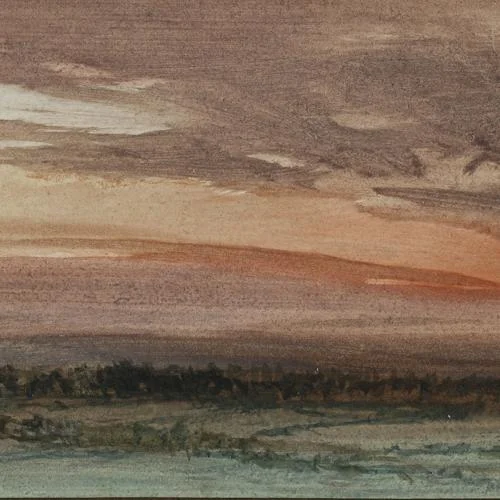
KT282 Arthur Severn (1842-1931) Sunset over a wooded landscape, probably at Coniston Water Signed l.l.: A. Severn, watercolour, inscribed on backing paper: 'This picture is by Arthur Severn/and was given to me in exchange/for a song in 1904’, in the original gilt frame 9 x 20.4 cm; 3 3/4 x 8 inches Framed size 18 x 29 cm.; 7 1/8 x 11 1/4 inches Severn loved to draw sunsets and this is a delightful example of his work, most probably drawn from near Brantwood where he lived with John Ruskin.
View details£ 1,250

Oil on laid paper laid down on canvas 20.5 x 25.1 cm.; 8 1/8 x 9 7/8 inches Provenance Private collection, USA, until 2025 This charming plein air sketch was made not long after the completion of the restoration of the Arch of Titus in 1824. During the early nineteenth century the integrity of the structure was spoilt by the remains of medieval stone walls and accumulations of rubble at the sides. These were cleared in the early 1820s by Giuseppe Valadier (1762–1839) who restored the Arch to something approaching its original (and current) appearance. The artist differentiates between the original Pentelic marble and the white Travertine used for the newly carved sections of the monument. On the Via Sacra to the south-east of the Forum, the Arch of Titus was designed to glorify the memory of the emperor Titus and his official deification or consecratio. It was built shortly after the death of Titus in 81AD by his brother Domitian, who succeeded him as emperor.
View details
Watercolour 17.5 by 25.5 cm Two of the dogs are terrier types (Irish terrier on the left, and black and tan on the right) and the white dog with brown spots is a pointer type. Provenance: Augusta Raymond-Barker, Fairford Park, Gloucestershire; thence by family descent until 2016 The artist was the youngest son of portrait painter Nathan Theodore Fielding. From 1827 to 1830 he lived in Paris, where he ran the family engraving business, at which William Callow worked. He was closely associated with the Anglo-French circle of artists centred around Bonington and Delacroix. He collaborated with his brothers Thales and Theodore in England before returning to France where he built up an extensive teaching practice, with pupils including members of the family of King Louis- Philippe. He published a number of teaching manuals and lived in France until his death.
View details
KT633 Fragments of a colossal statue at the Memnonium, Thebes Signed l.l.: 'David Roberts. R.A.' and inscribed and dated 'Memnonium, Thebes Dec. 5th, 1838', further inscribed l.r.: 'Dimensions of the statue/Between the shoulders [?] 26 feet/Circumference of the Head 54"/Shoulder to the elbow 13" [5]', watercolour over pencil heightened with bodycolour on blue-grey paper 32.7 x 48.9 cm; 12 7/8 x 19 ¼ inches PROVENANCE Possibly David Roberts; Christie's, London, 13-20 May, 1865, lot 67 as 'Thebes: Fragments of the Colossus of Rameses'; Anonymous sale; Sotheby's, London, 15 March 1990, lot 42; with Spink, London, 1990; Christie's, London, 16 November 2006, lot 128 This temple on the west bank of the Nile at Luxor, was visited twice by Roberts during his voyage on the Nile in 1838. On the outward journey, on the way to Abu Simbel, he had visited all the temples on both sides of the Nile at Luxor, and on 21 October hired donkeys to visit the ruins at Gurnah on the west bank, noting in his journal: 'The head and shoulders of the Memnon lying on the ground is enormous one can only wonder how it got there - the trouble of dislodging it must have been almost equal to the erection ...'. The present drawing was executed on the return journey when he was on the west bank of the river at Luxor from 3 to 5 December 1838. Roberts noted in his Journal 'I have been very industrious today, thanks to a Thunder Storm, a most uncommon thing in this part of the world - The sun was quite obscured and the peals of thunder were very loud accompanied with rain.... Made four large coloured sketches two of the Memnonium and two of Medinet Habou.' (Eastern Journal, National Library of Scotland). The present drawing was executed on the spot, although it is possible that the colouring was completed later during the trip. This drawing was used as the basis for the drawing which was eventually lithographed. This temple was called the Memnonium or the Tomb of Osymandyas, one of the names of Rameses II, the king to whom it was dedicated. It is now more commonly known as the Ramesseum and is the temple from which another colossal head was taken to the British Museum, where it inspired Shelley's famous sonnet Ozymandias.
View details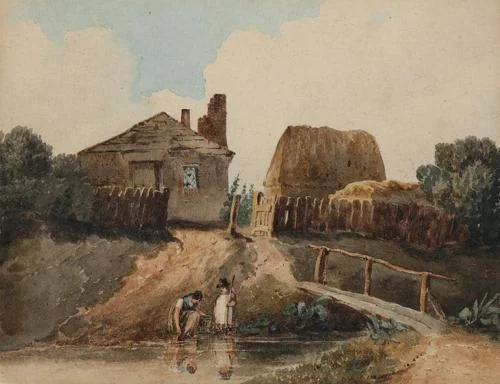
Watercolour over pencil with scratching out18.2 x 22.8 cm.; 7 ¼ x 9 1/8 inches Provenance Quentin and Molly Bridge until 2020 Exhibited Martyn Gregory, British Watercolours & Drawings, 2020, no. 8 This charming early drawing by Cox dates to circa 1815. A woman and a child can be seen collecting water in a bucket from a stream near a wooden bridge by a cottage. The child appears to be wearing a black Welsh hat.
View details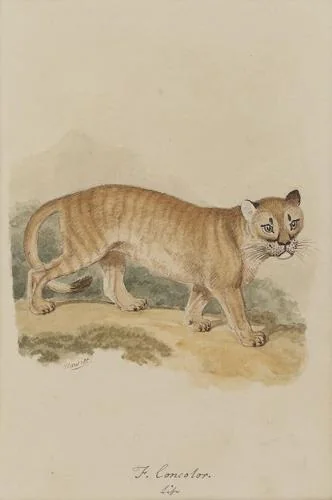
Two, each signed l.l.and l.r., each inscribed l.c.: F. Concolr./life and F. Ocelot.of.Albany./Life, watercolour over pencil Each approx. 25 x 17.5 cm.; 9 ¾ x 6 7/8 inches The artist was self-taught and specialised in drawings of animals and field sports. From a wealthy Quaker family, Howitt took up art professionally when he encountered financial difficulties and became a drawing master in Ealing. He married Thomas Rowlandson's sister Elizabeth in 1779 and was part of Rowlandson's circle together with George Morland, Henry Wigstead and J.R. Smith.
View details
Stamped with the artist’s stamp l.l., watercolour over pencil heighted with white on rough buff paper 32.3 x 46.5 cm; 12 5/8 x 18 ¼ inche Provenance: Christie’s, London, the Artist’s Studio sale, March 13 -17, 1884 (13 gns); The Fine Art Society, London, April 1966; Hermione Hobhouse (1933-2014); By family descent until 2020 Exhibited: Glasgow International Exhibition, 1888 Literature: Delia Millar, 'The Victorian Watercolours in the Collection of Her Majesty The Queen', 2 vols., London, 1995, no. 3422 Osborne House on the Isle of Wight was a summer retreat built for Queen Victoria and Prince Albert between 1845 and 1851, designed by Albert himself in the style of an Italian palazzo. The stone lions shown here at the foot of the steps, copied from the antique, were acquired in January 1851, and were in place by 9 March 1851. The groups of children possibly include Princess Helena and Princess Louise, described by their mother as 'looking extremely pretty in little blue silk polkas, with white silk hats' (Queen Victoria’s Journal, 15 August 1851). There is another smaller version of this watercolour in the Royal Collection dated August 1851 (RCIN 919847). The present drawing would seem to be the preliminary drawing as passages are unfinished. The version in the Royal Collection has an additional figure group at the bottom of the stairs. Leitch also drew two further watercolours of Osborne under construction drawn circa 1847 (RCIN 91982 and 91983). William Leighton Leitch was one of Queen Victoria's favourite watercolour artists, and she commissioned many watercolours from him for her View Albums. Leitch also taught watercolour to the Queen and her children, all of whom copied his work. He stayed at Osborne from 31 July 1851 and for most of August that year. It has been suggested that this drawing may have been made as a drawing lesson for some members of the Royal Family. Hermione Hobhouse was an architectural historian and preservation campaigner. During her distinguished career, during which she acted as secretary of ‘The Victorian Society’ from 1976-1983, she wrote numerous books, including Prince Albert: His Life and Work, 1983. Stamped with the artist’s stamp l.l., watercolour over pencil heighted with white on rough buff paper 32.3 x 46.5 cm; 12 5/8 x 18 ¼ inche Provenance: Christie’s, London, the Artist’s Studio sale, March 13 -17, 1884 (13 gns); The Fine Art Society, London, April 1966; Hermione Hobhouse (1933-2014); By family descent until 2020 Exhibited: Glasgow International Exhibition, 1888 Literature: Delia Millar, 'The Victorian Watercolours in the Collection of Her Majesty The Queen', 2 vols., London, 1995, no. 3422
View details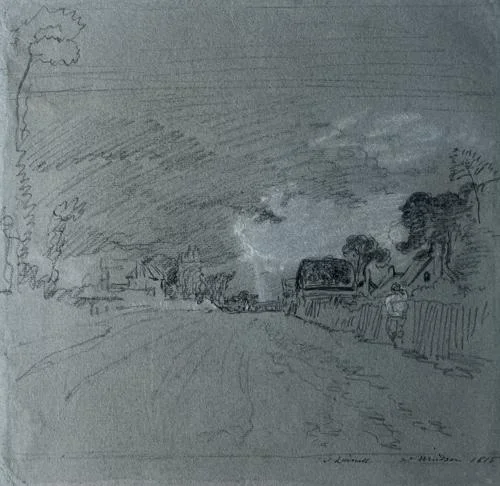
KT741 John Linnell (1792-1882) Near Windsor Signed, inscribed and dated l.r.: J Linnelll Nr Windsor 1815, pencil with white on blue paper 26.8 x 27.2 cm.; 10 5/8 x 10 ¾ inches Mount size 40 x 40 cm.; 15 3/4 x 15 3/4 inches Provenance Cheffins, Cambridge, 26 November 2015, lot 398, where bought by Professor David Bindman (1940-2025)
View details£ 1,750

Signed and dated lower left: J. Severn Roma 1825 Oil on canvas 61.6 by 75cm., 24 1/4 by 39 1/2 inches, framed size 82 x 90 cm.; 32 1/4 x 35 3/8 inches £22,000 This unpublished painting depicts the wife and child of a brigand apparently hiding from the authorities, probably in the Alban Hills. The sleeping man, his rifle at his side, is watched over by his wife who rocks their child in a makeshift cradle covered by a cloth and hanging from a tree branch. Banditti were a popular artistic subject, made fashionable by the work of Salvator Rosa, and Severn experienced an attempted robbery first hand in 1823 when he was travelling around Naples, where brigands were common. Here he focusses on the humanity of the mother and draws attention to the precarious condition of the family. Joseph Severn was the eldest son of a music teacher from Hoxton. At the age of 14 he became apprenticed to the engraver William Bond before entering the Royal Academy Schools in 1815. Here, in 1820, he was awarded the gold medal for historical painting for his Una and the Red Cross Knight in the Cave of Despair, which granted him a travelling scholarship. This coincided with the illness of his friend, the poet John Keats, and together they travelled to Rome in search of a better climate for the ailing poet. During the winter of 1820-21 Severn nursed Keats in their apartment near the Spanish Steps, his detailed letters from the period of great importance, but, on 23 February 1821, Keats died. Severn remained in Rome, launching his own artistic career as a painter of landscapes, portraits and subject paintings. His pictures of Italian peasant life won him such an avid following that there were times during the 1820s when he could not keep up with the flood of commissions. At the beginning of 1827 he wrote to his younger brother Charles that he had “now 9 pictures on order”, and by the beginning of the following year he had “eleven pictures on hand” and this popularity continued well into the 1830s. Patrons, friends, family and fellow artists all praised the freshness and originality of his Italian painting. Sir Charles Eastlake wrote of the “richness of colour” and the "truth of circumstance, situation, incident & costume," of Severn’s Italian work (Charles Eastlake to Severn, 7 May 1834 and May 1832 (MS: Harvard, bMS Eng 1434 [52, 51], quoted in Grant F. Scott, Joseph Severn Letters and Memoirs, 2005, p. 23). It seems probable that the present work was a commission. Severn exhibited extensively at the Royal Academy during the late 1820s and 1830s showing eleven paintings of which ten were Italian genre pictures. Today comparable paintings from this period can be found in the Thorvaldens Museum in Denmark, Italian woman and her Daughter, 1831 and Italian Peasant in The Royal Collection, Her Majesty Queen Elizabeth II. The Fountain of 1828 has a similar landscape background to the present work and hangs in the Royal Palace, Brussels. The Vintage, was commissioned by the Duke of Bedford in 1825 for Woburn Abbey. Further work is in the collections of the Tate Gallery, London and the Victoria and Albert Museum. Severn played a crucial role in the foundation of the British Academy of the Fine Arts at Rome (1823-1936), securing funding from various influential patrons including William Hamilton, the antiquarian, and hosting evening gatherings in his apartment on the Via di San Isodoro, where artists met to study and draw from life, and where they had access to casts, painting and sculpting material and books. It was also a temporary rooming house where artists who had recently arrived from England could stay while looking for a studio (see, Grant F. Scott, op. cit., p.17). Severn remained in Rome for most of his life other than a spell in England from 1841-1861. With the help of William Gladstone, an avid patron, he became British Consul in Rome from 1860-72. He died in Rome in 1879 and, at his request, was buried next to Keats in the Protestant cemetery near Porta San Paolo and adjacent to the Pyramid of Cestius. Their graves are pictured below.
View details£ 22,000
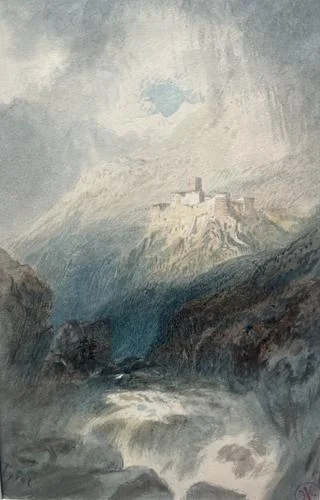
KT649B Harry John Johnson (1826-1884) Tirol Watercolour over traces of pencil heightened with white and scratching out, with studio stamp l.r. 23 x 15 cm.; 9 x 6 inches
View details£ 575
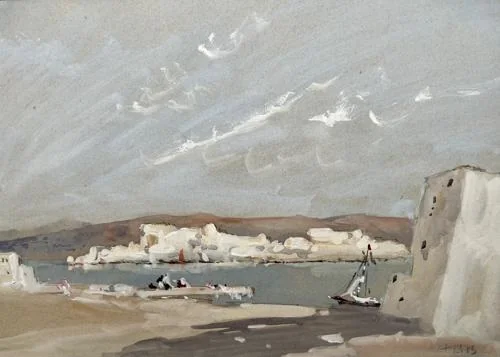
Signed with initials l.r.: HBB, watercolour and bodycolour over pencil, inscribed verso: Siracuse and stamped with collector’s mark Provenance Gilbert Davis (L. 757a.); Edward Seago, his estate sale at Christie’s, London 1 March 1977, lot 94; Where bought by B.M. Williams; Christie’s, London, 21 November 2007, lot 145, where acquired by the previous owner until 2025 Gilbert Davis (1899–1983) built up a large collection of watercolours in the middle of the twentieth century. He sold the bulk of his collection in 1959 to the Huntingdon Library and Botanical Gardens in San Marino, California. Edward Seago RBA, RWS (1910-1974) was one of the most popular British artists of 20th century, who painted in oils and watercolours.
View details
Signed l.r.: Edith Martineau, watercolour with scratching out and touches of gum arabic, inscribed on label attached to backboard: Hampstead Heath, looking/over to Harrow on the Hill, Brent/Reservoir, painted in early spring/from just beyond Spaniards old/Fir Trees in 1905. Edith Martineau A.R.W.S./5 Eldon Road/Hampstead/property of Miss Emma Lister/Hampstead Heath, and again on backboard: E.L. Lister/bought 1905, and with provenance details on a second label, in original gilded oak frame 28 x 39.5 cm.; 11 x 15 1⁄2 inches Provenance Miss Emma Lister, Upper Heath Street, Hampstead, 1905, a bequest to her great-nephew Walter Pierre Courtauld (1910-1989), November,1915; Private collection, London until 2021 Edith Martineau, together with her sister Gertrude, was one of a small group of female artists associated with the Pre-Raphaelites. The daughter of Dr James Martineau, a Unitarian minister and theologian of Hugenot descent, the artist was born in Liverpool. After studying at the Liverpool School of Art and Leigh's School of Art, later known as Heatherley’s, the first British school to allow women into their life classes, Martineau became one of the first women to be admitted to the Royal Academy Schools in 1862, aged nineteen, for seven years and then a further two. The artist exhibited at the Royal Academy from 1877-1890, the Grosvenor Gallery, the Dudley Gallery (with many other followers of the Pre-Raphaelites) and the New Society of Painters in Water Colour. Martineau contributed to numerous annual exhibitions at the Walker Art Gallery in Liverpool, the Royal Society of Artists in Birmingham, the Manchester City Art Gallery and the Society of Women Artists. In 1888 she was elected an associate member of the Royal Society of Painters in Water Colours, one of only nine women. Her work was also exhibited at the Palace of Fine Arts in 1893 at the World’s Columbian Exposition in Chicago. By 1901 Edith Martineau, who never married, lived at 5 Eldon Road in Hampstead near the Heath, with her sisters Gertrude and Mary. The Heath, depicted here in spring with the new grass appearing beside the remains of the winter bracken became a favourite subject. Wyld's Farm can be seen on the right of the composition; it was located just past Jack Straw's Castle where Wyldwood Road is today. Martineau painted the Heath's landscape and winding paths at different seasons until her death from influenza in February 1909. She held her first major exhibition together with her elder sister Gertrude (1837–1924), also a watercolourist, at the Modern Gallery in 1906. A second joint exhibition was held at the New Dudley Gallery in 1910 in commemoration of Edith Martineau's death. Martineau worked on a small scale in watercolour primarily and is known for her delicately painted and meticulous landscapes which owe much to the Pre-Raphaelites, and genre paintings. She worked in a number of styles, experimenting with classicism, aestheticism and portraiture. Examples of her work can be found in the collection of the Victoria & Albert Museum, the National Gallery of Art in Washington D.C. and other institutions. Her aunt Harriet Martineau (1802-1876) was a Victorian woman of note, a social theorist, political economist, journalist and writer.
View details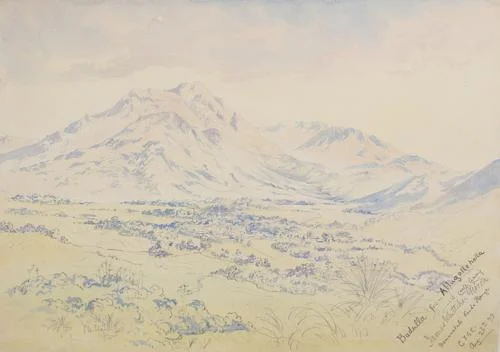
Badulla from Allugollehella, alias Castle Cumming Signed, inscribed and dated l.r.: Badulla from Allugollehella/alias Castle Cumming/Namamakuli Kanda Range/CFGC-/Aug. 25th 73 and signed by James Whittaker Gibson, watercolour over pencil ‘Badulla, the capital of Uva, a very pretty little town in the midst of a grassy and well-wooded and well-watered plain, about 2,200 feet above the sea-level, and surrounded on every side by fine hills of very varied form. There is a considerable amount of rice culture round the town, which seems like an island crested with cocoa-palms rising from a sea of velvety green’, Two Happy Years, p. 335. Badulla is in southern central Sri Lanka.
View details
Signed l.l.: E. Lear, pencil with watercolour, gum arabic and pen and black ink 17.7 x 23 cm.; 7 x 9 inches These charming, quirky drawings are characteristic early works by Lear, dating from the late 1820s or early 1830s when he was establishing himself as an ornithological artist. They relate to a group of drawings which Lear gave to Mrs Godfrey Wentworth, who supported his employment by the Zoological Society in 1831, and whom he credited with launching him as an artist. They are imaginary, fanciful subjects drawn with not a little humour, resembling the stylised watercolours of birds painted on late eighteenth century porcelain. Robert McCracken Peck has made the interesting suggestion that Lear and his sister Ann may have been thinking of approaching ceramics companies with them (see Robert McCracken Peck, The Natural History of Edward Lear, 2016, pp. 27-9). Two surviving family albums from the late 1820s, containing a mixture of similar natural history subjects by Edward Lear and his sisters Ann and Sarah, are in the collection of the Houghton Library, Harvard University (MS Typ 55.4 and 55.27). Sir Edward Strachey was a man of letters and friend of Lear’s, who wrote an introduction to Nonsense Songs in 1895. He lived at Sutton Court, Chew Magna in Somerset and was a neighbour of Lear’s close friend Chichester Fortescue, the Liberal politician whom Lear first met in Rome in 1845.
View details
Inscribed and dated l.l.: Tunbridge.1788, watercolour over traces of pencil on laid paper countermarked: J WHATMAN 36 x 53 cm; 14 ¼ x 20 ¾ inches Provenance: Mrs Charles E. Dunlap, her estate sale, Sotheby’s Parke Bernet Inc., New York, 3–5 December 1975, lot 337; Bought by John Baskett Ltd, London, 1975; Private collection, USA, 1976–2014; Private collection, USA, by descent, 2014–2018. Exhibited: Emily Lowe Gallery, Hofstra University, Hempstead, New York, 1980, British Watercolours and Drawings 1750–1925, ill. in colour, as pl. 10, p. 26. Davis & Langdale Company, New York, British Drawings 1760–1925, 1980, ill. This delightful view of Tonbridge (the town of bridges) shows the Great Bridge over the river Tunn with the keep of Tonbridge Castle in the background. On the east side of the High Street, the building on the north bank of the Great Bridge, on the right of the composition, was occupied by Widow Wise and Simon Wise, who manufactured Tunbridge Ware, a type of decoratively inlaid woodwork, often in the form of boxes. East of the High Street on the south bank, the occupier was Robert Gabriel; this building was perhaps already an inn, later the Castle Inn and the Six Bells.
View details
Pen and grey ink and watercolour over traces of pencil with touches of white 18.9 x 29 cm There are three drawings (on two sheets) for the eating room at Fairford in the Sir John Soane’s Museum dating from 1789–90 (SM (5) 80/1/65 recto & verso (6) 81/2/99). They aim to remodel the room to make the wall panels more balanced, to use the same cornice as the main stair - case and to remodel the existing chimneypiece. Provenance: Augusta Raymond-Barker, Fairford Park, Gloucestershire; thence by family descent until 2016
View details
Signed with initials l.l.: TC, oil on paper laid down on canvas 26.5 x 36 cm.; 10 3/8 x 14 1/8 inches The artist studied in Birmingham under Joseph V. Barber (1788-1838) and moved to London in 1828. He was one of the leading practitioners of the Birmingham School of Artists and a founder member of the Etching Club. Creswick exhibited over 250 paintings in London during his lifetime at the Royal Academy and Suffolk Street Galleries, and also worked as an illustrator. He sought out subjects from the rivers and streams all over the British Isles. The present work has a pleasing spontaneity and sense of place which reflects Creswick’s habit of painting outside from nature. He was particularly drawn to streams which he painted many times. He revels in depicting the colours, shapes and textures of the boulders in the foreground of this work and excels himself conveying the softness of the moss on the first rock. John Ruskin praised Creswick’s handling of foliage and his observations from nature in the first volume of Modern Painters (1843). Oils on paper by him are comparatively rare. Creswick’s work is represented in many British institutional collections and the Yale Center for British Art, New Haven.
View details£ 4,200
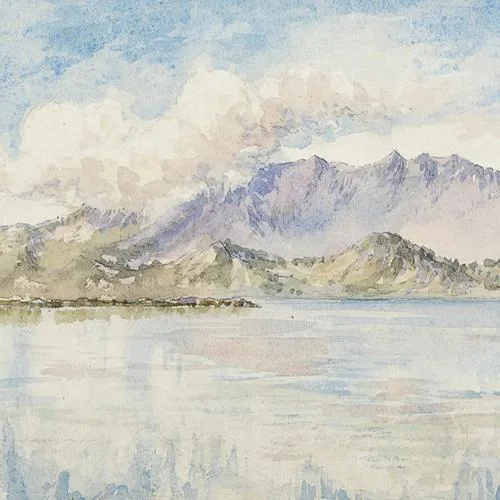
Isle of Sumbawa, Malay Archipelago Signed, inscribed and dated l.l.: Isle of Sumbawa./Malay Archipelago. (& Vlack?)/May 7th. 1875/C.F.G.C., watercolour over pencil 12.4 x 56.5 cm.; 4 7/8 x 22 ¼ inches Sumbawa is one of the lesser Sunda Islands chain, an archipelago within the Indonesian archipelago, which stretches east of Java and north of Australia. The islands of Lombok and Flores are to the west and east respectively.
View details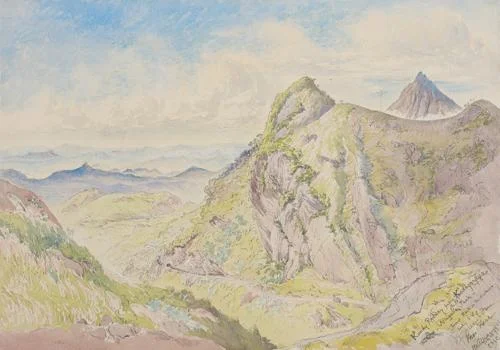
Kandy Railway passing Kaduganawa Signed, inscribed and date l.r.: Kandy Railway passing Kaduganawa/Allegalla Peak-/Turret Rock in the distance./looking S.W./July 26.73/CFG.C. and also signed by Bessie Farr, Thomas Farr and H. Williamson, watercolour over pencil 35.5 x 50.5 cm.; 14 x 19 ¾ inches The artist met Bessie Farr on the voyage out to Ceylon and spent time with her and her husband Tom at their home at Oolanakanda. She wrote that ‘perched at the base of the mighty crag which crowns Allagalla Peak, that home was in a sheltered nook embosomed in fruit-trees, and overlooking such a magnificent view as we may sometimes obtain for a few moments by climbing some mighty Alp, but which few homes can claim as their perpetual outlook’, Two Happy Years, p. 159. The view of the train from their house ‘labouring on its tortuous up-hill course, winding round the steep hillside. It was so far below us that it seemed like a fairy’s toy’. Alagalla Peak is the highest point of the Alagalla Mountain Range, standing at almost 4,000 feet, on the rail route from Colombo to Kandy, in southern Sri Lanka. Eka Gordon-Cumming took this single broad-gauge line train line in the spring of 1874, noting that the uniform gradient while rounding the flank of Alagalla was one in forty five. She spent some time in the area before moving on to Kandy, enjoying ‘happy days and weeks spent exploring many a lovely corner in that vast panorama’.
View details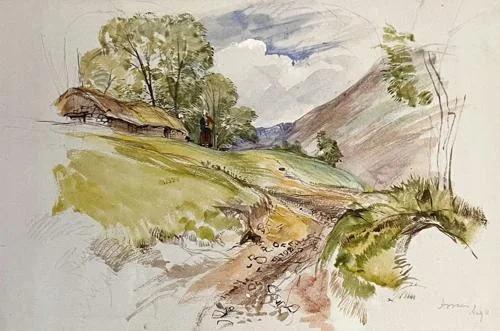
KT475 Dated l.r.: Aug 11, watercolour over pencil with a touch of white on grey paper 17.1 x 26.1 cm.; 6 ¾ x 10 ¼ inches Provenance Bernard Squire, Portman Square, London; Arnold Fellows, collection no. 23; Bequeathed to Queen Mary’s Grammar School, Walsall until sold by a charitable trust, 2023 Lewis visited Arran in 1830. A similar drawing of identical size dated two days later is in the collection of the Courtauld Institute of Art, The Witt Collection ( D.1952.RW.3018). Arnold Fellows was a pupil at Queen Mary’s Grammar School, Walsall, between 1911 and 1917. He became a master of the school for a brief period, before moving to spend the remainder of his life as a teacher at Chigwell School in Essex. Fellows devoted much of his life to collecting art, notably works on paper, and eventually donated his entire collection to Queen Mary’s Grammar School.He was the author of The wayfarer's companion : England's history in her buildings and countryside, published by Oxford University Press, 1937.
View details
Watercolour on laid paper, with exhibition label attached to backboard 15 x 32.5 cm.; 6 x 12 3⁄4 inches Provenance Miss Bostock, companion to Miss H.H. Tatlock, the artist’s granddaughter; Christie’s, 12 September 1941, lot 29; Where purchased by Thomas Agnew & Son Ltd., London; Sold to a private collector 18 May 1942; Private collection, Wiltshire until 2023 Exhibited Usher Art Gallery Lincoln, Peter De Wint Exhibition, 1937, no. 146 Horsemen can be seen in the foreground of this freely drawn, spare landscape, which exemplifies Peter de Wint’s brilliance and delicacy in the laying of washes.
View details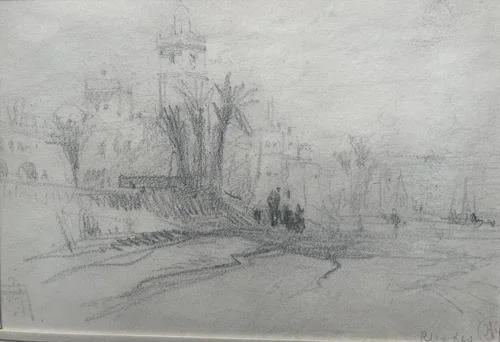
KT649B Harry John Johnson (1826-1884) Rhodes Stamped with studio stamp l.r. and inscribed: Rhodes, pencil 14 x 21 cm From a collection of watercolours by the artist
View details£ 950

Signed l.r.: CF Tunnicliffe, watercolour over pencil with touches of white on cream paper 41 x 55 cm.; 16 1/8 x 21 5/8 inches Provenance The Tryon Gallery; Private collection, UK, sold at Christies South Kensington, London, 3 November 2010, lot 58 The artist was a countryman who was brought up Cheshire. After studying at the Macclesfield School of Art he won a scholarship to the Royal College of Art in London, gaining his teaching diploma and a further scholarship to study in the RCA's new Etching and Engraving School. He worked as a commercial artist and taught art at Manchester Grammar School. Tunnicliffe was a regular exhibitor at the Royal Academy and in 1974 a ‘Members Exhibition’ was held there of his work. He and his wife Winifred moved from Cheshire to Angelsey in 1947 and lived at Shorelands in Malltraeth until his death.
View details
Sir Gerald Festus Kelly, P.R.A. (British 1879-1972) The Great Wall of China Oil on board Exhibited Martyn Gregory Gallery, ‘Modern British Painters’, October 1988, Catalogue no. 52, no. 34 This is a study for a painting of the same size of the Great Wall of China exhibited at the Royal Hibernian Academy, 1938, no.45 and the Royal Academy, London, Exhibition of Works by Sir Gerald Kelly, 1957, no.231. Born in London of Irish descent, Kelly was educated at Cambridge University, later living and studying art in Paris where he met Degas, Monet, Renoir and Sickert. Whistler was also an early influence as were Cézanne and Gaugin. Kelly was an enthusiastic traveller, visiting amongst other countries China, Spain, America, South Africa and Burma, where he painted some of his most characteristic and charming figure studies. He became a successful society portraitist whose sitters included Somerset Maugham, whom he painted several times, and he undertook numerous state portraits. Kelly is represented in many public collections, including the Tate, which holds seven works. He had retrospective exhibitions at the Leicester Galleries in 1950 and in 1957 at the RA. He was elected RA in 1930, was the Academy's Keeper from 1943-45 and President, defeating Augustus John in the election, from 1949-54. Kelly held a number of official positions, such as membership of the Royal Fine Arts Commission, 1938-43, and was knighted in 1945. Between 1909 and 1970 Kelly exhibited over 300 works at the RA. During his lifetime his work became well known through popular prints.
View details
Inscribed and dated l.r.: Patti 4 July 1847, inscribed: sloping towards x which is a very deep stuffy vegetable dell and with colour notes, numbered 212, pen and brown ink with pencil 20.2 x 44.5 cm.; 8 1/8 x 17 ½ inches, framed size 37 x 60.5 cm.; 14 1/2 x 23 3/4 inches Provenance Mary Ann Streeter (1932-2023), Boston, by descent until 2025 £5500 Lear travelled to Sicily between May 3 and July 15, 1847, with John Joshua Proby, later the 2nd Earl of Carysfort. They were to make two other tours together that year, to Calabria and Naples. Patti is a village in North-Eastern Sicily in the province of Messina between Milazzo and Capo Calvà, which includes the ancient Graeco-Roman village of Tindari with its famous Sanctuary. After graduating from Radcliffe College (Harvard University) with a degree in Fine Arts, Mary Ann Streeter moved to London for a year and started buying Lear watercolours in the late 1950s. She built up a large collection of Lear’s work.
View details£ 5,500
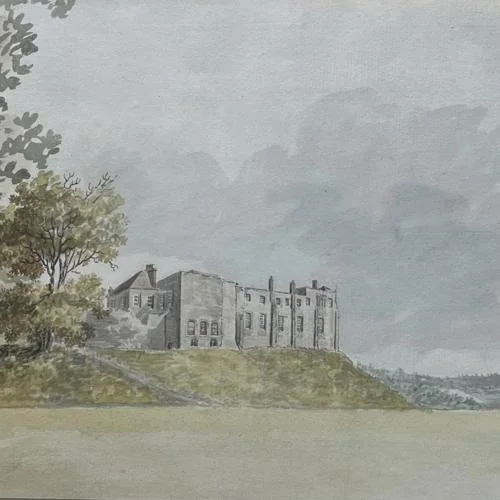
Charles Gore (1729-1807) A view of the East front of Arundel Castle, West Sussex, seen from the Bowling Green Inscribed l. r.: Arundel Castle taken from the Platform or/Bowling Green by Charles Gore Esq 1781 and indistinctly inscribed in pencil u. r.: Arundel Castle Sufsex/1781 Watercolour over touches of pencil on laid paper, with a Whatman watermark 19.6 by 49 cm., 7 ¾ by 19 ¼ inches Provenance Iolo Williams (1890-1962); And by descent until sold Sotheby's, London, 13 July 1989, lot 5; Private collection; With Guy Peppiatt Fine Art The bowling green is the name for the square earthworks located, with the fishponds, on the east side of the castle. They were probably made originally to improve the castle’s defences during the Civil War. Used as a bowling green in eighteenth century, as shown in the drawing by Charles Gore, today a rose garden can be found here. The Hon. Charles Gore was the son of a Lincolnshire landowner and educated at Westminster. He married a wealthy heiress of a shipbuilding company and learnt to draw and design ships. Gore travelled extensively in Europe, sketching with the German artist Jacob Philipp Hackert (1737-1807). Gore copied marine oils, completed the unfinished drawings of other artists, and also developed his own style having acquired an expert knowledge of the sea. His interest in classical antiquities led Charles Gore to join Hackert and Richard Payne Knight on their expedition to Sicily from April to June 1777. In 1779 Gore returned to England and became a member of the Dilettanti Society in 1781. He painted a series of panoramic views of Sussex including the current drawing. The family returned to the Continent in 1782 and he settled in Weimar in 1791 with his daughter Eliza. Examples of Gore's work can be found in the British Museum, the National Maritime Museum, Greenwich and the Goethe-Nationalmuseum, Weimar.
View details£ 1,500
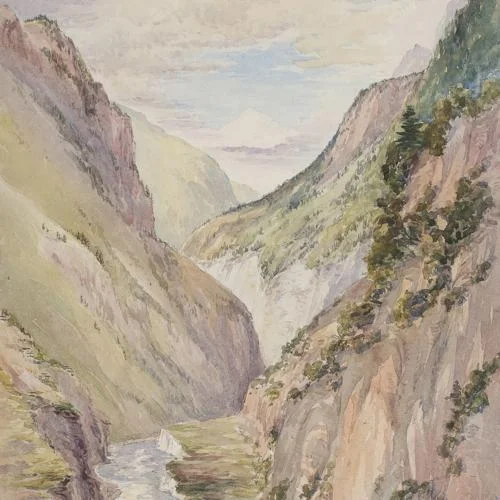
Raldung from Chigaom over Jula Inscribed l.l.: Raldung from Chigaom over Jula., watercolour over pencil 17.3 x 29.5 cm.; 6 ¾ x 11 5/8 inches A ‘Jula’ (a rope-bridge) runs over the Sutlej river by Chagaon in Himachal Pradesh. The artist recorded an encounter where ‘we found a most horribly unsafe jula- four ropes, quite decayed, stretching from rock to rock, while far below raged the turbid river, swollen by the mass of melted snow,’ which she was eventually forced to cross, In the Himalayas, p, 446.
View details
KT516 Signed l.l.: h. Harpignies and indistinctly dated 70, watercolour 12 x 16 cm.; 4 ¾ x 6 ¼ inches Provenance Thomas Agnew & Sons, London, no. 26164, cat. No. 19; By descent from the purchaser The artist was a landscape painter of the Barbizon school. After following his family’s wish for him to go into business he started to study art in his late twenties. Following a few years in Italy he returned to France and fell in with Corot and the other artists of the Barbizon school. He and Corot travelled to Italy together in 1860. He exhibited regularly at the Salon from 1861. His work can be found in many of the world’s major museums.
View details£ 2,750

KT634 inscribed and dated 'Canonteign July 24. 1829 [?]' on the reverse, pencil, pen and brown ink and grey wash 26.9 x 37.9 cm.; 10 ½ x 14 7/8 inches Provenance: Agnew's, London. Anonymous sale, Phillips, London, 16 July 1996, lot 16; with Heather Newman, Painswick, Gloucestershire. Abbott was one of the best amateur watercolourists of the late Eighteenth Century. A surgeon and apothecary, he lived in Exeter until 1825. He exhibited paintings at the Royal Academy from 1793, receiving contemporary acclaim for the style of his work. The artist John Downman said that ‘he prefers his drawings before his paintings, as they are done with more spirit’ (J. Farington, Diary 26 June 1804; vol. VI, p. 2362). In 1825 Abbott inherited Fordland, a Devon estate, from his uncle James White, an Exeter barrister, Nonconformist and close friend of Francis Towne. Abbott became a patron and pupil of Towne’s, and his linear style shows the artist’s influence. After moving to Fordland he devoted himself to drawing.
View details£ 3,200

KT494 Inscribed on original mount in pen and brown ink: Portland., watercolour over pencil 13.3 x 22.5 cm.; 5 ¼ x 8 7/8 inches Frame size 27 x 35.5 cm.; 10 5/8 x 14 inches Provenance Cothill Antiques, sold on 1 July 1970 to Thomas Agnew & Sons Ltd., no. 33077, catalogue no. 30; Private collection, U.K. 1971 - 2021 The artist was born in Cumberland and patronised by 2nd Earl of Warwick who sponsored his travels to Italy in 1776 and whose name became the artist’s sobriquet. Smith spent five years in Rome and Naples, befriending William Pars and Thomas Jones, in whose Memoirs he is frequently referenced. He was one of the most admired watercolourists of his day.
View details
Pencil 9 x 15 cm.; 3 ½ x 6 inches Provenance The artist's studio sale, Christie's, 8 - 15 May 1874, bt. by Thomas Agnew & Sons Ltd. (23366); J.M.M., a Christmas present from C. 1962
View details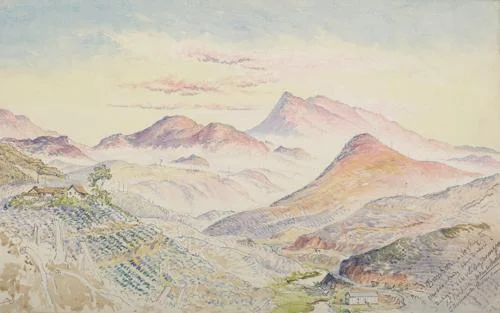
Dunbar looking to Elbedde-Kandy Inscribed l.r.: Dunbar looking to/Elbedde-Kandy. Between Dimbola &/Dickoya-6631 ft, and signed by J.T. Beckett, Mr Naylor …, C. Swinburnton and one other, watercolour over pencil 27 x 43 cm.; 10 5/8 x 16 7/8 inches Signs of deforestation, of which the artist was critical, are clearly evident in this watercolour. Dunbar is 60 miles east of Colombo.
View details
Signed with initials l.l., watercolour over pencil with touches of bodycolour on grey paper 17 x 26 cm.; 6 ¾ x 10 ¼ inches Exhibited Leger Galleries, London, November 1973; Private collection U.K. until 2022 The second son of Hercules Sharpe, the artist was educated at Harrow. After leaving Cambridge where he read Maths he decided to become an artist and studied in Rome for three years. On the death of his elder brother he inherited the Brabazon estates (and name) in Ireland. He spent his summers in England and his winters travelling in Europe and, from the 1860s, further afield. The artist visited India three times, in 1870, 1875 and 1876. In 1891 Sargent persuaded him to have an exhibition at the Goupil Gallery and, as a result, in his old age he was at the forefront of the modern movement.
View details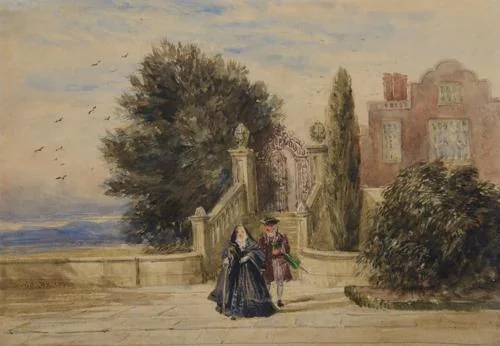
Signed and dated l.l.: David Cox. 1836, watercolour over pencil with scratching out 18 x 26 cm In the summer of 1836 Cox spent a few weeks at Rowsley, painting at Haddon Hall. He made several watercolours of elegant figures in seventeenth century costume strolling on the terrace there to which the present work relates. Although the present work does not appear to be of Haddon, it fits in with this period of his oeuvre.
View details
Inscribed l.l.: Chatham/1810 and inscribed verso: 8t October 1810, watercolour over traces of pencil14 x 22.2 cm.; 5 1⁄2 x 8 3⁄4 inches Provenance Private collection, England; Martyn Gregory, British Watercolours and Drawings 1750-1900, May 2016, no. 2 This is a view from Gillingham Bridge, Chatham. The historic dockyard at Chatham was one of Britain’s most important naval Dockyards for over 400 years. The daughter of Sir Thomas Spencer Wilson, Bt. of Charlton in Kent, the artist was a pupil of Francis Towne in her youth. Her mother was a Cheney of Badger Hall, Shropshire, where Peter de Wint was a frequent visitor. Lady (Margaret) Arden was a pupil and a patron of David Cox. She married George Compton, Lord Arden (1756-1840) in 1787.
View details
Watercolour over traces of pencil heightened with gum arabic and stopping out 12.7 x 21.2 cm.; 5 x 8 2/8 inches Provenance Martyn Gregory Fine Art This colourful watercolour dates from 1833-4 and is based on a sketch made on the spot by Commander Robert Elliot, R.N. (1790-1849) in the early 1820s. Several professional watercolour artists copied his sketches, amongst them Thomas Shotter Boys, David Cox, William Purser, Samuel Prout and Clarkson Stanfield, and their watercolours were engraved and published in 1834-5 as Views in India, China, and on the Shores of the Red Sea. The present watercolour was not engraved, but other views made for this series by Cotman are in the collection of the Victoria and Albert Museum, London and the Harris Museum and Art Gallery, Preston. The Elephanta Caves, on Elephanta Island off Mumbai are a UNESCO World Heritage Site, famous for their rock-architecture and carvings. This watercolour is taken from inside the most famous cave.
View details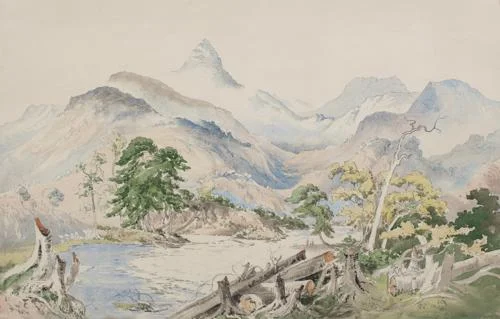
Watercolour over pencil 36.5 x 57.5 cm.; 14 ½ x 22 ¾ inches This is a study for a larger watercolour of this subject, which formed part of this collection and is now in the British Library. Adam’s Peak is about 85 miles east of Colombo.
View details
KT 173 Signed l.r.: STANLEY INCHBOLD, watercolour over traces of pencil 37.3 x 26.5 cm; 14 5/8 x 10 3/8 inches Framed in a gilt moulding 52 x 41.3 cm.; 20 ½ x 16 ¼ inches Stanley Inchbold studied art under Sir Hurbert von Herkomer. He exhibited at the leading London galleries from 1884, namely at the Royal Academy and New Watercolour Society, and was also a member of the Royal Society of British Artists. He became a skilled landscape painter in both watercolour and oil, and travelled to paint all over Europe, America and North Africa. During the first twenty years of the twentieth century he produced many beautiful book illustrations and illustrated A.C. Inchbold's - Under the Syrian Sun (1906) and Lisbon and Cintra (1907). Other publications included A Beckett, The Spirit of the Downs (1909) and G.N. Whittingham The Home of Fadeless Splendour (1921). In The Literary World, 1906 Inchbold’s work was praised, ‘We do not remember to have seen before any such attempt as Mr. Inchbold makes to represent the wonderful variety of continually changing colour that is peculiar to the Holy Lands. Though these watercolours have their purely artistic value, they are specially interesting because of the vivid and sympathetic way in which they represent the cities and landscape of Palestine’. This is one of the most beautiful and impressive gates among the gates of the wall of Jerusalem, which was built under Sultan Suleiman the Magnificent. This is a central gate in the wall which faces north towards Nablus and Damascus. In Arabic it is called “Bab El Amud” (“the gate of the pillar”), probably after the pillar that stood at the centre of the gate’s courtyard during the Romano-Byzantine era. Turban-like decorations decorate the gate, and due to its importance, many observations points and guard towers were built there. During the Roman era, a stone-paved courtyard was added and at its centre stood the statue of the emperor. Two streets started from this courtyard, leading towards the south. To this day, two main streets split from Damascus Gate, preserving the Roman structure of this area: the right street is the Khan A- Zeit or Beit Habad street, and the left street is El Wad Street- or Hagai, commercial streets that cross the city from north to south.
View details
Signed and inscribed l.l.: Toledo/S.Read, watercolour over pencil heightened with white, with a pencil line border 37.1 x 54 cm; 14 3/4 x 12 1/4 inches Samuel Read moved to London in 1841 to study wood engraving under J.W. Whymper. In 1843 he started to send architectural drawings to the Royal Academy for exhibition and in 1844 he began drawing for the Illustrated London News. He was the first artist special correspondent and was sent to Constantinople in 1853 to cover the Crimean War. He travelled extensively in Europe, particularly in Germany and Italy and visited Toledo in 1862, the presumed date of this drawing. An interior of Toledo Cathedral is in the collection of the Victoria and Albert Museum (1125-1886) and several views of Burgos cathedral are also recorded. He exhibited frequently at the Royal Society for Painters in Water Colour and in 1875 he published Leaves from a Sketchbook. Examples of his work, which can be reminiscent of that of David Roberts, can be found in the Victoria and Albert Museum and the Reading Art Gallery.
View details
KT397 Watercolour 17.6 x 25.8 cm.; 6 7/8 x 10¼ inches Framed size 34.5 x 44.5 cm.; 13 5/8 x 17 ½ inches Provenance Sotheby’s, London, 18 November 1971, lot 64; Charles J. Branchini until 2020 The second son of Hercules Sharpe, the artist was educated at Harrow. After leaving Cambridge where he read Maths he decided to become an artist and studied in Rome for three years. On the death of his elder brother he inherited the Brabazon estates (and name) in Ireland. He spent his summers in England and his winters travelling in Europe and, from the 1860s, further afield. In 1891 Sargent persuaded him to have an exhibition at the Goupil Gallery and, as a result, in his old age he was at the forefront of the modern movement. Brabazon was most influenced by Turner, Cox, Müller and de Wint and his work owes much to Turner's late work. This watercolour is reminiscent of the style of Sargent.
View details
KT383 Watercolour over pencil heightened with gum arabic and scratching out24.7 x 35.5 cm.; 9 7/8 x 14 inches Provenance: Christopher and Rosemary Warren until 2020 Exhibited: City of Bristol Museum and Art Gallery, ‘The Watercolours of Samuel Jackson 1794-1869’, 1986, no. 33 (private collection) This atmospheric and beautifully preserved watercolour dates from circa 1825. Jackson’s observation of gentle evening light and the reflections on the Avon are masterful. The well-recorded evening sketching meetings of the Bristol artists and amateurs in Leigh Woods at this time doubtless inspired Jackson to tackle this popular subject at dusk. Samuel Jackson has been described as ‘the Father of the School’ of Bristol artists. His contemporary Francis Danby (1793-1861) wrote that ‘I know Jackson is a man of genius by being with him in Leigh Woods…’(see F. Greenacre and S. Stodard, ‘The Bristol Landscape-the Watercolours of Samuel Jackson’, 1986, p. 85). His work is well represented at the British Museum, Bristol City Art Gallery and the Yale Center for British Art amongst other institutions.
View details
Signed, inscribed and dated u.r.,: John Tunnard/F. 13 63, watercolour and gouache with stopping out and scratching out, original label attached to backboard, in original frame 19.2 x 27.8 cm Provenance: McRoberts and Tunnard, London 3 March 1964, sold 15 April 1964 to a private collector; Their sale Bonhams, 1 July 2009, lot 44 Literature: Tunnard ledger 63/4-F: 13; Peat and B.A. Whitton, John Tunnard, His Life and Works, 1997, p. 197, no. 810 Peat and Whitton note that the artist's later painting had a more assured quality. Tunnard distilled his early mathematical precision and added a more atmospheric feeling, ‘this is most noted in the swiftly executed smaller gouaches'.
View details
Signed and dated l.r.: SOPHIA BEALE/1869, watercolour heightened with bodycolour and gum arabic 34.5 x 60 cm; 13 ¾ x 23 ½ inches Provenance Brightwell’s, Leominster, 12 January 2004; where purchased by Paddy Docker-Drysdale (1929-2020); By descent until 2022 This substantial landscape of Heidelberg is a fine example of a detailed Pre-Raphaelite landscape. The skillful use of bodycolour applied with a dry brush creates a pleasing richness which combined with the play of dappled sunlight on the mossy rocks in the foreground and the careful selection of colours elevates the view well above topography. Beale was born in London to Frances, née Smith, and Lionel John Beale, a surgeon. Her sister, Ellen Brooker Beale, was also an artist with whom she collaborated. Sophia and Ellen Beale went to Queen’s College School, London and took art lessons at the popular Leigh’s Academy run by the artist Matthew Leigh. They copied extensively after the Old Masters and antiquities in the National Gallery and British Museum. From 1860 to 1867 the two sisters shared a studio on Long Acre in Covent Garden. In 1869 Sophia Beale travelled in Germany and France, when the present work was drawn, and in 1872 she returned to Paris, where she took classes run for women at Charles Joshua Chaplin’s (1825-1891) studio (where Mary Cassatt also studied), financing her studies by working at M. Bertin’s studio. On her return to London, Beale used the money she had earned in Paris to open an art school in Albany Street, near Regent’s Park, teaching the latest Parisian techniques. Beale was a feminist and in 1889 among the two thousand signatories to the ‘Declaration in Favour of Women's Suffrage’ formulated by the Central Committee for Women’s Suffrage. Beale also advocated for the Royal Academy and the universities to allow greater access for women. The artist exhibited extensively during her lifetime at the Society of British Artists in Sussex Street, where she showed around thirty works, while she also had four works accepted by the Royal Academy between 1863 and 1887. Between 1868 and 1882 she exhibited at the Royal Hibernian Academy and with the Society of Women Artists from 1860 to 1881. She published four books, A guide to the Louvre (1883), The Amateur’s Guide to Architecture (1887), The Churches of Paris from Clovis to Charles X (1893) and her autobiography, Recollections of a Spinster Aunt (1908). She also wrote articles including a review of the 1894 exhibition ‘Fair Women’ at the Grafton Gallery in London for The American Architect and Building News (1876-1908), Boston 45, no. 975 (see Meaghan Clark, Fashionability, Exhibition Culture and Gender Politics: Fair Women, 2021, p. 21).
View details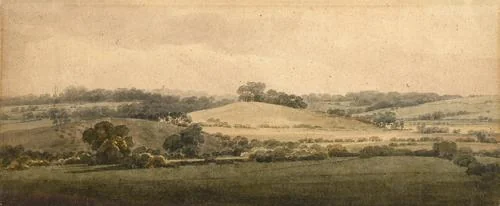
Inscribed verso: Primrose Hill coloured on the spot by/Girtin, watercolour over pencil on oatmeal paper. 19.7 x 48.7 cm.; 7 ¾ x 19 inches Provenance Arthur Boney, his sale, Sotheby’s, 7 October 1947, lot 34, bought by P. & D. Colnaghi & Co. , London; Ray Livingston Murphy (1923-1953), New York, by 1950, his sale, Christie’s, 19 November 1985, lot 35; Robert Tear, OBE (1939-2011), his sale, Sotheby’s, 9 July 2014, lot 189; With Guy Peppiatt Fine Art; Private collection, U.K. until 2024 Literature T. Girtin and D. Loshak, The Art of Thomas Girtin, 1954, no. 416, p. 191; G. Smith, Thomas Girtin (1775-1802): An Online Catalogue Archive and Introduction to the Artist, TG1761 Exhibited New Haven, Yale University Art Gallery, Prospects, 1950, no. 18., pl. 9b; Guy Peppiatt Fine Art, London, British Drawings and Watercolours, 2015, no. 17 This panoramic landscape has been identified as showing Primrose Hill in north London, on the basis of an inscription on the back of the drawing, and Thomas Girtin (1874–1960) and David Loshak consequently dated it to 1800–1801. The area was then undeveloped. It did not become a place of leisure and recreation until well into the nineteenth century, since when the rapid expansion of the city northwards changed the appearance of the landscape so greatly that it may never be possible to confirm the identification of the view with certainty. The work may well have been coloured on the spot, as the inscription suggests, as it is worked in a limited palette without much foreground detail.
View details
Signed l.c.: R. Cooper, pen and brown ink and wash over pencil on laid paper partially watermarked with the Strasburg Lily 20 x 29.4 cm.; 7 7/8 x 11 5/8 inches Framed size 31 x 41 cm.; 12 1/4 x 16 1/8 inches Provenance Iolo Williams collection The artist was born in Edinburgh and trained with his father, the engraver Richard Cooper Snr (1701-1764). He moved to London in 1761, but by 1767 was on the Continent and in Italy by 1771, where he stayed until late 1775. Cooper spent most of his time in Rome and Naples and befriended Jacob More, with whom he travelled, and was later appointed as one of More’s executors. On his return to England Cooper taught drawing at Eton College and later he also taught Princess Charlotte. He produced a series of landscape prints based on his Italian work.
View details£ 2,200

Inscribed and dated l.l.: Monte Generoso/1879, and further inscribed with colour notes, pen and brown ink over pencil 25 x 51.5 cm; 9 7/8 x 20 1/4 inches £8500 Lear returned to Varese and Monte Generoso, on the border between Italy and Switzerland between lakes Lugano and Como, from June 29 to September 22 1879. He stayed at Mendrisio, across the Swiss border in Ticino. He enjoyed sketching the views south across the plains, as in the present watercolour and the mountains stretching up to the Alps. Marianne North the botanical artist came to Como towards the end of his stay and they made a trip to Monte Civita near Monza together. This drawing is taken from a similar vantage point to that of an oil of the same subject dated 1880 in the collection of the Ashmolean Museum (WA196.39). An unpublished poem “The Lays of the Octopods’ about the perils of mass tourism at Monte Generoso has recently come to light in the British Library.
View details£ 8,500

KT636 Watercolour over traces of pencil with touches of gum arabic and scratching out 21 x 29 cm.; 8 ¼ x 11 3/8 inches Provenance Agnew’s, (1891); Private collection, Herefordshire until 2024 Samuel Jackson has been described as ‘the Father of the School’ of Bristol artists. His contemporary Francis Danby (1793-1861) wrote that ‘I know Jackson is a man of genius by being with him in Leigh Woods’ (see F. Greenacre and S. Stodard, ‘The Bristol Landscape-the Watercolours of Samuel Jackson’, 1986, p. 85). In 1820s Bristol was booming, the end of the Napoleonic Wars contributing to its prosperity as a trading city, the port of Bristol second only to London. This was the moment the ‘Bristol School of Artists’ flourished; Jackson and Francis Danby were its best-known members. Their original contribution to art in Britain was founded in their plein air practise in the countryside around the city, Leigh Woods, the Nightingale Valley and the Avon Gorge. Jackson was born in Bristol, the son of a partner in a firm of dry-salters with a Dutch grandmother, who dealt in the chemical products used in colour dyes and artists materials. It may be that in this business was the origin of the wide variety of pigments used in much of Jackson’s early work. Like many other Bristol artists Jackson travelled extensively and made frequent trips to Wales from 1825 through the 1830s and 1840s. In 1827 he visited Trinidad, St Vincent and Tobago in the West Indies. Scotland, the Lake District and Switzerland provided further subjects for his exhibited works. He lived in Bristol for his whole life becoming the elder statesman of the arts in the city. Jackson’s work is well represented at the British Museum, Bristol City Art Gallery and the Yale Center for British Art amongst other institutions.
View details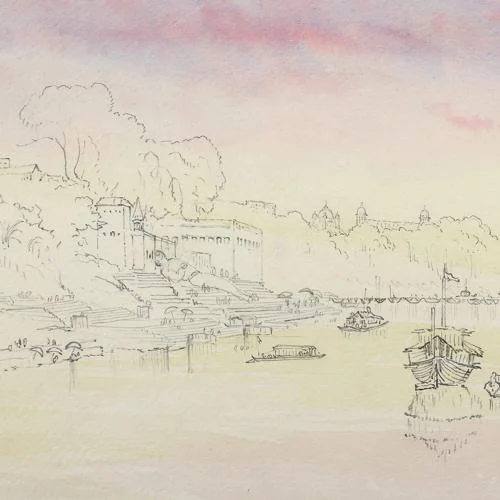
Bridge of Boats and Old Fort, Benares Inscribed and dated l.l.: Bridge of boats and/old Fort-/Benares-/Nov. 20th, watercolour and pencil 17 x 35 cm.; 6 ¾ x 13 ¾ inches In this work, drawn on the spot at Benares, now Varanasi, the Hindu holy city on the banks of the Ganges, a colossal sculpture can be seen on the steps of an old fort. Across the river boats have been lined up and firmly anchored, so that planks can be laid across them to provide passageway for people, carts and carriages, In the Himalayas, p108.
View details
Signed and dated l.r.: W. Callow.1833, watercolour over traces of pencil with scratching out Provenance Private collection U.K. until 2026 This fine example of Callow’s work dates from the time he was sharing a studio in Paris with Thomas Shotter Boys at 19 Rue de Bouloi near the Louvre. He visited England during the summer and presumably travelled through Dover.
View details£ 2,250

Signed with monogram l.l. and dated 1831, watercolour over traces of pencil with gum arabic and scratching out 8.5 x 12 cm.; 3 3/8 x 4 ¾ inches Boys moved to Paris in the early 1820s and became a friend and pupil of Richard Parkes Bonington (1802–1828). He exhibited a large number of watercolours in Paris in the 1830s and is deemed to have made an important contribution to the revival of watercolour painting in France. Boys made several visits to Belgium in the late 1820s and 1830s and was in Brussels during the Belgian Revolution of 1830. His wife Célestine was Belgian, her home either in or near Soignies. His Picturesque Architecture in Paris, Ghent, Rouen etc., was published in 1839.
View details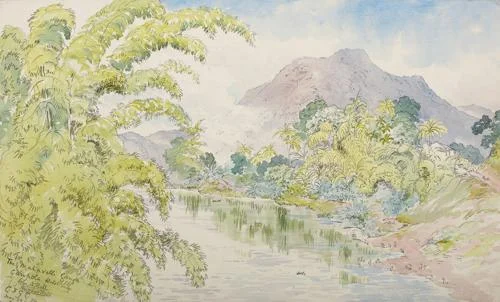
The Mahavelli Ganga (the Mahaweli River) Signed, inscribed and dated l.l.: The Mahavelli Ganga/Gampola Hill/C.FGC./May 29th 74 and signed by John A Bell and Mary Bell, watercolour over pencil 27 x 45 cm.; 10 ½ x 17 5/8 inches The Mahaweli is Sri Lanka’s longest river. Gampola was Sri Lanka’s capital from 1347 to around 1410. Gampola is about 50 miles west of Colombo.
View details
Graphite, with a collector’s mark l.r. 14 x 19.7 cm; 5 1/2 x 7 3/4 inches Provenance: Xavier Haas, c.1937; Professor Anne Crookshank until 2017 Infernal ghosts, and hellish furies, round/Environ’d thee; some howl’d; some yell’d, some shriek’d/Some bent at thee their fiery darts, while thou/Sat’st unappall’d in calm and sinless peace. John Milton, Paradise Regained, Book 4 This small but highly detailed drawing was done in late 1794 or early 1795, when Romney began to work on the subject of ‘The Temptation of Christ’, producing intense pencil sketches for a project that he barely began to realise in oils. The poet William Hayley’s son Thomas claims credit for having suggested this theme to Romney, which was inspired by a passage in Milton’s Paradise Regained [Book 4, lines 422-5]. Christ can be seen seated at the bottom right of this strong drawing, with the fiends of Satan whirling around his head. There are other studies of this subject in the collection of the Yale Centre for British Art, New Haven (see Alex Kidson, George Romney 1734-1802, London 2002, p. 228). John Romney claimed that his father’s projected canvas measured about 16 by 12 feet, which would have been by far the largest painting he ever conceived, and that it was ‘equal in original conception and wild fancy to any thing ever produced by any artist..had he finished [it] it would have ranked him with Michel Angelo’ (see Romney, Rev. John, Memoirs of the Life and Works of George Romney..’, London 1830, p. 245). The rolled canvas upon which there was a nearly finished head of Christ and the beginning of Satan’s head was sent to Christie’s in April 1807 for the studio sale, was never unrolled due to its size, and subsequently disappeared. Xavier Haas was a Parisian dealer of the Galerie Haas et Gross, who formed the greatest collection of Romney drawings after the break-up of the artist’s studio. Anne Crookshank (1927-2016) was Emeritus Professor of art history at Trinity College, Dublin and played a major role in the development of the study of Irish art.
View details
KT584 Signed and dated l.r.: SJ Lamorna Birch/.1916, watercolour with pen and red ink and bodycolour over traces of pencil on artist’s board, signed, inscribed and dated verso in pencil: No 5’The Valley of Lamorna’/SJ. Lamorna Birch RWS/RBS/Lamorna./Penzance., in the original frame made by J.H. Steer Ltd. 36.5 x 54 cm.; 14 3/8 x 21 ¼ inches Provenance W.G. Gill Esq, Aberdeenshire, bought from the RWS exhibition Exhibited Royal Society of Painters in Watercolours, 1916, no. 5 The artist settled in Lamorna in 1892 and lived with his wife at Flagstaff Cottage. He exhibited extensively at the Royal Academy. Shades of British Impressionism Lamorna Birch and his Circle was shown at the Warrington Museum and Art Gallery in October 2004. The exhibition explored his links with Henry Scott Tuke and Thomas Cooper Gotch and their emphasis on colour and light, truth and social realism.
View details
Chale Bay- looking out to sea from St Catherine’s Down and Oratory, Isle of Wight Watercolour over traces of pencil. 32.3 x 54.1 cm.; 12 ¾ x 21 ¼ inches Provenance Spink, London, sold 11 October 1956; Private collection U.K., until 2020; With Karen Taylor Fine Art; Private collection, U.K. until 2024 Turner of Oxford was in Sussex in 1846 from when this beautiful drawing may well date, as he made a large watercolour from near Portsmouth with the Isle of Wight in the distance in that year. He has chosen a calm day and the stillness of the shepherds amplifies the awe with which they are observing the beauty of nature. The location has an interesting history. In 1313, a ship, the St Mary of Bayonne, was blown off-course and ran aground on the treacherous Atherfield Ledge in Chale Bay. Its cargo of white wine was sold illegally by the sailors and many barrels found their way into the cellars of Walter de Godeton, Lord of the Manor of Chale. The ship came from Gascony, then part of King Edward II’s kingdom. He was not amused, and Walter de Godeton was fined by an ecclesiastical court. The Pope heard of the incident and, to avoid excommunication, de Godeton was ordered to build an oratory and beacon on Chale Down as penance.
View details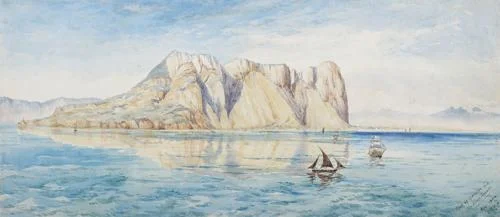
The Rock of Gibraltar and the Sierra Nevada Inscribed and dated l.r.: Rock of Gibraltar and /The Sierra Nevada/Nov. 1868/C.F.G.C., watercolour over pencil with touches of white 22.7 x 53.3 cm.; 9 x 21 inches
View details
Signed and dated l.r.: Edward Lear. Del 1842, inscribed l.l.: Villa Adriana., pencil heightened with white 24 x 36.7 cm.; 9 3/8 x 14 3/8 inches Provenance Phillip’s, London, 11 November 1997, lot 45; Private collection U.K. until 2023 £8500 Lear set out for Italy in the summer of 1837. For most of the next ten years the artist wintered in Rome and toured other parts of Italy during the summer. This crisply drawn view with white highlights of the Villa Adriana is a fine example of the artist’s pencil drawing, which he favoured early in his Italian soujourn and shows the influence of James Duffield Harding. A related drawing of the Villa Adriana in upright format is in the collection of the British Museum (P_1892-1119-15). The same figures can be seen in the foreground and the compositional emphasis is on the trees on the right of the composition. Situated on a low plain on the slopes of the Tiburtine Hills, Hadrian’s Villa was the largest villa of the Roman Empire, built over an area of more than one hundred hectares.
View details£ 8,500

KT523 Pen and grey ink and watercolour over pencil on laid paper watermarked J WHATMAN, inscribed verso in pencil: Inscribed on old mount/near Chepstow/William Day 30x 39 cm.; 11 ¾ x 15 3/8 inches Provenance Cyril Fry This exceptionally fresh drawing is a lovely example of the work of William Day, an accomplished amateur artist, who exhibited at the Royal Academy between 1782 and 1801 as an Honorary Exhibitor. The late Judy Egerton wrote an article about him in The Connoisseur, July 1970, pp. 176-185. It is not known for certain when Day met John Webber, the Swiss-born artist who is famous for accompanying Captain Cook on his last expedition to the South Seas between 1776 and 1780. The Connoisseur article notes, without giving a source, that the friendship between the two artists “began about 1787”. Day and Webber were sketching together in the Wye valley in 1788, which is the first time that pairs of views by the two artists of the same subject are known to exist. Two watercolours by Webber of Chepstow Castle dated 1788, which are now in the Whitworth Art Gallery, University of Manchester (D.1900.12 & D.1970.77) (see Charles Nugent, British Watercolours in the Whitworth Art Gallery, 2003, p. 282) correspond to two watercolours by Day which were acquired by Chepstow Museum in 2012. A family note lists Day’s interest in the following order:’ Geology, Minerology and Painting’ and he formed one of the earliest private collections of minerals in England. His collection was carried on by his son William Day (1797-1849) and his grandson and passed to the Hampstead Central Library where it was destroyed by bombing during WWII.
View details£ 2,800

Signed l.l.: Edith Martineau., watercolour over traces of pencil with scratching out and gum arabic 29 x 23.5 cm; 11 3/8 x 9 ¼ inches This is a view of Hampstead Heath looking towards Harrow on the Hill. Edith Martineau, together with her sister Gertrude, was one of a small group of female artists associated with the Pre-Raphaelites. The daughter of Dr James Martineau, a Unitarian minister and theologian, the artist was born in Liverpool. After studying at the Liverpool School of Art and Leigh's Academy, she became one of the first women to be admitted to the Royal Academy Schools in 1862, regularly exhibiting there and at the Royal Watercolour Society (where she was elected an associate member in 1862), the Grosvenor Gallery and the New Water-colour Society. Her work was also exhibited at the Palace of Fine Arts in 1893 at the World’s Columbian Exposition in Chicago. She died in Hampstead. Martineau worked in watercolour primarily and is known for her delicately painted and meticulous landscapes which owe much to the Pre-Raphaelites, and genre paintings. Examples of her work can be found in the collection of the Victoria & Albert Museum, the National Gallery of Art in Washington D.C. and other institutions.
View details£ 1,250
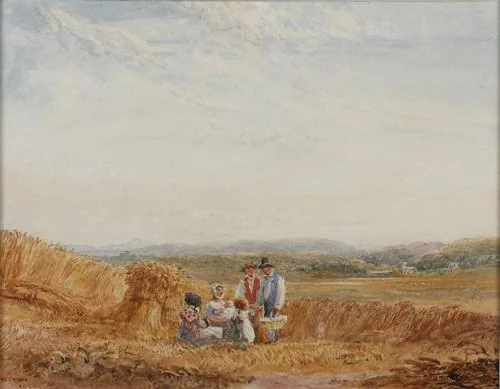
KT587 Signed and dated l.l.: D. Cox/1824, watercolour over pencil 22.6 x 28.9 cm.; 8 ¾ x 11 3/8 inches Provenance Colnaghi (exhibited as ‘In the Wye Valley’); Viscount Eccles (1905-1994); Abbott and Holder; from where acquired by Peter Roberts until 2023 Exhibited Probably the Society of Painters in Water-Colours, 1824, no. 289, Hay Field – View near Hereford This charming watercolour is a fine example of the fluent small-scale drawings with which Cox had commercial success in the mid to late 1820s. He wrote to William Radclyffe that he intended to devote more time to saleable smaller works, as his larger pictures were not finding buyers (Scott Wilcox points out that his discovery of the elegant small watercolours by Bonington at this date would have provided a compelling model (See Scott Wilcox, ed., Sun, Wind, and Rain: The Art of David Cox, exhibition catalogue, Yale Centre for British Art, p. 36). The castellated church in in middle distance may well be modelled on St Peter’s, Lugwardine. The building to the right of the church bears a passing resemblance to Sufton Court (which is not so close to the church). Cox was an artist, not a topographer, and frequently modified landscapes and landmarks to suit his artistic vision. Viscount (David) Eccles (1905-1994) had a fine collection of 18th and 19th century British drawings. He was a politician who organised the coronation of Queen Elizabeth II. After being sacked by Harold Macmillan in July 1962 he went back into business, first as a director of Courtaulds and later as chairman of West Cumberland Silk Mills. Peter Roberts was a school master and collector of English watercolours who taught English at Oundle School until his retirement in 2007.
View details
Signed with initials in pencil l.r.: HBB, watercolour 24 x 17 cm.; 9 ½ x 6 ¾ inches Provenance Pietro Raffo, until 2022 £2200 This watercolour shows the influence of J.M.W. Turner, whose watercolour studies were copied by Brabazon.
View details£ 2,200
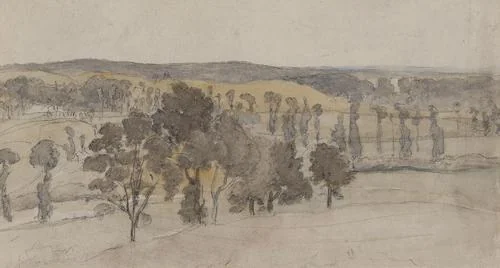
Watercolour over pencil 20.5 x 38 cm.; 8 1/8 x 15 inches Provenance Walter Coleridge Richmond (1852-1931), the son of the artist, by descent; With Radnorshire Fine Art Richmond continued to draw and paint landscapes throughout his successful career as a portraitist. These works remained private and stayed mainly in his family. This beautiful sketch has a directness which reflects his enjoyment of the opportunity for contemplation when drawing from nature.
View details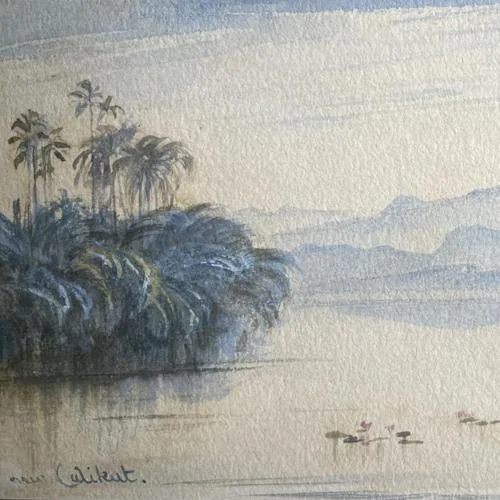
Signed with monogram l.r., inscribed l.l.: near Calikut., watercolour heightened with touches of bodycolour Provenance Franklin Lushington (1823-1901) and thence by descent Lear was invited to India by his friend and patron Lord Northbrook who was appointed Viceroy in 1871, and his journey there was the last and longest of his life. He was overwhelmed by the colour and vitality of India and enjoyed the bustle of Viceregal life. Calicut, or present-day Kozhikode, is on the Malabar coast in Kerala and was a centre of the Indian spice trade. Edward Lear arrived there in October 1874, just as the monsoon began. He was warned about the dangers of contracting fever but stayed, despite the pouring rain, until the skies were clear enough to draw. He described the roads around the city as “of such redundant beauty one can hardly dream.” Franklin Lushington, Lear’s close friend and first owner of this drawing, was the son of Edmund Henry Lushington. He was appointed judge to the Supreme Court of Justice in the Ionian Islands in 1855 and Lear went with him to live in Corfu. They first met in Malta in 1849, where Franklin’s elder brother Henry was Chief Secretary to the government. On his death, Lear left all his papers to Lushington, who later destroyed most of them.
View details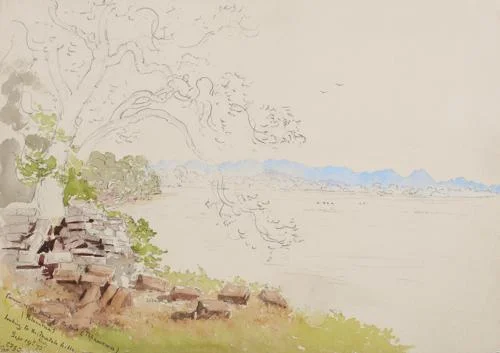
Corner of the Band of the Tank, Tapawewa, Polanarua (Polonnaruwa), looking to the Matele hills Signed, inscribed and dated l.l.: Corner of the Band of the Tank (Tapawewa)/(Polanarua)/looking to the Matele hills./Kandy/Sept 19th 73./CFGC/117, watercolour and pencil 35.5 x 50.5 cm.; 6 ¼ x 19 ¾ inches Polonnaruwa is in North Central Sri Lanka.
View details
KT519 Signed with monogram and dated 1929 l.r., watercolour 15 x 24.2 cm.; 5 7/8 x 9 ½ inches Provenance The family of the artist, by descent until 2022 Southall was born in Nottingham of Quaker parents, and was taken by his mother to Birmingham when his father died in 1862. In 1874 he entered the Friends’ School, Bootham, where he was taught painting by Edwin Moore (brother of Albert and Henry). Four years later he joined the Birmingham firm of architects, Martin and Chamberlain, but in 1882 he left to focus on painting and joined the Birmingham School of Art settling in Edgbaston, where he lived for the rest of his life. Southall and his wife Anna paid frequent visits to Italy and France.
View details