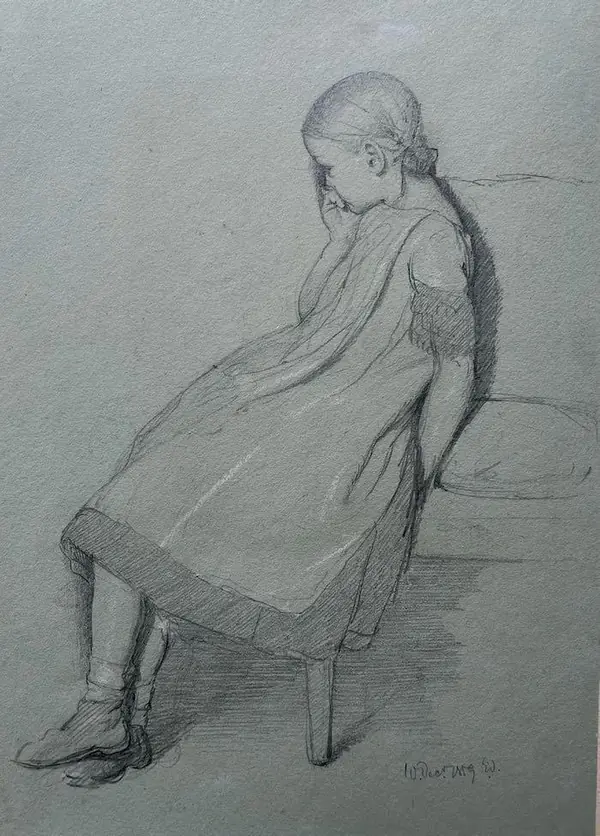
Inscribed verso: At Dulwich, sepia wash
15.5 x 11.3 cm.; 6 1/8 x 4 3/8 inches
This drawing was executed while Cox was living in Dulwich between 1809 - 1813, in the house beside the windmill on Dulwich Common.
Exhibited
Dulwich Picture Gallery, ‘Bicentenary Exhibition’, catalogue no. 4;
Dulwich Picture Gallery, ‘Dulwich Past and Present’, summer 1993
Provenance
The Carnegie family;
By descent to Lord Rosehill;
Anthony Reed, English Drawings and Paintings, Cork Street, London W1;
Sotheby’s, 1 April 1993, lot 75;
Barbara Brind;
By descent until 2022
You Might Also Like

Inscribed l.r.: Bruges, watercolour7.6 x 11.4 cm; 3 x 4½ inchesProvenanceSpink & Son Ltd, London, K3/1890b, part of a group purchased from Appleby Brothers, 2 August 1960.This spontaneous, on-the-spot sketch was presumably done when Cox visited Bruges in 1826. His first trip to the Continent was organised by his brother-in-law Mr Gardener, an agent for the sale of government ordnance maps who had premises at 163 Regent Street, London. Gardener persuaded Cox and his son David Cox Jr to accompany him on a business trip to Brussels. The party travelled from Dover to Calais and then, travelling by diligence, on to Dunkerque, Bruges and Brussels. Cox evidently liked the caps worn by the market women in Belgium as he sketched them again in Brussels.1 1.See N. Neil Solly, Memoir of the Life of David Cox, 1873, reprinted 1973, p. 49.
View details
Signed and dated l.l.: David Cox. 1836, watercolour over pencil with scratching out18 x 26 cmIn the summer of 1836 Cox spent a few weeks at Rowsley, painting at Haddon Hall. He made several watercolours of elegant figures in seventeenth century costume strolling on the terrace there to which the present work relates. Although the present work does not appear to be of Haddon, it fits in with this period of his oeuvre.
View details
Signed l.l.: David Cox., watercolour over traces of pencil with touches of pen and black ink on buff paper29.6 x 39 cm; 11 ¾ x 15 ⅜ inchesProvenance: Agnew’s, London, 126th annual exhibition, March 1999, no. 63; The Flannery collection, UK, and by descent until 2018.This very freely drawn watercolour represents a transitional stage in the development of the important theme of ‘Peace and War’, one of David Cox’s major subjects. Two local men, one seated, one standing, watch a small troop of soldiers on the march in an extensive sweeping landscape under a huge sky, with Lancaster Castle in the middle distance and the waters of Morecambe Bay beyond. Unusually for Cox there is not much pencil underdrawing.Cox’s preoccupation with military activity during the very unsettled years of the 1830s and 1840s manifests itself after his 1838 trip with his wife to Seabrook, near Hythe in Kent, for six weeks. The artist made sketching trips along the coast of Kent, including one to Lympne, five miles from Hythe, resulting in Peace and War: Lympne Castle ( c. 1838, Birmingham Museums & Art Gallery).The present work, which is similar in style and feel to the Lympne watercolour, presumably dates from the same time, but shows the composition reversed and the distant focus of Lancaster Castle as in Lancaster: Peace and War, 1842 (Art Institute of Chicago). Most of Cox’s numerous ‘Peace and War’ subjects are set at Lancaster rather than Lympne and have more developed references to ‘War’ than the small troop of riders seen here on the top of the hill on the left.The theme is repeatedly treated by Cox at this period, resulting in his 1838 exhibits at the Society of Painters in Water-colours in London, Rocky Scene – Infantry on the March and Stirling Castle – Cavalry on the March and the 1839 Cavalry on the March. In 1848 the first work to be entitled Peace and War (Lady Lever Art Gallery, Port Sunlight, National Museums Liverpool) was exhibited at the Society of Painters in Water-colours.
View details
Watercolour over pencil with scratching out18.2 x 22.8 cm.; 7 ¼ x 9 1/8 inchesProvenanceQuentin and Molly Bridge until 2020ExhibitedMartyn Gregory, British Watercolours & Drawings, 2020, no. 8This charming early drawing by Cox dates to circa 1815. A woman and a child can be seen collecting water in a bucket from a stream near a wooden bridge by a cottage. The child appears to be wearing a black Welsh hat.
View details
KT587Signed and dated l.l.: D. Cox/1824, watercolour over pencil22.6 x 28.9 cm.; 8 ¾ x 11 3/8 inchesProvenanceColnaghi (exhibited as ‘In the Wye Valley’);Viscount Eccles (1905-1994);Abbott and Holder; from where acquired byPeter Roberts until 2023ExhibitedProbably the Society of Painters in Water-Colours, 1824, no. 289, Hay Field – View near HerefordThis charming watercolour is a fine example of the fluent small-scale drawings with which Cox had commercial success in the mid to late 1820s.He wrote to William Radclyffe that he intended to devote more time to saleable smaller works, as his larger pictures were not finding buyers (Scott Wilcox points out that his discovery of the elegant small watercolours by Bonington at this date would have provided a compelling model (See Scott Wilcox, ed., Sun, Wind, and Rain: The Art of David Cox, exhibition catalogue, Yale Centre for British Art, p. 36).The castellated church in in middle distance may well be modelled on St Peter’s, Lugwardine. The building to the right of the church bears a passing resemblance to Sufton Court (which is not so close to the church). Cox was an artist, not a topographer, and frequently modified landscapes and landmarks to suit his artistic vision.Viscount (David) Eccles (1905-1994) had a fine collection of 18th and 19th century British drawings. He was a politician who organised the coronation of Queen Elizabeth II. After being sacked by Harold Macmillan in July 1962 he went back into business, first as a director of Courtaulds and later as chairman of West Cumberland Silk Mills.Peter Roberts was a school master and collector of English watercolours who taught English at Oundle School until his retirement in 2007.
View details
Head and shoulders, pen and brown ink and wash22.9 x 17.3 cm; 9 x 10 3/4 inchesProvenance: Private collection, UK, bought at a charity auction at the Finchingfield GuildhallLandseer’s caricatures are a less well-known aspect of his art. They were made for private circulation and show Landseer’s effortless ability to capture the physical oddities of his subjects in an acute yet affectionate fashion. This drawing was once thought to depict Paganini but the subject is currently unidentified.
View details
Watercolour, with a pencil sketch of a house in a landscape verso, on laid paper11.2 x 13 cmProvenance: William Arnold Sandby; John Manning, London; Private collection, UK until 2017William Arnold Sandby (c. 1828-1904) was the great-grandson of Thomas Sandby, author of the first book about the artists, Thomas and Paul Sandby-Royal Academicians, 1892, and the historian of the Royal Academy (two volumes of its history published in 1862). He had a large collection of the work of his forebears, helped organise their first exhibition at Nottingham Castle Museum in 1884 and bequeathed many of their works to museum collections.
View details
Signed l.r.: W. HUNT, pencil, tiny sketches of figures and a list verso, on wove paper12 x 8.4 cm.; 7 ¼ x 4 ¾ inchesProvenance: Cyril and Shirley Fry until 2021Literature: J. Witt, 'William Henry Hunt (1790-1864)', 1982, no. 370Exhibited: 'Hunt Exhibition Fry Collection', 1967, no. 17 (1)This drawing dates from circa 1820. Hunt drew the same girl on another occasion in a similar pose (Rossetti Collection, J. Witt, ibid. no. 492).
View details
Oil on board, inscribed verso: Grindlay, inscribed on old backing paper by one of Edward Grindlay’s children: An early James Gunn/My father admired it in the/Studio so James framed it/and gave it to him22.4 x 14.2 cm.; 8 7/8 x 5 5/8 inchesFrame size 34 x 24 cm.; 13 3/8 x 9 ½ inchesProvenanceGiven by the artist to Edward Grindlay;By descent until 2021This beautiful view of the Place de la Concorde was done in 1911-1912 when Gunn studied at the Académie Julian in Paris under Jean Paul Laurens. It is previously unrecorded and a significant addition to his rare small pictures of Paris.While in Paris Gunn started to make tonally delicate panels of the city on small boards, using a muted palette reminiscent of Whistler, capturing street scenes with tiny figures drawn with a few strokes of the brush. He also made regular visits to the Louvre to draw from the Old Masters and rented a room at 2 bis rue Perel. His small pictures of Paris are not numerous and are highly sought after.Gunn has painted this work from near the centre of the Place de la Concorde, looking towards the eastern end of the Champs Elysées, with the Grand Palais visible behind the trees of the Jardin des Champs-Elysées. The statue on the plinth is one of the famous Chevaux de Marly by Guillaume Costou, brought from the Chateau de Marly in 1719 and now in the Louvre.James Gunn attended drawing lessons from the age of five. He studied at the Glasgow School of Art, the Edinburgh College of Art before he went to Paris. Gunn returned to Edinburgh in 1912 and also spent time in London. Early in 1914, at the instigation of the London dealer W.B. Paterson, he travelled widely in Europe, sending pictures back home, and revisiting Paris and Étretat. He enlisted with the Artists Rifles in 1915.Gunn gave a speech to the Glasgow Art Club in November 1955 and reminisced about his early career,‘…In Paris I studied at the Académie Julian under Jean Paul Laurens…I returned from Paris with a collection of sketches made in the streets and by the river. Many of these passed through the house of Anna. There they were seen and some were purchased by a dealer from Bond Street, W.B. Paterson, brother of the distinguished Scottish Academician, James. He gave me a contract, paid me a retaining fee and I undertook to provide him with not less than thirty pictures a year. At his instigation I went to Spain at the beginning of 1914. There I travelled, seeing and painting, till the echoes from Sarajevo warned that the good days were soon to end’.Edward ‘Teddy’ Grindlay and Gunn met in 1917 towards the end of WWI when they were commissioned into the 10th Scottish Rifles, the beginning of a life-long friendship. Gunn’s drawings of his fellow officers were published in a book ‘The 10th Battalion, The Cameronians (Scottish Rifles): a Record and a Memorial 1914-1918’.Grindlay saw this oil sketch in Gunn’s studio and admired it, so the artist had it framed and gave it to his friend. Edward and his wife Evelyn were both painted by Gunn who also painted a conversation piece of their house at 1 Newton Grove, Bedford Park in London in 1927. They later moved to Westcott near Dorking. They owned many paintings and drawings by Gunn who used his friend as a model for Maurice Baring in his famous conversation piece with Hilaire Belloc and G.K. Chesterton, which is now in the National Portrait Gallery, London (NPG3654). He received commissions from many of the leading figures of the day and painted the Royal Family in another famous conversation piece at Royal Lodge, Windsor (NPG3778).Gunn had a successful career as a portrait painter and in 1961 was elected a member of the Royal Academy.
View details
Chale Bay- looking out to sea from St Catherine’s Down and Oratory, Isle of WightWatercolour over traces of pencil.32.3 x 54.1 cm.; 12 ¾ x 21 ¼ inchesProvenanceSpink, London, sold 11 October 1956;Private collection U.K., until 2020;With Karen Taylor Fine Art;Private collection, U.K. until 2024Turner of Oxford was in Sussex in 1846 from when this beautiful drawing may well date, as he made a large watercolour from near Portsmouth with the Isle of Wight in the distance in that year. He has chosen a calm day and the stillness of the shepherds amplifies the awe with which they are observing the beauty of nature.The location has an interesting history. In 1313, a ship, the St Mary of Bayonne, was blown off-course and ran aground on the treacherous Atherfield Ledge in Chale Bay. Its cargo of white wine was sold illegally by the sailors and many barrels found their way into the cellars of Walter de Godeton, Lord of the Manor of Chale.The ship came from Gascony, then part of King Edward II’s kingdom. He was not amused, and Walter de Godeton was fined by an ecclesiastical court. The Pope heard of the incident and, to avoid excommunication, de Godeton was ordered to build an oratory and beacon on Chale Down as penance.
View details