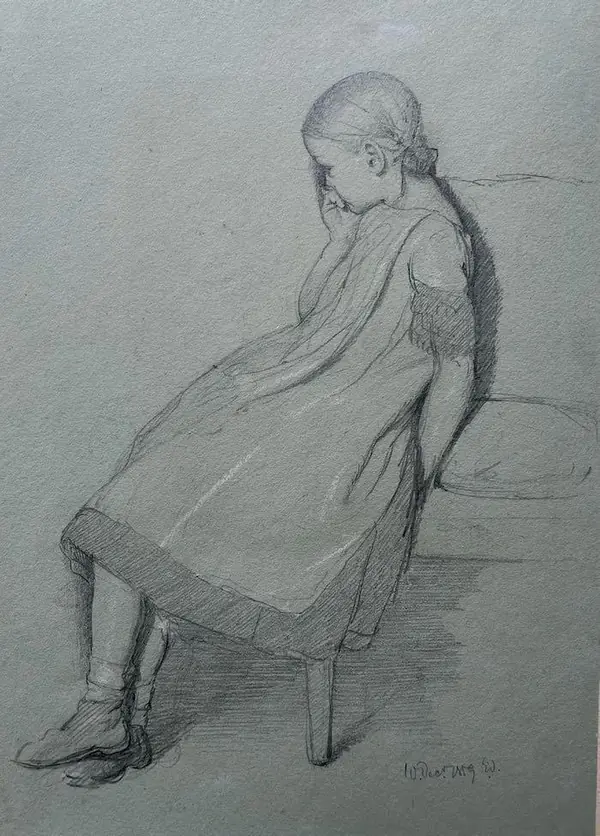
Signed with initials lower right: GR, pen and brown ink
13 by 20.9 cm; 5 ¼ x 8 ¼ inches
Provenance: Cyril and Shirley Fry until 2021
This beautiful, spare drawing probably dates from the 1840s. Richmond added his initials in pencil to many of his drawings towards the end of his life.
You Might Also Like

Signed and dated in gold paint l.l.: Geo Richmond.1834, watercolour over pencil heightened with white and gold and touches of gum arabic35.3 x 25.1 cm.; 13 ¾ x 9 7/8 inchesProvenanceBy descent in the family of the sitter until 2015;Their sale, Bonhams, London, 24 November 2015, lot 95;Private collection, U.K.LiteratureR. Lister, George Richmond A Critical Biography, 1981, p. 162, nos. 203 and 204The sitter wears the uniform of the Madras Horse Artillery, and the Order of the Bath Companion’s breast badge, and is standing in an Indian landscape with his hand upon a cannon.Lieutenant Colonel Sir Charles Hopkinson was born on September 14th, 1783, in Grantham, Lincolnshire. He had a distinguished career in the service of the East India Company and commanded the Company's artillery during the First Anglo-Burmese War (1824-1826). He was made a Companion of the Most Honourable Military Order of The Bath and subsequently knighted for his services. He died in December 1864.The Madras Army was the army of the Presidency of Madras and run by the East India Company until 1858. It was finally merged into the Indian army in 1895.After his marriage to Julia Tatham in 1831 George Richmond turned to portrait painting. He quickly established a fashionable painting practise and became one of the most fashionable portrait painters of his time.
View details
Watercolour over pencil20.5 x 38 cm.; 8 1/8 x 15 inchesProvenanceWalter Coleridge Richmond (1852-1931), the son of the artist, by descent;With Radnorshire Fine ArtRichmond continued to draw and paint landscapes throughout his successful career as a portraitist. These works remained private and stayed mainly in his family. This beautiful sketch has a directness which reflects his enjoyment of the opportunity for contemplation when drawing from nature.
View details
Inscribed verso: Primrose Hill coloured on the spot by/Girtin, watercolour over pencil on oatmeal paper.19.7 x 48.7 cm.; 7 ¾ x 19 inchesProvenanceArthur Boney, his sale, Sotheby’s, 7 October 1947, lot 34, bought by P. & D. Colnaghi & Co. , London;Ray Livingston Murphy (1923-1953), New York, by 1950, his sale, Christie’s, 19 November 1985, lot 35; Robert Tear, OBE (1939-2011), his sale, Sotheby’s, 9 July 2014, lot 189;With Guy Peppiatt Fine Art;Private collection, U.K. until 2024LiteratureT. Girtin and D. Loshak, The Art of Thomas Girtin, 1954, no. 416, p. 191;G. Smith, Thomas Girtin (1775-1802): An Online CatalogueArchive and Introduction to the Artist, TG1761ExhibitedNew Haven, Yale University Art Gallery, Prospects, 1950, no. 18., pl. 9b;Guy Peppiatt Fine Art, London, British Drawings and Watercolours, 2015, no. 17This panoramic landscape has been identified as showing Primrose Hill in north London, on the basis of an inscription on the back of the drawing, and Thomas Girtin (1874–1960) and David Loshak consequently dated it to 1800–1801. The area was then undeveloped. It did not become a place of leisure and recreation until well into the nineteenth century, since when the rapid expansion of the city northwards changed the appearance of the landscape so greatly that it may never be possible to confirm the identification of the view with certainty.The work may well have been coloured on the spot, as the inscription suggests, as it is worked in a limited palette without much foreground detail.
View details
Watercolour on laid paper, with exhibition label attached to backboard15 x 32.5 cm.; 6 x 12 3⁄4 inchesProvenanceMiss Bostock, companion to Miss H.H. Tatlock, the artist’s granddaughter;Christie’s, 12 September 1941, lot 29;Where purchased by Thomas Agnew & Son Ltd., London;Sold to a private collector 18 May 1942;Private collection, Wiltshire until 2023ExhibitedUsher Art Gallery Lincoln, Peter De Wint Exhibition, 1937, no. 146Horsemen can be seen in the foreground of this freely drawn, spare landscape, which exemplifies Peter de Wint’s brilliance and delicacy in the laying of washes.
View details
Signed with monogram l.r., inscribed l.l.: near Calikut., watercolour heightened with touches of bodycolourProvenanceFranklin Lushington (1823-1901) and thence by descentLear was invited to India by his friend and patron Lord Northbrook who was appointed Viceroy in 1871, and his journey there was the last and longest of his life. He was overwhelmed by the colour and vitality of India and enjoyed the bustle of Viceregal life.Calicut, or present-day Kozhikode, is on the Malabar coast in Kerala and was a centre of the Indian spice trade. Edward Lear arrived there in October 1874, just as the monsoon began. He was warned about the dangers of contracting fever but stayed, despite the pouring rain, until the skies were clear enough to draw. He described the roads around the city as “of such redundant beauty one can hardly dream.” Franklin Lushington, Lear’s close friend and first owner of this drawing, was the son of Edmund Henry Lushington. He was appointed judge to the Supreme Court of Justice in the Ionian Islands in 1855 and Lear went with him to live in Corfu. They first met in Malta in 1849, where Franklin’s elder brother Henry was Chief Secretary to the government. On his death, Lear left all his papers to Lushington, who later destroyed most of them.
View details
Watercolour17.5 by 25.5 cmTwo of the dogs are terrier types (Irish terrier on the left, and black and tan on the right) and the white dog with brown spots is a pointer type.Provenance: Augusta Raymond-Barker, Fairford Park, Gloucestershire; thence by family descent until 2016The artist was the youngest son of portrait painter Nathan Theodore Fielding. From 1827 to 1830 he lived in Paris, where he ran the family engraving business, at which William Callow worked. He was closely associated with the Anglo-French circle of artists centred around Bonington and Delacroix.He collaborated with his brothers Thales and Theodore in England before returning to France where he built up an extensive teaching practice, with pupils including members of the family of King Louis- Philippe. He published a number of teaching manuals and lived in France until his death.
View details
Laura Knight, DBE, RA, RWS (1877-1970)Anna Pavlova rehearsing The Bacchanal, c. 1910-1911Signed l.l.: Laura Knight, oil on canvas45.5 x 41 cm.; 17 5/8 x 16 1/8 inchesProvenancePeter and Vera Chadwick, 1977 (according to an inscription onthe previous frame);Harry Greatorex, 1988;His sale at Sotheby’s, unidentified sale 1988(?), lot 73;Private collection U.K. until 2025Knight captures the grace, elegance and kinetic energy of the most famous ballerina of her day on stage performing her most dynamic and erotic role.Pavlova (1881 – 1931) visited London with Sergei Diaghilev's company for the first time in the summer of 1910. She caused a sensation with her dramatic Dance Bacchanal from Pepita's ballet The Seasons, choreographed by Mikhail Fokine, which was to become one of her signature roles. An erotic duet, performed with Mikhail Mordkin saw the dancers throwing garlands and striking sensual poses with theatrical abandon, wearing Greek tunics.Knight was mesmerised by the Ballets Russes when they performed in London during the years before the First World War. In particular, she became enamoured with the dancer Anna Pavlova. In her autobiography, 1965, Knight wrote: ‘The whole look of Pavlova had perfection of finish … But whatever the beauty of form may have been, she possessed an attraction all her own ... a something not of this world.’ (L. Knight, The Magic of a Line, p. 161). In 1911 she made sketches of Pavlova at the Palace Theatre, continuing her interest in the figure in motion. Pavlova often invited Knight to her home, The Ivy House in Golders Green next to Hampstead Heath, which she bought in 1912, so she could sketch her. Knight drew Pavlova’s portrait many times as well as sketching her backstage and made small enamel pieces recording her dancing. Her work helped cement the dancer’s reputation in Britain and beyond.Pavlova settled in London after the Russian Revolution of 1917.
View details
KT453BInscribed and dated in pencil verso: Tring Hill/ 1791, oil on paper12.8 x 19 cm.; 5 1/16 x 7 ½ inchesFrame size 29 x 34 cm.; 11 1/4 x 13 ¼ inchesProvenanceMr Nicholson, Oxford, until 1942, when acquired byEdward Croft-Murray, CBE, (1907-1980);Jill Croft-Murray until 2020;Woolley and Wallis, The Edward Croft-Murray Collection, 11 August 2021, lot 421This spontaneous oil sketch originally came from an album of oil sketches from nature, executed in 1790s and assembled by the artist for his own pleasure, inscribed ‘Studies from nature by G. Garrard’. Five further examples of his oil sketches of locations in and around London are in the collection of Tate Gallery.
View details
Inscribed on original label now attached to backboard: General Distant View of the Carnarvonshire Mountains, seen from the road beyond Llangerniew,/going by the Vale of the Elwyn from St Asaph to Llanrwst-Principal in this Towering Group, are Moel Siabod, Snowdon, The Glyders/ and Trevaon Denbighshire, watercolour over pencil.13 x 20.8 cm.; 5 1/8 x 8 ¼ inchesProvenanceGeorge Greville, 2nd Earl of Warwick (1746-1816), no. 17, part of an album sold at Sotheby’s, 17 June 1936;With Leger Galleries, 1980; Christie’s, London, 20 November 1984, lot 113, where bought by a private collector, until 2024Smith seems to have been fascinated by the Welsh countryside and dated drawings, often inscribed ‘taken on the spot’, point to visits nearly every year from 1784-1798, after his return from Italy.The artist was born in Cumberland and patronised by 2nd Earl of Warwick who sponsored his travels to Italy in 1776 and whose name became the artist’s sobriquet. Smith spent five years in Rome and Naples, befriending William Pars and Thomas Jones, in whose Memoirs he is frequently referenced. He travelled home in 1781 through Switzerland with Francis Towne and was among the most admired watercolourists of his day.
View details
Inscribed (recto): T Von Holst, pencil and pen and brown ink, verso: pencil, on laid paper with a partial Strasburg Lily watermark, laid down on a brown sheet numbered 1027.2 x 21.4 cm; 10 3⁄4 x 8 1⁄2 inchesProvenanceJohn Welch Etherington Rolls (1807-1870);By family descent to Lady Shelley Rolls, her sale at Sotheby’s, London,12 June 1959;P. & D. Colnaghi;Private collection U.K. until 2019Von Holst’s drawing of the seated woman, recto, is after a figure in Raphael’s ‘Miraculous Draft of Fishes’; the drawing for the tapestry cartoon is in the Albertina, Vienna. A print was made after the drawing, which von Holst probably copied. The figure of the standing female on the recto is a characteristic Holst pose, derived from Vincenzo Danti’s bronze statue of Venus in the Palazzo Vecchio, Florence (see Max Browne, The Romantic Art of Theodor von Holst 1810-44, 1994, p.15).The drawing on the verso illustrates a scene inspired by a Gothic novel such as The Mysteries of Udolpho by Ann Radcliffe, published in 1794. One of the most popular novels of its day, its main character Emily St. Aubert, a virtuous and beautiful young woman, undertakes a series of dramatic adventures; she escapes from captivity at the hands of a cruel villain in a brooding castle to freedom.The brown card inlay on which the present drawing is contained is from the Rolls album, a large leather-bound album which forms the largest-known group of drawings by the artist. The family lived at The Hendre in Monmouthshire, where they also had at least five oils by von Holst. They were also involved with the theatre and opened their own in the grounds.The pencil inscription “T. Von Holst’ appears on almost all the drawings in the album and is effectively its collection mark.
View details