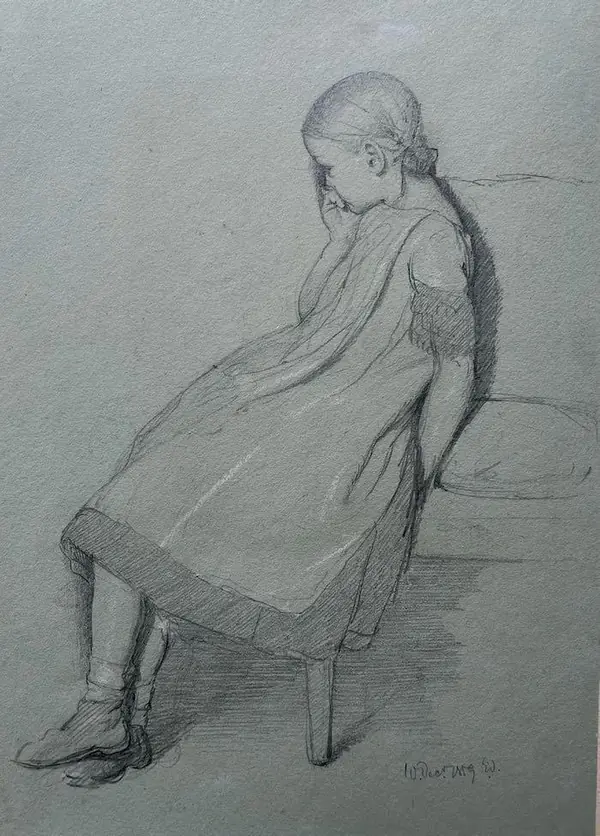
Signed and dated l.l.: Arthur Severn R.I./1906, watercolour over traces of pencil, with label attached to backing board.
27 x 37 cm.; 10 5/8 x 10 5/8 inches.
Provenance: The Leicester Galleries, London, ‘Exhibition of Works by Arthur Severn, R.I’, June 1906, no. 30, where bought by George Allen Esq; The Court Gallery, East Molesey, Surrey; Sotheby's London, July 6, 2016, Lot 328.
The son of Joseph Severn, the artist and friend of John Keats, the artist studied in Paris and Rome and first exhibited at the Royal Academy in London in 1862, at Whistler’s suggestion. He was a founder member of the Arts Club and a member of the Royal Institute of Oil Painters and the Royal Institute of Painters in Water Colours who exhibited widely throughout his career.
Arthur married Joan Agnew, a cousin of John Ruskin in 1871. When Ruskin moved from Denmark Hill in South London to Brantwood on Coniston Water in the Lake District the Severns accompanied him and remained part of the household until his death.
Arthur Severn's recollections of Ruskin, edited by James Dearden, were published in 1967 under the title The Professor.
You Might Also Like

Watercolour and bodycolour over traces of pencil on blue paper, inscribed in pencil on old mount (and partially strengthened in pencil) Dent du midi- from valley of the Rhone- early morning17.4 x 25.1 cmThe Dent du Midi is a mountain with seven summits in the Chablais Alps in the Swiss canton of Valais, reaching a height of 3257 metres (10,686 feet). Dominating the Vald’Illiez and the Rhône Valley, to the south it faces the Lac de Salanfe, an artificial reservoir. Geologically it makes up a part of the massif Haut Giffre. In this watercolour the Haut Cime, the highest summit, dominates the composition.In 1871 Severn married Joan Agnew, a cousin of the Ruskins, who had acted as companion to John Ruskin’s mother, who died in that year. When Ruskin then moved from Denmark Hill in South London to Brantwood in the Lake District, the Severns accompanied him and remained part of the household until his death.In April 1872 the Severns were invited by Ruskin on a continental tour; Albert Goodwin was also one of the party. Goodwin and Severn sketched together at Mont Blanc, at Chambéry and at Geneva, from where they continued to Italy. The present drawing probably derives from this trip.Literature: James S. Dearden, ed., The Professor: Arthur Severn’s Memoir of John Ruskin, London: Allen & Unwin, 1967 I am grateful to Stephen Wildman and Christopher Newall for their comments on this drawing.
View details
KT514Signed and dated on mount l.l.: E. Dayes 1791, pen and grey ink and watercolour with touches of bodycolour over traces of pencil on wove paper, on original laid paper mount21 x 13.9 cm.; 8 ¼ x 5 ½ inchesProvenanceSotheby’s, 25 January 1989, lot 54, where bought byJames Hall, his collection no. 23, until 2022The Abbey was founded for the Cistercians between 1175 and 1178 by Hervey de Montemarisco, Marshall of Henry II, who became its first abbot. At the Reformation Henry VIII granted the Abbey to Sir Osborne Itchingham. The church is one of the longest Cistercian churches in Ireland.
View details
Extensively inscribed and dated in pencil and in pen and brown ink: Quarries of Assouan AM 11.30- 1 PM January 27.1867 all one color [sic] pinky drab oker [sic], numbered (242) and with further colour notes, pen and brown ink and watercolour over pencil heightened with white29 x 53 cm.; 11 3/8 x 20 ¾ inchesProvenanceMrs R.K. Judges;The Fine Art Society, January 1993, where bought byMartin Davies (1924-2023)This beautifully drawn watercolour dates from Lear’s second trip up the Nile and his third visit to Egypt in the winter of 1866-1867, when he travelled with his Canadian cousin, Archie Jones. The men met in Luxor and visited Esneh, Edfu and Denderah, and had reached Philae by the end of January. Lear found his cousin irritating due to his habit of whistling and his lack of enthusiasm for the temples.It was nevertheless a productive trip for the artist, who made many drawings. He was particularly interested in the country between the First and Second Cataracts which was new to him. Another drawing from this trip dating from 30 January of the first Cataract is numbered 267 (formerly in the collection of Dayton International), indicating that he produced twenty-five drawings in 3 days. He wrote to Lady Waldegrave on 9th March 1867 that the Nubian desert was, ‘a sad, stern, uncompromising landscape, dark ashy purple lines of hills, piles of granite rocks, fringes of palm, and ever and anon astonishing ruins of oldest temples’ (Vivien Noakes, Edward Lear: Selected Letters, London, 1988, pp. 208-209).This detailed view accurately depicts the ancient granite quarries at Aswan mined by the ancient Egyptians. A line of unfinished carved granite can be seen lying in the sand in the background. When the construction of the Aswan Dam began in 1960, it became apparent that the ancient temples and surrounding area would be submerged and destroyed by the rising waters of the newly created Lake Nasser. UNESCO led an international fund-raising campaign to relocate them to higher ground by 1968.Martin Davies (1924-2023) was the President of the Egypt Society of Bristol, who visited and photographed the second cataract twice in 1960s before the Aswan Dam was moved. He amassed an interesting collection of views of Egypt.
View details
Signed, inscribed and dated u.r.,: John Tunnard/F. 13 63, watercolour and gouache with stopping out and scratching out, original label attached to backboard, in original frame19.2 x 27.8 cmProvenance: McRoberts and Tunnard, London 3 March 1964, sold 15 April 1964 to a private collector;Their sale Bonhams, 1 July 2009, lot 44Literature: Tunnard ledger 63/4-F: 13;Peat and B.A. Whitton, John Tunnard, His Life and Works, 1997, p. 197, no. 810Peat and Whitton note that the artist's later painting had a more assured quality. Tunnard distilled his early mathematical precision and added a more atmospheric feeling, ‘this is most noted in the swiftly executed smaller gouaches'.
View details
Signed l.l.: John, pencil and black chalk45.5 x 30.5 cm.; 17 7/8 x 12 inchesProvenanceLady Hornby (1934-2021)ExhibitedAugustus John, Olympia, 23-28 February 1999, no. 61 (no catalogue)This freely drawn, captivating drawing dates from c. 1904-1906. It epitomises the qualities of John’s fluent draughtsmanship and his ability to capture the essence of a sitter with apparent ease. Its immediacy, sureness and simplicity place it amongst his finest female portraits.Sheran Cazalet was the daughter of Peter Cazalet, Queen Elizabeth, the Queen Mother’s, racing trainer. Her grandparents, William and Maud Cazalet, were friends of Augustus John. She married Sir Simon Hornby in 1968. He was the last family member to serve as chairman of WH Smith and served as chairman of the Design Council; he died in 2010. The couple lived at The Ham, Oxfordshire, where they assembled a collection of twentieth century works on paper, created a beautiful garden and entertained in style. Many of the contents of The Ham were sold at Christie’s, London, in 2012.
View details
Signed with initials and dated l.r.: J.B. April 7 18.., pen and grey ink and grey wash16.2 x 21.2 cm.; 6 3/8 x 8 3/8 inchesLiteratureDr A. Sneddon, ‘Representing Magic in Modern Ireland, Belief, History and Culture,’, CUP, 2022, ill. fig. 1In Britain and Ireland amongst ordinary people popular belief in witches remained strong up until the twentieth century. This drawing appears to depict a consultation with a cunning person or white witch. A stock part of 18th and 19th century country life, these commercial, multifarious magical practitioners provided local communities with a range of services for a small fee, such as un-witching, fortune-telling, and divination. They could gain quite serious reputations and some prospered. The position gave them status in their local communities. The 'witch' seems to have a good-natured face and her bonnet is not peaked, and a cat is perched benignly on it. The old woman is seated, a horse skull above her chair and consulting a magical book or grimoire: the ownership of such expensive objects often added to the allure and kudos of cunning-folk. The family are approaching her in a deferential way (the man holds his hat, his wife looks expectant) to ask her help. The girl looks frightened, is she seeing the real witch, the cause of their maladies? After all, cunning-folk were often brought in to counter black or harmful magic.Boyne left Co. Down for London at the age of nine with his father and was apprenticed to the engraver William Byrne. He joined a company of strolling players until 1781 and thereafter established a drawing school.Boyne’s caricatures which provide an amusing insight into British contemporary life can be found in many public collections including the British Museum, the Victoria and Albert Museum, The Fitzwilliam Museum and the Yale Center for British Art, New Haven.With thanks for Dr Andrew Sneddon for his comments on this drawing.
View details
Head and shoulders, pen and brown ink and wash22.9 x 17.3 cm; 9 x 10 3/4 inchesProvenance: Private collection, UK, bought at a charity auction at the Finchingfield GuildhallLandseer’s caricatures are a less well-known aspect of his art. They were made for private circulation and show Landseer’s effortless ability to capture the physical oddities of his subjects in an acute yet affectionate fashion. This drawing was once thought to depict Paganini but the subject is currently unidentified.
View details
Signed l.r.: E. Lear, pencil with watercolour and touches of gold23 x 17.7 cm.; 9 x 7 inchesProvenance (for all the bird drawings)Sir Edward Strachey, Bt., (1812-1901) and by descent to the previous ownersThe drawings are available individually or as a groupThese charming, quirky drawings are characteristic early works by Lear, dating from the late 1820s or early 1830s when he was establishing himself as an ornithological artist. They relate to a group of drawings which Lear gave to Mrs Godfrey Wentworth, who supported his employment by the Zoological Society in 1831, and whom he credited with launching him as an artist. They are imaginary, fanciful subjects drawn with not a little humour, resembling the stylised watercolours of birds painted on late eighteenth century porcelain. Robert McCracken Peck has made the interesting suggestion that Lear and his sister Ann may have been thinking of approaching ceramics companies with them (see Robert McCracken Peck, The Natural History of Edward Lear, 2016, pp. 27-9).Two surviving family albums from the late 1820s, containing a mixture of similar natural history subjects by Edward Lear and his sisters Ann and Sarah, are in the collection of the Houghton Library, Harvard University (MS Typ 55.4 and 55.27).Sir Edward Strachey was a man of letters and friend of Lear’s, who wrote an introduction to Nonsense Songs in 1895. He lived at Sutton Court, Chew Magna in Somerset and was a neighbour of Lear’s close friend Chichester Fortescue, the Liberal politician whom Lear first met in Rome in 1845.
View details
Two, each signed l.l.and l.r., each inscribed l.c.: F. Concolr./life and F. Ocelot.of.Albany./Life, watercolour over pencilEach approx. 25 x 17.5 cm.; 9 ¾ x 6 7/8 inchesThe artist was self-taught and specialised in drawings of animals and field sports.From a wealthy Quaker family, Howitt took up art professionally when he encountered financial difficulties and became a drawing master in Ealing.He married Thomas Rowlandson's sister Elizabeth in 1779 and was part of Rowlandson's circle together with George Morland, Henry Wigstead and J.R. Smith.
View details
Inscribed with artist’s shorthand and dated 35 c.r., pencil7.2 x 15.1 cm.; 2 ¾ x 5 7/8 inchesProvenanceThe Manning Galleries Ltd., January 1972;Private collection until 2023
View details