Signed or inscribed with monogram twice l.r., oil on canvas, fragments of a label attached to reverse of frame 54.5 x 45 cm Frame size 77 x 65 x 8 cm The artistic tradition of painting a self-portrait with a mirror goes back self-consciously to Velazquez’ Las Meninas and has been used by many artists to probe their artistic identity. The artist stares out at the viewer with authority and proclaims self-confident virtuosity as he paints a reflection of himself standing in front of a large canvas (another reference to Las Meninas, although he has chosen the opposite side of the composition) within the large brown wooden mirror which frames his work. He adds another smaller arched wooden mirror to provide a reflection of the back of his head, a play on space and composition which takes our eye a moment or two to unravel. A gilt framed painting is leaning against the wall and a doorway to a sunlit garden can be seen in the distance introducing a light source in the same position as Velazquez chose in Las Meninas. A painter’s rag can be seen wedged into the space between the top of the post and the mirror itself, an indication of work in progress. An interesting account of the two most famous mirrors in the history of western art, the convex mirror in Van Eyck’s Arnolfini Marriage and the rectangular mirror in Velazquez’ Las Meninas can be found in the exhibition catalogue of Reflections- Van Eyck and the Pre-Raphaelites, A. Smith et al, National Gallery, 2018. Paul Audra was the son of a painter from whom he learnt his craft. He studied at the École des Beaux-Arts in Lyon and then in 1888 at the École Nationale Supérieure des Beaux-Arts in Paris. In the atelier of Gustave Moreau, he worked alongside Matisse and Rouault. He returned home to Valence and became the teacher of drawing at the local school and set up his own atelier, moving in 1908 to Nice when he ran the École des Art Décoratifs from 1910. After serving in WWI he started painting again in 1917 and met Renoir and also became reacquainted with Matisse who he helped find a studio in Nice and with whom he occasionally collaborated. He is known to have enjoyed painting self-portraits. Audra exhibited at the salon in Lyon in 1897 and at the Salons d’Automne from 1907-1920.
View details42 items
Portraits
British 18th, 19th and early 20th century portrait drawings and watercolours by leading artists and historical portraits of notable figures from the period.


Gouache on vellum, in the original swept frame with labels attached, inscribed on a former label: ‘…ell Pinxt…about the year 1756’ 28 x 24 cm; 11 x 9 1/2 inches Provenance Sotheby’s, London, 22 March 1979, lot 84; Davis & Long Company, New York, British Watercolours 1 - 29 November 1980, ex. catalogue; Private collection, U.S.; Paul F. Walter, New York, until 2017 Exhibited Anthony Reed, London, 1980, ‘Heads and Bodies’, no. 15, ill.; Sainsbury Centre for Visual Arts, University of East Anglia, ‘Sporting Art from East Anglian Collections’, 28 June-10 August 1980, no. 19, ill. Comparative Literature: cf. Walpole Soc. XLVI (l978) M.Kirby Talley Jr.: 'Thomas Bardwell of Bungay, artist and author' This rural conversation piece is of exceptional interest as it is rare to find 18th century conversation pieces on vellum on such a small scale; it also has a fine level of painted detail providing invaluable information for the social historian. Major Francis Longe (1726-1776), the owner of Spixworth Hall near Norwich, is painted at home, just returned from shooting, presenting his wife, Tabitha (née Howes) with a bag containing a live leveret, a symbol of love. His dog peers around the door which shows the park from which his master has just returned, and a spaniel lies at his mistress’s feet. The sitters’ identity as landowners of some standing is directly expressed. The label on the back of the painting states that Major Longe is 30 years of age and this dates the work to 1756. His only son Francis, born in 1748, is standing next to his mother and would have been 8 years old at the time this work was made. Francis Longe married Tabitha Howes soon after he came down from Cambridge. Francis and Tabitha had a son, Francis, in 1748. Francis (the elder) was educated at Westminster School and Emmanuel College, Cambridge and served as High Sheriff of Norfolk in 1752, an office his son Francis was also to hold. His wife was the daughter of John Howes (d. 1771) of Morningthorpe Manor, Norfolk and his wife Barbara, daughter and heiress of Rev. Thomas Sydnor; they married in 1720. Barbara Howes was painted with her four children by D. Heins, when Tabitha was 14 years old. Francis, the boy in the present drawing, inherited the estate on the death of his father in 1776. He had married Catherine Jackson (1752-1828) four years earlier. Catherine’s father had an important position in the Admiralty, and sponsored Captain James Cook’s voyage of discovery to Australia. Sydney was originally called Port Jackson after him. Francis and Catherine Longe had no issue; Francis died in 1812 and the estate passed to his cousin upon his widow’s death in 1828. Spixworth Hall was an Elizabethan house located just north of Norwich on the Buxton Road. The estate became mired in debt in the hands of Francis’s widow Catherine; there were disputes over her ability to sell or mortgage parts of the property. She was reduced to cutting down a grand avenue of oak trees that lined the drive up to the Hall to produce an income. Spixworth Park was inherited by a relative, a great-grandson of Francis Longe and grandson of his second son called John (b.1731), Rector of Spixworth until his death in 1806. The house was demolished in 1950. The attribution to Thomas Bardwell is historic and strongly based upon stylistic grounds as well as the inscription on the (now lost) label which accompanied it into the late 20th century. Bardwell was born in East Anglia in 1704 and died in Norwich on 9th September 1767 and became very popular amongst the gentry of East Anglia where he painted portraits, views of country houses and conversation pieces. The Geffrye Museum, London have an oil group portrait, possibly of the Brewster family of Beccles, dated 1736 in their collection with similarities to the present drawing, notably in the high level of detail of the interior. Another comparable oil of the Broke and Bowles family dated 1740 is in the Government Art Collection (and was included in 'Manners and Morals, Hogarth and British Painting 1700-1760', Tate 1987-8). There are however no other known vellum works by Bardwell on the scale of the present work. Later in his career, Bardwell undertook a tour through Yorkshire to Scotland and painted portraits in some of the large houses en route. In his later years he had a thriving practice in Norwich. In 1756 he published a treatise entitled 'The Practice of Painting and Perspective Made Easy', an important book of its kind and of its time. The genre which grew in popularity from the early 1730s was initially associated with painters such as William Hogarth and Gawen Hamilton. These "conversations" represent a peculiarly English contribution to the arts. They reflected the rising prosperity of the urban middle class in the early 18th century which led to a demand for a more intimate and modest style of portraiture appropriate to the social status of a new class of patrons. They often depict their subjects in their domestic surroundings, a contrast to the swagger of grand portraiture. The paintings thus produced with a high level of skill are exceptional visual evidence of their lifestyle and rising prosperity, their pride in their economic achievements and their self-confidence within their prosperous bourgeois surroundings. Alongside these urban interiors are the relaxed rural conversation pieces of the Tory squirearchy produced in the years after about 1740 by artists such as Arthur Devis, Francis Hayman, Edward Haytley and Thomas Gainsborough. Bardwell would appear to have been well aware of these latest developments of composition and style both locally and in the metropolis. The portrait possibly of the Brewster Family of 1736 (see above) shows he was a pioneer of the genre, in both East Anglia and the country as a whole. Paul Walter was born in 1935 to Fred and Anna Walter, co-founders of the New Jersey industrial instruments firm Thermo Electric. Anna Walter was a benefactor of the Morgan Library and Museum and the Los Angeles County Museum of Art. Through collecting, patronage, and leadership roles at the Museum of Modern Art and the Metropolitan Museum of Art in New York, Paul Walter became one of the city’s most respected connoisseurs. We are grateful to M. Kirby Talley Jr. for his comments on this work.
View details
Signed with initials and dated l.r.: J.B. April 7 18.., pen and grey ink and grey wash 16.2 x 21.2 cm.; 6 3/8 x 8 3/8 inches Literature Dr A. Sneddon, ‘Representing Magic in Modern Ireland, Belief, History and Culture,’, CUP, 2022, ill. fig. 1 In Britain and Ireland amongst ordinary people popular belief in witches remained strong up until the twentieth century. This drawing appears to depict a consultation with a cunning person or white witch. A stock part of 18th and 19th century country life, these commercial, multifarious magical practitioners provided local communities with a range of services for a small fee, such as un-witching, fortune-telling, and divination. They could gain quite serious reputations and some prospered. The position gave them status in their local communities. The 'witch' seems to have a good-natured face and her bonnet is not peaked, and a cat is perched benignly on it. The old woman is seated, a horse skull above her chair and consulting a magical book or grimoire: the ownership of such expensive objects often added to the allure and kudos of cunning-folk. The family are approaching her in a deferential way (the man holds his hat, his wife looks expectant) to ask her help. The girl looks frightened, is she seeing the real witch, the cause of their maladies? After all, cunning-folk were often brought in to counter black or harmful magic. Boyne left Co. Down for London at the age of nine with his father and was apprenticed to the engraver William Byrne. He joined a company of strolling players until 1781 and thereafter established a drawing school. Boyne’s caricatures which provide an amusing insight into British contemporary life can be found in many public collections including the British Museum, the Victoria and Albert Museum, The Fitzwilliam Museum and the Yale Center for British Art, New Haven. With thanks for Dr Andrew Sneddon for his comments on this drawing.
View details
Inscribed in brown ink l.r.: Mrs Paget, pencil on laid paper, recto, with a portrait of a gentleman verso 18 x 12.7 cm; 7 x 5 inches Provenance: By descent in the artist’s family until 2017 Henrietta (Etta) Paget, née Farr, was a painter, the daughter of statistician, William Farr. The Pagets, a family of artists and illustrators, were neighbours of the Yeats family in Bedford Park in west London in the 1890s. Etta studied at the Heatherley School of Fine Art where she met Henry Marriott Paget, RBA, (1857–1936). They married in 1879 and were leading members of the Bedford Park circle of writers and artists. The house in The Orchard had a north facing studio which Etta and Henry both used before their children were born. Bedford Park was known for its free thinkers and ‘New Women’ who participated in discussions ranging from politics to art and literature with men on an equal basis. The couple had four children over eleven years, one of whom, Dorothy, became an actress. Etta’s artistic practice dwindled in the face of family life. Etta, Henry and her sister Florence, the actress, were members of the Golden Dawn, a group involved with spiritualism and the occult. W. B. Yeats was also a member and Florence was said to have had an affair with him and George Bernard Shaw. Henry Paget was a painter of historical subjects and portraits and his portrait of W.B. Yeats is in the Ulster Museum. His paintings, especially his historical scenes, were illustrative rather than inspiring and he also painted mythological subjects. Paget worked as an illustrator for the Sphere in Constantinople during the Balkan War of 1912-13.
View details
Black and red chalk on laid paper Oval 15.3 x 11.5 cm.; 6 1/8 x 4 ½ inches Provenance Bonhams, 19 February 2008, lot 144; Cyril Fry; Private collection U.K. until 2020 The artist was the eldest daughter of John Carwardine of Thinghills Court, Withington, Herefordshire, and his wife Anne Bullock, a miniature painter. She also practised miniature painting, regarded as a genteel pastime for a woman. It seems that Penelope took up painting as a means of earning a living after her father ran into financial difficulties from around 1754. Cawardine exhibited at the Society of Artists in 1771 and 1772. Cawardine painted many fashionable sitters including Lady Anne Egerton, the Earl of Coventry, Maria Gunning, Countess of Coventry (Wallace Collection) and Alice, the Countess of Egremont (Kenwood). James Boswell the diarist visited her home on March 15, 1763 to call on Lord Eglington who was having a miniature done, and described her in his London Journal as a ‘a very good-looking, agreeable woman’. She moved in artistic circles and was painted by George Romney, John Downman and Thomas Bardwell. She is said to have been a friend of Sir Joshua Reynolds and his sister Frances, and apparently Reynolds painted a portrait of one of her sisters as a present for her. (The only record of this is in Algernon Graves and William Vine Cronin’s A History of the Works of Sir Joshua Reynolds P.R.A., 1899, where a brief entry for Miss Cawardine states ‘Sat in 1777’). Her brother Rev. Thomas Carwardine (1734-1824), was rector and clerk of Earl's Colne Priory, Essex and a close friend of Romney, who was godfather to his daughter Anne (b.1779) and a frequent visitor to their house. Romney painted his portrait in 1772. Penelope Cawardine married James Butler, organist of Ranelagh and St. Margaret's, and St. Anne's, Westminster in 1763 at St James’s, Piccadilly. After her marriage she worked much less, as the social customs of the day dictated. The National Museum of Sweden owns the only other recorded drawing by Cawardine, drawn in a very similar style to the present work. It shares the characteristic diagonal hatching of the red chalk, is on similar laid paper and is cut into a rough oval in the same way. Examples of her miniatures can be found in the Wallace Collection, the Victoria & Albert Museum, Kenwood House, the Museum of Fine Arts, Houston and the Tormey-Holder Collection. Cyril Fry (1918 -2010) was a dealer in British drawings who owned a gallery in Jermyn Street. Fry and his wife Shirley amassed a substantial private collection over the course of his career.
View details
Inscribed with artist’s shorthand and dated 35 c.r., pencil 7.2 x 15.1 cm.; 2 ¾ x 5 7/8 inches Provenance The Manning Galleries Ltd., January 1972; Private collection until 2023
View details
William Wallace Collett-Mason (1895-1957) A young Indian man in military uniform and a turban holding a bayonet Pencil, black chalk and watercolour 57 x 36 cm.; 22 ½ x 14 ¼ inches This work was most probably drawn in the Jhelum area of the Punjab, now in Pakistan, near the border with Kashmir. From May 1921, Jhelum hosted the 10th Battalion of the newly reorganised 1st Punjab Regiment. The subject may be a soldier or a member of the Balochistan police force. His turban is in the style of the "Kulla Wali Pagh" which includes a "Cone Cap", which was worn by Punjabi Muslims. Head and shoulders portrait in profile of Supharas Khan from Jhelum with a comb in his hair Pencil and black chalk, with a sketch of his torso verso 56.5 x 35.5 cm.; 22 ¼ x 14 inches The sitter Supharas Khan came from the Jhelum area of the Punjab, now in Pakistan, near the border with Kashmir. Head and shoulders portrait of Supharas Khan, wearing a shirt and with a comb in his hair Inscribed l.l.: Subharas Khan. 26/Punjab. From jelhum, pencil, with a sketch l.l. 56.5 x 35.5 cm.; 22 ¼ x 14 inches The sitter is drawn from the front. The Jhelum area of the Punjab is now in Pakistan, near the border with Kashmir. From May 1921, Jhelum hosted the 10th Battalion of the newly reorganised 1st Punjab Regiment. Head and shoulders portrait of Supharas Khan, wearing a shirt with a comb in his hair Inscribed l.l: S, pencil 56.5 x 35.5 cm.; 22 ¼ x 14 inches Portrait of a young Indian man wearing a turban Signed l.r.: COLLET-MASON -, pencil 56.5 x 35.5 cm.; 22 ¼ x 14 inches Provenance By descent in the family of the artist until 2025
View details
Inscribed l.r.: Bruges, watercolour 7.6 x 11.4 cm; 3 x 4½ inches Provenance Spink & Son Ltd, London, K3/1890b, part of a group purchased from Appleby Brothers, 2 August 1960. This spontaneous, on-the-spot sketch was presumably done when Cox visited Bruges in 1826. His first trip to the Continent was organised by his brother-in-law Mr Gardener, an agent for the sale of government ordnance maps who had premises at 163 Regent Street, London. Gardener persuaded Cox and his son David Cox Jr to accompany him on a business trip to Brussels. The party travelled from Dover to Calais and then, travelling by diligence, on to Dunkerque, Bruges and Brussels. Cox evidently liked the caps worn by the market women in Belgium as he sketched them again in Brussels.1 1. See N. Neil Solly, Memoir of the Life of David Cox, 1873, reprinted 1973, p. 49.
View details
Pencil on laid paper 15 x 17.5 cm.; 6 x 7 ¼ inches Provenance Sabin Galleries Ltd., “The Sublime and Beautiful’, 1973, no. 88 The artist was an architect and surveyor as well as an artist, the fifth and youngest son of the architect George Dance the Elder, from a family of architects, artists and dramatists. His brother Nathaniel Dance (Dance-Holland) was also a painter and later a politician. Both brothers were founder members of the Royal Academy in 1768. There has been confusion over the authorship of some of the caricatures with which both brothers are associated.
View details
KT748 Evelyn de Morgan (1855-1919) A head study of the model Alessandro di Marco Coloured chalks on coloured paper 35.5 x 32.5 cm: 14 x 12 ½ inches Provenance Private collection, U.K. Alessandro di Marco was a professional artist’s model from Piedmont. Evelyn De Morgan made studies of him on several occasions, initially when she was at the Slade and later in her own studio. This drawing probably dates from 1890s. Another study of Alessandro in the De Morgan Foundation collection, for her 1899 painting The Valley of Shadows is not dissimilar to the present work (D_EDM_0038): https://www.demorgan.org.uk/collection/study-of-a-head-male/ Di Marco was used by Evelyn De Morgan in two works depicting Boreas, 'Boreas and Oreithyia' (De Morgan Foundation P_EDM_0040, 1896) and 'Boreas and the Fallen Leaves' (c. 1910-14). He also features in 'Aurora Triumphans' (1876), 'Life and Thought Have Gone Away’ (1893), 'The Poor Man Who Saved the City' (1901), 'The Marriage of St. Francis and Holy Poverty' (1905), 'The Gilded Cage, A Soul in Hell’ (with curly hair) and '1914'. Di Marco modelled for Frederic, Lord Leighton (1830-1896) in Rome and was one of the artists’ models working in London around 1870. Sir William Blake Richmond (1842-1921) described him as “a fellow so graceful and of such a colour, a kind of bronze gold” (S.T. Buckle, British Art Journal, Autumn 2012, Vol. 13, Issue 2, p.67: https://www.eb-j.org/pdfViewer/articles/MTA1OA== 2012). William Hamo Thornycroft noted in his diary that Alessandro sat for long periods of time without a break. He was the model for Merlin in Edward Burne-Jones’s earlier work 'The Beguiling of Merlin' (1872-77). He was also photographed by Julia Margaret Cameron. George Richmond described him as ‘the living embodiment of a classical sculpture’.
View details
Inscribed l.r. (under mount): inscribed lower right: to place a / piece of very / white Paper / under it, but not / to paste it to any / thing – or kept in a book, black chalk, stump and watercolour 21.5 x 17.6 cm.; 8 ½ x 6 7/8 inches Provenance: With Sabin Galleries, London; Christie's, London, 11 November 1997, lot 22; Timothy Clowes until 2020
View details
Watercolour over traces of pencil, inscribed verso: Llangollen-lan-Llangollen and inscribed on mount: Emily Dundas, a tiny sketch of a girl’s head verso 9.3 x 9.4 cm; 3 5/8 x 3 5/8 inches, in a carved wood frame Both the Ladies of Llangollen came from Ireland and it was here that the two women formed a strong emotional bond and attachment that would endure for the rest of their lives and attract the attention of Regency society. Eleanor Charlotte Butler (1739 –1829) (seated in this drawing and wearing the order of Saint Louis, an order of chivalry founded by the French king) was the youngest daughter of the Earl of Ormonde of Kilkenny Castle. Sarah Ponsonby (1755 – 1831) lived with relatives, Sir William and Lady Elizabeth Fownes, in Woodstock, County Kilkenny and was a second cousin of Frederick Ponsonby, 3rd Earl of Bessborough, father of Lady Caroline Lamb. Ponsonby attended boarding school at Kilkenny, and it was there, aged 13, that she met Butler, who was 16 years her senior. They became fast friends and corresponded regularly. Rather than face the possibility of being forced into unwanted marriages, or into a convent in the case of Butler, the pair left County Kilkenny together in April 1778 dressed as men, with a pistol and Sarah’s beloved dog Frisk. Their families tracked them down and tried to make them give up their plans. They finally succeeded in fleeing together to Wales and established themselves at a cottage near Llangollen, which they renamed Plas Newydd, in 1780, which they refurbished in a Gothick style. Windows were gothicised and old stained glass panels inserted into them. A library was filled with finely bound books and curiosities of all kinds, including a lock of Mary Queen of Scots' hair. They developed a passion for old, carved wood, from medieval churches to fragments of Elizabethan furniture. The staircase hall was lined with it, and a trio of canopies built on to the door and windows. The extraordinary front porch incorporates carvings of the four evangelists, Latin inscriptions, seventeenth century bedposts and lions donated by the Duke of Wellington (visitors soon learnt that to appear with gifts of carvings ensured a warm welcome). Over the years they added a circular stone dairy and created a garden in the picturesque style. Eleanor kept a diary of their activities. Living on a modest income they maintained a quiet life, studying literature and languages which they described as their ‘system’ and improving their estate. They did not actively socialise and were uninterested in fashion, wearing dark riding habits for formal and informal occasions and beaver hats, as seen in Dundas’ drawing. Their hair remained cropped in the ‘Titus’ style, fashionable in the 1790s and they continued to use hair power, which went out of fashion after the same decade. Many observers commented on their masculine appearance. Their life began to attract the interest of the outside world and Plas Newydd became a haven for visitors, as they become a celebrated example of 'retirement', leaving society for a rustic idyll, which delighted writers such as Wordsworth and Sir Walter Scott. They were also admired for their 'Romantic Friendship’.Visitors including Southey, Wordsworth, Shelley, Lord Byron, Lady Caroline Lamb, Sir Walter Scott, the Duke of Wellington and Josiah Wedgwood visited. The two formed a literary circle that encompassed Mary Tighe, Ann Talbot, Anna Seward, Hester Thrale (otherwise known as Hester Piozzi, Dr. Johnson’s friend, was a neighbour), Henrietta Bowdler, Madame de Genlis and William Wordsworth. Copious correspondence resulted, some of which, for example letters to Anna Seward, have been published (Collected Letters of Anna Seward, 1811). On some days as many as twenty visitors arrived. Their notoriety spread abroad and continental visitors includedPrince Hermann von Pückler-Muskau, the German nobleman and landscape designer, who wrote admiringly about them. Queen Charlotte wanted to see their cottage and persuaded George III to grant them a pension. There was speculation that there was more than romantic friendship between Eleanor and Sarah in their own lifetime. The diaries of Anne Lister (1791–1840), an English landowner from Halifax, West Yorkshire, record a visit to the Ladies of Llangollen in 1822. Her diaries contain accounts of her own lesbian relationships written in code. She was fascinated by the two women and discreetly tried to establish if they were more than just friends, concluding that it seemed unlikely that their friendship was just platonic. Their queer materiality has been explored by Fiona Brideoak in ’Desire, Indeterminism and the Legacies of Criticism’, 2017.Butler and Ponsonby lived together for over fifty years until the end of their lives. Their books and glassware carried both sets of initials and their letters were jointly signed. Eleanor Butler died in 1829, and Sarah Ponsonby two years later. They are both buried at St Collen's Church in Llangollen. Plas Newydd is now a museum run by Denbighshire County Council and is open to the public. Although the Ladies of Llangollen's fame was extraordinary, romantic female friendships were common in eighteenth century Europe. Women often spent a great deal of time in each other's company and developed strong, intense relationships. Female friends frequently wrote to one another using passionate, romantic language that can suggest a sexual relationship to modern readers. Some of the relationships reflected in correspondence were no doubt sexual, others may simply have reflected the conventions of friendship. It is impossible to find conclusive proof whether the relationship between Eleanor Butler and Sarah Ponsonby was sexual or not, but there is abundant evidence that it was loving. Not that many images of the pair are known as the ladies disliked having their portrait taken. Lady Mary Leighton (née Parker) sketched them individually in pencil and a lithograph was made by Richard James Lane, after Lady Leighton circa 1830-1840s showing them seated at Plas Newydd. A second pirated version was made by James Henry Lynch, printed by Day & Haghe, circa 1833-1845 and shows the pair full-length wearing riding habits and top hats in their garden. Lady Delamere sketched them in old age showing them walking inside Plas Newydd (see E. Mavor, 'The Ladies of Llangollen- a study in Romantic Friendship',1971, ill. facing frontispiece and facing p. 97). Provenance: Augusta Raymond-Barker (step-niece of the artist), Fairford Park, Gloucestershire; thence by family descent until 2016 See also:Fiona Brideoak, 'The Ladies of Llangollen – Desire, Indeterminism and the Legacies of Criticism', 2017. The artist of this drawing, which lies somewhere between portraiture and caricature, was Lady Emily Dundas, née Reynolds-Moreton, the fourth daughter of Thomas, 1st Earl of Ducie. In 1847 she married Admiral Sir James Whitley Deans Dundas, GCB, (1785-1862) as his second wife. He became the First Naval Lord in the first Russell ministry in July 1847 and they lived at Admiralty House. Thackeray records that during the 1850 season Lady Emily Dundas gave a glittering party. Lady Emily Dundas is recorded as accompanying her husband on many official engagements such as inspecting the fleet in various places from Cork to Malta and as far afield as New Zealand. He was appointed Commander-in-Chief in the Mediterranean in 1852 and led all naval operations in the Black Sea, including the bombardment of Sevastopol in October 1854 during the Crimean War. She went with him to Turkey and took a house at Therapia. Lady Emily Dundas had four sisters. Her youngest sister, Lady Catherine Reynolds-Moreton (d. 2 Dec. 1892), married in 1841, John Raymond-Barker, of Fairford Park, Gloucestershire (d. 21 May 1888). He had two daughters by his first wife, Harriet Bosanquet (1798-1830) Augusta (1827-1900) and Leonora. Augusta assembled the friendship album from which this watercolour comes which reveals the women of her family and circle as accomplished watercolourists. The artist of this drawing, which lies somewhere between portraiture and caricature, was Lady Emily Dundas, née Reynolds-Moreton, the fourth daughter of Thomas, 1st Earl of Ducie. In 1847 she married Admiral Sir James Whitley Deans Dundas, GCB, (1785-1862) as his second wife. He became the First Naval Lord in the first Russell ministry in July 1847 and they lived at Admiralty House. Thackeray records that during the 1850 season Lady Emily Dundas gave a glittering party. Lady Emily Dundas is recorded as accompanying her husband on many official engagements such as inspecting the fleet in various places from Cork to Malta and as far afield as New Zealand. He was appointed Commander-in-Chief in the Mediterranean in 1852 and led all naval operations in the Black Sea, including the bombardment of Sevastopol in October 1854 during the Crimean War. She went with him to Turkey and took a house at Therapia. Lady Emily Dundas had four sisters. Her youngest sister, Lady Catherine Reynolds-Moreton (d. 2 Dec. 1892), married in 1841, John Raymond-Barker, of Fairford Park, Gloucestershire (d. 21 May 1888). He had two daughters by his first wife, Harriet Bosanquet (1798-1830) Augusta (1827-1900) and Leonora. Augusta assembled the friendship album from which this watercolour comes which reveals the women of her family and circle as accomplished watercolourists.
View details
Pencil and grey wash 20.2 x 14.6 cm.; 8 1/8 x 5 ¾ inches Frame size 41 x 34 cm.; 16 x 13 2/8 inches Provenance: By descent in the Seymour family and that of Earl Spencer, until sold at Christie's, London, 'The Althorp Attic Sale', 7 July 2010, lot 1;with Martyn Gregory, London;with Ellison Fine Art, London; Timothy Clowes until 2020 The brothers, drawn here in the mid 1790s, were the children of Vice-Admiral Lord Hugh Seymour and Lady Anne Horatia Waldegrave. Sir Horace entered the army and served as an MP. Frederick was to marry twice, firstly Lady Mary Gordon, daughter of the 9th Marquess of Huntly and then, in 1832, Lady Augusta Hervey, daughter of Frederick, 1st Marquess of Bristol. This picture descended in the Spencer family until the Christie's sale of 2010. The Seymours were related to the Spencers by marriage. Sir Horace married, as his second wife, Frances Poyntz, whose sister was Georgiana, wife of Frederick, 4th Earl Spencer. She died in 1851 and three years later the Earl married Sir Horace's daughter, Adelaide.
View details
Signed, inscribed and dated l.r.: Nina Hamnett/Oct 1924/Paris, pencil, partial watermark ENGLAND 25.4 x 25.7 cm.; 10 x 10 1/8 inches Provenance By family descent until 2024 This may be a portrait of Mary Torr, painted in oils by Hamnett in 1924. The daughter of an army officer, Hamnett was born in Wales and had a peripatetic childhood, showing early talent for drawing and painting. In 1911 she set up a studio in Grafton Street in Fitzrovia. Throughout her early career she worked at the Omega Workshops and was well known on the London art scene. Hamnett moved to Paris in 1913 and lived in Montparnasse. She attended Marie Wassilieff's academy where she had lessons with Fernand Leger, worked as an artist’s model and met Amedeo Modigliani, Chaim Soutine, and Gertrude Stein. She was at the heart of the Anglo-French exchange of artistic ideas at this period and came and went between Paris and London. Hamnett was back in France in 1920 enjoying the Bohemian life of the French capital with other artists and seeking out the avant-garde. One of Hamnett’s first solo exhibitions was held at the Eldar Gallery, London in 1918 and consisted mainly of portraits of figures she had met in Paris. Hamnett, dubbed the ‘Queen of Bohemia’ is now recognised as a leading proponent of British Modernism and a retrospective of her work, including many drawings, was held at Charleston in 2021. The grandmother of the previous owner and her husband used to frequent the Fitzroy Tavern and drink with the artists and intellectuals who were regulars there.
View details
Signed l.r.: W. HUNT, pencil, tiny sketches of figures and a list verso, on wove paper 12 x 8.4 cm.; 7 ¼ x 4 ¾ inches Provenance: Cyril and Shirley Fry until 2021 Literature: J. Witt, 'William Henry Hunt (1790-1864)', 1982, no. 370 Exhibited: 'Hunt Exhibition Fry Collection', 1967, no. 17 (1) This drawing dates from circa 1820. Hunt drew the same girl on another occasion in a similar pose (Rossetti Collection, J. Witt, ibid. no. 492).
View details
Pencil on laid paper, partially watermarked and countermarked 1819 14.5 x 10.9 cm.; 5 ¾ x 4 ¼ inches Provenance: Cyril and Shirley Fry until 2021 Literature: J. Witt, 'William Henry Hunt (1790-1864)', 1982, no. 369 Exhibited: 'Hunt Exhibition Fry Collection', 1967, no. 17 (2) This work dates from c. 1820.
View details
Signed l.r.: W. HUNT, watercolour over pencil with scratching out 34 x 24.5 cm.; 13 3/8 x 9 5/8 inches Provenance J.P. Heseltine (1843-1929); Christopher W. Witt, Buckinghamshire; The Bourne Gallery, Surrey; David Pike (1936-2024) Literature J.P. Heseltine, John Varley and his Pupils, W. Mulready, J. Linnell and W. Hunt. Original Drawings in the Collection of J.P.H. 1918, ill. p. 13; John Witt, William Henry Hunt (1790-1864) Life and Works, with a catalogue, no. 539, ill. pl. 66 This shows Sarah Hunt, the artist’s wife, aged about twenty-one reading a letter. The couple were married in 1830 and Hunt used his wife as a model in 1830s, when this work was drawn. It may be compared with a similar example in the collection of the Victoria & Albert Museum entitled ‘Love Missive' (J. Witt, no. 529). The same chest and chair can be seen in both works. John Postle Heseltine (1843-1929) was a stockbroker and senior partner in the family firm, Heseltine, Powell & Co. He was a draughtsman and etcher, a collector oil paintings, drawings and watercolours of the English and Continental schools and a Trustee of the National Gallery who advised on purchases.
View details
Signed l.l.: John, pencil and black chalk 45.5 x 30.5 cm.; 17 7/8 x 12 inches Provenance Lady Hornby (1934-2021) Exhibited Augustus John, Olympia, 23-28 February 1999, no. 61 (no catalogue) This freely drawn, captivating drawing dates from c. 1904-1906. It epitomises the qualities of John’s fluent draughtsmanship and his ability to capture the essence of a sitter with apparent ease. Its immediacy, sureness and simplicity place it amongst his finest female portraits. Sheran Cazalet was the daughter of Peter Cazalet, Queen Elizabeth, the Queen Mother’s, racing trainer. Her grandparents, William and Maud Cazalet, were friends of Augustus John. She married Sir Simon Hornby in 1968. He was the last family member to serve as chairman of WH Smith and served as chairman of the Design Council; he died in 2010. The couple lived at The Ham, Oxfordshire, where they assembled a collection of twentieth century works on paper, created a beautiful garden and entertained in style. Many of the contents of The Ham were sold at Christie’s, London, in 2012.
View details
Henry Lamb (Australian/British 1883 – 1960) Inscribed l.r.: Edwin John, pencil Provenance The Estate of the artist; Davis & Langdale Company, New York (DLA 3328); Where purchased by Sarah John (1946 - 2024); Bequeathed to the present owner This drawing dates from c. 1913-1915. Edwin John (1905-1978) was the fourth son of Augustus John and Ida and was born in Paris. After a brief career as a middleweight boxer he became a watercolourist. He inherited the estate of his aunt Gwen and did much to secure her posthumous reputation. Henry Lamb was born in Adelaide, Australia in 1883. He studied medicine in Manchester before abandoning it in1905 to train as an artist. At twenty-two he left for London to study under Augustus John and William Orpen at their Chelsea Art School at 72 Flood Street. They held weekly classes in life drawing and painting, still life, figure composition, landscape and decorative painting. He was a talented student and he and John formed a strong friendship. For a while Lamb imitated John’s bohemian manner of dress, wore gold earrings and grew his hair longer. He also began to draw like John. Lamb was a frequent visitor to the John household into 1930s and became close to Dorelia (with whom he had an affair) and to the children who he encouraged to draw. This drawing also has echoes of the work of Stanley Spencer. Spencer (like John) had studied at the Slade from 1908-1912 under Henry Tonks. Lamb and Spencer met in 1913 and were close friends for a while. Another drawing of Edwin from this period was with Piano Nobile in 2024 (Augustus John and the First Crisis of Brilliance, 26 April –13 July 2024, no. 12).
View details
Head and shoulders, pen and brown ink and wash 22.9 x 17.3 cm; 9 x 10 3/4 inches Provenance: Private collection, UK, bought at a charity auction at the Finchingfield Guildhall Landseer’s caricatures are a less well-known aspect of his art. They were made for private circulation and show Landseer’s effortless ability to capture the physical oddities of his subjects in an acute yet affectionate fashion. This drawing was once thought to depict Paganini but the subject is currently unidentified.
View details
Signed with initials l.r., pen and brown ink 14.5 x 12 cm.; 5 ½ x 4 ¾ inches Provenance: Mrs F.L. Evans; With Colnaghi, 1951, catalogue no. 59 Duncan Beresford-Jones until 2000 The Shah of Persia presented a group of Arabian horses to the Prince Regent, commemorated in a painting of 1819 by H.B. Chalon (Tate Britain, TO2357). Landseer was also attracted to the subject and two versions of oils of an Arabian stallion with an Attendant in Persian dress are known, see Richard Ormond, Sir Edwin Landseer, 1982, p. 54. The Shah sent an Ambassador, Mirza Abdul Hassan Shiraz, to London in 1819 to discuss with Lord Castlereagh, the Foreign Secretary, aspects of the Anglo-Persian treaty concluded by Sir Gore Ouseley in Tehran in 1812, and more recently revised. That treaty had established an Anglo-Persian alliance against a possible Franco-Russian one and the Shah was hoping for positive assurances that England would protect Persia in the event of a Russian invasion. The Ambassador left Tehran in October 1818 laden with presents from the Shah, including eighteen selected Arabian horses for the Prince Regent. The horses travelled with the Ambassador to Constantinople and then the British government organised their transport to London, an expensive undertaking arranged by a Mr George Willcox and costing over £1500. The presentation of the Shah’s gifts was listed in The Times of 24 May and took place at Carlton House, the Prince Regent’s London residence. There are seven horses pictured in Chalon’s painting, and it is not known how many of them survived the journey, but the present drawing presumably shows one of them. Mirza Abdu Hassan Shiraz’s visit aroused considerable social and popular attention but the visit was not a success, as following the defeat of Napoleon and the conclusion of an alliance with Russia the British no longer attached much importance to their Persian alliance.
View details
Pencil and black and red chalk, in original frame 42 x 34.5 cm.; 16 ½ x 13 5/8 inches Provenance: With Dorothy Roberts, Lincoln, 1996; Acquired by the previous owner in May 1996 from Douglas Turner; Private collection U.K. until 2021 Literature: Kenneth Garlick, ‘A Catalogue of the Paintings, Drawings and Pastels of Sir Thomas Lawrence’ in The Walpole Society; 1962–64, xxxix, 1964, p. 244 This unpublished drawing by Lawrence is an addition to a group of three known portraits of Munia. Lawrence became friendly with the Angerstein family in about 1790, when John Julius Angerstein (1735–1823) took charge of his financial affairs. Lawrence did paintings and drawings of most of the family, which included John Julius’ son, John Angerstein, M.P. (1772/3–1858), who married, in 1799, Amelia Lock, daughter of William Lock, who was also a friend and patron of Lawrence. Isabel Smith, or Munia, was nurse to the couple’s five children at Woodlands, the family residence which John Julius had built at Blackheath in 1770s. She was described as Russian in the papers of Miss May Rowley, a direct descendant of Elizabeth Julia Angerstein, daughter of John Julius. (Archive reference number NG14/230/1). This smaller version of this composition (measuring 35.5 x 30.25 cm; 14 x 11 15/16 inches) from May Rowley is now in the collection of Tate (T00768). The Tate drawing is inscribed on the back ‘This is a drawing of my Nurse Isabel Smith, called Munia, buried at Nh Willingham Lincolne. Wm Angerstein, drawn by Sr Thos Lawrence at Woodlands’. The Tate drawing originally belonged to Elizabeth, John Angerstein’s daughter, and was bequeathed to the nation in 1965 by May Rowley, who had inherited it from her grandfather Richard Freeman Rowley, Elizabeth’s husband. A second version, the same larger size as the present drawing, is in the possession of Viscount Daventry at Arbury, and was exhibited at Bristol City Art Gallery, ‘Exhibition of works by Sir Thomas Lawrence P.R.A.’, 1951, no. 48. Garlick records a further smaller version of this subject measuring 35.6 x 30.2 cm as being in the possession of Miss Keightley in 1925. She inherited the drawing from her father Archibald Keightley who was Lawrence’s executor. This drawing, in poor condition, is now in the Royal Academy (LAW/3/1). This work was illustrated in R.Brimley Johnson, Mrs Delaney, 1925, rep. facing p. 256 (incorrectly called Mrs Delaney). The financier and philanthropist John Julius Angerstein was born in St Petersburg in 1735 to a German family who had settled in Russia. He emigrated to England in about 1749 and built a fortune, partly from a career in the City of London, developing Lloyd’s insurance business. An active philanthropist, he was a patron of Lawrence’s and the artist advised him on his picture acquisitions together with Benjamin West. Angerstein started collecting around 1790. On Angerstein’s death the British Government purchased thirty-eight of his pictures and took over the lease of his Pall Mall town house. The public was able to view the collection here before the National Gallery, founded in 1824, was constructed in Trafalgar Square and it formed the nucleus of the gallery’s collection. Four paintings from the Pall Mall house were not purchased, a Reynolds portrait of Angerstein’s first wife and their first child, and three Fuseli paintings after Milton’s ‘Paradise Lost’which were returned to Angerstein’s heirs, and which remained at Woodlands until 1870. For further information about Woodlands and the collection kept there see Susanna Avery-Quash, ‘The lover of the fine arts is well amused with the choice pictures that adorn the house’: John Julius Angerstein’s ‘other’ art collection at his suburban villa, Woodlands https://academic.oup.com/jhc/article/33/3/fhx055/4773890 (Journal of the History of Collections, Volume 33, Issue 3, November 2021, fhx055, https://doi.org/10.1093/jhc/fhx055 See also Anthony Twist, A Life of John Julius Angerstein, 1735–1823: Widening circles of finance, philanthropy, and the arts in eighteenth-century London (London, 2006).
View details
Signed with initials and dated u.r.: A.L./1880, sepia wash over pencil with a touch of red chalk on laid paper, in the original frame 44.5 x 32 cm.; 17 ½ x 12 ½ inches Provenance Frank Edward Bliss until 1923; (L. 265 and 988 supplement), his sale at Christie’s, London, 9 February 1923, lot 25; Arthur Crossland, Heaton Mount, Bradford, His sale at Christie’s, London, 3 February 1956, lot 59, bt, Meatyard; Arnold Fellows collection no. 322; Bequeathed to Queen Mary’s Grammar School, Walsall until sold by a charitable trust, 2023 Exhibited City of Bradford Corporation Art Gallery Jubilee Exhibition, 1930, no. 453 This powerful drawing is a fine example of the extraordinary technique of Alphonse Legros. A painter, sculptor and etcher, Legros was born in Dijon and spent his early career in Paris. Legros was encouraged by Whistler to come to London in 1863. He was Professor of Fine Art at the Slade from 1875-1892, where his insistence on the quality of line laid the foundation for the Slade tradition of fine draughtsmanship. He set out to broaden the syllabus, introducing etching and, in 1884, classes in medal making. Frank Edward Bliss (1847-1930) was born in America and moved to London in 1886. He amassed a large collection of modern prints from 1905 and put together a famous collection of the work of Legros (see the British Museum letterbook for 1929). He sold them in three sales in 1913, 1920 and 1923. Bliss returned to the USA in 1923 to live in California. Arnold Fellows was a pupil at Queen Mary’s Grammar School, Walsall, between 1911 and 1917. He became a master of the school for a brief period, before moving to spend the remainder of his life as a teacher at Chigwell School in Essex. Fellows devoted much of his life to collecting art, notably works on paper, and eventually donated his entire collection to Queen Mary’s Grammar School. He was the author of The wayfarer's companion: England's history in her buildings and countryside, published by Oxford University Press, 1937.
View details
KT663 Thérèse Lessore (1884 – 1945) In a Belgian Train Signed and dated l.r.: Lessore/1921, watercolour over pencil, with a pencil outline, inscribed in pencil with title beneath mount l.r.: in a Belgian train Image 23 x 26.5 cm.; 9 x 10 3/8 inches, full sheet 28 x 32 cm.; 11 x 12 5/8 inches Provenance Bonhams, London, 17 November 1988, lot 27; Sandra Lumis Fine Art, London; Bernard Kelly, bought from the above, his sale at Lyon and Turnbull, London, 15 January 2025, lot 225 The artist came from an artistic family and was the daughter of the painter Jules Lessore (1849-1892) and sister of the sculptor Frederick Lessore (1879-1951). Born in Brighton, she attended the South-Western Polytechnic Art School and the Slade School of Fine Art from 1904–9, where she won the Melville Nettleship Prize for Figure Composition. She exhibited regularly at the New English Art Club and the Goupil Gallery, and had her first solo exhibition at Eldar Gallery, with a catalogue preface written by Walter Sickert. She was a founder member of The London Group, the artist-run organisation of radical painters which grew out of The Camden Town Group, where she was to exhibit regularly. Lessore was amongst the most talented female artists of The London Group. She married firstly the artist Bernard Adeney and in then 1926 she married Walter Sickert, as his third wife. He described her as “a Persian miniature”. The two artists shared a love of the music-hall and the circus which feature in both their work. Her contributions to exhibitions at The London Group were fewer after her marriage to Sickert who was 24 years her senior and for whom she cared and acted as his artist’s assistant. This acutely observed watercolour of two fellow passengers observed by the artist in Belgium a few years after the end of WWI verges on caricature.
View details
Signed with initials on border l.r.: F .Y (?) M, and inscribed l.c.: Female Hottentot watercolour on wove paper, with a laid paper border Drawing size 20.6 x 15.3 cm.; 8 ½ x 6 inches, with border 26 x 20 cm.; 10 ¼ x 7 7/8 inches This drawing came from a now disbound English album which contained works on paper from the late 18th and early 19th centuries.
View details
Slave Girl of the Cape Signed with initials on border l.r.: F .Y. (?) M, and inscribed l.c.: Slave Girl of the Cape, watercolour on wove paper, with a laid paper border watermarked 1801 Drawing size 20.3 x 14.6 cm.; 8 1/8 x 5 ¾ inches, with border 25.8 x 20.2 cm.; 10 1/8 x 8 inches This drawing came from a now disbound English album which contained works on paper from the late 18th and early 19th centuries. Slavery in South African began around 1650 when the Cape colony was controlled by the Dutch East India Company (VOC) when Cape Town was founded as a supply port for their shipping. The trade continued until the eventual abolition of slavery in the Colony, by then under British rule, in 1834. The British had banned trading in slaves between her colonies in 1807 but the final emancipation was delayed until 1834.
View details
Daniel Maclise , R.A. (1806-1870) A seated girl reading in a doorway Pencil 13.5 x 8 cm.; 5 ¼ x 3 1/8 inches Provenance Covent Garden Gallery Ltd. Daniel Maclise was born in Cork to a family of Scottish descent. After a brief period working in a bank, Maclise’s passion for drawing led him to pursue a career in art which he studied at the Cork Society of Arts. He moved to London in 1826 to attend the Royal Academy where he excelled as a student, particularly in life drawing and history painting. He began exhibiting in the RA in 1829, was made an associate in 1830, and an academician in 1840.
View details
Signed and dated u.r.: Mancinelli/Geny (?). 1882, pencil 16.8 x 14.3 cm; 6.6 x 5.6 inches Provenance: David M. Daniels and Stevan Beck Baloga, their sale at Sotheby’s 29 October 2002, lot 116 Exhibited: Shepherd Gallery, R.J.M. Olsen, ‘Italian 19th Century Drawings and Watercolours, An Album: Camuccini & Minardi to Mancini & Balla,’, Spring 1976, no. 155, ill. p. 45; The American Federation of Arts, ‘Italian Drawings 1780-1890’, March 1980-January 1981, no 84 This is an exceptionally fine drawing by this Italian portrait painter who lived for most of his life in Naples where he was honorary Professor of the Institute of Fine Arts. His subjects included Umberto I and Margherita di Savoia (1884) and other Italian aristocrats, as well as Orientalist and historical work.
View details
Signed l.l.: W Muller/1839., oil on panel 43.5 x 27 cm.; 17 x 10 5/8 inches Provenance Thomas Agnew & Sons, London; Anonymous sale Sotheby’s, London, 10 November 1982, lot 49; Noortman & Brod, New York, 1983; Anonymous sale, Christie’s, New York, 10 February 1998 lot 160; Matthew Rutenberg, New York, until 2020 Exhibited Noortman & Brod, 18th and 19th Century Paintings, April – May 1983, New York, June - July 1983, London This spirited painting executed with great bravura was done shortly after the artist’s return from Egypt in 1839. Müller arrived in Egypt by steamer in November 1838. He was one of the first established European artists to visit Egypt and was there at the same time as David Roberts, although neither knew of the other’s presence there. Müller was exhilarated by his arrival in the bustling metropolis of Cairo and was particularly intrigued by the slave market, which he described as ‘one of my most favourite haunts’ (W. J. Müller, ‘An Artist’s Tour of Egypt’, Art-Union 1, London, 1839, pp. 131-2). Müller is the best-known artist of the Bristol School. His German father settled in the city and was the first curator of the Bristol Institution, the forerunner of the Bristol Museum and Art Gallery. His early exposure to art led to a short apprenticeship with James Baker Pyne and a friendship with the Reverend James Bulwer (1749-1879), a pupil of John Sell Cotman, whose collection of Norwich School drawings Müller would have known. In 1833 Müller was one of the founders of the Bristol Sketching Club and his travels began the following year with visits to Holland, Germany and Venice. His 1838 trip started in Athens before he continued to Cairo. In 1840 he visited France and in 1843 he went to Lycia at the same time as Sir Charles Fellows’ expedition, during which he produced some of his finest watercolours. He died at the age of 43 after his return from Turkey. Following Müller’s death, prices of his oil paintings rose dramatically in the salerooms. Articles on his work appeared regularly and in 1875 N. Neal Solly, the biographer of David Cox, wrote a long biography. In 1896 the Birmingham Museum and Art Gallery held a retrospective of 192 of Müller’s paintings, watercolour and drawings. His reputation was kept alive in Bristol where the 150th anniversary of his birth in 1962 was celebrated with an exhibition at Bristol Art Gallery, while in 1984 Tate Gallery held a show of his French and Lycian watercolours. In 1991 a major retrospective was held at Bristol Museum and Art Gallery, who hold the most comprehensive collection of his work, organised by Francis Greenacre, the renowed authority on Müller and the Bristol School.
View details
Signed twice l.r.: Mary and M.Perrin, watercolour over traces of pencil with bodycolour and gum arabic, inscribed verso: The Flamingo Fan/by/Miss Mary Perrin,/Fortfield House/Terenure/Co Dublin/From Professor McHardy F.R.C.S./March 1911/Exhibition picture Royal Academy, further inscribed on fragments of original label attached to backboard: Miss Mary P….n/Fortfield House/Terenure Co. Dublin/No:2/The Flamingo Fan/…Dubli/…House/…/ure/Dublin Circular, 21 cm diam.; 8 ¼ inches, on artist’s board measuring 22.5 x 22 cm.; 8 ¾ x 8 5/8 inches Frame size 35.5 x 35.5 cm.; 14 x 14 inches Exhibited Royal Academy, London, 1905, no. 929 Mary Perrin specialised in intense watercolour portraits of female subjects, often drawing them with elaborate hats or coiffures. She also painted landscapes. Her work is recorded frequently in Irish exhibitions. Perrin exhibited at the Water Colour Society of Ireland (WCSI) which was founded in 1870 as the Amateur Drawing Society by an informal group of six well-connected women from Co. Waterford, Baroness Pauline Prochazca, Miss Harriet Keane, Miss Frances Keane, Miss Henrietta Phipps, Miss Fanny Currey and Miss Fanny Musgrave. Eight years after its founding, the organisation briefly became the "Irish Fine Art Society" before settling to its current name in 1888. It held (and still holds) an Annual Exhibition of the work of its members. Perrin started to exhibit at the Royal Institute of Painters in Watercolour in London in 1896 at their galleries at 195 Piccadilly. Perrin also showed regularly at the Royal Academy, the Society of Women Artists and the Walker Art Gallery in Liverpool. Perrin’s work was frequently praised by contemporary critics who remarked on the ‘richness and power’ of her watercolour (Freeman’s Journal, 8 March 1886, in a review of The Irish Fine Art Society exhibition) and she won many prizes at various Irish societies. The backboard labels on this work records her Irish address Fortfield House, Terenure, Co. Dublin. Another work by her has a partial address in London, …s (Hans?) Crescent, London SW., suggesting that she moved between the two cities. Perrin took an active part in the social life of Dublin and is often mentioned in contemporary newspapers as attending charitable and major social events such as the Viceregal Drawing Room in Belfast and costume balls. The artist’s family home, Fortfield House in Dublin, was bought by the Rt. Hon. John Hatchell (1788-1870) in 1858. He was an Irish lawyer and politician and his daughter Penelope married John Perrin. The house remained in the Perrin-Hatchell family until the death of Mary Perrin in 1929. In her will she left her estate to George Hatchell of Tanganyika. The house was demolished in 1834. This work may have belonged to Professor Malcolm McHardy, FRCSE (d.1912) who was Professor of Ophthalmology at King’s College and Ophthalmic Surgeon to King’s College Hospital. He published extensively on ophthalmic surgery.
View details
Signed and dated in gold paint l.l.: Geo Richmond.1834, watercolour over pencil heightened with white and gold and touches of gum arabic 35.3 x 25.1 cm.; 13 ¾ x 9 7/8 inches Provenance By descent in the family of the sitter until 2015; Their sale, Bonhams, London, 24 November 2015, lot 95; Private collection, U.K. Literature R. Lister, George Richmond A Critical Biography, 1981, p. 162, nos. 203 and 204 The sitter wears the uniform of the Madras Horse Artillery, and the Order of the Bath Companion’s breast badge, and is standing in an Indian landscape with his hand upon a cannon. Lieutenant Colonel Sir Charles Hopkinson was born on September 14th, 1783, in Grantham, Lincolnshire. He had a distinguished career in the service of the East India Company and commanded the Company's artillery during the First Anglo-Burmese War (1824-1826). He was made a Companion of the Most Honourable Military Order of The Bath and subsequently knighted for his services. He died in December 1864. The Madras Army was the army of the Presidency of Madras and run by the East India Company until 1858. It was finally merged into the Indian army in 1895. After his marriage to Julia Tatham in 1831 George Richmond turned to portrait painting. He quickly established a fashionable painting practise and became one of the most fashionable portrait painters of his time.
View details
Pen and grey ink and grey wash over pencil 24.5 x 17.1 cm.; 10 x 6 ¾ inches Provenance With the Squire Gallery; J. Thursby-Pelham; Mrs Guy Argles and by descent until 1995, anon. sale Christie’s, London, 7 November 1995, lot 71; Spink, London; Christie’s, London, 21 November 2002, lot 8, where bought by the previous owner; Dreweatt’s, Château de Lasfonds sale, 16 November 2022, lot 143 Exhibited Spink, London, ‘Annual Exhibition of Watercolours and Drawings, 28 May – 21 June 1996, no. 4 This imposing drawing shows Satan holding his shield aloft to defend himself against Heaven. Romney made many illustrations to Milton’s ‘Paradise Lost’ around 1794. This drawing appears to show a moment in Book 1 when Satan and the other rebels are ‘Hurled headlong, flaming from the ethereal sky’. Elsewhere in the poem Milton compares Satan’s shield to a moon seen through Galileo’s telescope. Another similar drawing in the collection of the Fitzwilliam Museum also shows Satan holding his shield above his head https://data.fitzmuseum.cam.ac.uk/id/object/16046 It is possible that the French Revolution, raging at this time, was close to Romney’s mind when he worked on these drawings for 'Paradise Lost', giving them some contemporary political significance.
View details
Thomas Rowlandson (1756-1827) A sheep in wolf’s clothing Pen and brown ink and watercolour over traces of pencil 17 x 14.2 cm.; 6 ¾ x 6 ½ inches Frame size 32.5 x 29 cm.; 12 ½ x 11 ½ inches Provenance The Leger Galleries Ltd., August 1961; Private collection U.K. until 2021 Exhibited The Leger Galleries Ltd, August 1961 This amusing, mildly erotic, drawing, which dates from c. 1805-1820, illustrates a subject which Rowlandson drew often throughout his career. The young beauty donning men’s clothes is clearly the dominant figure in the composition which shows an ageing man ogling the progress of her toilette from around the doorway and an old crone assisting her. There is ambiguity in the subject which may show an elopement or, more likely, an actress preparing for the stage. In late eighteenth century comedies an actress who dresses as a man to meet her lover is a frequent plot device. The present drawing may represent either such a scene or an actress in her dressing room putting on her costume in preparation for this. The bottle lends weight to the possibility of this being a theatrical subject which may be compared with the 1810 print ‘Dramatic demireps at their morning rehearsal’ which contains numerous bottles [link]. A further example of Rowlandson tackling a similar subject can be found in ‘dressing for a masquerade’ in the collection of the Barber Institute [link], a subject after which a print was made in 1788, ‘Cyprians; Dressing for a Masquerade’.
View details
Oil on canvas 60 x 50 cm; 23 1/2 x 19 1/2 inches Frame size 72 x 62 cm Mary Anne Fisher, the daughter of Colonel Fisher of Cambridge married Thomas Quintin (1780 - 1852) in June 1801, at St. Mary-The-Great, Cambridge. Thomas’s grandfather was Thomas Quintin (d. 1806), a wealthy London glass manufacturer, who bought the Hatley St George estate in Cambridgeshire in 1785. His eldest son, John Whitby Quintin (d. 1833), inherited the estate. Mary Anne’s husband Thomas was his eldest son. The couple had at least ten children and named their second son William St Quintin. From the late 1830s Thomas appears to have adopted the surname St Quintin although, confusingly, he still appears to have been referred to as Thomas Quintin. A monument to the family in Hatley St George church refers to him as Quintin, but to his son and grandson as St Quintin. Two of their sons followed their father to Cambridge, William St. Quintin to Peterhouse in 1824 and John Whitby II to Emmanuel in 1834. William joined the Bengal Civil Service. Thomas and Mary Ann succeeded to the family estate in Little Gransden, adjoining Hatley St. George. By 1816 the estate consisted of 1,400 acres. In 1841 the parish, excluding the 50 acres of the park, was largely divided between four farms, of which three were held by Thomas St. Quintin's tenants. In 1868 the estate was sold to John Carberry Evans. Mary Ann Fisher St Quintin died on 4 July 1874 at Lathbury, Buckinghamshire and is buried with her husband at St Peter and All Saints Church, Harrold, Bedfordshire.
View details
Signed, inscribed and dated l.r.: To Fitzroy Carrington/hommage/Albert Sterner/1906, red, black and white chalks on buff paper, with fragmentary original label 66.6 x 41.7 cm.; 26 1⁄4 x 16 3/8 inches Provenance Frederick Keppel & Co., no. 5542; Bourne Gallery, Reigate, U.K.; Private collection U.K. until 2022 Albert Sterner was born in London to American parents. He started his artistic training at the Art Institute in Birmingham and continued his studies under Gustave Boulanger, Jules Lefebvre, and Jean-Léon Gérôme at the Académie Julian in Paris. In 1879, Sterner went to America, working initially as a lithographer and draughtsman in Chicago. In 1885, he founded his own workshop in New York and in 1907 was appointed chairman of the Society of Illustrators. In 1934, Sterner became a member of the National Academy of Design. Sterner’s extensive work for the press included Harper's, Quiver, Pick-me-up, English Illustrated, Black and White, Life, and Scribner's. He illustrated many literary works including L'ennui, Madame! by D. Meunier, Prue and I by G.W. Curtis and Fenwick's Career by Mrs Ward. He exhibited in Paris at the Salon des Artistes Français, winning an award in 1891 and a bronze medal in 1900 at the Universal Exhibition as well as a gold medal in Munich in 1905. Sterner’s work can be found in many US and international museums. Fitzroy Carrington (1869 – 1954) was an English-born American editor who became known as a leading authority on prints, particularly those of the fifteenth and sixteenth centuries. Born in England he moved to the United States in 1886. From 1892 to 1913 he worked closely with Frederick Keppel & Co., the New York print dealers founded in 1868, and joined the firm after 1899. From 1911-1917 he was editor of The Print Collector’s Quarterly. In 1912 he became curator of prints at the Museum of Fine Arts, Boston. He published several books about prints and print collecting. The elegant subject of this drawing is his wife, Charlotte Austen Carrington, née Singleton. The couple had a son Harold, born in 1900.
View details
One hundred and forty-four drawings on sixty-eight pages, laid into an album bound in vellum, the fly leaf with a large label inscribed: Miss Stones/First Efforts/plates.71 The drawings are of various sizes, on laid paper, each page 31.5 x 19.7 cm.; 12 1⁄4 x 7 3⁄4 inches Provenance Private collection, U.K.;Private sale by Sotheby’s Australia, January 25 2001; Patrick Dockar-Drysdale (1929-2020) Exhibited Tate Britain, 'Now you See Us- Women Artists in Britain 1520-1920', May - October 2024, ill. p.42, p. 205 Sarah Stone was the daughter of James Stone, a fan painter and is thought to have assisted her father. The family lived in London. The dated drawings in this album suggest that Stone executed many of them when she was ten or eleven years old and identify her as something of a child prodigy. This album contains many copies from drawing books which were a popular means of allowing an artist to develop their technique by copying. The number of drawings and the repetition of certain subjects reflect a systematic approach and a determination to improve and there are drawings after Holbein, Ribera and Boucher, the minor details may be after Le Brun. One of the drawings is inscribed ‘The New Drawing Book‘ which could be a reference to Francis Vivares, A New Drawing Book, in the Manner of Chalk fit for Youth to Draw after. 6 sepia soft ground etchings, by W. Hebert after Vanloo and Boucher, 4to. Frans. Vivares. Sept. 1759. The plates in this were in the manner of red chalk. The range of subjects in the present album suggests Stone was using one of the compilation drawing books, such as Carrington Bowles, The School of Art; or, most compleat Drawing-Book extant: consisting of an extensive series of well chosen examples, selected from the designs of those eminent masters, Watteau, Boucher, Bouchardson, Le Brun, Eisen, &c. engraved on sixty copper plates, and performed in a method which expresses the manner of handling the chalk, 1765 and later editions.
View details
Signed and dated l.r.: E. Sumner/1899, black chalk 25 x 17.5 cm.; 9 7/8 x 6 7/8 inches Provenance Private collection U.K. until 2023 The artist of the work was known as Lily, the oldest daughter of the Rev. John Henry Robertson Sumner and his second wife Elizabeth Anne (née Gibson). The family lived at Kelbarrow near Grasmere in the Lake District. A collection of papers relating to the Sumner family are in the possession of the Cumbria Archive Centre. It includes numerous sketchbooks by several members of the Sumner family including several of the Lake District and also of European subjects. Her sister Maggie Sumner (1859–1919) was a correspondence pupil of John Ruskin and his letters contained detailed instructions aimed at improving her drawing. She was the only female artist to contribute to the first five issues of The Yellow Book, the fashionable magazine edited by Aubrey Beardsley. Her work was very detailed and meticulous in the Pre-Raphaelite tradition. One of her sketchbooks, depicting landscapes surrounded by floral borders, has an inscription gifting it to her sister Lily for Christmas 1875 and is now in the collection of the Art Institute of Chicago (Karen Taylor, British Women Artists 1780- 1890, 2020, no. 18).
View details
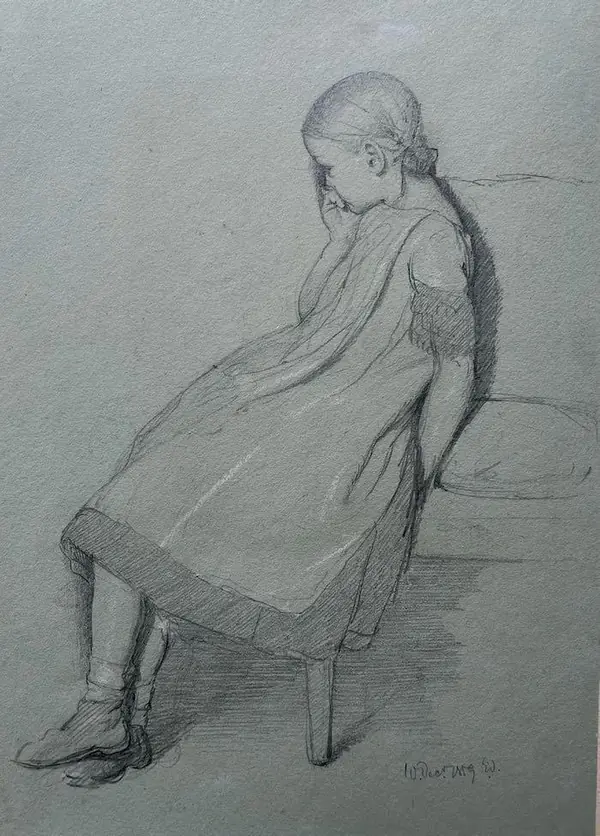
Signed with initials and dated l.r.: 10 December 1859 ED, pencil heightened with white on blue paper 23.8 x 17.8 cm.; 9 3/8 x 7 inches Provenance Arnold Fellows; Bequeathed to Queen Mary’s Grammar School, Walsall until sold by a charitable trust, 2023 The artist was born in Worcester and trained there and in Birmingham. He specialised in depictions of country life and his drawings of young girls are delightfully and minutely observed. Arnold Fellows was a pupil at Queen Mary’s Grammar School, Walsall, between 1911 and 1917. He became a master of the school for a brief period, before moving to spend the remainder of his life as a teacher at Chigwell School in Essex. Fellows devoted much of his life to collecting art, notably works on paper, and eventually donated his entire collection to his old school. He was the author of The wayfarer's companion: England's history in her buildings and countryside, published by Oxford University Press, 1937.
View details
Pastel over traces of pencil, signed in pen and ink on backboard: Anna Tonelli/fece in Londra/1794, inscribed on labels attached to backboard with details of sitters and its provenance Oval, in the original frame 25 x 30 cm; 9 ¾ x 11 5/8 inches Provenance Richard Curzon-Howe, 1st Earl Howe (1796-1870) Lady de la Zouche, Hagley Hall, Rugeley, Staffordshire (according to a label on reverse of frame); Edward Curzon, 6th Earl Howe of Gopsall Park and Penn House (1906-1984), Buckinghamshire; Thence by family descent until 2023 Literature N. Jeffares, Dictionary of Pastellists before 1800, online, J.722.1373 The charmingly drawn sitters are the young children of the Hon. Penn Assheton Curzon (1757-1797) and Lady Sophia Charlotte Howe, Baroness Howe of Langar (1762-1835). George Augustus William Curzon (1788-1805) died aged 16 and is buried in Penn, Buckinghamshire where he shares a memorial in the church of the Holy Trinity, Penn, with his parents. His younger sister Marianne (1790-1820) was also buried at Penn. This branch of the Curzon family had houses at Penn House, near Amersham in Buckinghamshire, and Hagley Hall at Rugeley in Staffordshire, near Cannock Chase.
View details
Pastel, inscribed on reverse of original backboard: Anna Tonelli/fece in Londra/1796, in the original frame bearing the inscription Anna Tonelli H.D.Hamilton 1796 26.1 x 22.6 cm.; 10 ¼ x 8 7/8 inches Provenance Mellors & Kirk, Nottingham, 9-10 June 2011, lot 713 (as of Tonelli by Hugh Douglas Hamilton); Private collection, U.K. until 2022 Literature N. Jeffares, Dictionary of Pastellists before 1800, online edition, no. J.722.167 Anna Tonelli, née Nistri, was probably trained in Florence, possibly by Giuseppe Piattoli (1743-1823) with whom she collaborated on a portrait of the family of Granduca Pietro Leopoldo, which was engraved in 1785. At some stage before 1785 she married the virtuoso violinist Luigi Tonelli. It seems highly likely that she came across the work of Hugh Douglas Hamilton in Rome. Tonelli met Lord Clive, ‘Clive of India’, while he was travelling in Italy, and he employed her to make pastels of members of his family. From 1794 she taught drawing to his children in London. She exhibited at the Royal Academy in 1794 and 1797, giving her address as 97 Norton Street. The artist travelled with the Clive family to India between 1798 and 1801, moving around southern India with Lady Clive and her daughters. During her time in the subcontinent, she seems to have worked in watercolour or miniature, rather than pastel, and charged twelve to thirty guineas for a miniature. She painted the Rajah of Tanjore and Tipu Sultan on this trip. She returned to Florence in 1801. Tonelli’s work has been confused with that of Hugh Douglas Hamilton, which may account for the inscription on the frame. She is known to have copied his work for Lord Clive, producing portraits in 1790s to add to a series begun by Hamilton. It seems unlikely that Hamilton has any connection with the present work, as he had returned to Ireland by this date. In 1806 the American agent in Paris, Filippo Mazzei, engaged her to bring up his daughter Elisabetta. He provided a description of the family to Thomas Jefferson (letter, 20th July 1806) with a view to their emigrating to the USA, praising the father, a violinist ‘the peer of any other’, the two children (born c.1789–90), and the mother who ‘sings and plays the piano like an expert; knows very well her own language, French, and English; draws and paints with excellent taste; is accomplished in embroidery and all needlework; and knows geography quite well.’ Jefferson’s response highlighted the expense of living in a major city, which may have deterred the family, as by 2 November 1807 they were in Pisa with Mazzei, while by 1809 they seem to have returned to Florence. I am grateful to Neil Jeffares for his biographical information about the artist.
View details
Anna Tonelli (née Nistri) (c. 1763-1846) Portrait of Frances Anderson (née Gosling) (1768-1850), half-length, wearing a white dress and blue headdress, signed on backboard: Anna Tonelli/fe..in Londra/1798, inscribed on backing on reverse: glass taken out and restored 1848 (?). Frances Anderson née Gosling/born 1768 died 1850 at Dorset Gardens/Brighton Pastel, framed as an oval in the original frame 25.5 x 21 cm.; 10 x 8 ¼ inches Provenance By family descent to Pamela Bruce Clarke (1915-1989); By family descent at The Grange, Wendover, Buckinghamshire, until October 2024 Literature N. Jeffares, Dictionary of Pastellists before 1800, online edition, no. J.722.167 Portrait of Robert Anderson (1764-1837) half-length, wearing a black coat and with powdered hair, signed on backboard: Anna Tonelli/fece in Londra/1798, inscribed on label attached to backboard: Robert Anderson M.D. Born 1704 died 1837/at Dorset Gardens, Brighton, Restored 1893. W.B.C./Ancestor of Pamela Bruce Clarke Pastel, framed as an oval, in the original frame 25.5 x 21 cm.; 10 x 8 ¼ inches Frame size 32 x 28 cm.; 12 ½ x 11 inches Robert Anderson was a physician in Brighton who married Frances Gosling in 1788. The couple lived in Dorset Gardens, Brighton. Anna Tonelli, née Nistri, was probably trained in Florence, possibly by Giuseppe Piattoli (1743-1823) with whom she collaborated on a portrait of the family of Granduca Pietro Leopoldo, which was engraved in 1785. At some stage before 1785 she married the virtuoso violinist Luigi Tonelli. It seems highly likely that she came across the work of Hugh Douglas Hamilton in Rome. Tonelli met Lord Clive, ‘Clive of India’, while he was travelling in Italy, and he employed her to make pastels of members of his family. From 1794 she taught drawing to his children in London. She exhibited at the Royal Academy in 1794 and 1797, giving her address as 97 Norton Street. The artist travelled with the Clive family to India between 1798 and 1801, moving around southern India with Lady Clive and her daughters. During her time in the subcontinent, she seems to have worked in watercolour or miniature, rather than pastel, and charged twelve to thirty guineas for a miniature. She painted the Rajah of Tanjore and Tipu Sultan on this trip. She returned to Florence in 1801. Tonelli’s work has been confused often with that of Hugh Douglas Hamilton. She is known to have copied his work for Lord Clive, producing portraits in 1790s to add to a series begun by Hamilton. In 1806 the American agent in Paris, Filippo Mazzei, engaged her to bring up his daughter Elisabetta. He provided a description of the family to Thomas Jefferson (letter, 20th July 1806) with a view to them emigrating to the USA, praising the father, a violinist ‘the peer of any other’, the two children (born c.1789–90), and the mother who ‘sings and plays the piano like an expert; knows very well her own language, French, and English; draws and paints with excellent taste; is accomplished in embroidery and all needlework; and knows geography quite well.’ Jefferson’s response highlighted the expense of living in a major city, which may have deterred the family, as by 2 November 1807 they were in Pisa with Mazzei, while by 1809 they seem to have returned to Florence. The Grange, Wendover was owned from 1789 to 1794 by John Barker Church (1748-1818). Barker Church was an English born businessman and the supplier of the Continental Army during the American Revolutionary War. He was one of the few American revolutionaries to sit in the English parliament. His brother-in-law was Alexander Hamilton the influential founding father of the United States. Hamilton and Church were not only business partners but also friends having married sisters. Hamilton went on to have a love affair with Church’s wife Angelica Schuyler. She is featured in the popular musical ‘Hamilton’ by Lin-Manuel Miranda and Church is referred to as her ‘wealthy husband’.
View details
Inscribed (recto): T Von Holst, pencil and pen and brown ink, verso: pencil, on laid paper with a partial Strasburg Lily watermark, laid down on a brown sheet numbered 10 27.2 x 21.4 cm; 10 3⁄4 x 8 1⁄2 inches Provenance John Welch Etherington Rolls (1807-1870); By family descent to Lady Shelley Rolls, her sale at Sotheby’s, London,12 June 1959; P. & D. Colnaghi; Private collection U.K. until 2019 Von Holst’s drawing of the seated woman, recto, is after a figure in Raphael’s ‘Miraculous Draft of Fishes’; the drawing for the tapestry cartoon is in the Albertina, Vienna. A print was made after the drawing, which von Holst probably copied. The figure of the standing female on the recto is a characteristic Holst pose, derived from Vincenzo Danti’s bronze statue of Venus in the Palazzo Vecchio, Florence (see Max Browne, The Romantic Art of Theodor von Holst 1810-44, 1994, p.15). The drawing on the verso illustrates a scene inspired by a Gothic novel such as The Mysteries of Udolpho by Ann Radcliffe, published in 1794. One of the most popular novels of its day, its main character Emily St. Aubert, a virtuous and beautiful young woman, undertakes a series of dramatic adventures; she escapes from captivity at the hands of a cruel villain in a brooding castle to freedom. The brown card inlay on which the present drawing is contained is from the Rolls album, a large leather-bound album which forms the largest-known group of drawings by the artist. The family lived at The Hendre in Monmouthshire, where they also had at least five oils by von Holst. They were also involved with the theatre and opened their own in the grounds. The pencil inscription “T. Von Holst’ appears on almost all the drawings in the album and is effectively its collection mark.
View details