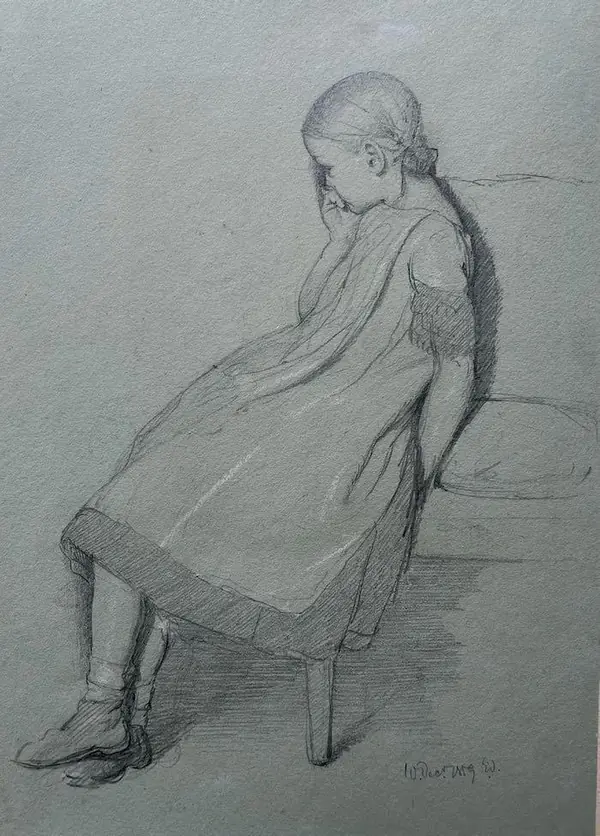
Brown wash heightened with bodycolour over traces of pencil
Sight size 12 x 8 cm; 4 ¾ x 3 ¼ inches
Framed in the original gilt moulding 30.5 x 23.5 cm.; 12 x 9 1/4 inches
The artist studied in Paris with William Bouguereau and Jean-Léon Gérome. He exhibited both in Paris and at the Royal Academy and Society of British Artists in London where he lived in St John’s Wood. He also exhibited his work with the London dealers Vicars Brothers.
Seymour specialized in Orientalist work, taking his cue from Gérome, and may be presumed to have visited North Africa from where the majority of his Orientalist subjects are taken. He favoured working in brown washes which he worked up with bodycolour to achieve an intense and dramatic finish.
You Might Also Like

Watercolour on laid paper, with exhibition label attached to backboard15 x 32.5 cm.; 6 x 12 3⁄4 inchesProvenanceMiss Bostock, companion to Miss H.H. Tatlock, the artist’s granddaughter;Christie’s, 12 September 1941, lot 29;Where purchased by Thomas Agnew & Son Ltd., London;Sold to a private collector 18 May 1942;Private collection, Wiltshire until 2023ExhibitedUsher Art Gallery Lincoln, Peter De Wint Exhibition, 1937, no. 146Horsemen can be seen in the foreground of this freely drawn, spare landscape, which exemplifies Peter de Wint’s brilliance and delicacy in the laying of washes.
View details
KT488Signed and inscribed on the old backing board attached to reverse: View of Shipton on Charwell [sic]-Evening.\W. Turner./Oxfd., watercolour over traces of pencil25.6 x 41 cm.; 10 x 16 inchesProvenanceW/S Fine Art Ltd., ‘Watercolours and Drawings’, June 2005, no. 47;Private collection U.K. until 2021This view shows the manor house and part of the estate of the artist’s uncle, William Turner, and the church of Holy Cross, amongst the trees to the right of the house. The artist built the church, in fourteenth -century style, at the expense of his uncle. It is thus an intensely personal work in which the artist depicts his home and the only building he designed.William Turner Senior had supported the artistic training of his nephew after his father died. In 1804 he bought the estate of Shipton-on-Cherwell with its manor house and park, as seen in the present watercolour. In 1809 the young artist recorded his address as Shipton (Martin Hardie, ‘William Turner of Oxford’, The Old Water-Colour Society’s Club, IX, 1932, p. 2).Turner first exhibited at the Royal Academy in 1807 and in January 1808 he became the youngest associate of the Society of Painters in Water Colours and was elected a full member in November of that year.The church, which seems to be Turner of Oxford’s only architectural work, dates from 1831. The artist was buried there at his death in 1862 and in 1896 a screen was erected in his memory.Some of the artist’s most celebrated watercolours are of water lilies on the River Cherwell, and from 1835 he sent a number to the exhibitions at the Society of Painters in Water Colours. The earliest of these, now in the collection of the Yale Center for British Art (B1981.24), shows the church at Shipton-on-Cherwell in the trees in the distance, a focal point of the composition.
View details
Pen and brown ink and watercolour, inscribed with pencil numbers l.r.4 x 11.6 cm.; 1 5/8 x 4 5/8 inchesLear’s diary of 5th May 1864 records that he was sketching at the Lake of Kourna, ‘very fine and Cumberlandish- in a nook at the foot of very high hills…11.15 Lunch is done: the wrens and titmice still sing-still. Zeriff [Turkish armed servant] hubblebubbles. The four Cretan creturs [sic] sleep, and the sun comes over the oak tree I lie beneath so I must move. Very delightful hours…’
View details
Watercolour over pencil20.5 x 38 cm.; 8 1/8 x 15 inchesProvenanceWalter Coleridge Richmond (1852-1931), the son of the artist, by descent;With Radnorshire Fine ArtRichmond continued to draw and paint landscapes throughout his successful career as a portraitist. These works remained private and stayed mainly in his family. This beautiful sketch has a directness which reflects his enjoyment of the opportunity for contemplation when drawing from nature.
View details
Signed with initials on border l.r.: F .Y (?) M, and inscribed l.c.: Female Hottentot watercolour on wove paper, with a laid paper borderDrawing size 20.6 x 15.3 cm.; 8 ½ x 6 inches, with border 26 x 20 cm.; 10 ¼ x 7 7/8 inchesThis drawing came from a now disbound English album which contained works on paper from the late 18th and early 19th centuries.
View details
John Stanton Ward, CBE, R.A. (1917 – 2006)Still life with a vase of wildflowersSigned in pencil l.r.: John Ward, watercolour over pencil18.7 x 56 cm.; 7 ¼ x 22 inchesProvenancePrivate collection, U.K., until 2026
View details
Inscribed verso: Primrose Hill coloured on the spot by/Girtin, watercolour over pencil on oatmeal paper.19.7 x 48.7 cm.; 7 ¾ x 19 inchesProvenanceArthur Boney, his sale, Sotheby’s, 7 October 1947, lot 34, bought by P. & D. Colnaghi & Co. , London;Ray Livingston Murphy (1923-1953), New York, by 1950, his sale, Christie’s, 19 November 1985, lot 35; Robert Tear, OBE (1939-2011), his sale, Sotheby’s, 9 July 2014, lot 189;With Guy Peppiatt Fine Art;Private collection, U.K. until 2024LiteratureT. Girtin and D. Loshak, The Art of Thomas Girtin, 1954, no. 416, p. 191;G. Smith, Thomas Girtin (1775-1802): An Online CatalogueArchive and Introduction to the Artist, TG1761ExhibitedNew Haven, Yale University Art Gallery, Prospects, 1950, no. 18., pl. 9b;Guy Peppiatt Fine Art, London, British Drawings and Watercolours, 2015, no. 17This panoramic landscape has been identified as showing Primrose Hill in north London, on the basis of an inscription on the back of the drawing, and Thomas Girtin (1874–1960) and David Loshak consequently dated it to 1800–1801. The area was then undeveloped. It did not become a place of leisure and recreation until well into the nineteenth century, since when the rapid expansion of the city northwards changed the appearance of the landscape so greatly that it may never be possible to confirm the identification of the view with certainty.The work may well have been coloured on the spot, as the inscription suggests, as it is worked in a limited palette without much foreground detail.
View details
Signed with initials l.r.: HSM, watercolour over traces of pencil on buff paper heightened with white24 x 9 cm.; 5 ¾ x 3 ¾ inchesFrame size 27 x 18.5 cm.; 9½ x 7 ½ inchesProvenanceThe Fine Art SocietyMarks’ earlier works were usually historical and literary, especially Shakespearian and sometimes humorous. However, he became increasingly interested in painting birds and this body of work was highly praised by John Ruskin. Marks had three exhibitions in six years at the Fine Art Society in London, the first of which was Birds in Bond Street in 1889. He was a frequent visitor to London Zoo where he was frequently approached by other curious visitors . He wrote in his preface to the 1890 catalogue: “The most common remark I hear is, “Ah pretty creature! Don’t he seem to know he’s sitting for his picture?” and concluded “… I hope I may be excused, and not held too eccentric, in preferring to converse with a parrot for one hour, rather than with a politician for two”. The Victoria and Albert Museum have a holding of his work.The artist was born in London, the fourth child of John Isaac Marks, a solicitor. He studied in London at the Royal Academy Schools and later in Paris. He exhibited at the Royal Academy and elsewhere from 1853. He was elected ARA in 1870 and became a full RA in 1878.
View details
Inscribed and dated l.l.: Monte Generoso/1879, and further inscribed with colour notes, pen and brown ink over pencil25 x 51.5 cm; 9 7/8 x 20 1/4 inches£8500Lear returned to Varese and Monte Generoso, on the border between Italy and Switzerland between lakes Lugano and Como, from June 29 to September 22 1879. He stayed at Mendrisio, across the Swiss border in Ticino. He enjoyed sketching the views south across the plains, as in the present watercolour and the mountains stretching up to the Alps. Marianne North the botanical artist came to Como towards the end of his stay and they made a trip to Monte Civita near Monza together.This drawing is taken from a similar vantage point to that of an oil of the same subject dated 1880 in the collection of the Ashmolean Museum (WA196.39).An unpublished poem “The Lays of the Octopods’ about the perils of mass tourism at Monte Generoso has recently come to light in the British Library.
View details£ 8,500

Signed, inscribed and dated u.r.,: John Tunnard/F. 13 63, watercolour and gouache with stopping out and scratching out, original label attached to backboard, in original frame19.2 x 27.8 cmProvenance: McRoberts and Tunnard, London 3 March 1964, sold 15 April 1964 to a private collector;Their sale Bonhams, 1 July 2009, lot 44Literature: Tunnard ledger 63/4-F: 13;Peat and B.A. Whitton, John Tunnard, His Life and Works, 1997, p. 197, no. 810Peat and Whitton note that the artist's later painting had a more assured quality. Tunnard distilled his early mathematical precision and added a more atmospheric feeling, ‘this is most noted in the swiftly executed smaller gouaches'.
View details