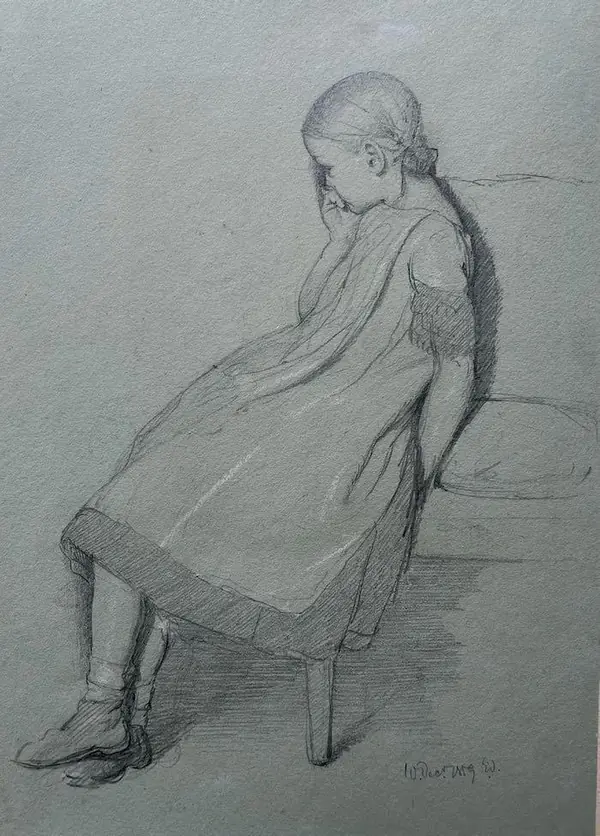
William Henry Hunt OWS Lighting the Brazier
- Reference
- 11253 / KT747
- Category
- Frieze Masters 2026 / Portraits
William Henry Hunt, OWS (1790-1864)
Lighting the Brazier
Signed l.l.: W HUNT., watercolour over traces of pencil with scratching out, title inscribed on original frame
36.2 x 26.7 cm.; 14 ¼ x 10 ½ inches
Provenance
Agnew’s, Liverpool, no. 253;
Malllams, Oxford, 19 March 2026, lot 443
This unpublished watercolour is a notable addition to the group of black subjects drawn by W.H. Hunt held in public collections in the UK and USA. It fits into a group on which Hunt was working in 1830s depicting black children warming themselves by fires. For domestic servants lighting fires was a daily job.
In the 1830s Hunt exhibited twenty humorous images of children which were later lithographed as Hunt’s Comic Sketches published in 1844, including two of black children, including Master James Crow -Out of His Element and Miss Jim Ima Crow seated by fires. The Lady Lever Art Gallery, Port Sunlight, has the original watercolour of Jim Crow which appears to show the same black boy as in the present work (see J. Witt, William Henry Hunt (1790-1846), 1982, no.477, see lithograph). Both boys are shown seated in front of a brazier, a suggestion that they feel the cold alluded to in the title of the lithograph, seated on a barrel or basket of the same height. The present watercolour (executed circa 1830-40) also has similarities with a watercolour of the same black model holding a slate at the Victoria and Albert Museum, London also entitled ‘A Brown Study’ (FA526). Both drawings share the same neutral background and have an added strip at the top. Another version of this work, without an added strip, is in the collection of the Yale Center for British Art (B1975.4.583).
Hunt made several other studies of black sitters, including a drawing of a young girl in pencil on buff paper in the Courtauld Institute, London and a boy posing as a boxer in the Metropolitan Museum of Art, New York (2020.120). Jan Marsh has suggested that because of Hunt’s choice of theme his sitters are most likely to have been youths aged around 10 – 14 years old who were not at school or apprenticed but earning small amounts in the street running errands, carrying parcels and doing other small jobs, and were therefore visible and available to artists notably in London, Bristol and Liverpool (private email March 2026). Hunt preferred to use the same sitters as models.
Hunt was born with a deformation of his legs which restricted his movement and seems to have had a form of dwarfism. According to his early biographer, F. G. Stephens, Hunt was: ‘was a little less than… five foot. He was broad as well as round shouldered and his head was large beyond proportion to the rest of his figure which the torso was that of a larger man. His large and long frock coats and loose trousers although favourable to him on other accounts, did not add to his outward graces.’ . Stephens adds that Hunt’s personal disabilities: ‘frequently made him reserved and not very easily accessible to strangers.’ While Hunt’s interactions with black sitters were inevitably informed by the prejudices of his age it is quite possible that his own disability drew him to marginalised members of his society. He is known to have befriended black acrobats and musicians.
British artists showed increasing interest in Black subjects during the 1830s. Slavery was abolished throughout the British Empire over the years 1833 -1838 and the abolition movement was hotly debated in Parliament and beyond.