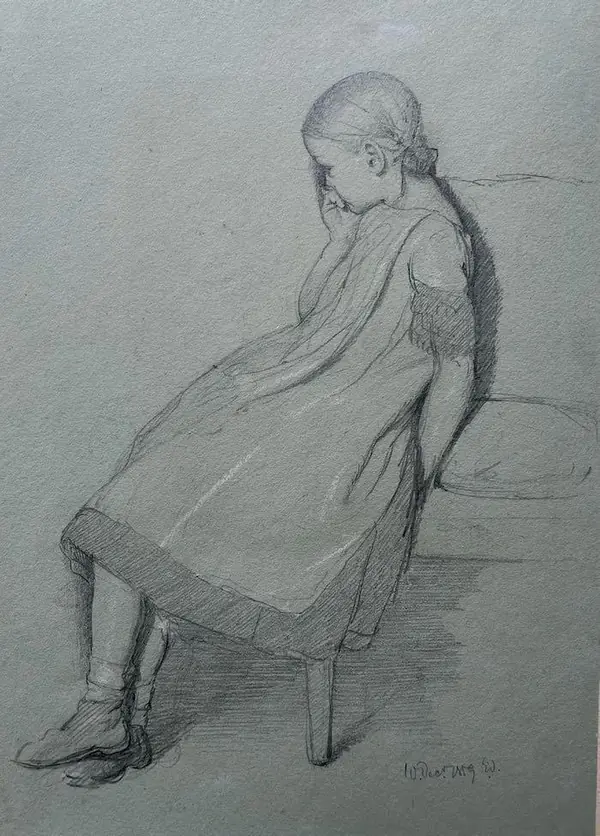
Inscribed in brown ink l.r.: Mrs Paget, pencil on laid paper, recto, with a portrait of a gentleman verso
18 x 12.7 cm; 7 x 5 inches
Provenance: By descent in the artist’s family until 2017
Henrietta (Etta) Paget, née Farr, was a painter, the daughter of statistician, William Farr. The Pagets, a family of artists and illustrators, were neighbours of the Yeats family in Bedford Park in west London in the 1890s.
Etta studied at the Heatherley School of Fine Art where she met Henry Marriott Paget, RBA, (1857–1936). They married in 1879 and were leading members of the Bedford Park circle of writers and artists. The house in The Orchard had a north facing studio which Etta and Henry both used before their children were born. Bedford Park was known for its free thinkers and ‘New Women’ who participated in discussions ranging from politics to art and literature with men on an equal basis. The couple had four children over eleven years, one of whom, Dorothy, became an actress. Etta’s artistic practice dwindled in the face of family life. Etta, Henry and her sister Florence, the actress, were members of the Golden Dawn, a group involved with spiritualism and the occult. W. B. Yeats was also a member and Florence was said to have had an affair with him and George Bernard Shaw.
Henry Paget was a painter of historical subjects and portraits and his portrait of W.B. Yeats is in the Ulster Museum. His paintings, especially his historical scenes, were illustrative rather than inspiring and he also painted mythological subjects. Paget worked as an illustrator for the Sphere in Constantinople during the Balkan War of 1912-13.
You Might Also Like

Signed l.l.: E. Lear, pencil with watercolour, gum arabic and pen and black ink 17.7 x 23 cm.; 7 x 9 inches These charming, quirky drawings are characteristic early works by Lear, dating from the late 1820s or early 1830s when he was establishing himself as an ornithological artist. They relate to a group of drawings which Lear gave to Mrs Godfrey Wentworth, who supported his employment by the Zoological Society in 1831, and whom he credited with launching him as an artist. They are imaginary, fanciful subjects drawn with not a little humour, resembling the stylised watercolours of birds painted on late eighteenth century porcelain. Robert McCracken Peck has made the interesting suggestion that Lear and his sister Ann may have been thinking of approaching ceramics companies with them (see Robert McCracken Peck, The Natural History of Edward Lear, 2016, pp. 27-9). Two surviving family albums from the late 1820s, containing a mixture of similar natural history subjects by Edward Lear and his sisters Ann and Sarah, are in the collection of the Houghton Library, Harvard University (MS Typ 55.4 and 55.27). Sir Edward Strachey was a man of letters and friend of Lear’s, who wrote an introduction to Nonsense Songs in 1895. He lived at Sutton Court, Chew Magna in Somerset and was a neighbour of Lear’s close friend Chichester Fortescue, the Liberal politician whom Lear first met in Rome in 1845.
View details
Signed with initials l.r.: HSM, watercolour over traces of pencil on buff paper heightened with white 24 x 9 cm.; 5 ¾ x 3 ¾ inches Frame size 27 x 18.5 cm.; 9½ x 7 ½ inches Provenance The Fine Art Society Marks’ earlier works were usually historical and literary, especially Shakespearian and sometimes humorous. However, he became increasingly interested in painting birds and this body of work was highly praised by John Ruskin. Marks had three exhibitions in six years at the Fine Art Society in London, the first of which was Birds in Bond Street in 1889. He was a frequent visitor to London Zoo where he was frequently approached by other curious visitors . He wrote in his preface to the 1890 catalogue: “The most common remark I hear is, “Ah pretty creature! Don’t he seem to know he’s sitting for his picture?” and concluded “… I hope I may be excused, and not held too eccentric, in preferring to converse with a parrot for one hour, rather than with a politician for two”. The Victoria and Albert Museum have a holding of his work. The artist was born in London, the fourth child of John Isaac Marks, a solicitor. He studied in London at the Royal Academy Schools and later in Paris. He exhibited at the Royal Academy and elsewhere from 1853. He was elected ARA in 1870 and became a full RA in 1878.
View details
Signed and dated l.r.: SOPHIA BEALE/1869, watercolour heightened with bodycolour and gum arabic 34.5 x 60 cm; 13 ¾ x 23 ½ inches Provenance Brightwell’s, Leominster, 12 January 2004; where purchased by Paddy Docker-Drysdale (1929-2020); By descent until 2022 This substantial landscape of Heidelberg is a fine example of a detailed Pre-Raphaelite landscape. The skillful use of bodycolour applied with a dry brush creates a pleasing richness which combined with the play of dappled sunlight on the mossy rocks in the foreground and the careful selection of colours elevates the view well above topography. Beale was born in London to Frances, née Smith, and Lionel John Beale, a surgeon. Her sister, Ellen Brooker Beale, was also an artist with whom she collaborated. Sophia and Ellen Beale went to Queen’s College School, London and took art lessons at the popular Leigh’s Academy run by the artist Matthew Leigh. They copied extensively after the Old Masters and antiquities in the National Gallery and British Museum. From 1860 to 1867 the two sisters shared a studio on Long Acre in Covent Garden. In 1869 Sophia Beale travelled in Germany and France, when the present work was drawn, and in 1872 she returned to Paris, where she took classes run for women at Charles Joshua Chaplin’s (1825-1891) studio (where Mary Cassatt also studied), financing her studies by working at M. Bertin’s studio. On her return to London, Beale used the money she had earned in Paris to open an art school in Albany Street, near Regent’s Park, teaching the latest Parisian techniques. Beale was a feminist and in 1889 among the two thousand signatories to the ‘Declaration in Favour of Women's Suffrage’ formulated by the Central Committee for Women’s Suffrage. Beale also advocated for the Royal Academy and the universities to allow greater access for women. The artist exhibited extensively during her lifetime at the Society of British Artists in Sussex Street, where she showed around thirty works, while she also had four works accepted by the Royal Academy between 1863 and 1887. Between 1868 and 1882 she exhibited at the Royal Hibernian Academy and with the Society of Women Artists from 1860 to 1881. She published four books, A guide to the Louvre (1883), The Amateur’s Guide to Architecture (1887), The Churches of Paris from Clovis to Charles X (1893) and her autobiography, Recollections of a Spinster Aunt (1908). She also wrote articles including a review of the 1894 exhibition ‘Fair Women’ at the Grafton Gallery in London for The American Architect and Building News (1876-1908), Boston 45, no. 975 (see Meaghan Clark, Fashionability, Exhibition Culture and Gender Politics: Fair Women, 2021, p. 21).
View details
Daniel Maclise , R.A. (1806-1870) A seated girl reading in a doorway Pencil 13.5 x 8 cm.; 5 ¼ x 3 1/8 inches Provenance Covent Garden Gallery Ltd. Daniel Maclise was born in Cork to a family of Scottish descent. After a brief period working in a bank, Maclise’s passion for drawing led him to pursue a career in art which he studied at the Cork Society of Arts. He moved to London in 1826 to attend the Royal Academy where he excelled as a student, particularly in life drawing and history painting. He began exhibiting in the RA in 1829, was made an associate in 1830, and an academician in 1840.
View details
Oil on paper laid down on canvas 15.1 x 21.6 cm.; 6 x 8 ½ inches Frame size 25.5 x 32 cm.; 10 x 12 ½ inches Engraved By the artist as a lithograph on chine collé, printed by Charles Motte, 1828, plate 8 Newton Fielding produced a series of lithographs of mammals which were printed by Charles Motte in 1828. The artist was the youngest son of portrait painter Nathan Theodore Fielding. From 1827 to 1830 he lived in Paris, where he ran the family engraving business, at which William Callow worked. He was closely associated with the Anglo-French circle of artists centred around Bonington and Delacroix. He collaborated with his brothers Thales and Theodore in England before returning to France where he built up an extensive teaching practice, with pupils including members of the family of King Louis- Philippe. He published a number of teaching manuals and lived in France until his death.
View details
KT488 Signed and inscribed on the old backing board attached to reverse: View of Shipton on Charwell [sic]-Evening.\W. Turner./Oxfd., watercolour over traces of pencil 25.6 x 41 cm.; 10 x 16 inches Provenance W/S Fine Art Ltd., ‘Watercolours and Drawings’, June 2005, no. 47; Private collection U.K. until 2021 This view shows the manor house and part of the estate of the artist’s uncle, William Turner, and the church of Holy Cross, amongst the trees to the right of the house. The artist built the church, in fourteenth -century style, at the expense of his uncle. It is thus an intensely personal work in which the artist depicts his home and the only building he designed. William Turner Senior had supported the artistic training of his nephew after his father died. In 1804 he bought the estate of Shipton-on-Cherwell with its manor house and park, as seen in the present watercolour. In 1809 the young artist recorded his address as Shipton (Martin Hardie, ‘William Turner of Oxford’, The Old Water-Colour Society’s Club, IX, 1932, p. 2). Turner first exhibited at the Royal Academy in 1807 and in January 1808 he became the youngest associate of the Society of Painters in Water Colours and was elected a full member in November of that year. The church, which seems to be Turner of Oxford’s only architectural work, dates from 1831. The artist was buried there at his death in 1862 and in 1896 a screen was erected in his memory. Some of the artist’s most celebrated watercolours are of water lilies on the River Cherwell, and from 1835 he sent a number to the exhibitions at the Society of Painters in Water Colours. The earliest of these, now in the collection of the Yale Center for British Art (B1981.24), shows the church at Shipton-on-Cherwell in the trees in the distance, a focal point of the composition.
View details
KT453B Inscribed and dated in pencil verso: Tring Hill/ 1791, oil on paper 12.8 x 19 cm.; 5 1/16 x 7 ½ inches Frame size 29 x 34 cm.; 11 1/4 x 13 ¼ inches Provenance Mr Nicholson, Oxford, until 1942, when acquired by Edward Croft-Murray, CBE, (1907-1980); Jill Croft-Murray until 2020; Woolley and Wallis, The Edward Croft-Murray Collection, 11 August 2021, lot 421 This spontaneous oil sketch originally came from an album of oil sketches from nature, executed in 1790s and assembled by the artist for his own pleasure, inscribed ‘Studies from nature by G. Garrard’. Five further examples of his oil sketches of locations in and around London are in the collection of Tate Gallery.
View details
Signed and dated l.l.: David Cox. 1836, watercolour over pencil with scratching out 18 x 26 cm In the summer of 1836 Cox spent a few weeks at Rowsley, painting at Haddon Hall. He made several watercolours of elegant figures in seventeenth century costume strolling on the terrace there to which the present work relates. Although the present work does not appear to be of Haddon, it fits in with this period of his oeuvre.
View details
Sir Gerald Festus Kelly, P.R.A. (British 1879-1972) The Great Wall of China Oil on board Exhibited Martyn Gregory Gallery, ‘Modern British Painters’, October 1988, Catalogue no. 52, no. 34 This is a study for a painting of the same size of the Great Wall of China exhibited at the Royal Hibernian Academy, 1938, no.45 and the Royal Academy, London, Exhibition of Works by Sir Gerald Kelly, 1957, no.231. Born in London of Irish descent, Kelly was educated at Cambridge University, later living and studying art in Paris where he met Degas, Monet, Renoir and Sickert. Whistler was also an early influence as were Cézanne and Gaugin. Kelly was an enthusiastic traveller, visiting amongst other countries China, Spain, America, South Africa and Burma, where he painted some of his most characteristic and charming figure studies. He became a successful society portraitist whose sitters included Somerset Maugham, whom he painted several times, and he undertook numerous state portraits. Kelly is represented in many public collections, including the Tate, which holds seven works. He had retrospective exhibitions at the Leicester Galleries in 1950 and in 1957 at the RA. He was elected RA in 1930, was the Academy's Keeper from 1943-45 and President, defeating Augustus John in the election, from 1949-54. Kelly held a number of official positions, such as membership of the Royal Fine Arts Commission, 1938-43, and was knighted in 1945. Between 1909 and 1970 Kelly exhibited over 300 works at the RA. During his lifetime his work became well known through popular prints.
View details
Oil on panel 22 x 27 cm.; 8 ¾ x 10 5/8 inches Provenance The artist’s widow, Lady Kelly; Michael Parkin Fine Art Ltd; From whom purchased by J.G. Cluff, private collection U.K. until 2022 Born in London of Irish descent, Kelly was educated at Cambridge University, later living and studying art in Paris where he met Degas, Monet, Renoir and Sickert. Whistler was also an early influence as were Cézanne and Gaugin. Kelly was an enthusiastic traveller, visiting many countries from Egypt to China. His sketches of his travels are pleasingly spontaneous and tend to be painted more freely than his finished portraits. He became a successful society portraitist whose sitters included Somerset Maugham, whom he painted several times, and he undertook numerous state portraits. Kelly is represented in many public collections, including the Tate, which holds seven works. He had retrospective exhibitions at the Leicester Galleries in 1950 and in 1957 at the RA. He was elected RA in 1930, was the Academy's Keeper from 1943-45 and President, defeating Augustus John in the election, from 1949-54. Kelly held a number of official positions, such as membership of the Royal Fine Arts Commission, 1938-43, and was knighted in 1945. Between 1909 and 1970 Kelly exhibited over 300 works at the RA. During his lifetime his work became well known through popular prints.
View details