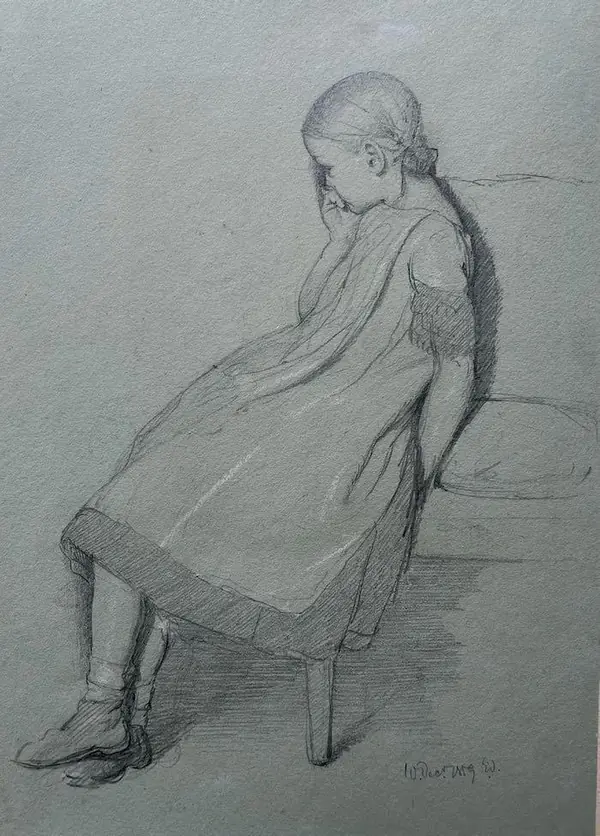
Signed l.r.: Hugo VP, oil on canvas board, in an antique hardwood frame
23 x 17.5 cm; 9 x 6 7/8 inches
Frame size 42 x 35 cm.; 16 ½ x 13 ¾ inches
SOLD
Literature
H. V. Pedersen, ‘Door den Oost-Indische archipel’, 1902, ill. p. 122
This sitter is described in the artist’s book of 1902 as someone who worked for the Sultan of Deli in Medan, North Sumatra, at his annual party. It is a rare depiction of a servant portrayed with great sensitivity.
Pedersen was born in Copenhagen in 1870. Having studied at the Academy of Arts in Copenhagen he travelled for 20 years in India, Sri Lanka, Indonesia, Penang and Singapore. His older brother worked on a tobacco plantation in Sumatra and in 1898 he first visited Indonesia, travelling to Sumatra, Penang, Singapore, Java and Siam. He painted many portraits of native subjects which he clearly found interesting on his travels as well as landscapes and cityscapes. He worked for the Susuhunan (ruler) of Surakarta in Java, whose kraton or palace Von Pedersen visited (thanks to the Dutch Governor General) and whose portrait he painted and was subsequently given as a token of the Susuhunan’s loyalty to the Queen of the Netherlands. It is now in the Royal Dutch Collection.
Eight of the artists’ paintings were published in 1926 in "Peeps at many lands" ed. by J.F. Scheltema.
You Might Also Like

Inscribed l.l.: TRENANT SIR E. BULLERS., pen and grey ink and watercolour over traces of pencil14 x 23.3 cm; 5 ½ x 9 1/8 inchesProvenanceJ.A.D. Bridger, his sale at Sotheby’s London, 24 January 1951, lot 150; bought by Thomas Agnew & Sons Ltd.; H.M. Langton; Spink & Son Ltd., K3/1993;Exhibited Thomas Agnew & Sons Ltd., 80th Annual Exhibition of Water-colour Drawings (January – March 1953), no. 85Rowlandson worked extensively in the West Country early in his career and made annual tours. He usually stayed with his friend and patron Matthew Michell, a banker, who had an estate at Hengar near Bodmin in Cornwall.Sir Edward Buller, 1st Baronet (24 December 1764 – 15 April 1824) was an officer in the Royal Navy who served during the American War of Independence, and the French Revolutionary and Napoleonic Wars. He was MP for East Looe in Cornwall from 1802-1820. He lived at Trenant Park in East Cornwall.
View details
Charles Gore (1729-1807)A view of the East front of Arundel Castle, West Sussex, seen from the Bowling GreenInscribed l. r.: Arundel Castle taken from the Platform or/Bowling Green by Charles Gore Esq 1781 and indistinctly inscribed in pencil u. r.: Arundel Castle Sufsex/1781Watercolour over touches of pencil on laid paper, with a Whatman watermark19.6 by 49 cm., 7 ¾ by 19 ¼ inchesProvenanceIolo Williams (1890-1962); And by descent until sold Sotheby's, London, 13 July 1989, lot 5; Private collection;With Guy Peppiatt Fine ArtThe bowling green is the name for the square earthworks located, with the fishponds, on the east side of the castle. They were probably made originally to improve the castle’s defences during the Civil War. Used as a bowling green in eighteenth century, as shown in the drawing by Charles Gore, today a rose garden can be found here. The Hon. Charles Gore was the son of a Lincolnshire landowner and educated at Westminster. He married a wealthy heiress of a shipbuilding company and learnt to draw and design ships. Gore travelled extensively in Europe, sketching with the German artist Jacob Philipp Hackert (1737-1807). Gore copied marine oils, completed the unfinished drawings of other artists, and also developed his own style having acquired an expert knowledge of the sea. His interest in classical antiquities led Charles Gore to join Hackert and Richard Payne Knight on their expedition to Sicily from April to June 1777.In 1779 Gore returned to England and became a member of the Dilettanti Society in 1781. He painted a series of panoramic views of Sussex including the current drawing. The family returned to the Continent in 1782 and he settled in Weimar in 1791 with his daughter Eliza. Examples of Gore's work can be found in the British Museum, the National Maritime Museum, Greenwich and the Goethe-Nationalmuseum, Weimar.
View details
KT475Dated l.r.: Aug 11, watercolour over pencil with a touch of white on grey paper17.1 x 26.1 cm.; 6 ¾ x 10 ¼ inchesProvenanceBernard Squire, Portman Square, London;Arnold Fellows, collection no. 23;Bequeathed to Queen Mary’s Grammar School, Walsall until sold by a charitable trust, 2023Lewis visited Arran in 1830. A similar drawing of identical size dated two days later is in the collection of the Courtauld Institute of Art, The Witt Collection ( D.1952.RW.3018).Arnold Fellows was a pupil at Queen Mary’s Grammar School, Walsall, between 1911 and 1917. He became a master of the school for a brief period, before moving to spend the remainder of his life as a teacher at Chigwell School in Essex. Fellows devoted much of his life to collecting art, notably works on paper, and eventually donated his entire collection to Queen Mary’s Grammar School.He was the author of The wayfarer's companion : England's history in her buildings and countryside, published by Oxford University Press, 1937.
View details
Inscribed and dated l.r.: Patti 4 July 1847, inscribed: sloping towards x which is a very deep stuffy vegetable dell and with colour notes, numbered 212, pen and brown ink with pencil20.2 x 44.5 cm.; 8 1/8 x 17 ½ inches, framed size 37 x 60.5 cm.; 14 1/2 x 23 3/4 inchesProvenanceMary Ann Streeter (1932-2023), Boston, by descent until 2025£5500Lear travelled to Sicily between May 3 and July 15, 1847, with John Joshua Proby, later the 2nd Earl of Carysfort. They were to make two other tours together that year, to Calabria and Naples.Patti is a village in North-Eastern Sicily in the province of Messina between Milazzo and Capo Calvà, which includes the ancient Graeco-Roman village of Tindari with its famous Sanctuary.After graduating from Radcliffe College (Harvard University) with a degree in Fine Arts, Mary Ann Streeter moved to London for a year and started buying Lear watercolours in the late 1950s. She built up a large collection of Lear’s work.
View details£ 5,500

Dated l.l.: 1 PM. Jan 2 1867, numbered l.r.: 130 and inscribed with colour notes, pen and brown ink and watercolour heightened with bodycolour on buff paper8 x 24.5 cm.; 3 1/8 x 9 5/8 inchesProvenanceSpink (K3/4703)This watercolour dates from Lear’s second trip up the Nile and his third visit to Egypt in the winter of 1866-1867, when he travelled with his Canadian cousin, Archie Jones. The men met in Luxor and visited Esneh, Edfu and Denderah, and had reached Philae by the end of January. Lear found his cousin irritating due to his habit of whistling and his lack of enthusiasm for the temples.
View details
KT453BInscribed and dated in pencil verso: Tring Hill/ 1791, oil on paper12.8 x 19 cm.; 5 1/16 x 7 ½ inchesFrame size 29 x 34 cm.; 11 1/4 x 13 ¼ inchesProvenanceMr Nicholson, Oxford, until 1942, when acquired byEdward Croft-Murray, CBE, (1907-1980);Jill Croft-Murray until 2020;Woolley and Wallis, The Edward Croft-Murray Collection, 11 August 2021, lot 421This spontaneous oil sketch originally came from an album of oil sketches from nature, executed in 1790s and assembled by the artist for his own pleasure, inscribed ‘Studies from nature by G. Garrard’. Five further examples of his oil sketches of locations in and around London are in the collection of Tate Gallery.
View details
Signed with initials and dated l.r.: J.B. April 7 18.., pen and grey ink and grey wash16.2 x 21.2 cm.; 6 3/8 x 8 3/8 inchesLiteratureDr A. Sneddon, ‘Representing Magic in Modern Ireland, Belief, History and Culture,’, CUP, 2022, ill. fig. 1In Britain and Ireland amongst ordinary people popular belief in witches remained strong up until the twentieth century. This drawing appears to depict a consultation with a cunning person or white witch. A stock part of 18th and 19th century country life, these commercial, multifarious magical practitioners provided local communities with a range of services for a small fee, such as un-witching, fortune-telling, and divination. They could gain quite serious reputations and some prospered. The position gave them status in their local communities. The 'witch' seems to have a good-natured face and her bonnet is not peaked, and a cat is perched benignly on it. The old woman is seated, a horse skull above her chair and consulting a magical book or grimoire: the ownership of such expensive objects often added to the allure and kudos of cunning-folk. The family are approaching her in a deferential way (the man holds his hat, his wife looks expectant) to ask her help. The girl looks frightened, is she seeing the real witch, the cause of their maladies? After all, cunning-folk were often brought in to counter black or harmful magic.Boyne left Co. Down for London at the age of nine with his father and was apprenticed to the engraver William Byrne. He joined a company of strolling players until 1781 and thereafter established a drawing school.Boyne’s caricatures which provide an amusing insight into British contemporary life can be found in many public collections including the British Museum, the Victoria and Albert Museum, The Fitzwilliam Museum and the Yale Center for British Art, New Haven.With thanks for Dr Andrew Sneddon for his comments on this drawing.
View details
Signed, inscribed and dated u.r.,: John Tunnard/F. 13 63, watercolour and gouache with stopping out and scratching out, original label attached to backboard, in original frame19.2 x 27.8 cmProvenance: McRoberts and Tunnard, London 3 March 1964, sold 15 April 1964 to a private collector;Their sale Bonhams, 1 July 2009, lot 44Literature: Tunnard ledger 63/4-F: 13;Peat and B.A. Whitton, John Tunnard, His Life and Works, 1997, p. 197, no. 810Peat and Whitton note that the artist's later painting had a more assured quality. Tunnard distilled his early mathematical precision and added a more atmospheric feeling, ‘this is most noted in the swiftly executed smaller gouaches'.
View details
Signed l.l.: E. Lear, pencil with watercolour23 x 17.7 cm.; 9 x 7 inchesThese charming, quirky drawings are characteristic early works by Lear, dating from the late 1820s or early 1830s when he was establishing himself as an ornithological artist. They relate to a group of drawings which Lear gave to Mrs Godfrey Wentworth, who supported his employment by the Zoological Society in 1831, and whom he credited with launching him as an artist. They are imaginary, fanciful subjects drawn with not a little humour, resembling the stylised watercolours of birds painted on late eighteenth century porcelain. Robert McCracken Peck has made the interesting suggestion that Lear and his sister Ann may have been thinking of approaching ceramics companies with them (see Robert McCracken Peck, The Natural History of Edward Lear, 2016, pp. 27-9).Two surviving family albums from the late 1820s, containing a mixture of similar natural history subjects by Edward Lear and his sisters Ann and Sarah, are in the collection of the Houghton Library, Harvard University (MS Typ 55.4 and 55.27).Sir Edward Strachey was a man of letters and friend of Lear’s, who wrote an introduction to Nonsense Songs in 1895. He lived at Sutton Court, Chew Magna in Somerset and was a neighbour of Lear’s close friend Chichester Fortescue, the Liberal politician whom Lear first met in Rome in 1845.
View details
Signed l.r.: W. HUNT, pencil, tiny sketches of figures and a list verso, on wove paper12 x 8.4 cm.; 7 ¼ x 4 ¾ inchesProvenance: Cyril and Shirley Fry until 2021Literature: J. Witt, 'William Henry Hunt (1790-1864)', 1982, no. 370Exhibited: 'Hunt Exhibition Fry Collection', 1967, no. 17 (1)This drawing dates from circa 1820. Hunt drew the same girl on another occasion in a similar pose (Rossetti Collection, J. Witt, ibid. no. 492).
View details