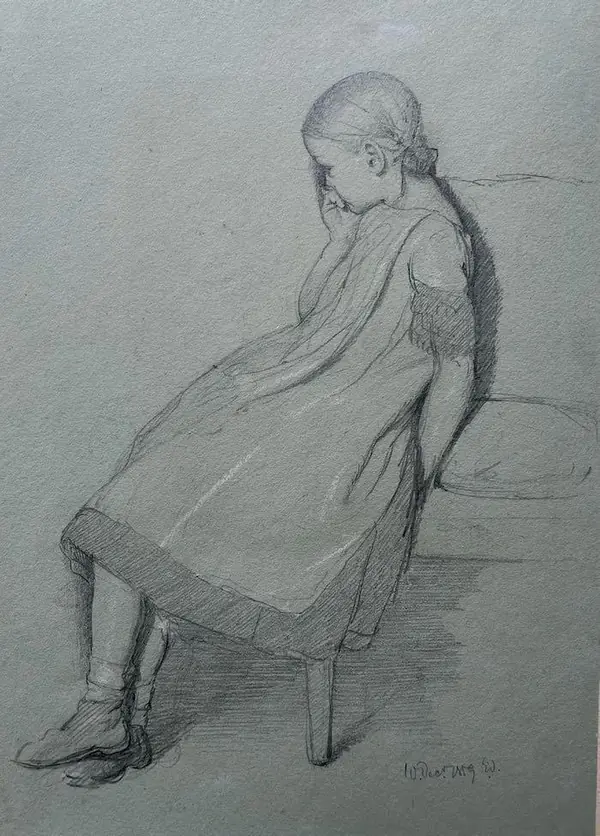
Henry Lamb Self Portrait
- Reference
- 10876
- Category
- 20th Century / Frieze Masters 2026 / Portraits
Pencil
26.5 x 18 cm.; 10 1⁄2 x 7 1/8 inches
Provenance
Estate of the artist (his daughter Henrietta Phipps), until 2000;
Davis & Langdale Company, New York, 2000;
Private collection, from 2000 until 2023
Exhibited:
Davis & Langdale Company, New York, 2000, Henry Lamb: Works on Paper, no. 13 [checklist]
This compelling drawing was executed around 1930.
Henry Lamb was born in Adelaide, Australia in 1883, shortly before his father moved the family to Manchester, where he spent his childhood. He studied medicine before abandoning this path to be an artist. At twenty-two he left for London to study under Augustus John and William Orpen at their Chelsea Art School.
John was a particularly formative influence and Lamb moved to Paris with him a few years later. Lamb spent a couple of summers on the south coast of Brittany, in search of a more traditional way of life. This impulse drew Lamb to Gola Island in Northern Ireland two years later.
In London in 1905, Lamb joined the Fitzroy Street Group and was a founding member of both the Camden Town Group and the London Group. He married Nina Forrest, or Euphemia, in 1906 but the marriage proved short-lived. He was friendly with the Bloomsbury Group, having known Vanessa Stephen and Clive Bell from his early days in London, but he often had little patience with them. He was close friends with the eminent critic and biographer Lytton Strachey and between 1912 and 1914 he painted his portrait, now held in the Tate and one of his greatest works.
In the First World War, Lamb served as a doctor in the Royal Army Medical Corps in France, Salonika and Palestine; he was awarded the Military Cross. He was not an official war artist but drew extensively and the resulting oils are an important part of his oeuvre.
In 1928 he married Lady Pansy Pakenham and moved to Coombe Bissett in Wiltshire. Lamb was appointed an official war artist for the Second World War, making portraits of soldiers and studies of servicemen at work across the South of England. Lamb was elected as an associate of the Royal Academy and a Trustee of both the National Portrait Gallery and the Tate at this time. He was finally awarded full membership of the Royal Academy in 1949.
Interest in Lamb’s work has revived in recent years, and he has been the subject of recent exhibitions at Salisbury Museum and Poole Museum. His work can be found in many collections around the world, including the Tate, the Imperial War Museum, the Government Art Collection and the National Gallery of Canada.