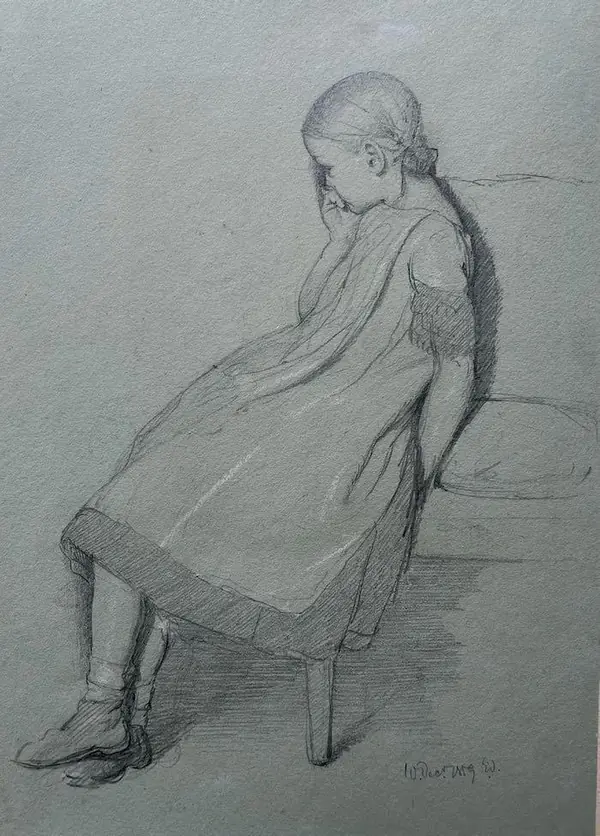
Pencil
17.8 x 17.7 cm; 7 x 7 inches
Provenance: M. D. E. Clayton-Stamm, by descent until 2018.
Evelyn De Morgan, who attended the Slade School of Art, was influenced by George F. Watts and Edward Burne-Jones and by the work of her uncle John Roddam Spencer Stanhope. She often visited Stanhope in Florence, where she developed a love of the work of Botticelli and Quattrocento art. She first exhibited at the Grosvenor Gallery in 1877. In 1887 she married the ceramicist William De Morgan, with whom she often wintered in Florence.
It has been suggested that this may be a preliminary study for a figure in her painting The Red Cross, 1916, in the collection of the De Morgan Foundation.
Her work is held in many national collections including the Walker Art Gallery, Liverpool; the National Trust properties Wightwick Manor, Wolverhampton, and Knightshayes Court, Devon; the Russell-Cotes Art Gallery and Museum, Bournemouth; the National Portrait Gallery, London; and the Southwark Art Collection, London.
Maxwell David Eugene Clayton-Stamm was an authority on the work of William De Morgan (on whom he published extensively), Pre-Raphaelite ceramics and the Blake-Varley sketchbook of 1819. He was a collector and bibliophile.
You Might Also Like

Evelyn De Morgan (1855 – 1919)The head of a womanColoured chalks on buff paper35.8 x 23.4 cm.; 14 1/8 x 9 ¼ inchesProvenancePrivate collection U.K., by descent until 2024.This beautiful drawing of the head of a woman deep in thought may be a study for the figure of Purity in De Morgan’s 1914 painting 'The Vision', also known as ‘1914', an allegoricalpainting inspired by World War I. The work depicts two women representing Peace andPurity in the foreground, with a demon representing war behind them (private collection, with the Louise Whitford Gallery/David Hughes in 1981).De Morgan was a pacifist, deeply moved by the horrors of the Boer War (1899-1902) andWorld War I, who made over fifteen paintings criticising war.
View details
KT748Evelyn de Morgan (1855-1919)A head study of the model Alessandro di MarcoColoured chalks on coloured paper35.5 x 32.5 cm: 14 x 12 ½ inchesProvenancePrivate collection, U.K.Alessandro di Marco was a professional artist’s model from Piedmont. Evelyn De Morgan made studies of him on several occasions, initially when she was at the Slade and later in her own studio. This drawing probably dates from 1890s. Another study of Alessandro in the De Morgan Foundation collection, for her 1899 painting The Valley of Shadows is not dissimilar to the present work (D_EDM_0038): https://www.demorgan.org.uk/collection/study-of-a-head-male/Di Marco was used by Evelyn De Morgan in two works depicting Boreas, 'Boreas and Oreithyia' (De Morgan Foundation P_EDM_0040, 1896) and 'Boreas and the Fallen Leaves' (c. 1910-14). He also features in 'Aurora Triumphans' (1876), 'Life and Thought Have Gone Away’ (1893), 'The Poor Man Who Saved the City' (1901), 'The Marriage of St. Francis and Holy Poverty' (1905), 'The Gilded Cage, A Soul in Hell’ (with curly hair) and '1914'.Di Marco modelled for Frederic, Lord Leighton (1830-1896) in Rome and was one of the artists’ models working in London around 1870. Sir William Blake Richmond (1842-1921) described him as “a fellow so graceful and of such a colour, a kind of bronze gold” (S.T. Buckle, British Art Journal, Autumn 2012, Vol. 13, Issue 2, p.67:https://www.eb-j.org/pdfViewer/articles/MTA1OA== 2012). William Hamo Thornycroft noted in his diary that Alessandro sat for long periods of time without a break. He was the model for Merlin in Edward Burne-Jones’s earlier work 'The Beguiling of Merlin' (1872-77). He was also photographed by Julia Margaret Cameron. George Richmond described him as ‘the living embodiment of a classical sculpture’.
View details
Inscribed l.l.: TRENANT SIR E. BULLERS., pen and grey ink and watercolour over traces of pencil14 x 23.3 cm; 5 ½ x 9 1/8 inchesProvenanceJ.A.D. Bridger, his sale at Sotheby’s London, 24 January 1951, lot 150; bought by Thomas Agnew & Sons Ltd.; H.M. Langton; Spink & Son Ltd., K3/1993;Exhibited Thomas Agnew & Sons Ltd., 80th Annual Exhibition of Water-colour Drawings (January – March 1953), no. 85Rowlandson worked extensively in the West Country early in his career and made annual tours. He usually stayed with his friend and patron Matthew Michell, a banker, who had an estate at Hengar near Bodmin in Cornwall.Sir Edward Buller, 1st Baronet (24 December 1764 – 15 April 1824) was an officer in the Royal Navy who served during the American War of Independence, and the French Revolutionary and Napoleonic Wars. He was MP for East Looe in Cornwall from 1802-1820. He lived at Trenant Park in East Cornwall.
View details
Pen and grey ink and grey wash over pencil24.5 x 17.1 cm.; 10 x 6 ¾ inchesProvenanceWith the Squire Gallery;J. Thursby-Pelham;Mrs Guy Argles and by descent until 1995, anon. sale Christie’s, London, 7 November 1995, lot 71;Spink, London;Christie’s, London, 21 November 2002, lot 8, where bought by the previous owner;Dreweatt’s, Château de Lasfonds sale, 16 November 2022, lot 143ExhibitedSpink, London, ‘Annual Exhibition of Watercolours and Drawings, 28 May – 21 June 1996, no. 4This imposing drawing shows Satan holding his shield aloft to defend himself against Heaven. Romney made many illustrations to Milton’s ‘Paradise Lost’ around 1794. This drawing appears to show a moment in Book 1 when Satan and the other rebels are ‘Hurled headlong, flaming from the ethereal sky’. Elsewhere in the poem Milton compares Satan’s shield to a moon seen through Galileo’s telescope.Another similar drawing in the collection of the Fitzwilliam Museum also shows Satan holding his shield above his headhttps://data.fitzmuseum.cam.ac.uk/id/object/16046It is possible that the French Revolution, raging at this time, was close to Romney’s mind when he worked on these drawings for 'Paradise Lost', giving them some contemporary political significance.
View details
John Stanton Ward, CBE, R.A. (1917 – 2006)Still life with a vase of wildflowersSigned in pencil l.r.: John Ward, watercolour over pencil18.7 x 56 cm.; 7 ¼ x 22 inchesProvenancePrivate collection, U.K., until 2026
View details
Signed with initials in pencil l.r.: HBB, watercolour24 x 17 cm.; 9 ½ x 6 ¾ inchesProvenancePietro Raffo, until 2022£2200This watercolour shows the influence of J.M.W. Turner, whose watercolour studies were copied by Brabazon.
View details£ 2,200

Anna Tonelli (née Nistri) (c. 1763-1846)Portrait of Frances Anderson (née Gosling)(1768-1850),half-length, wearing a white dress and blue headdress, signed on backboard: Anna Tonelli/fe..in Londra/1798, inscribed on backing on reverse: glass taken out and restored 1848 (?). Frances Anderson née Gosling/born 1768 died 1850 at Dorset Gardens/BrightonPastel, framed as an oval in the original frame25.5 x 21 cm.; 10 x 8 ¼ inchesProvenanceBy family descent to Pamela Bruce Clarke(1915-1989);By family descent at The Grange, Wendover,Buckinghamshire, until October 2024LiteratureN. Jeffares, Dictionary of Pastellists before 1800, online edition, no. J.722.167Portrait of Robert Anderson (1764-1837)half-length, wearing a black coat and with powdered hair, signed on backboard: Anna Tonelli/fece in Londra/1798, inscribed on label attached to backboard: Robert Anderson M.D. Born 1704 died 1837/at Dorset Gardens, Brighton, Restored 1893. W.B.C./Ancestor of Pamela Bruce ClarkePastel, framed as an oval, in the original frame25.5 x 21 cm.; 10 x 8 ¼ inchesFrame size 32 x 28 cm.; 12 ½ x 11 inchesRobert Anderson was a physician in Brighton who married Frances Gosling in 1788. The couple lived in Dorset Gardens, Brighton.Anna Tonelli, née Nistri, was probably trained in Florence, possibly by Giuseppe Piattoli (1743-1823) with whom she collaborated on a portrait of the family of Granduca Pietro Leopoldo, which was engraved in 1785. At some stage before 1785 she married the virtuoso violinist Luigi Tonelli. It seems highly likely that she came across the work of Hugh Douglas Hamilton in Rome. Tonelli met Lord Clive, ‘Clive of India’, while he was travelling in Italy, and he employed her to make pastels of members of his family. From 1794 she taught drawing to his children in London. She exhibited at the Royal Academy in 1794 and 1797, giving her address as 97 Norton Street. The artist travelled with the Clive family to India between 1798 and 1801, moving around southern India with Lady Clive and her daughters. During her time in the subcontinent, she seems to have worked in watercolour or miniature, rather than pastel, and charged twelve to thirty guineas for a miniature. She painted the Rajah of Tanjore and Tipu Sultan on this trip. She returned to Florence in 1801.Tonelli’s work has been confused often with that of Hugh Douglas Hamilton. She is known to have copied his work for Lord Clive, producing portraits in 1790s to add to a series begun by Hamilton. In 1806 the American agent in Paris, Filippo Mazzei, engaged her to bring up his daughter Elisabetta. He provided a description of the family to Thomas Jefferson (letter, 20th July 1806) with a view to them emigrating to the USA, praising the father, a violinist ‘the peer of any other’, the two children (born c.1789–90), and the mother who ‘sings and plays the piano like an expert; knows very well her own language, French, and English; draws and paints with excellent taste; is accomplished in embroidery and all needlework; and knows geography quite well.’ Jefferson’s response highlighted the expense of living in a major city, which may have deterred the family, as by 2 November 1807 they were in Pisa with Mazzei, while by 1809 they seem to have returned to Florence.The Grange, Wendover was owned from 1789 to 1794 by John Barker Church (1748-1818). Barker Church was an English born businessman and the supplier of the Continental Army during the American Revolutionary War. He was one of the few American revolutionaries to sit in the English parliament. His brother-in-law was Alexander Hamilton the influential founding father of the United States. Hamilton and Church were not only business partners but also friends having married sisters. Hamilton went on to have a love affair with Church’s wife Angelica Schuyler. She is featured in the popular musical ‘Hamilton’ by Lin-Manuel Miranda and Church is referred to as her ‘wealthy husband’.
View details
Signed l.l.: W Muller/1839., oil on panel43.5 x 27 cm.; 17 x 10 5/8 inchesProvenanceThomas Agnew & Sons, London;Anonymous sale Sotheby’s, London, 10 November 1982, lot 49;Noortman & Brod, New York, 1983;Anonymous sale, Christie’s, New York, 10 February 1998 lot 160;Matthew Rutenberg, New York, until 2020ExhibitedNoortman & Brod, 18th and 19th Century Paintings, April – May 1983, New York, June - July 1983, LondonThis spirited painting executed with great bravura was done shortly after the artist’s return from Egypt in 1839. Müller arrived in Egypt by steamer in November 1838. He was one of the first established European artists to visit Egypt and was there at the same time as David Roberts, although neither knew of the other’s presence there.Müller was exhilarated by his arrival in the bustling metropolis of Cairo and was particularly intrigued by the slave market, which he described as ‘one of my most favourite haunts’ (W. J. Müller, ‘An Artist’s Tour of Egypt’, Art-Union 1, London, 1839, pp. 131-2).Müller is the best-known artist of the Bristol School. His German father settled in the city and was the first curator of the Bristol Institution, the forerunner of the Bristol Museum and Art Gallery. His early exposure to art led to a short apprenticeship with James Baker Pyne and a friendship with the Reverend James Bulwer (1749-1879), a pupil of John Sell Cotman, whose collection of Norwich School drawings Müller would have known.In 1833 Müller was one of the founders of the Bristol Sketching Club and his travels began the following year with visits to Holland, Germany and Venice. His 1838 trip started in Athens before he continued to Cairo. In 1840 he visited France and in 1843 he went to Lycia at the same time as Sir Charles Fellows’ expedition, during which he produced some of his finest watercolours. He died at the age of 43 after his return from Turkey.Following Müller’s death, prices of his oil paintings rose dramatically in the salerooms. Articles on his work appeared regularly and in 1875 N. Neal Solly, the biographer of David Cox, wrote a long biography. In 1896 the Birmingham Museum and Art Gallery held a retrospective of 192 of Müller’s paintings, watercolour and drawings. His reputation was kept alive in Bristol where the 150th anniversary of his birth in 1962 was celebrated with an exhibition at Bristol Art Gallery, while in 1984 Tate Gallery held a show of his French and Lycian watercolours. In 1991 a major retrospective was held at Bristol Museum and Art Gallery, who hold the most comprehensive collection of his work, organised by Francis Greenacre, the renowed authority on Müller and the Bristol School.
View details
Daniel Maclise , R.A. (1806-1870)A seated girl reading in a doorwayPencil13.5 x 8 cm.; 5 ¼ x 3 1/8 inchesProvenanceCovent Garden Gallery Ltd.Daniel Maclise was born in Cork to a family of Scottish descent. After a brief period working in a bank, Maclise’s passion for drawing led him to pursue a career in art which he studied at the Cork Society of Arts.He moved to London in 1826 to attend the Royal Academy where he excelled as a student, particularly in life drawing and history painting. He began exhibiting in the RA in 1829, was made an associate in 1830, and an academician in 1840.
View details
Signed with monogram l.r., inscribed l.l.: near Calikut., watercolour heightened with touches of bodycolourProvenanceFranklin Lushington (1823-1901) and thence by descentLear was invited to India by his friend and patron Lord Northbrook who was appointed Viceroy in 1871, and his journey there was the last and longest of his life. He was overwhelmed by the colour and vitality of India and enjoyed the bustle of Viceregal life.Calicut, or present-day Kozhikode, is on the Malabar coast in Kerala and was a centre of the Indian spice trade. Edward Lear arrived there in October 1874, just as the monsoon began. He was warned about the dangers of contracting fever but stayed, despite the pouring rain, until the skies were clear enough to draw. He described the roads around the city as “of such redundant beauty one can hardly dream.” Franklin Lushington, Lear’s close friend and first owner of this drawing, was the son of Edmund Henry Lushington. He was appointed judge to the Supreme Court of Justice in the Ionian Islands in 1855 and Lear went with him to live in Corfu. They first met in Malta in 1849, where Franklin’s elder brother Henry was Chief Secretary to the government. On his death, Lear left all his papers to Lushington, who later destroyed most of them.
View details