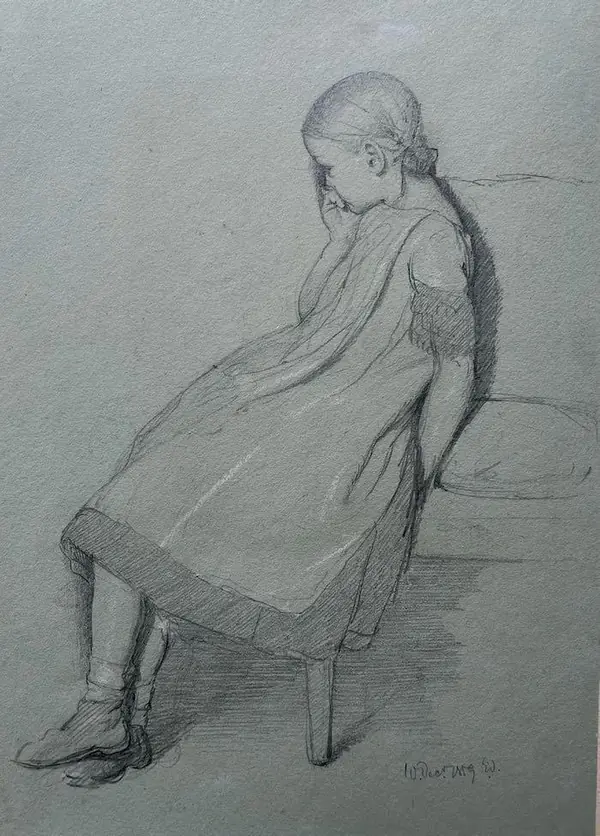
Pen and brown and grey ink and watercolour on two sheets of laid paper, joined
25.8 x 36.7 cm.; 10 x 14 ½ inches
Provenance
By descent from the artist until 2015;
Guy Peppiatt Ltd.;
Hugo Burge (1979-2023)
Abbott was one of the best amateur watercolourists of the late Eighteenth Century. A surgeon and apothecary, he lived in Exeter until 1825. He exhibited paintings at the Royal Academy from 1793, receiving contemporary acclaim for the style of his work. The artist John Downman said that ‘he prefers his drawings before his paintings, as they are done with more spirit’ (J. Farington, Diary 26 June 1804; vol. VI, p. 2362).
In 1825 Abbott inherited Fordland, a Devon estate, from his uncle James White, an Exeter barrister, Nonconformist and close friend of Francis Towne. Abbott became a patron and pupil of Towne’s, and his linear style shows the artist’s influence. After moving to Fordland he devoted himself to drawing where this work is most likely to have been drawn.
You Might Also Like
Inscribed verso: Nutwell.Oct.24th 1796, pen and grey ink and watercolour over traces of pencil11.2 x 18 cm.; 4 3/8 x 7 1/8 inchesProvenancePrivate collection U.K. until 2024 Nutwell Court is in east Devon near Lympstone overlooking the Exe estuary. Owned by Sir Francis Henry Drake, 5th Bt. (1723-1794) the estate was planted with fig trees in 1752, cedars in 1754, and laurels and evergreen oaks in 1755. By 1756 there were grape vines, a raspberry tree, a strawberry tree, a weeping willow, plane trees, cypresses, Newfoundland firs, larch trees, and a cistus. Further planting followed with black poplars, apricot trees, orange trees, Weymouth pines, myrtle and Scotch pines.
View details£1,750
Pen and grey ink and wash, inscribed verso and dated: Kerswell Oct.3.181223.7 x 37 cm.; 9 ¼ x 14 ½ inchesProvenancePrivate collection, U.K. until 2025Kerswell is a hamlet in the Teignbridge district of Devon north-east of Exeter.
View detailsSigned, inscribed and dated on original label attached to backboard: Dulverton.Somerset/JWA May 30 1800, pen and black ink and watercolour on wove paper25 x 16.5 cm.; 9 3⁄4 x 6 1⁄2 inchesProvenanceH.L.Bradfer-Lawrence;Andrew Wyld, his sale at Christie’s, London, 10 July 2012, lot 57, where bought by the present ownerExhibitedW/S Fine Art, London, Summer 2006, no. 13;W/S Fine Art, London, Summer 2009, no. 11Abbott was one of the best amateur watercolorists of the late Eighteenth Century. A surgeon and apothecary, he lived in Exeter until 1825. He exhibited paintings at the Royal Academy from 1793, receiving contemporary acclaim for the style of his work. The artist John Downman said that ‘he prefers his drawings before his paintings, as they are done with more spirit’ (J. Farington, Diary 26 June 1804; vol. VI, p. 2362).In 1825 Abbott inherited Fordland, a Devon estate, from his uncle James White, an Exeter barrister, Nonconformist and close friend of Francis Towne. Abbott became a patron and pupil of Towne’s, and his linear style shows the artist’s influence. After moving to Fordland he devoted himself to drawing.Dulverton is in west Somerset, on the edge of Exmoor and just over the border from Devon. This view, little changed today, looks east from near the bridge over the river Barle.Harry Bradfer-Lawrence (1887-1965) was an antiquary and manuscript collector. From King’s Lynn, he became chairman of United Breweries in 1960.
View detailsKT634inscribed and dated 'Canonteign July 24. 1829 [?]' on the reverse, pencil, pen and brown ink and grey wash 26.9 x 37.9 cm.; 10 ½ x 14 7/8 inchesProvenance:Agnew's, London. Anonymous sale, Phillips, London, 16 July 1996, lot 16; with Heather Newman, Painswick, Gloucestershire.Abbott was one of the best amateur watercolourists of the late Eighteenth Century. A surgeon and apothecary, he lived in Exeter until 1825. He exhibited paintings at the Royal Academy from 1793, receiving contemporary acclaim for the style of his work. The artist John Downman said that ‘he prefers his drawings before his paintings, as they are done with more spirit’ (J. Farington, Diary 26 June 1804; vol. VI, p. 2362).In 1825 Abbott inherited Fordland, a Devon estate, from his uncle James White, an Exeter barrister, Nonconformist and close friend of Francis Towne. Abbott became a patron and pupil of Towne’s, and his linear style shows the artist’s influence. After moving to Fordland he devoted himself to drawing.
View details£3,200
Pen and grey ink and watercolour with a pen and ink line border on laid paper, signed and dated 1776 and inscribed “copied from a drawing by Captain Grose”, verso23 x 25 cm; 9 x 9 5/8 inchesProvenanceBy descent in the family to Geoffrey Gosselin, the great, great, great-grandson of the artist, his sale at Philipps, London, 5 November 1999, lot 31 (part lot)Joshua Gosselin joined the Guernsey Militia in 1758 and over a military career of forty years rose to the rank of Colonel in 1789. He was elected a Greffier of the Royal Court in 1768. Gosselin had a deep love of nature and made a comprehensive list of the wildflowers of Guernsey, the earliest record of its kind. He also collected and studied seashells, was a noted antiquarian and an important figure in Guernsey society.
View details£3750Signed, inscribed and dated below: Drawn 1785, by I. Johnson. Woodbridge.-/This OAK stands in Winfarthing, Norfolk, on the Estate of the Rt. Hon: Lord ALBERMARLE./Circumference at Base 51 Feet, at three Feet high 32 Feet, at six Feet, 30 Feet Circum. Height 60 Feet., watercolour and bodycolour over pencil with pen and black inkImage size 34 x 29 cm.; 13 3/8 x 11 3/8 inches, sheet size 40 x 33 cm.; 15 ¾ x 13 inchesProvenanceSimon Carter, Woodbridge;R. Geoffrey Smith, Berveriche Manor Farm, Middleton;Martyn Gregory Gallery, London;Hugh Burge (1972-2023)LiteratureHuon Mallalieu, Dictionary of British Watercolour Artists up to 1920, vol. III, 1990, p. 191, ill.;John Blatchley, Isaac Johnson of Woodbridge: Georgian Surveyor and Artist, 2014, pp. 12-16The artist was a surveyor and antiquarian as well as an artist who lived in Woodbridge, Suffolk for his adult life. Around 1785 he was considering a volume illustrating the most remarkable trees of Norfolk and Suffolk which never came to fruition, but for which the current drawing would have been a likely candidate.White's History, Gazetteer, and Directory of Norfolk, 1883 describes the tree which stood on the estate of the Earl of Albermarle:The celebrated 'Winfarthing Oak,' probably the largest in England except the one at Cowthorpe, in Yorkshire, stands near the Lodge farmhouse, and is a grand and picturesque old ruin. It measures 70 feet round at the roots, and 40 feet in the middle of the main stem, and must have been at one time a magnificent spreading tree, with enormous arms. It is traditionally said to have been called the 'Old Oak' in the time of the Conqueror, and is usually considered to be more than 1200 years old. It is now a mere shell, bleached snowy white, and capable of containing a large number of persons in its interior. It still retains vitality on its south side, and three years ago a rook's nest was built in its branches.
View details£3,750
KT609Signed and dated l.l.: M.E. Cotman/June .18th, pencil, in a 19th century burr maple frame33 x 24.5 cm.; 13 x 9 5/8 inchesProvenanceDr Henry Lowe and Judy Lowe (née) Cotman until 2023
View details£1,750
Inscribed l.l.: TRENANT SIR E. BULLERS., pen and grey ink and watercolour over traces of pencil14 x 23.3 cm; 5 ½ x 9 1/8 inchesProvenanceJ.A.D. Bridger, his sale at Sotheby’s London, 24 January 1951, lot 150; bought by Thomas Agnew & Sons Ltd.; H.M. Langton; Spink & Son Ltd., K3/1993;Exhibited Thomas Agnew & Sons Ltd., 80th Annual Exhibition of Water-colour Drawings (January – March 1953), no. 85Rowlandson worked extensively in the West Country early in his career and made annual tours. He usually stayed with his friend and patron Matthew Michell, a banker, who had an estate at Hengar near Bodmin in Cornwall.Sir Edward Buller, 1st Baronet (24 December 1764 – 15 April 1824) was an officer in the Royal Navy who served during the American War of Independence, and the French Revolutionary and Napoleonic Wars. He was MP for East Looe in Cornwall from 1802-1820. He lived at Trenant Park in East Cornwall.
View detailsSigned and dated l.r.: Edward Lear. Del 1842, inscribed l.l.: Villa Adriana., pencil heightened with white24 x 36.7 cm.; 9 3/8 x 14 3/8 inchesProvenancePhillip’s, London, 11 November 1997, lot 45; Private collection U.K. until 2023£8500Lear set out for Italy in the summer of 1837. For most of the next ten years the artist wintered in Rome and toured other parts of Italy during the summer. This crisply drawn view with white highlights of the Villa Adriana is a fine example of the artist’s pencil drawing, which he favoured early in his Italian soujourn and shows the influence of James Duffield Harding.A related drawing of the Villa Adriana in upright format is in the collection of the British Museum (P_1892-1119-15). The same figures can be seen in the foreground and the compositional emphasis is on the trees on the right of the composition.Situated on a low plain on the slopes of the Tiburtine Hills, Hadrian’s Villa was the largest villa of the Roman Empire, built over an area of more than one hundred hectares.
View details£8,500
KT523Pen and grey ink and watercolour over pencil on laid paper watermarked J WHATMAN, inscribed verso in pencil: Inscribed on old mount/near Chepstow/William Day30x 39 cm.; 11 ¾ x 15 3/8 inchesProvenanceCyril FryThis exceptionally fresh drawing is a lovely example of the work of William Day, an accomplished amateur artist, who exhibited at the Royal Academy between 1782 and 1801 as an Honorary Exhibitor. The late Judy Egerton wrote an article about him in The Connoisseur, July 1970, pp. 176-185. It is not known for certain when Day met John Webber, the Swiss-born artist who is famous for accompanying Captain Cook on his last expedition to the South Seas between 1776 and 1780.The Connoisseur article notes, without giving a source, that the friendship between the two artists “began about 1787”. Day and Webber were sketching together in the Wye valley in 1788, which is the first time that pairs of views by the two artists of the same subject are known to exist. Two watercolours by Webber of Chepstow Castle dated 1788, which are now in the Whitworth Art Gallery, University of Manchester (D.1900.12 & D.1970.77) (see Charles Nugent, British Watercolours in the Whitworth Art Gallery, 2003, p. 282) correspond to two watercolours by Day which were acquired by Chepstow Museum in 2012.A family note lists Day’s interest in the following order:’ Geology, Minerology and Painting’ and he formed one of the earliest private collections of minerals in England. His collection was carried on by his son William Day (1797-1849) and his grandson and passed to the Hampstead Central Library where it was destroyed by bombing during WWII.
View details£2,800